Historical Background
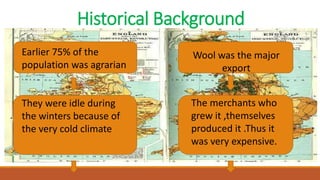
Earlier 75% of the
population was agrarian
They were idle during
the winters because of
the very cold climate
Wool was the major
export
The merchants who
grew it ,themselves
produced it .Thus it
was very expensive.
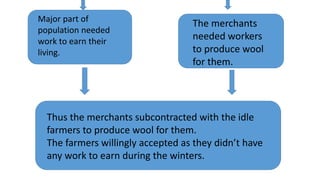
Major part of
population needed
work to earn their
living.
The merchants
needed workers
to produce wool
for them.
Thus the merchants subcontracted with the idle
farmers to produce wool for them.
The farmers willingly accepted as they didn’t have
any work to earn during the winters.
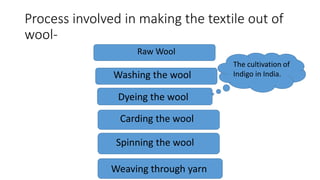
Process involved in making the textile out of
wool-
Raw Wool
Washing the wool
Carding the wool
Spinning the wool
Weaving through yarn
Dyeing the wool
The cultivation of
Indigo in India.
Distribution of work to the villagers
 The merchants allocated different work to different member
of the family
 Foe eg. The spinning work was given to the unmarried
lady i.e.(spinster). And the tough weaving process to the
man of the family.
 Throughout the winters the families performed the work
given to them on very poor wages.
 After some period the merchants came and collected the
produced wool from them and gave them their wages.
Continued..
 The produced wool was thus now either sold in the internal
markets or was exported to other countries.
 The merchants now, had a lot of profit as the wool now
produced was very cheap for them and the villagers too were
happy with this subcontracting.
 The similar practice carried for the next 40-50 years and during
the course ,many families gave up farming and chose producing
wool as their main occupation
 After some years the demand for wool fell down and cotton
took its place . The export markets now demanded more
cotton to be exported.
 The farmers and businessmen started producing more of
cotton and exported.
 As the demand was continuously increasing thus some
intellectuals suggested that the population will grow in the
pattern 2-4-8-16-32..(GP) and the cotton production was
growing in the pattern 2-3-4-5-6(AP),
 Thus they felt that new methods and techniques must be
introduced to cop up with the increasing demand.
Causes of industrial revolution
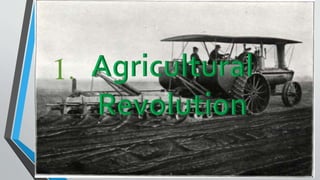
1.
Invention of new equipment (to increase production)
The scientists of that era thus started experiments to invent new
equipment to boost up the production and invented…
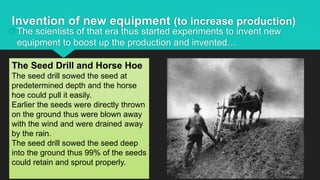
The Seed Drill and Horse Hoe
The seed drill sowed the seed at
predetermined depth and the horse
hoe could pull it easily.
Earlier the seeds were directly thrown
on the ground thus were blown away
with the wind and were drained away
by the rain.
The seed drill sowed the seed deep
into the ground thus 99% of the seeds
could retain and sprout properly.
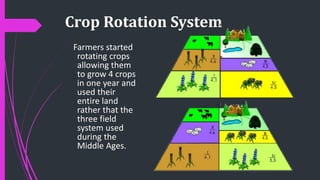
Crop Rotation System
Farmers started
rotating crops
allowing them
to grow 4 crops
in one year and
used their
entire land
rather that the
three field
system used
during the
Middle Ages.
Thus the farming output was increased by 300% after
the agricultural revolution.
Thus there was need to process the raw material
produced in the field into textiles as the work was still
done with hands in the factories.
Thus now the scientists got involved in experiments to
invent something which can fasten the processing.
LAND ENCLOSURES ACT2.
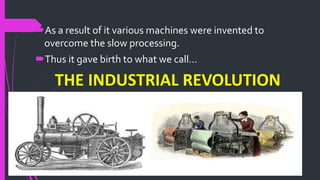
As a result of it various machines were invented to
overcome the slow processing.
Thus it gave birth to what we call…
THE INDUSTRIAL REVOLUTION
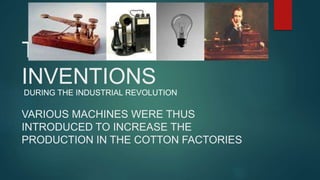
THE MAJOR
INVENTIONS
VARIOUS MACHINES WERE THUS
INTRODUCED TO INCREASE THE
PRODUCTION IN THE COTTON FACTORIES
DURING THE INDUSTRIAL REVOLUTION
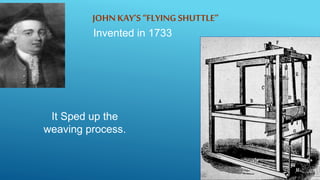
JOHN KAY’S “FLYING SHUTTLE”
It Sped up the
weaving process.
Invented in 1733
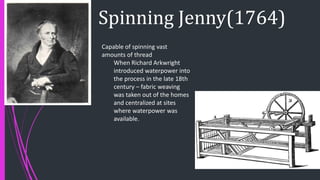
Spinning Jenny(1764)
Capable of spinning vast
amounts of thread
When Richard Arkwright
introduced waterpower into
the process in the late 18th
century – fabric weaving
was taken out of the homes
and centralized at sites
where waterpower was
available.
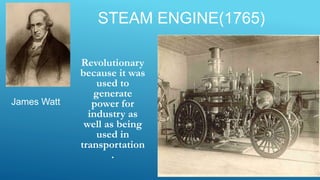
STEAM ENGINE(1765)
Revolutionary
because it was
used to
generate
power for
industry as
well as being
used in
transportation
.
James Watt
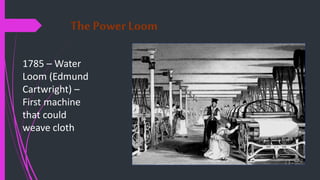
The Power Loom
1785 – Water
Loom (Edmund
Cartwright) –
First machine
that could
weave cloth
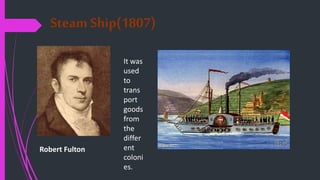
Steam Ship(1807)
Robert Fulton
It was
used
to
trans
port
goods
from
the
differ
ent
coloni
es.
As a result of these inventions
The cotton textile increased with huge numbers as the machines did the
processing efficiently.
Flying Shuttle-improved the carding of cotton.
Spinning Jenny-improved the spinning process
Water loom-improved the weaving.
Crompton,s mule.
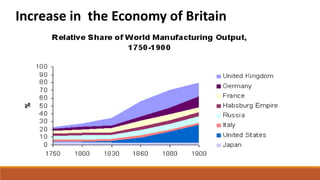
Increase in the Economy of Britain
IMPACTS OF THESE INVENTIONS
Thus due to all these inventions the textile producing
process became very fast and the agricultural land
available seemed less and the raw cotton demand
increased.
Britishers now started establishing colonies in different
countries for the raw material and the market for the
produced textile.
Earlier the British depended on Burma for wood supplies
for charcoals and after these inventions it was now also
used in the making of steam boats.
.
Continued..
Cotton was exported from the Indian continent.
Dye was used to colour the wool and cotton and it was
extracted from the Indigo plants that were planted in the
Indian colony—as a result the Indians revolted against it.
Slavery in the colonies increased and the slaves were used to
practice the cultivation and the loading work.
The cultivated produce of the colonial countries was then
imported to the Britain and other export markets.
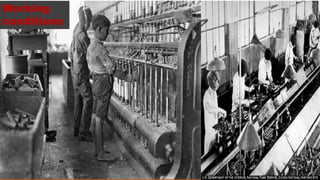
Women and children worked for 16 hours a day throughout the
week to earn their living.
The life expectancy rate worsened and the life expectancy rates
of the cities like- Birmingham , Manchester and Derby was
brought down to 16 ,17 and 22 years respectively.
Various epidemic diseases like cholera ,typhoid , tuberculosis
,spread all over in 1832 and 31000 died due to this.
They started living in the slum areas and therefore various
diseases spread all over the urban areas.
The villagers now started to migrate towards the cities for
employment.
Many of them were jobless as most of the work was done with
machines,
The children didn’t get enough education as their parents didn’t have

enough resources to send them to schools.
Women and children were exploited too much and were used in
cleaning the machinery as they had small hands ,easy to reach.
Continued...
Working
conditions
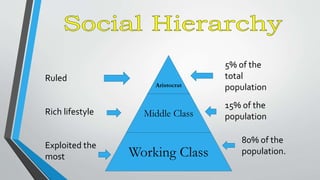
New social class emerged
Business
Owners
Managers,
accountants,
ministers,
lawyers,
doctors, and
other skilled
professionals
Factory workers
in the cities and
peasant farmers
in the
countryside
Working class
Aristocrat
Middle Class
Working Class
5% of the
total
population
15% of the
population
80% of the
population.
Ruled
Rich lifestyle
Exploited the
most
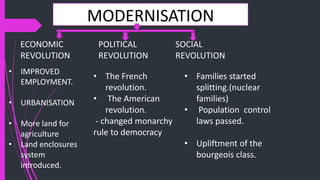
MODERNISATION
ECONOMIC
REVOLUTION
POLITICAL
REVOLUTION
SOCIAL
REVOLUTION
• IMPROVED
EMPLOYMENT.
• URBANISATION
• More land for
agriculture
• Land enclosures
system
introduced.
• The French
revolution.
• The American
revolution.
- changed monarchy
rule to democracy
• Families started
splitting.(nuclear
families)
• Population control
laws passed.
• Upliftment of the
bourgeois class.
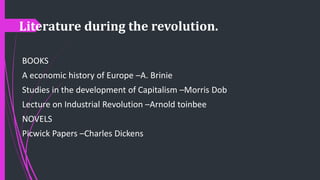
Literature during the revolution.
BOOKS
A economic history of Europe –A. Brinie
Studies in the development of Capitalism –Morris Dob
Lecture on Industrial Revolution –Arnold toinbee
NOVELS
Picwick Papers –Charles Dickens
Why it all happened first in Britain?
Single monarchy of Sir George III:
The monarch Sir George was the only king of Britain he
maintained the law and order in the country.no citizen were free
to oppose any policy under the monarch.
Single Currency:
The barter system was now replaced by the currency. The
citizens started getting their pays fast and easy.
Global market :
The britishers had various colonies from which they got cheap raw
materials and the produced good was sold at high price.
Establishment of bank of England.(1694)
The bank started giving loans to the middle class to establish more
and more industries and thus they were privileged with this move.
Tax free system in the internal market:
The Britain was divided into 3 parts –Wales,Scotland and the England.the
trade between these states didn’t charge any taxes from the merchants.
Good education system
Had a good naval system
-England had many ports and natural cricks which provided the ships to
hoard and load the material easily.
-Britain is surrounded through water almost from all sides thus attacking it
was not too easy and it had strong control over the ports.
Awards were given to new inventions
The English royal society announced awards for new inventions.
Industrial revolution in
the other countries
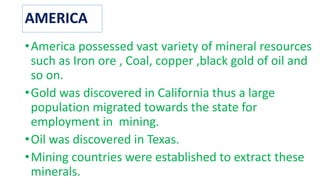
AMERICA
•America possessed vast variety of mineral resources
such as Iron ore , Coal, copper ,black gold of oil and
so on.
•Gold was discovered in California thus a large
population migrated towards the state for
employment in mining.
•Oil was discovered in Texas.
•Mining countries were established to extract these
minerals.
• William Kelly discovered the technique to extract steel from pig
iron using coal.
• Pennsylvania came to be known as THE STEEL CITY because of
the bridges, pipes, electric poles were spread all over the city.
• mechanization of agriculture on a large scale began in the 18th
century.
• Harvesters and thrashers were invented to fasten the cultivation
process.
Thee railroads helped the shepherds and the
cowboys to transport the cattle the slaughter
house of Chicago.
Thus Chicago became the great centre of meat
production.
Invention of automobile industries by Henry
ford.
Germany
Germany had abundant amount of mineral resources lkike
coal and iron ore in the Ruhr and Saar regions.
 these enabled the countries to establish the iron and steel
industries.
Germany set up a number of industries to manufacture
dyes, steel, textiles and chemicals.
Bayer and Hoesht dominated the world market in
producing several chemical dyes.
German agriculture produce was also increase was leaps
and bounds with the use of fertilisers.
Continued…
Karl benz and Nicholas otto made the four stroke internal
combustion engine in 1870 which gave birth to the
automobile industries.
The steel giant Krupp started manufacturing arms and
ammunitions which played a mojor role the war beteen
Prussia and the French.
The germans started making battleships to defeat the
britishers in the twentieth century and for this they also
deepened the Keil canal.
WHY IS THE INDUSTRIALISATION AS
“REVOLUTION” DEBATABLE?
• THE PROCESS OF THE INDUSTRIALISATION WAS VERY
SLOW- “THUS WE CANNOT CALL IT A PURE
REVOLUTION”.
• IT DIDN’T SPREAD IN ALL THE ENGLAND RATHER IT
WAS LIMITED ONLY TO SOME CITIES.
• THE TRADE DURING THIS PERIOD AGAIN STARTED DUE
TO THE AMERICAN REVOLUTION AS IT HAD JUST
The Economic Index
 Change in the Economic Index was seen only after 1820 as before
this period the Britain was involved in THE SEVEN YEARS war with the
French and after that the American revolution.
 Because of which there was no improvement in the economic index
of the country.
 The labour involved in the factories were forced to fight in the wars
and the money which was lent for the industries was being used
against the French.
 Slavery was prevailing in the Britain thus the need to introduce the
machinery was not felt.
Continued….
Slavery was prevailing in the Britain thus the need
to introduce the machinery was not felt.
The proletariat class didn’t want the industrial
revolution as the revolution bring changes the
society.
Industrial revolution

Industrial revolution

  • 2.
    Historical Background Earlier 75%of the population was agrarian They were idle during the winters because of the very cold climate Wool was the major export The merchants who grew it ,themselves produced it .Thus it was very expensive.
  • 3.
    Major part of populationneeded work to earn their living. The merchants needed workers to produce wool for them. Thus the merchants subcontracted with the idle farmers to produce wool for them. The farmers willingly accepted as they didn’t have any work to earn during the winters.
  • 5.
    Process involved inmaking the textile out of wool- Raw Wool Washing the wool Carding the wool Spinning the wool Weaving through yarn Dyeing the wool The cultivation of Indigo in India.
  • 6.
    Distribution of workto the villagers  The merchants allocated different work to different member of the family  Foe eg. The spinning work was given to the unmarried lady i.e.(spinster). And the tough weaving process to the man of the family.  Throughout the winters the families performed the work given to them on very poor wages.  After some period the merchants came and collected the produced wool from them and gave them their wages.
  • 7.
    Continued..  The producedwool was thus now either sold in the internal markets or was exported to other countries.  The merchants now, had a lot of profit as the wool now produced was very cheap for them and the villagers too were happy with this subcontracting.  The similar practice carried for the next 40-50 years and during the course ,many families gave up farming and chose producing wool as their main occupation
  • 8.
     After someyears the demand for wool fell down and cotton took its place . The export markets now demanded more cotton to be exported.  The farmers and businessmen started producing more of cotton and exported.  As the demand was continuously increasing thus some intellectuals suggested that the population will grow in the pattern 2-4-8-16-32..(GP) and the cotton production was growing in the pattern 2-3-4-5-6(AP),  Thus they felt that new methods and techniques must be introduced to cop up with the increasing demand.
  • 9.
  • 10.
  • 11.
    Invention of newequipment (to increase production) The scientists of that era thus started experiments to invent new equipment to boost up the production and invented… The Seed Drill and Horse Hoe The seed drill sowed the seed at predetermined depth and the horse hoe could pull it easily. Earlier the seeds were directly thrown on the ground thus were blown away with the wind and were drained away by the rain. The seed drill sowed the seed deep into the ground thus 99% of the seeds could retain and sprout properly.
  • 12.
    Crop Rotation System Farmersstarted rotating crops allowing them to grow 4 crops in one year and used their entire land rather that the three field system used during the Middle Ages.
  • 13.
    Thus the farmingoutput was increased by 300% after the agricultural revolution. Thus there was need to process the raw material produced in the field into textiles as the work was still done with hands in the factories. Thus now the scientists got involved in experiments to invent something which can fasten the processing.
  • 14.
  • 15.
    As a resultof it various machines were invented to overcome the slow processing. Thus it gave birth to what we call… THE INDUSTRIAL REVOLUTION
  • 16.
    THE MAJOR INVENTIONS VARIOUS MACHINESWERE THUS INTRODUCED TO INCREASE THE PRODUCTION IN THE COTTON FACTORIES DURING THE INDUSTRIAL REVOLUTION
  • 17.
    JOHN KAY’S “FLYINGSHUTTLE” It Sped up the weaving process. Invented in 1733
  • 18.
    Spinning Jenny(1764) Capable ofspinning vast amounts of thread When Richard Arkwright introduced waterpower into the process in the late 18th century – fabric weaving was taken out of the homes and centralized at sites where waterpower was available.
  • 19.
    STEAM ENGINE(1765) Revolutionary because itwas used to generate power for industry as well as being used in transportation . James Watt
  • 20.
    The Power Loom 1785– Water Loom (Edmund Cartwright) – First machine that could weave cloth
  • 21.
    Steam Ship(1807) Robert Fulton Itwas used to trans port goods from the differ ent coloni es.
  • 23.
    As a resultof these inventions The cotton textile increased with huge numbers as the machines did the processing efficiently. Flying Shuttle-improved the carding of cotton. Spinning Jenny-improved the spinning process Water loom-improved the weaving. Crompton,s mule.
  • 24.
    Increase in theEconomy of Britain
  • 25.
    IMPACTS OF THESEINVENTIONS
  • 26.
    Thus due toall these inventions the textile producing process became very fast and the agricultural land available seemed less and the raw cotton demand increased. Britishers now started establishing colonies in different countries for the raw material and the market for the produced textile. Earlier the British depended on Burma for wood supplies for charcoals and after these inventions it was now also used in the making of steam boats. .
  • 27.
    Continued.. Cotton was exportedfrom the Indian continent. Dye was used to colour the wool and cotton and it was extracted from the Indigo plants that were planted in the Indian colony—as a result the Indians revolted against it. Slavery in the colonies increased and the slaves were used to practice the cultivation and the loading work. The cultivated produce of the colonial countries was then imported to the Britain and other export markets.
  • 28.
    Women and childrenworked for 16 hours a day throughout the week to earn their living. The life expectancy rate worsened and the life expectancy rates of the cities like- Birmingham , Manchester and Derby was brought down to 16 ,17 and 22 years respectively. Various epidemic diseases like cholera ,typhoid , tuberculosis ,spread all over in 1832 and 31000 died due to this. They started living in the slum areas and therefore various diseases spread all over the urban areas.
  • 30.
    The villagers nowstarted to migrate towards the cities for employment. Many of them were jobless as most of the work was done with machines, The children didn’t get enough education as their parents didn’t have enough resources to send them to schools. Women and children were exploited too much and were used in cleaning the machinery as they had small hands ,easy to reach. Continued...
  • 31.
  • 32.
    New social classemerged Business Owners Managers, accountants, ministers, lawyers, doctors, and other skilled professionals Factory workers in the cities and peasant farmers in the countryside Working class
  • 33.
    Aristocrat Middle Class Working Class 5%of the total population 15% of the population 80% of the population. Ruled Rich lifestyle Exploited the most
  • 34.
    MODERNISATION ECONOMIC REVOLUTION POLITICAL REVOLUTION SOCIAL REVOLUTION • IMPROVED EMPLOYMENT. • URBANISATION •More land for agriculture • Land enclosures system introduced. • The French revolution. • The American revolution. - changed monarchy rule to democracy • Families started splitting.(nuclear families) • Population control laws passed. • Upliftment of the bourgeois class.
  • 35.
    Literature during therevolution. BOOKS A economic history of Europe –A. Brinie Studies in the development of Capitalism –Morris Dob Lecture on Industrial Revolution –Arnold toinbee NOVELS Picwick Papers –Charles Dickens
  • 36.
    Why it allhappened first in Britain? Single monarchy of Sir George III: The monarch Sir George was the only king of Britain he maintained the law and order in the country.no citizen were free to oppose any policy under the monarch. Single Currency: The barter system was now replaced by the currency. The citizens started getting their pays fast and easy.
  • 37.
    Global market : Thebritishers had various colonies from which they got cheap raw materials and the produced good was sold at high price. Establishment of bank of England.(1694) The bank started giving loans to the middle class to establish more and more industries and thus they were privileged with this move. Tax free system in the internal market: The Britain was divided into 3 parts –Wales,Scotland and the England.the trade between these states didn’t charge any taxes from the merchants.
  • 38.
    Good education system Hada good naval system -England had many ports and natural cricks which provided the ships to hoard and load the material easily. -Britain is surrounded through water almost from all sides thus attacking it was not too easy and it had strong control over the ports. Awards were given to new inventions The English royal society announced awards for new inventions.
  • 40.
  • 41.
    AMERICA •America possessed vastvariety of mineral resources such as Iron ore , Coal, copper ,black gold of oil and so on. •Gold was discovered in California thus a large population migrated towards the state for employment in mining. •Oil was discovered in Texas. •Mining countries were established to extract these minerals.
  • 43.
    • William Kellydiscovered the technique to extract steel from pig iron using coal. • Pennsylvania came to be known as THE STEEL CITY because of the bridges, pipes, electric poles were spread all over the city. • mechanization of agriculture on a large scale began in the 18th century. • Harvesters and thrashers were invented to fasten the cultivation process.
  • 44.
    Thee railroads helpedthe shepherds and the cowboys to transport the cattle the slaughter house of Chicago. Thus Chicago became the great centre of meat production. Invention of automobile industries by Henry ford.
  • 45.
    Germany Germany had abundantamount of mineral resources lkike coal and iron ore in the Ruhr and Saar regions.  these enabled the countries to establish the iron and steel industries. Germany set up a number of industries to manufacture dyes, steel, textiles and chemicals. Bayer and Hoesht dominated the world market in producing several chemical dyes. German agriculture produce was also increase was leaps and bounds with the use of fertilisers.
  • 46.
    Continued… Karl benz andNicholas otto made the four stroke internal combustion engine in 1870 which gave birth to the automobile industries. The steel giant Krupp started manufacturing arms and ammunitions which played a mojor role the war beteen Prussia and the French. The germans started making battleships to defeat the britishers in the twentieth century and for this they also deepened the Keil canal.
  • 47.
    WHY IS THEINDUSTRIALISATION AS “REVOLUTION” DEBATABLE? • THE PROCESS OF THE INDUSTRIALISATION WAS VERY SLOW- “THUS WE CANNOT CALL IT A PURE REVOLUTION”. • IT DIDN’T SPREAD IN ALL THE ENGLAND RATHER IT WAS LIMITED ONLY TO SOME CITIES. • THE TRADE DURING THIS PERIOD AGAIN STARTED DUE TO THE AMERICAN REVOLUTION AS IT HAD JUST
  • 48.
    The Economic Index Change in the Economic Index was seen only after 1820 as before this period the Britain was involved in THE SEVEN YEARS war with the French and after that the American revolution.  Because of which there was no improvement in the economic index of the country.  The labour involved in the factories were forced to fight in the wars and the money which was lent for the industries was being used against the French.  Slavery was prevailing in the Britain thus the need to introduce the machinery was not felt.
  • 49.
    Continued…. Slavery was prevailingin the Britain thus the need to introduce the machinery was not felt. The proletariat class didn’t want the industrial revolution as the revolution bring changes the society.

Editor's Notes

  • #23 Around 26000 new innventions carried out during this period.