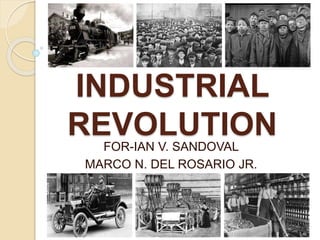
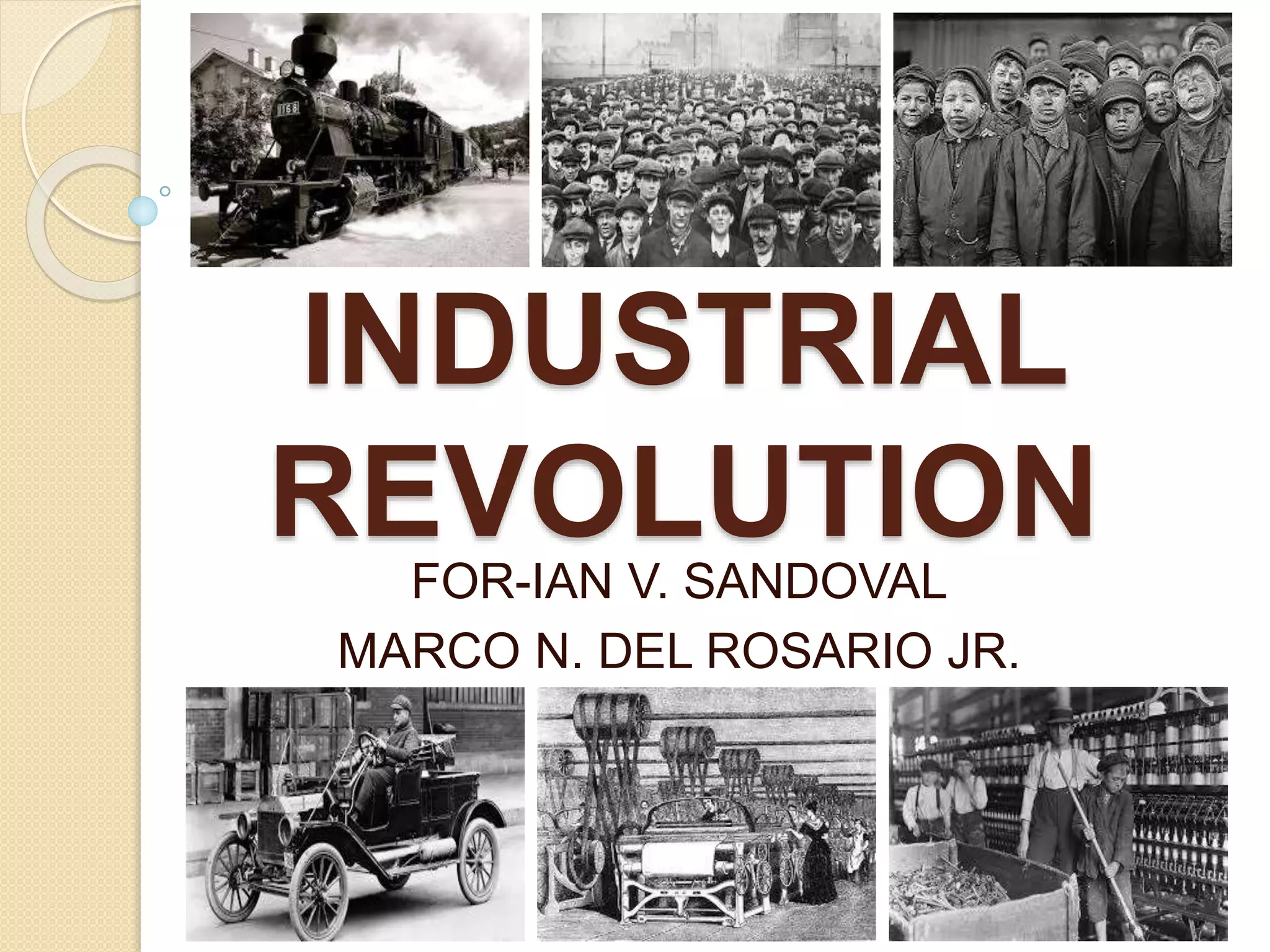






INDUSTRIAL
REVOLUTIONFOR-IAN V. SANDOVAL
MARCO N. DEL ROSARIO JR.
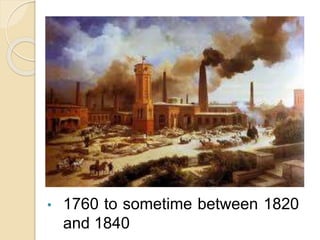
• 1760 to sometime between 1820
and 1840
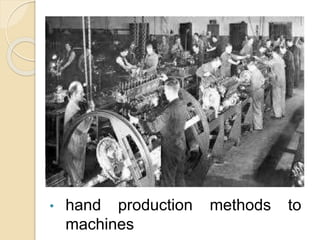
• hand production methods to
machines
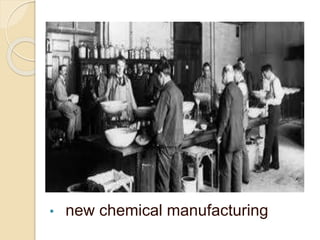
• new chemical manufacturing
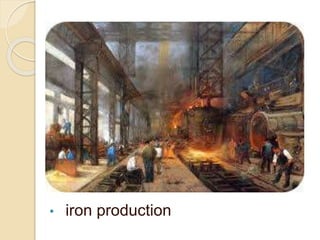
• iron production
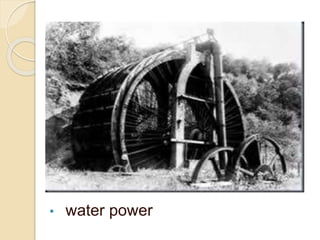
• water power
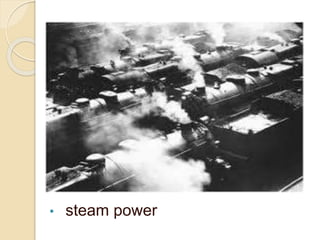
• steam power
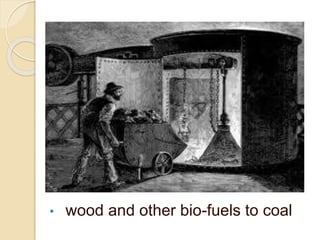
• wood and other bio-fuels to coal
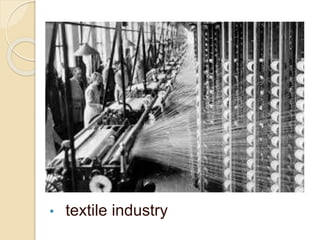
• textile industry
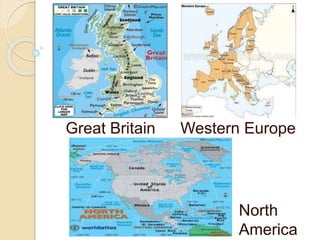
Great Britain Western Europe
North
America
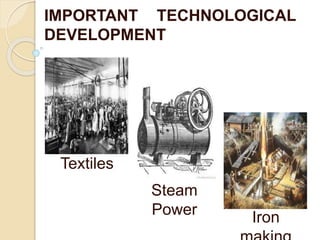
Textiles
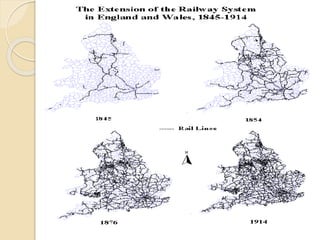
IMPORTANT TECHNOLOGICAL
DEVELOPMENT
Steam
Power Iron
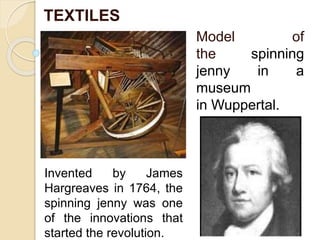
Model of
the spinning
jenny in a
museum
in Wuppertal.
TEXTILES
Invented by James
Hargreaves in 1764, the
spinning jenny was one
of the innovations that
started the revolution.
TEXTILES
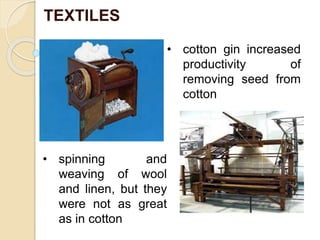
• cotton gin increased
productivity of
removing seed from
cotton
• spinning and
weaving of wool
and linen, but they
were not as great
as in cotton
STEAM POWER ENGINES
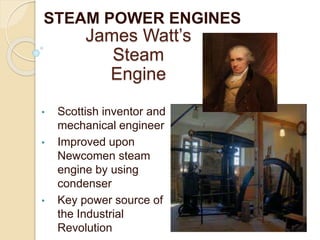
James Watt’s
Steam
Engine
• Scottish inventor and
mechanical engineer
• Improved upon
Newcomen steam
engine by using
condenser
• Key power source of
the Industrial
Revolution
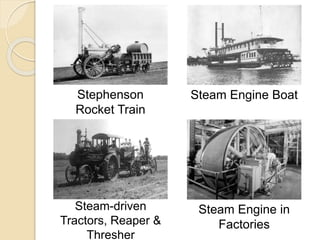
Stephenson
Rocket Train
Steam Engine Boat
Steam-driven
Tractors, Reaper &
Thresher
Steam Engine in
Factories
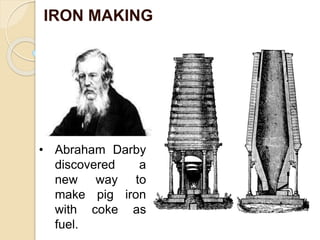
IRON MAKING
• Abraham Darby
discovered a
new way to
make pig iron
with coke as
fuel.
IRON MAKING
• Coke replaced
charcoal as the
preferred source of
fuel
• Coke lowered the
fuel cost for pig iron
and wrought iron
• Coke also allowed
larger blast furnaces,
resulting in
economies of scale
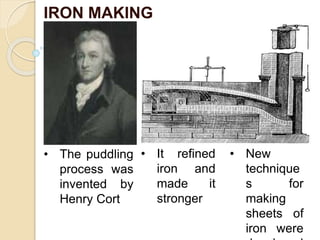
IRON MAKING
• The puddling
process was
invented by
Henry Cort
• It refined
iron and
made it
stronger
• New
technique
s for
making
sheets of
iron were
IRON MAKING
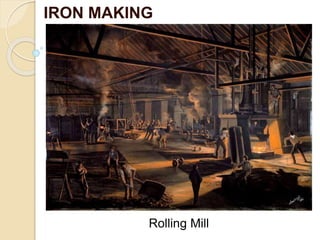
Rolling Mill
IRON MAKING
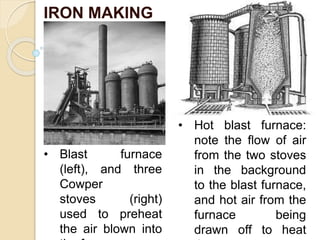
• Blast furnace
(left), and three
Cowper
stoves (right)
used to preheat
the air blown into
• Hot blast furnace:
note the flow of air
from the two stoves
in the background
to the blast furnace,
and hot air from the
furnace being
drawn off to heat
IRON STRUCTURES
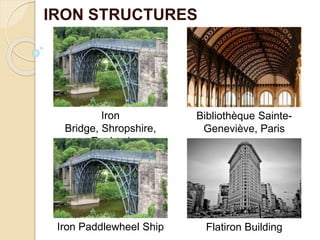
Iron
Bridge, Shropshire,
England
Bibliothèque Sainte-
Geneviève, Paris
Iron Paddlewheel Ship Flatiron Building
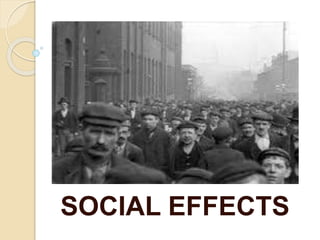
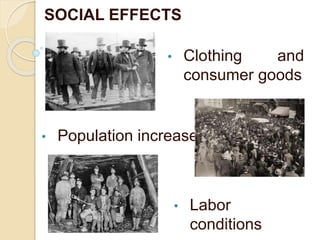
SOCIAL EFFECTS
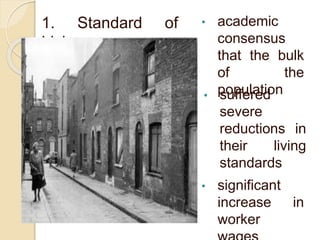
1. Standard of
Living
• academic
consensus
that the bulk
of the
population• suffered
severe
reductions in
their living
standards
• significant
increase in
worker
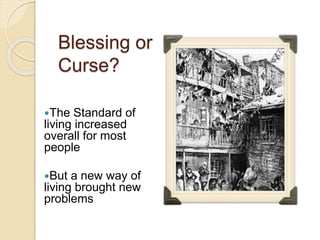
Blessing or
Curse?
The Standard of
living increased
overall for most
people
But a new way of
living brought new
problems
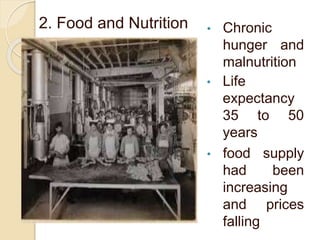
2. Food and Nutrition • Chronic
hunger and
malnutrition
• Life
expectancy
35 to 50
years
• food supply
had been
increasing
and prices
falling
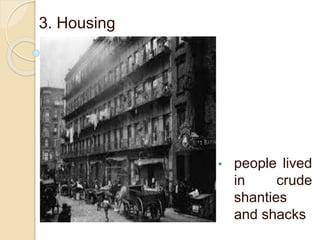
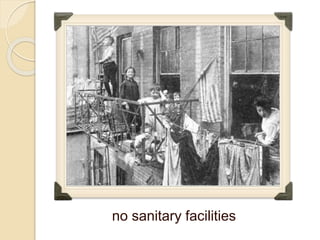
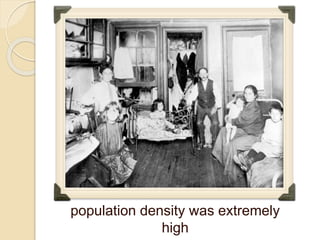
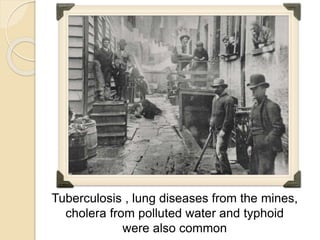
3. Housing
• people lived
in crude
shanties
and shacks
no sanitary facilities
population density was extremely
high
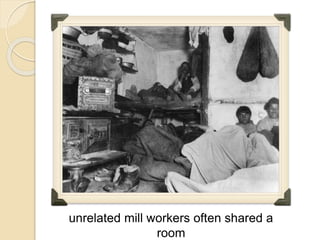
unrelated mill workers often shared a
room
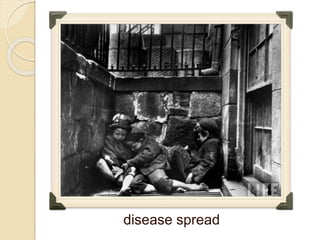
disease spread
Tuberculosis , lung diseases from the mines,
cholera from polluted water and typhoid
were also common
• Clothing and
consumer goods
SOCIAL EFFECTS
• Population increase
• Labor
conditions
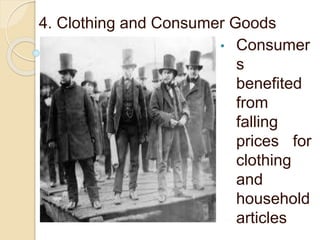
4. Clothing and Consumer Goods
• Consumer
s
benefited
from
falling
prices for
clothing
and
household
articles
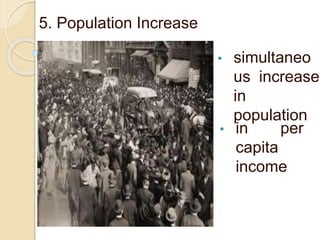
5. Population Increase
• simultaneo
us increase
in
population
• in per
capita
income
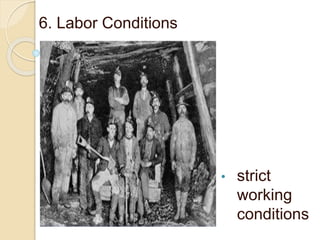
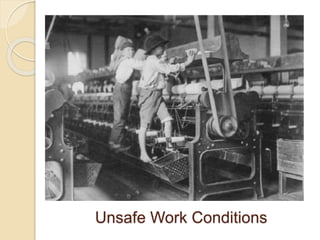
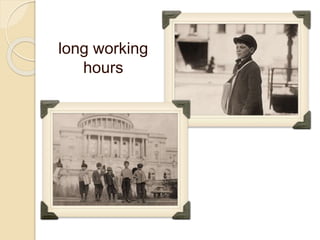
6. Labor Conditions
• strict
working
conditions
Unsafe Work Conditions
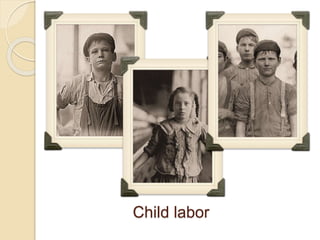
Child labor
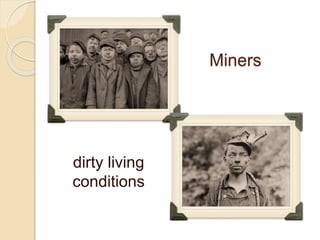
Miners
dirty living
conditions
long working
hours
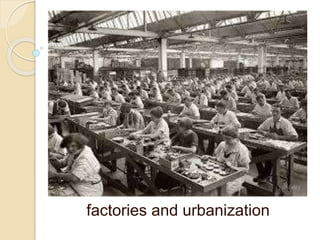
factories and urbanization
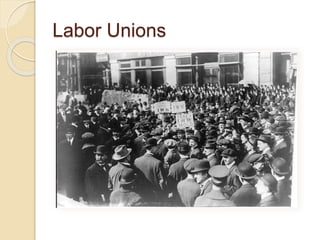
Labor Unions
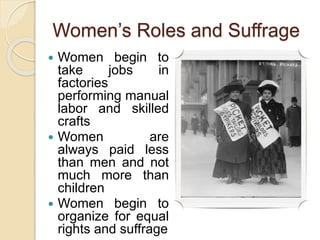
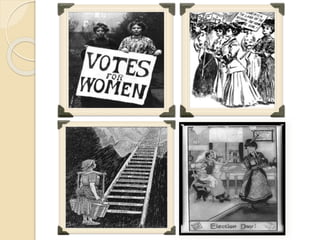
Women’s Roles and Suffrage
 Women begin to
take jobs in
factories
performing manual
labor and skilled
crafts
 Women are
always paid less
than men and not
much more than
children
 Women begin to
organize for equal
rights and suffrage
INDUSTRIALIZATION
BEYOND GREAT
BRITAIN
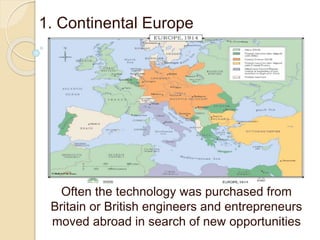
1. Continental Europe
Often the technology was purchased from
Britain or British engineers and entrepreneurs
moved abroad in search of new opportunities
, bla
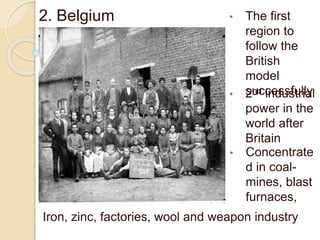
2. Belgium • The first
region to
follow the
British
model
successfully• 2nd industrial
power in the
world after
Britain
• Concentrate
d in coal-
mines, blast
furnaces,
Iron, zinc, factories, wool and weapon industry
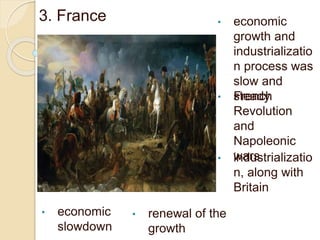
3. France • economic
growth and
industrializatio
n process was
slow and
steady• French
Revolution
and
Napoleonic
wars• industrializatio
n, along with
Britain
• economic
slowdown
• renewal of the
growth
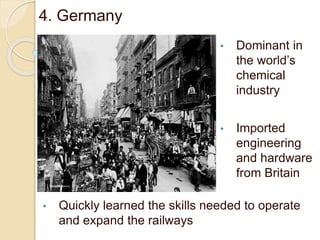
4. Germany
• Dominant in
the world’s
chemical
industry
• Imported
engineering
and hardware
from Britain
• Quickly learned the skills needed to operate
and expand the railways
5. Sweden • Agricultural
revolution
• Commercializatio
n of farming
• Free and
mandatory
schooling
• Abolition of the
national
monopoly trade
• Stock company
law• Mechanical
engineering
• Power utilities
• Papermaking
• Textile
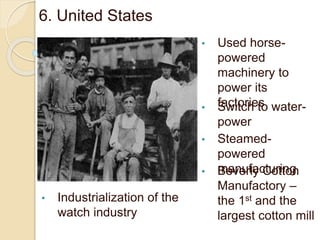
6. United States
• Used horse-
powered
machinery to
power its
factories• Switch to water-
power
• Steamed-
powered
manufacturing• Beverly Cotton
Manufactory –
the 1st and the
largest cotton mill
• Industrialization of the
watch industry
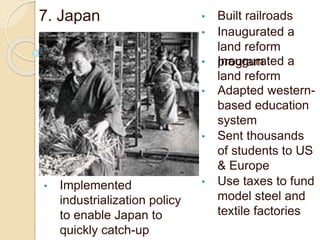
7. Japan • Built railroads
• Inaugurated a
land reform
program• Inaugurated a
land reform
• Adapted western-
based education
system
• Sent thousands
of students to US
& Europe
• Use taxes to fund
model steel and
textile factories
• Implemented
industrialization policy
to enable Japan to
quickly catch-up
2ND INDUSTRALIZATION
REVOLUTION
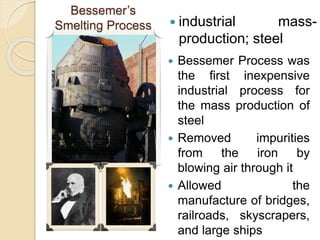
 industrial mass-
production; steel
Bessemer’s
Smelting Process
 Bessemer Process was
the first inexpensive
industrial process for
the mass production of
steel
 Removed impurities
from the iron by
blowing air through it
 Allowed the
manufacture of bridges,
railroads, skyscrapers,
and large ships
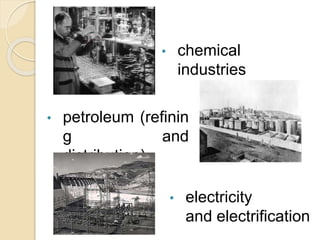
• chemical
industries
• petroleum (refinin
g and
distribution)
• electricity
and electrification
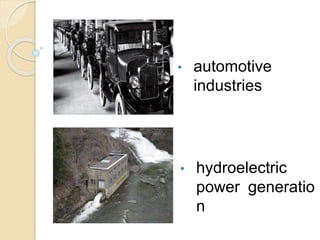
• hydroelectric
power generatio
n
• automotive
industries
INTELLECTUAL
PARADIGMS AND
CRITICISMS
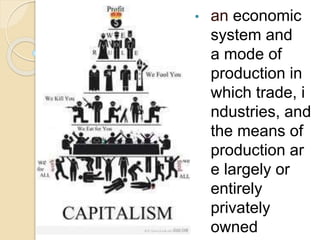
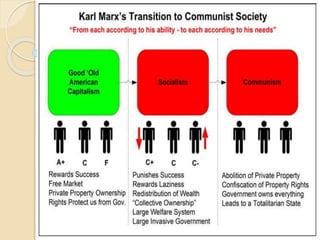
• an economic
system and
a mode of
production in
which trade, i
ndustries, and
the means of
production ar
e largely or
entirely
privately
owned
• social and
economic system
characterized by
social ownership
of the means of
production and
co-operative
management of
the economy, as
well as a political
theory and
movement that
aims at the
establishment of
such a system
Socialis
m
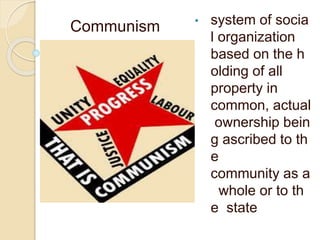
• system of socia
l organization
based on the h
olding of all
property in
common, actual
ownership bein
g ascribed to th
e
community as a
whole or to th
e state
Communism
(also the Romantic
era or the
Romantic period)
was an artistic,
literary, and
intellectual
movement that
originated in
Europe toward the
end of the 18th
century and in
most areas was at
its peak in the
approximate period
from 1800 to 1850.
Romanticism
CAUSES OF
INDUSTRIAL
REVOLUTION
• outgrowth of social and
institutional changes brought by
the end
of feudalism in Britain after
the English Civil War
• percentage of children who lived
past infancy rose significantly,
leading to a larger workforce
• presence of a large domestic
market• Governments' grant of
limited monopolies to inventors
under a developing patent system
• education and technological
changes• religion and beliefs
• self-interest and an
entrepreneurial spirit
• natural or financial resources
• availability of key resources
• stable political situation
TRANSFER OF
KNOWLEDGE
• Industrialized countries engaged
in study-touring
• publications describing
technology such Encyclopedias
• periodical publications
• presence of
an entrepreneurial class which
believed in progress, technology
and hard work
THANK YOU!!!

Technological Change: Industrial Revolution

Editor's Notes

  • #3 Industrial Revolution was the transition to new manufacturing processes
  • #10 Textiles were the dominant industry of the Industrial Revolution in terms of employment, value of output and capital invested; the textile industry was also the first to use modern production methods.
  • #11 The Industrial Revolution began in Great Britain, and spread to Western Europe and North America within a few decades. First Industrial Revolution evolved into the Second Industrial Revolution in the transition years between 1840 and 1870, when technological and economic progress continued with the increasing adoption of steam transport (steam-powered railways, boats and ships), the large-scale manufacture of machine tools and the increasing use of machinery in steam-powered factories
  • #12 The commencement of the Industrial Revolution is closely linked to a small number of innovations, beginning in the second half of the 18th century.
  • #15 The efficiency of steam engines increased so that they used between one-fifth and one-tenth as much fuel.
  • #18 At first this method of processing iron produced iron that were impure, so it was impossible for forge masters to turn it into tools and goods. Improvements later improved the quality by using more advanced techniques.
  • #19 The substitution of coke for charcoal greatly lowered the fuel cost for pig iron and wrought iron production
  • #20 At first this method of processing iron produced iron that were impure, so it was impossible for forge masters to turn it into tools and goods. Improvements later improved the quality by using more advanced techniques.
  • #21 The rolling mill was fifteen times faster than hammering wrought iron
  • #22 At first this method of processing iron produced iron that were impure, so it was impossible for forge masters to turn it into tools and goods. Improvements later improved the quality by using more advanced techniques.
  • #27  food supply had been increasing and prices falling before the Industrial Revolution due to better agricultural practices Transportation improvements, such as canals and improved roads, also lowered food costs. Railroads were introduced near the end of the Industrial Revolution.
  • #31 Eight to ten unrelated mill workers often shared a room, often with no furniture, and slept on a pile of straw or sawdust
  • #32 Disease spread through a contaminated water supply
  • #33 Tuberculosis (spread in congested dwellings), lung diseases from the mines,cholera from polluted water and typhoid were also common
  • #37 most industrial workers in the United States still worked a 10-hour day (12 hours in the steel industry), yet earned from 20% to 40% less than the minimum deemed necessary for a decent life
  • #39 Industrial Revolution led to a population increase but the chances of surviving childhood did not improve limited opportunity for education and children were expected to work Children as young as four were employed Children died before the age of 25 Children working 14 hours a day Factory Acts, were passed in Britain: Children younger than nine were not allowed to work, children were not permitted to work at night, and the work day of youth under the age of 18 was limited to twelve hours
  • #42 Industrialization led to the creation of the factory The factory system contributed to the growth of urban areas, as large numbers of workers migrated into the cities in search of work in the factories
  • #47 Ruhr Valley in Westphalia was called 'Miniature England' because of its similarities to the industrial areas of England
  • #48 Ruhr Valley in Westphalia was called 'Miniature England' because of its similarities to the industrial areas of England
  • #52 Ruhr Valley in Westphalia was called 'Miniature England' because of its similarities to the industrial areas of England
  • #53 Ruhr Valley in Westphalia was called 'Miniature England' because of its similarities to the industrial areas of England