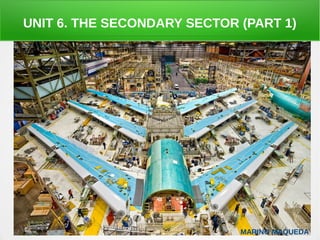
UNIT 6. THE SECONDARY SECTOR (PART 1)
MARINO MAQUEDA
What are the activities indluded in the
secondary sector?
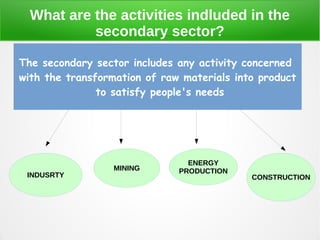
The secondary sector includes any activity concerned
with the transformation of raw materials into product
to satisfy people's needs
INDUSRTY
MINING
ENERGY
PRODUCTION
CONSTRUCTION
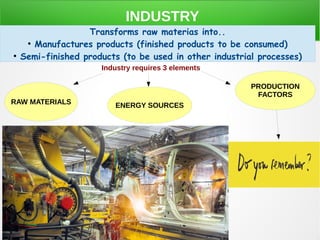
INDUSTRY
Transforms raw materias into..
●
Manufactures products (finished products to be consumed)
●
Semi-finished products (to be used in other industrial processes)
Industry requires 3 elements
RAW MATERIALS ENERGY SOURCES
PRODUCTION
FACTORS
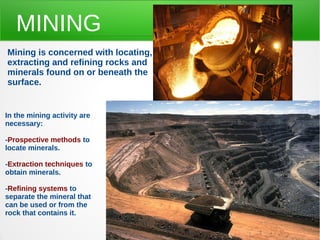
MINING
Mining is concerned with locating,
extracting and refining rocks and
minerals found on or beneath the
surface.
In the mining activity are
necessary:
-Prospective methods to
locate minerals.
-Extraction techniques to
obtain minerals.
-Refining systems to
separate the mineral that
can be used or from the
rock that contains it.
ENERGY PRODUCTION
Transfors energy sources into heat and electricity in
specialised installations (Power Stations)
CONSTRUCTION
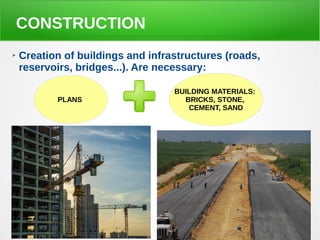
➢ Creation of buildings and infrastructures (roads,
reservoirs, bridges...). Are necessary:
PLANS
BUILDING MATERIALS:
BRICKS, STONE,
CEMENT, SAND
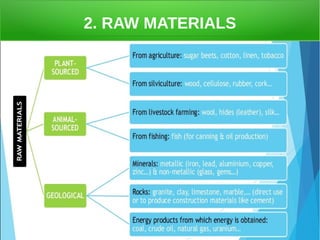
2. RAW MATERIALS
2. RAW MATERIALS
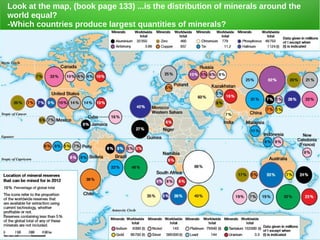
Look at the map, (book page 133) ...is the distribution of minerals around the
world equal?
-Which countries produce largest quantities of minerals?
PRODUCTION AND TRADE IN RAW
MATERIALS
MAIN PRODUCING
COUNTRIES:
- CANADA
-AUSTRALIA
-RUSSIA
-BRAZIL
-SOUTH AFRICA
-USA
-CHINA
Some countries have specific resources, such us:
-The Middle East (Iraq, Iran, Saudi Arabia... → CRUDE OIL
-Dem. Rep. Congo → COLTAN
- Ivory Coast → COCOA
What do they have
In common?
What do you think
Is the most important
Raw material?
1) What's the country with the highest levels of mineral raw materials?
2) What's the main producing country of Platinium metals?
3) What's the main country of cobalt?
PRODUCTION AND TRADE IN RAW
MATERIALS
The consumption of raw
materials is concentrated in:
1) Western Europe
2) USA
3) Japan
4) China
5) India
Reasons:
● Most industrialized regions
● Populated areas
● Consumeriest society (sociedad
consumista)
China comsuption
of raw materials
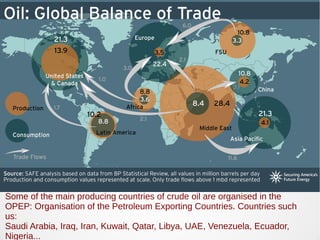
Some of the main producing countries of crude oil are organised in the
OPEP: Organisation of the Petroleum Exporting Countries. Countries such
us:
Saudi Arabia, Iraq, Iran, Kuwait, Qatar, Libya, UAE, Venezuela, Ecuador,
Nigeria...
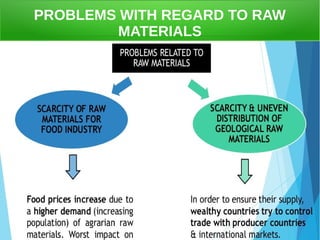
PROBLEMS WITH REGARD TO RAW
MATERIALS
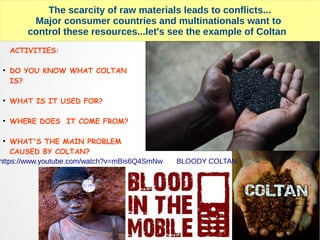
The scarcity of raw materials leads to conflicts...
Major consumer countries and multinationals want to
control these resources...let's see the example of Coltan
ACTIVITIES:
●
DO YOU KNOW WHAT COLTAN
IS?
●
WHAT IS IT USED FOR?
●
WHERE DOES IT COME FROM?
●
WHAT'S THE MAIN PROBLEM
CAUSED BY COLTAN?
https://www.youtube.com/watch?v=mBis6Q4SmNw BLOODY COLTAN
ENERGY SOURCES
DEFINING A CONCEPT
What it is?
What does it consist of?
Why is it important?
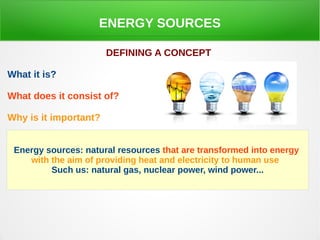
Energy sources: natural resources that are transformed into energy
with the aim of providing heat and electricity to human use
Such us: natural gas, nuclear power, wind power...
ENERGY SOURCES
Energy sources can be clasiffied depending on where they started to
be used:
TRADITIONAL ENERGY
SOURCES
ALTERNATIVE ENERGY
SOURCES
ENERGY SOURCES
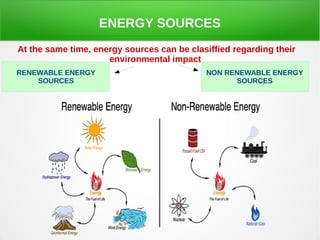
At the same time, energy sources can be clasiffied regarding their
environmental impact
RENEWABLE ENERGY
SOURCES
NON RENEWABLE ENERGY
SOURCES
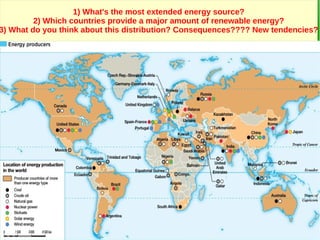
1) What's the most extended energy source?
2) Which countries provide a major amount of renewable energy?
3) What do you think about this distribution? Consequences???? New tendencies?
ENERGY CONSUMPTION
1) Are we using more renewable or non-renewable energies?
2) What's the most consumed energy source?
3) What energy sources have an increasing tendency in the last decade?
4) What energy source is supposed to have a high increasing in the future
decades?
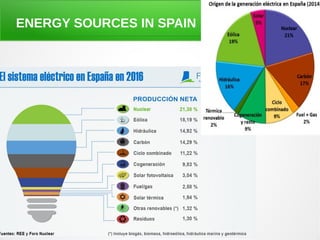
ENERGY SOURCES IN SPAIN
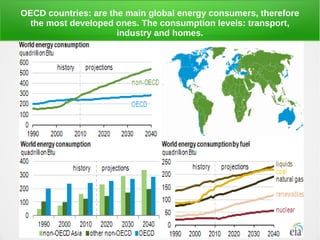
OECD countries: are the main global energy consumers, therefore
the most developed ones. The consumption levels: transport,
industry and homes.
INDUSTRY AND GLOBALISATION
TYPES OF INDUSTRY
ACCORDING TO THEIR POSITION
INTHE PRODUCTION PROCESS
● HEAVY INDUSTRY: procudes
semi-finished products (iron and
steel industry. Petrochemistry)
● CAPITAL GOODS INDUSTRY:
transforms semi-finished
products into equipments needed
by other industries (machinery,
industrial equipment,
construction: cement, transport.)
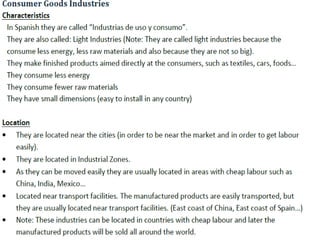
● CONSUMER GOODS INDUSTRY:
manufactures products intended
directly for consumers: textiles,
canned food, paper..
ACCORDING TO
THE WEIGHT OF
RAW MATERIALS
● HEAVY INDUSTRY
(large quantities of
heavy raw materials)
● SEMI-HEAVY
INDUSTRY (raw
materials on a
smaller scale)
● LIGHT INDUSTRY
(uses lightweight
materials)
ACCORDING TO
ITS TECHNOLOGY
● LOW TECHNOLOGY:
traditional industries,
steel industry,
shipbuildings.
● MATURE
TECHNOLOGY:
(stagnant) car
industry,
petrochemistry.
● HIGH-TECH: major
expansion:
telecommunications,
biotechnology,
computing,
pharmaceutical
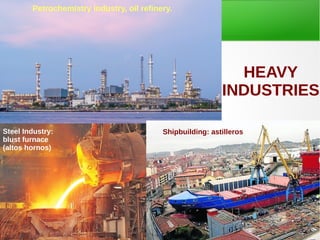
Petrochemistry industry, oil refinery.
Steel Industry:
blust furnace
(altos hornos)
Shipbuilding: astilleros
HEAVY
INDUSTRIES
CAPITAL GOODS
INDUSTRY:
- Construction
materials
- Aerospace
- Industrial
equipment
Drug industry plant
Textile industry in Pakistan
CONSUMER
GOODS INDUSTRY
Canned food industry
Car Industry
WHERE TO LOCATE
AN INDUSTRY????
THEY ARE ALWAYS LOCATED IN PLACES THAT
PROVIDE THE MOST FAVOURABLE CONDITIONS
TO ERAN THE MAXIMUM PROFIT
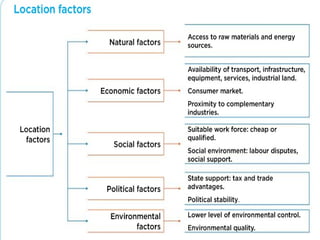
Obviously there are some factors that influence more
than others in the indutrial location. Any guess about the
most important one???
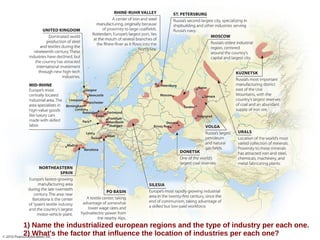
1) Name the industrialized european regions and the type of industry per each one.
2) What's the factor that influence the location of industries per each one?
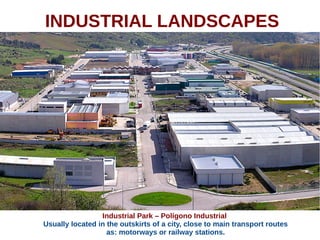
INDUSTRIAL LANDSCAPES
Industrial Park – Polígono Industrial
Usually located in the outskirts of a city, close to main transport routes
as: motorways or railway stations.
Science Park – Parque Tecnológico in Gijon (Asturias)
They tend to be located in the outskirts of a big city, in places with high
environmental quality.
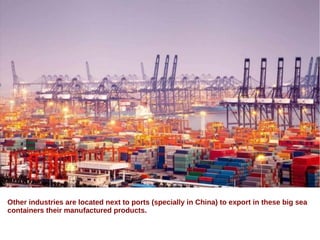
Other industries are located next to ports (specially in China) to export in these big sea
containers their manufactured products.
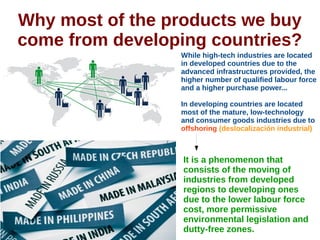
Why most of the products we buy
come from developing countries?
While high-tech industries are located
in developed countries due to the
advanced infrastructures provided, the
higher number of qualified labour force
and a higher purchase power...
In developing countries are located
most of the mature, low-technology
and consumer goods industries due to
offshoring (deslocalización industrial)
It is a phenomenon that
consists of the moving of
industries from developed
regions to developing ones
due to the lower labour force
cost, more permissive
environmental legislation and
dutty-free zones.
Unit 6. the secondary sector

Unit 6. the secondary sector

  • 1.
    UNIT 6. THESECONDARY SECTOR (PART 1) MARINO MAQUEDA
  • 2.
    What are theactivities indluded in the secondary sector? The secondary sector includes any activity concerned with the transformation of raw materials into product to satisfy people's needs INDUSRTY MINING ENERGY PRODUCTION CONSTRUCTION
  • 3.
    INDUSTRY Transforms raw materiasinto.. ● Manufactures products (finished products to be consumed) ● Semi-finished products (to be used in other industrial processes) Industry requires 3 elements RAW MATERIALS ENERGY SOURCES PRODUCTION FACTORS
  • 4.
    MINING Mining is concernedwith locating, extracting and refining rocks and minerals found on or beneath the surface. In the mining activity are necessary: -Prospective methods to locate minerals. -Extraction techniques to obtain minerals. -Refining systems to separate the mineral that can be used or from the rock that contains it.
  • 5.
    ENERGY PRODUCTION Transfors energysources into heat and electricity in specialised installations (Power Stations)
  • 6.
    CONSTRUCTION ➢ Creation ofbuildings and infrastructures (roads, reservoirs, bridges...). Are necessary: PLANS BUILDING MATERIALS: BRICKS, STONE, CEMENT, SAND
  • 7.
  • 8.
  • 9.
    Look at themap, (book page 133) ...is the distribution of minerals around the world equal? -Which countries produce largest quantities of minerals?
  • 10.
    PRODUCTION AND TRADEIN RAW MATERIALS MAIN PRODUCING COUNTRIES: - CANADA -AUSTRALIA -RUSSIA -BRAZIL -SOUTH AFRICA -USA -CHINA Some countries have specific resources, such us: -The Middle East (Iraq, Iran, Saudi Arabia... → CRUDE OIL -Dem. Rep. Congo → COLTAN - Ivory Coast → COCOA What do they have In common? What do you think Is the most important Raw material?
  • 11.
    1) What's thecountry with the highest levels of mineral raw materials? 2) What's the main producing country of Platinium metals? 3) What's the main country of cobalt?
  • 12.
    PRODUCTION AND TRADEIN RAW MATERIALS The consumption of raw materials is concentrated in: 1) Western Europe 2) USA 3) Japan 4) China 5) India Reasons: ● Most industrialized regions ● Populated areas ● Consumeriest society (sociedad consumista) China comsuption of raw materials
  • 13.
    Some of themain producing countries of crude oil are organised in the OPEP: Organisation of the Petroleum Exporting Countries. Countries such us: Saudi Arabia, Iraq, Iran, Kuwait, Qatar, Libya, UAE, Venezuela, Ecuador, Nigeria...
  • 14.
    PROBLEMS WITH REGARDTO RAW MATERIALS
  • 15.
    The scarcity ofraw materials leads to conflicts... Major consumer countries and multinationals want to control these resources...let's see the example of Coltan ACTIVITIES: ● DO YOU KNOW WHAT COLTAN IS? ● WHAT IS IT USED FOR? ● WHERE DOES IT COME FROM? ● WHAT'S THE MAIN PROBLEM CAUSED BY COLTAN? https://www.youtube.com/watch?v=mBis6Q4SmNw BLOODY COLTAN
  • 16.
    ENERGY SOURCES DEFINING ACONCEPT What it is? What does it consist of? Why is it important? Energy sources: natural resources that are transformed into energy with the aim of providing heat and electricity to human use Such us: natural gas, nuclear power, wind power...
  • 17.
    ENERGY SOURCES Energy sourcescan be clasiffied depending on where they started to be used: TRADITIONAL ENERGY SOURCES ALTERNATIVE ENERGY SOURCES
  • 18.
    ENERGY SOURCES At thesame time, energy sources can be clasiffied regarding their environmental impact RENEWABLE ENERGY SOURCES NON RENEWABLE ENERGY SOURCES
  • 19.
    1) What's themost extended energy source? 2) Which countries provide a major amount of renewable energy? 3) What do you think about this distribution? Consequences???? New tendencies?
  • 20.
    ENERGY CONSUMPTION 1) Arewe using more renewable or non-renewable energies? 2) What's the most consumed energy source? 3) What energy sources have an increasing tendency in the last decade? 4) What energy source is supposed to have a high increasing in the future decades?
  • 21.
  • 22.
    OECD countries: arethe main global energy consumers, therefore the most developed ones. The consumption levels: transport, industry and homes.
  • 23.
    INDUSTRY AND GLOBALISATION TYPESOF INDUSTRY ACCORDING TO THEIR POSITION INTHE PRODUCTION PROCESS ● HEAVY INDUSTRY: procudes semi-finished products (iron and steel industry. Petrochemistry) ● CAPITAL GOODS INDUSTRY: transforms semi-finished products into equipments needed by other industries (machinery, industrial equipment, construction: cement, transport.) ● CONSUMER GOODS INDUSTRY: manufactures products intended directly for consumers: textiles, canned food, paper.. ACCORDING TO THE WEIGHT OF RAW MATERIALS ● HEAVY INDUSTRY (large quantities of heavy raw materials) ● SEMI-HEAVY INDUSTRY (raw materials on a smaller scale) ● LIGHT INDUSTRY (uses lightweight materials) ACCORDING TO ITS TECHNOLOGY ● LOW TECHNOLOGY: traditional industries, steel industry, shipbuildings. ● MATURE TECHNOLOGY: (stagnant) car industry, petrochemistry. ● HIGH-TECH: major expansion: telecommunications, biotechnology, computing, pharmaceutical
  • 24.
    Petrochemistry industry, oilrefinery. Steel Industry: blust furnace (altos hornos) Shipbuilding: astilleros HEAVY INDUSTRIES
  • 25.
  • 26.
    Drug industry plant Textileindustry in Pakistan CONSUMER GOODS INDUSTRY Canned food industry Car Industry
  • 27.
    WHERE TO LOCATE ANINDUSTRY????
  • 28.
    THEY ARE ALWAYSLOCATED IN PLACES THAT PROVIDE THE MOST FAVOURABLE CONDITIONS TO ERAN THE MAXIMUM PROFIT Obviously there are some factors that influence more than others in the indutrial location. Any guess about the most important one???
  • 30.
    1) Name theindustrialized european regions and the type of industry per each one. 2) What's the factor that influence the location of industries per each one?
  • 35.
    INDUSTRIAL LANDSCAPES Industrial Park– Polígono Industrial Usually located in the outskirts of a city, close to main transport routes as: motorways or railway stations.
  • 36.
    Science Park –Parque Tecnológico in Gijon (Asturias) They tend to be located in the outskirts of a big city, in places with high environmental quality.
  • 37.
    Other industries arelocated next to ports (specially in China) to export in these big sea containers their manufactured products.
  • 38.
    Why most ofthe products we buy come from developing countries? While high-tech industries are located in developed countries due to the advanced infrastructures provided, the higher number of qualified labour force and a higher purchase power... In developing countries are located most of the mature, low-technology and consumer goods industries due to offshoring (deslocalización industrial) It is a phenomenon that consists of the moving of industries from developed regions to developing ones due to the lower labour force cost, more permissive environmental legislation and dutty-free zones.