Typhoid Fever Presented by: Dave Jay S. Manriquez, BSN, RN
Other names: Enteric Fever Bilious Fever Yellow Jack
Causative Agent Salmonella Typhi
3 main antigenic factors: the O, or somatic antigen the Vi, or encapsulation antigen the H, or flagellar antigen
Epidemiology World:  17 million cases per year  U.S.:  400 cases per year (70% in travelers)‏ Philippines:  (Nov 2006) 478 in Agusan del Sur; (May 2004) 292 in Bacolod City
Incidence of Typhoid Fever  red - strongly endemic; orange – endemic; gray - sporadic cases
Mode of Transmission Ingestion of contaminated food or water; rarely from person to person transmission through fecal-oral route.
Incubation Period First 7-14 days after ingestion
Symptoms Diarrhea may occur  Active infection  Severe Headache  Generalized Abdominal Pain Anorexia
Symptoms Fever [usually higher in the evening] - Intermittent Fever initially  - Sustained Fever to high temperatures later
Symptoms Severe cases ulcers on the intestinal wall shock delirium stupor
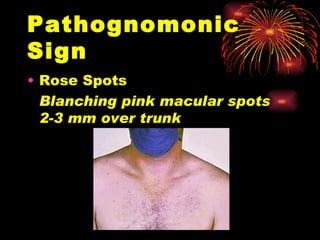
Pathognomonic Sign Rose Spots Blanching pink macular spots 2-3 mm over trunk
Complications Intestinal perforation, gastrointestinal hemorrhage and peritonitis may occur in the 3rd and 4th week of illness; rarely pancreatitis, hepatic and splenic abscesses, disseminated intravascular coagulation, myocarditis, meningitis, encephalitis.
Pathophysiology Salmonella Typhi survives the acidity of the stomach invades the Peyer’s Patches of the intestinal wall macrophages (Peyer’s Patches)‏ the bacteria is within the macrophages and survives bacteria spreads via the lymphatics while inside the macrophages
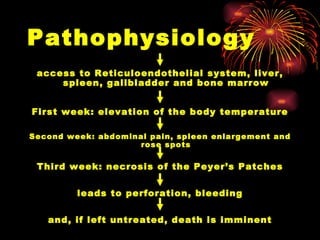
Pathophysiology access to Reticuloendothelial system, liver, spleen, gallbladder and bone marrow First week: elevation of the body temperature Second week: abdominal pain, spleen enlargement and rose spots Third week: necrosis of the Peyer’s Patches leads to perforation, bleeding and, if left untreated, death is imminent
Diagnostics CBC (normal WBC despite fever), platelet count Tourniquet Test
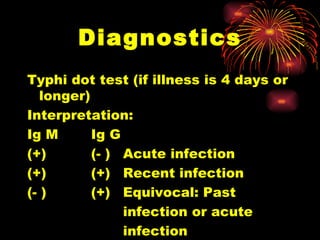
Diagnostics Typhi dot test (if illness is 4 days or longer)‏ Interpretation: Ig M Ig G (+) (- ) Acute infection (+) (+) Recent infection (- ) (+) Equivocal: Past  infection or acute  infection
Diagnostics Malarial smear (Differential diagnosis)‏ Chest X-ray Urinalysis
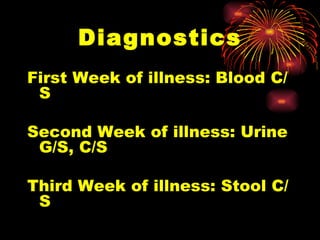
Diagnostics First Week of illness: Blood C/S Second Week of illness: Urine G/S, C/S Third Week of illness: Stool C/S
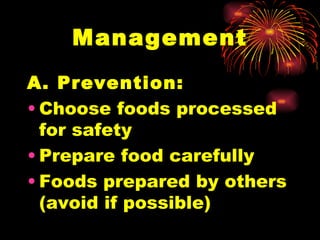
Management A. Prevention: Choose foods processed for safety Prepare food carefully Foods prepared by others (avoid if possible)‏
Management Keep food contact surfaces clean Eat cooked food as soon as possible Maintain clean hands
Management Steam or boil shellfish at least 10 minutes All milk and dairy products should be pasteurized  Control fly populations
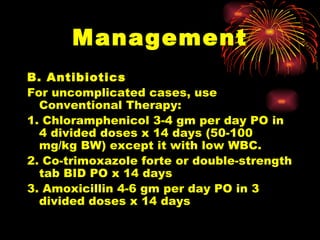
Management B. Antibiotics For uncomplicated cases, use Conventional Therapy: 1. Chloramphenicol 3-4 gm per day PO in 4 divided doses x 14 days (50-100 mg/kg BW) except it with low WBC. 2. Co-trimoxazole forte or double-strength tab BID PO x 14 days 3. Amoxicillin 4-6 gm per day PO in 3 divided doses x 14 days
Management For cases with complications, presence of severe symptoms, or clinical deterioration despite conventional therapy, use Empiric Therapy for Suspected Resistant Typhoid Fever: 1. Ceftriaxone (Rocephin) 3 gm IV infusion OD x 5-7 days Ceftriaxone may be used for pregnant women and children. 2. Fluoroquinolones: Ciprofloxacin (Ciprobay) 500 mg tab PO BID x 7-10 days Ofloxacin (Inoflox) 400 mg tab PO BID x 7-10 days Perfloxacin (Floxin) 400 mg tab PO BID x 7-10 days
Management C. Vaccines 5 years 1 capsule every other day, total of 3 capsules Oral 6 years Ty21 a, live 3 years 0.5 ml Subcutaneous 2 years Vi CPS 3 years 0.5 ml (0.25 ml for children < 10y)‏ x 2 times, 4 weeks apart Subcutaneous 5 years Killed whole-cell vaccine Revaccination Dosage Route Age Vaccine
Management D. Public Health Nursing    Responsibility - Teach members of the family how to report all symptoms to the attending physician especially when patient is being cared for at home.
Management - Teach, guide and supervise members of the family on nursing techniques which will contribute to the patient’s recovery.
Management - Interpret to family nature of disease and need for practicing preventive and control measures.
Management E. Nursing Care - Demonstrate to family how to give bedside care, such as tepid sponge bath, feeding, changing of bed linen, use of bedpan and mouth care.
Management - Any bleeding from the rectum, blood in stools, sudden acute abdominal pain, restlessness, falling of temperature should be reported at once to the physician or the patient should be brought at once to the hospital.
Management - Take TPR, I&O and teach family members how to take and record same.
Historical Background Mary Mallon  (September 23, 1869 – November 11, 1938)
Thank you!

Typhoid Fever

  • 1.
    Typhoid Fever Presentedby: Dave Jay S. Manriquez, BSN, RN
  • 2.
    Other names: EntericFever Bilious Fever Yellow Jack
  • 3.
  • 4.
    3 main antigenicfactors: the O, or somatic antigen the Vi, or encapsulation antigen the H, or flagellar antigen
  • 5.
    Epidemiology World: 17 million cases per year U.S.: 400 cases per year (70% in travelers)‏ Philippines: (Nov 2006) 478 in Agusan del Sur; (May 2004) 292 in Bacolod City
  • 6.
    Incidence of TyphoidFever red - strongly endemic; orange – endemic; gray - sporadic cases
  • 7.
    Mode of TransmissionIngestion of contaminated food or water; rarely from person to person transmission through fecal-oral route.
  • 8.
    Incubation Period First7-14 days after ingestion
  • 9.
    Symptoms Diarrhea mayoccur Active infection Severe Headache Generalized Abdominal Pain Anorexia
  • 10.
    Symptoms Fever [usuallyhigher in the evening] - Intermittent Fever initially - Sustained Fever to high temperatures later
  • 11.
    Symptoms Severe casesulcers on the intestinal wall shock delirium stupor
  • 12.
    Pathognomonic Sign RoseSpots Blanching pink macular spots 2-3 mm over trunk
  • 13.
    Complications Intestinal perforation,gastrointestinal hemorrhage and peritonitis may occur in the 3rd and 4th week of illness; rarely pancreatitis, hepatic and splenic abscesses, disseminated intravascular coagulation, myocarditis, meningitis, encephalitis.
  • 14.
    Pathophysiology Salmonella Typhisurvives the acidity of the stomach invades the Peyer’s Patches of the intestinal wall macrophages (Peyer’s Patches)‏ the bacteria is within the macrophages and survives bacteria spreads via the lymphatics while inside the macrophages
  • 15.
    Pathophysiology access toReticuloendothelial system, liver, spleen, gallbladder and bone marrow First week: elevation of the body temperature Second week: abdominal pain, spleen enlargement and rose spots Third week: necrosis of the Peyer’s Patches leads to perforation, bleeding and, if left untreated, death is imminent
  • 16.
    Diagnostics CBC (normalWBC despite fever), platelet count Tourniquet Test
  • 17.
    Diagnostics Typhi dottest (if illness is 4 days or longer)‏ Interpretation: Ig M Ig G (+) (- ) Acute infection (+) (+) Recent infection (- ) (+) Equivocal: Past infection or acute infection
  • 18.
    Diagnostics Malarial smear(Differential diagnosis)‏ Chest X-ray Urinalysis
  • 19.
    Diagnostics First Weekof illness: Blood C/S Second Week of illness: Urine G/S, C/S Third Week of illness: Stool C/S
  • 20.
    Management A. Prevention:Choose foods processed for safety Prepare food carefully Foods prepared by others (avoid if possible)‏
  • 21.
    Management Keep foodcontact surfaces clean Eat cooked food as soon as possible Maintain clean hands
  • 22.
    Management Steam orboil shellfish at least 10 minutes All milk and dairy products should be pasteurized Control fly populations
  • 23.
    Management B. AntibioticsFor uncomplicated cases, use Conventional Therapy: 1. Chloramphenicol 3-4 gm per day PO in 4 divided doses x 14 days (50-100 mg/kg BW) except it with low WBC. 2. Co-trimoxazole forte or double-strength tab BID PO x 14 days 3. Amoxicillin 4-6 gm per day PO in 3 divided doses x 14 days
  • 24.
    Management For caseswith complications, presence of severe symptoms, or clinical deterioration despite conventional therapy, use Empiric Therapy for Suspected Resistant Typhoid Fever: 1. Ceftriaxone (Rocephin) 3 gm IV infusion OD x 5-7 days Ceftriaxone may be used for pregnant women and children. 2. Fluoroquinolones: Ciprofloxacin (Ciprobay) 500 mg tab PO BID x 7-10 days Ofloxacin (Inoflox) 400 mg tab PO BID x 7-10 days Perfloxacin (Floxin) 400 mg tab PO BID x 7-10 days
  • 25.
    Management C. Vaccines5 years 1 capsule every other day, total of 3 capsules Oral 6 years Ty21 a, live 3 years 0.5 ml Subcutaneous 2 years Vi CPS 3 years 0.5 ml (0.25 ml for children < 10y)‏ x 2 times, 4 weeks apart Subcutaneous 5 years Killed whole-cell vaccine Revaccination Dosage Route Age Vaccine
  • 26.
    Management D. PublicHealth Nursing Responsibility - Teach members of the family how to report all symptoms to the attending physician especially when patient is being cared for at home.
  • 27.
    Management - Teach,guide and supervise members of the family on nursing techniques which will contribute to the patient’s recovery.
  • 28.
    Management - Interpretto family nature of disease and need for practicing preventive and control measures.
  • 29.
    Management E. NursingCare - Demonstrate to family how to give bedside care, such as tepid sponge bath, feeding, changing of bed linen, use of bedpan and mouth care.
  • 30.
    Management - Anybleeding from the rectum, blood in stools, sudden acute abdominal pain, restlessness, falling of temperature should be reported at once to the physician or the patient should be brought at once to the hospital.
  • 31.
    Management - TakeTPR, I&O and teach family members how to take and record same.
  • 32.
    Historical Background MaryMallon (September 23, 1869 – November 11, 1938)
  • 33.