GASTROINTESTINAL INFECTIONS
V. S. Swathi
Assistant Professor
VIPT, Duvvada
Definition
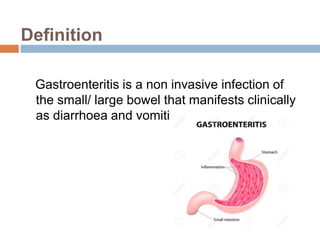
Gastroenteritis is a non invasive infection of
the small/ large bowel that manifests clinically
as diarrhoea and vomiting
Epidemiology
 In 2015, nearly 2 billion cases of
gastroenteritis observed in world. Among them
nearly 1.3 million deaths occur due to
gastroenteritis
 Among 1.3 million deaths of gastroenteritis,
80% of total deaths were in India
Types
 Escherichia coli infection – This is a common
problem for travellers to countries with poor
sanitation. Infection is caused by drinking
contaminated water or eating contaminated raw
fruits and vegetables
 Campylobacter infection – This is caused due to
bacteria which are found in animal faeces (poo)
and uncooked meat, particularly poultry. Infection
is caused by, for example, consuming
contaminated food or water, eating undercooked
meat (especially chicken), and not washing your
hands after handling infected animals
 Cryptosporidium infection – This is caused by
parasites which are found in the bowels of
humans and animals. Infection is caused by, for
example, swimming in a contaminated pool and
accidentally swallowing water, or through contact
with infected animals. An infected person may
spread the parasites to food or surfaces if they
don’t wash their hands after going to the toilet
 Giardiasis – This is caused by parasites
transmitted by drinking contaminated water,
handling infected animals or changing the nappy
of an infected baby and not washing your hands
afterwards.
 Salmonellosis – This infection is caused by bacteria,
which is found in animal faeces. Infection is caused by
eating contaminated food or handling infected
animals. An infected person may also spread the
bacteria to other people or surfaces by not washing
their hands properly
 Shigellosis – It is caused by bacteria, found in human
faeces. An infected person may spread the bacteria to
food or surfaces if they don’t wash their hands after
going to the toilet
 Viral gastroenteritis – This infection is caused by
virus, through person-to-person contact such as
touching contaminated hands, faeces or vomit, or by
drinking contaminated water or food.
Risk factors
 Infants, Children
 Elders
 Immunocomprimised patients
 Travallers
 Poor hygiene
 Improperly stored and cooked food
 Non Vegetarians
 Persons who take raw food
 Swimming
Etiology
 Bacillus cereus
 Campylobacer
 Clostridium perfringes
 Clostridium difficile
 Clostridium botulicum
 E. coli
 Salmonella enterica
 Shigella
 Staphylococcus aureus
 Vibrio cholera
 Giardia
 Cryptospordium
 Entmeba histolytica
Virus
Bacteria Protozoa
Pathogenesis
Bacteria, Virus , Protozoa
↓
Food/ Water/ Air
↓
Enter in to GIT
↓
Release
Conti…….
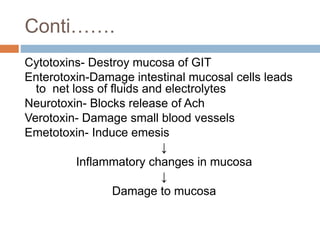
Cytotoxins- Destroy mucosa of GIT
Enterotoxin-Damage intestinal mucosal cells leads
to net loss of fluids and electrolytes
Neurotoxin- Blocks release of Ach
Verotoxin- Damage small blood vessels
Emetotoxin- Induce emesis
↓
Inflammatory changes in mucosa
↓
Damage to mucosa
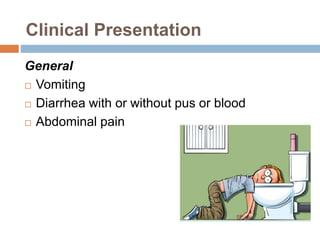
Clinical Presentation
General
 Vomiting
 Diarrhea with or without pus or blood
 Abdominal pain
Typhoid
 Head ache
 Malaise
 Abdominal distension
 Fever
 Diarrhoea
 Rose spots on trunk
 Haemorrhage and perforation of GIT
Botulism
 Diplopia
 Dysphagia
 Symmetrical descending motor paralysis
Complications
 Dehydration
 Electrolyte imbalance
 Kidney failure
 Sepsis
 Inflammatory bowel syndrome
 Ulcerative colitis
 Reactive arthritis
 Haemolytic uremic syndrome (Anemia+
Thrombocytopenia+ Renal Failure)
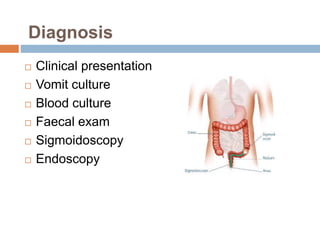
Diagnosis
 Clinical presentation
 Vomit culture
 Blood culture
 Faecal exam
 Sigmoidoscopy
 Endoscopy
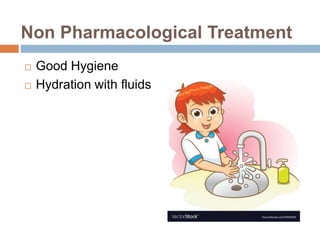
Non Pharmacological Treatment
 Good Hygiene
 Hydration with fluids
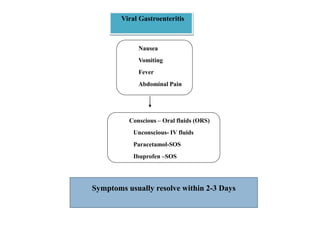
Viral Gastroenteritis
Nausea
Vomiting
Fever
Abdominal Pain
Conscious – Oral fluids (ORS)
Unconscious- IV fluids
Paracetamol-SOS
Ibuprofen –SOS
Symptoms usually resolve within 2-3 Days
Bacterial Gastroenteritis
Nausea
Vomiting
Fever
Abdominal Pain
Diarrhea with or
without blood
Conscious – Oral fluids (ORS)
Unconscious- IV fluids
Paracetamol-SOS
Ibuprofen –SOS
Faecal Exam
Stool culture
Consider antibiotics
Drug Category Mode of action Dose Adverse effects
Ciprofloxacin Fluroquinolone Inhibit DNA synthesis
in bacteria
500mg-BD
7-10 days
(Enteric fever)
 GI disturbances
 Changes in LFT and RFT
 Rashes
 Restlessness
Azithromycin Macrolide Inhibit protein synthesis
in bacteria
500mg-OD
3 days
 GI disturbances
 Vaginitis
 Dyspepsia
 Malaise
 Flatulence
Trimethoprim Sulphanamide Inhibit folic acid synthesis
in bacteria 100mg-BD
 Fever
 Pruritis
 Phototoxic skin eruptions
 Changes in RFT and LFT
Rifaximine Miscellaneous
antibiotic
Inhibit DNA synthesis
in bacteria
200mg-TID
for 3 days
 Flatulence
 Headache
 Defecation urgency
 Abdominal pain
 Rectal tenesmus
Cotrimoxazole
(Trimethoprim+
Sulphamethoxazole)
Sulphanamide Inhibit folic acid synthesis
in bacteria
80+400mg
or
160+800mg
for 5 days
 Anorexia
 Vertigo
 Hyperkelemia
 Hyponatremia
 peripheral neuritis
 Steven Johnson syndrome
Drugs used in treatment of
Gastroenteritis
Chloramphenicol Miscellaneous
antibiotic
Inhibit protein synthesis
in bacteria
50mg/kg/day-
QID for 14 days
(Enteric fever)
 Head ache
 Enterocolitis
 Bone marrow suppression
 Peripheral Neuropathy
 Gray baby syndrome
Tetracycline Tetracycline Inhibit protein synthesis
in bacteria
250mg-QID  GI disturbances
 Discoluration of teeth
 photosensitivity
 Hepatotoxicity
 Bone marrow supression
Doxycycline Tetracycline Inhibit protein synthesis
in bacteria
100mg-OD  Anorexia
 Teeth discoloration
 GI disturbances
 Hepatotoxicity
 Bone marrow supression
Vancomycin Glycopeptide
antibiotic
Inhibit cell wall
synthesis in bacteria
125mg-QID for 10 days  Vomiting
 Diarrhea
 Pyrexia
 UTI
 Peripheral edema
Metronidazole Miscellaneous
antibiotic
Inhibit DNA synthesis in
bacteria
800mg-TID
for 5 days
 Anorexia
 GI disturbances
 Candidiasis
 Dark urine
 Furry tongue
Resources
 https://www.sciencedirect.com/science/article/pii/S
1876034119300681
 https://www.sciencedirect.com/science/article/pii/S
2214109X19302074
 https://www.sciencedirect.com/science/article/pii/S
0264410X17312306
 https://www.sciencedirect.com/science/article/pii/S
0264410X17315955
 https://www.sciencedirect.com/science/article/pii/S
0264410X19309272

GASTROENTERITIS

  • 1.
    GASTROINTESTINAL INFECTIONS V. S.Swathi Assistant Professor VIPT, Duvvada
  • 2.
    Definition Gastroenteritis is anon invasive infection of the small/ large bowel that manifests clinically as diarrhoea and vomiting
  • 3.
    Epidemiology  In 2015,nearly 2 billion cases of gastroenteritis observed in world. Among them nearly 1.3 million deaths occur due to gastroenteritis  Among 1.3 million deaths of gastroenteritis, 80% of total deaths were in India
  • 4.
    Types  Escherichia coliinfection – This is a common problem for travellers to countries with poor sanitation. Infection is caused by drinking contaminated water or eating contaminated raw fruits and vegetables  Campylobacter infection – This is caused due to bacteria which are found in animal faeces (poo) and uncooked meat, particularly poultry. Infection is caused by, for example, consuming contaminated food or water, eating undercooked meat (especially chicken), and not washing your hands after handling infected animals
  • 5.
     Cryptosporidium infection– This is caused by parasites which are found in the bowels of humans and animals. Infection is caused by, for example, swimming in a contaminated pool and accidentally swallowing water, or through contact with infected animals. An infected person may spread the parasites to food or surfaces if they don’t wash their hands after going to the toilet  Giardiasis – This is caused by parasites transmitted by drinking contaminated water, handling infected animals or changing the nappy of an infected baby and not washing your hands afterwards.
  • 6.
     Salmonellosis –This infection is caused by bacteria, which is found in animal faeces. Infection is caused by eating contaminated food or handling infected animals. An infected person may also spread the bacteria to other people or surfaces by not washing their hands properly  Shigellosis – It is caused by bacteria, found in human faeces. An infected person may spread the bacteria to food or surfaces if they don’t wash their hands after going to the toilet  Viral gastroenteritis – This infection is caused by virus, through person-to-person contact such as touching contaminated hands, faeces or vomit, or by drinking contaminated water or food.
  • 7.
    Risk factors  Infants,Children  Elders  Immunocomprimised patients  Travallers  Poor hygiene  Improperly stored and cooked food  Non Vegetarians  Persons who take raw food  Swimming
  • 8.
    Etiology  Bacillus cereus Campylobacer  Clostridium perfringes  Clostridium difficile  Clostridium botulicum  E. coli  Salmonella enterica  Shigella  Staphylococcus aureus  Vibrio cholera  Giardia  Cryptospordium  Entmeba histolytica Virus Bacteria Protozoa
  • 9.
    Pathogenesis Bacteria, Virus ,Protozoa ↓ Food/ Water/ Air ↓ Enter in to GIT ↓ Release
  • 10.
    Conti……. Cytotoxins- Destroy mucosaof GIT Enterotoxin-Damage intestinal mucosal cells leads to net loss of fluids and electrolytes Neurotoxin- Blocks release of Ach Verotoxin- Damage small blood vessels Emetotoxin- Induce emesis ↓ Inflammatory changes in mucosa ↓ Damage to mucosa
  • 11.
    Clinical Presentation General  Vomiting Diarrhea with or without pus or blood  Abdominal pain
  • 12.
    Typhoid  Head ache Malaise  Abdominal distension  Fever  Diarrhoea  Rose spots on trunk  Haemorrhage and perforation of GIT
  • 13.
    Botulism  Diplopia  Dysphagia Symmetrical descending motor paralysis
  • 14.
    Complications  Dehydration  Electrolyteimbalance  Kidney failure  Sepsis  Inflammatory bowel syndrome  Ulcerative colitis  Reactive arthritis  Haemolytic uremic syndrome (Anemia+ Thrombocytopenia+ Renal Failure)
  • 15.
    Diagnosis  Clinical presentation Vomit culture  Blood culture  Faecal exam  Sigmoidoscopy  Endoscopy
  • 16.
    Non Pharmacological Treatment Good Hygiene  Hydration with fluids
  • 17.
    Viral Gastroenteritis Nausea Vomiting Fever Abdominal Pain Conscious– Oral fluids (ORS) Unconscious- IV fluids Paracetamol-SOS Ibuprofen –SOS Symptoms usually resolve within 2-3 Days
  • 18.
    Bacterial Gastroenteritis Nausea Vomiting Fever Abdominal Pain Diarrheawith or without blood Conscious – Oral fluids (ORS) Unconscious- IV fluids Paracetamol-SOS Ibuprofen –SOS Faecal Exam Stool culture Consider antibiotics
  • 19.
    Drug Category Modeof action Dose Adverse effects Ciprofloxacin Fluroquinolone Inhibit DNA synthesis in bacteria 500mg-BD 7-10 days (Enteric fever)  GI disturbances  Changes in LFT and RFT  Rashes  Restlessness Azithromycin Macrolide Inhibit protein synthesis in bacteria 500mg-OD 3 days  GI disturbances  Vaginitis  Dyspepsia  Malaise  Flatulence Trimethoprim Sulphanamide Inhibit folic acid synthesis in bacteria 100mg-BD  Fever  Pruritis  Phototoxic skin eruptions  Changes in RFT and LFT Rifaximine Miscellaneous antibiotic Inhibit DNA synthesis in bacteria 200mg-TID for 3 days  Flatulence  Headache  Defecation urgency  Abdominal pain  Rectal tenesmus Cotrimoxazole (Trimethoprim+ Sulphamethoxazole) Sulphanamide Inhibit folic acid synthesis in bacteria 80+400mg or 160+800mg for 5 days  Anorexia  Vertigo  Hyperkelemia  Hyponatremia  peripheral neuritis  Steven Johnson syndrome Drugs used in treatment of Gastroenteritis
  • 20.
    Chloramphenicol Miscellaneous antibiotic Inhibit proteinsynthesis in bacteria 50mg/kg/day- QID for 14 days (Enteric fever)  Head ache  Enterocolitis  Bone marrow suppression  Peripheral Neuropathy  Gray baby syndrome Tetracycline Tetracycline Inhibit protein synthesis in bacteria 250mg-QID  GI disturbances  Discoluration of teeth  photosensitivity  Hepatotoxicity  Bone marrow supression Doxycycline Tetracycline Inhibit protein synthesis in bacteria 100mg-OD  Anorexia  Teeth discoloration  GI disturbances  Hepatotoxicity  Bone marrow supression Vancomycin Glycopeptide antibiotic Inhibit cell wall synthesis in bacteria 125mg-QID for 10 days  Vomiting  Diarrhea  Pyrexia  UTI  Peripheral edema Metronidazole Miscellaneous antibiotic Inhibit DNA synthesis in bacteria 800mg-TID for 5 days  Anorexia  GI disturbances  Candidiasis  Dark urine  Furry tongue
  • 21.
    Resources  https://www.sciencedirect.com/science/article/pii/S 1876034119300681  https://www.sciencedirect.com/science/article/pii/S 2214109X19302074 https://www.sciencedirect.com/science/article/pii/S 0264410X17312306  https://www.sciencedirect.com/science/article/pii/S 0264410X17315955  https://www.sciencedirect.com/science/article/pii/S 0264410X19309272