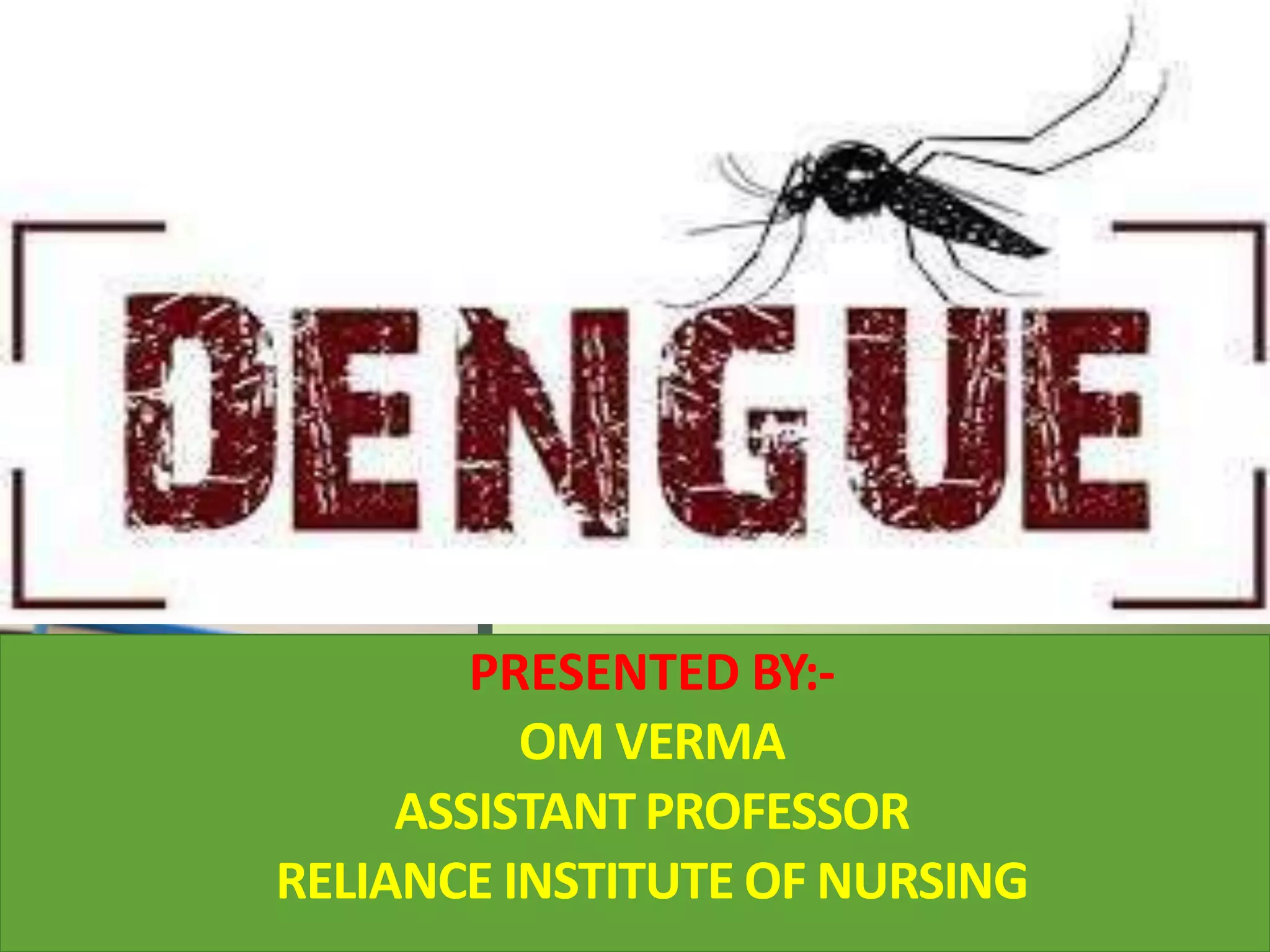
PRESENTED BY:-
OM VERMA
ASSISTANT PROFESSOR
RELIANCE INSTITUTE OF NURSING
INTRODUCTION
Dengue fever is a
painful debilitating
mosquito born
disease caused by
any one of four
closely related
dengue virus
DEFINITION
Dengue fever is transmitted by the bite of an
Aedes mosquito infected with a dengue
virus. The mosquito becomes infected when
it bites a person with dengue virus in
their blood. It can’t be spread directly from
one person to another person.
DEFINITION
• Dengue fever is also known as breakbone fever
is a mosquito born tropical disease caused by
the mosquito bite.
• The alternative name for dengue, "breakbone
fever", comes from the associated muscle and
joint pains.
• It is caused by the female aedes aegypti
mosquito bite, which transmit the dengue virus
to human.
INCIDENCE
Each year an estimated 100 millions
cases of dengue occur world wide.
• The global incidence of dengue has
grown dramatically in recent decades.
• In INDIA the cases has increase sharply
over past five years there have been
38,000 so far in 2013.
Tropical regions are :-
 Indian sub continent
 Mexico
 Africa
 Southern China
PHASES
Febrile Phase x 7days
High fever 40 °C (104 °F)
headache
generalized arthalgia
myalgia
petechiae
bleeding from mucus membrane.
A rash occurs in 50–80%
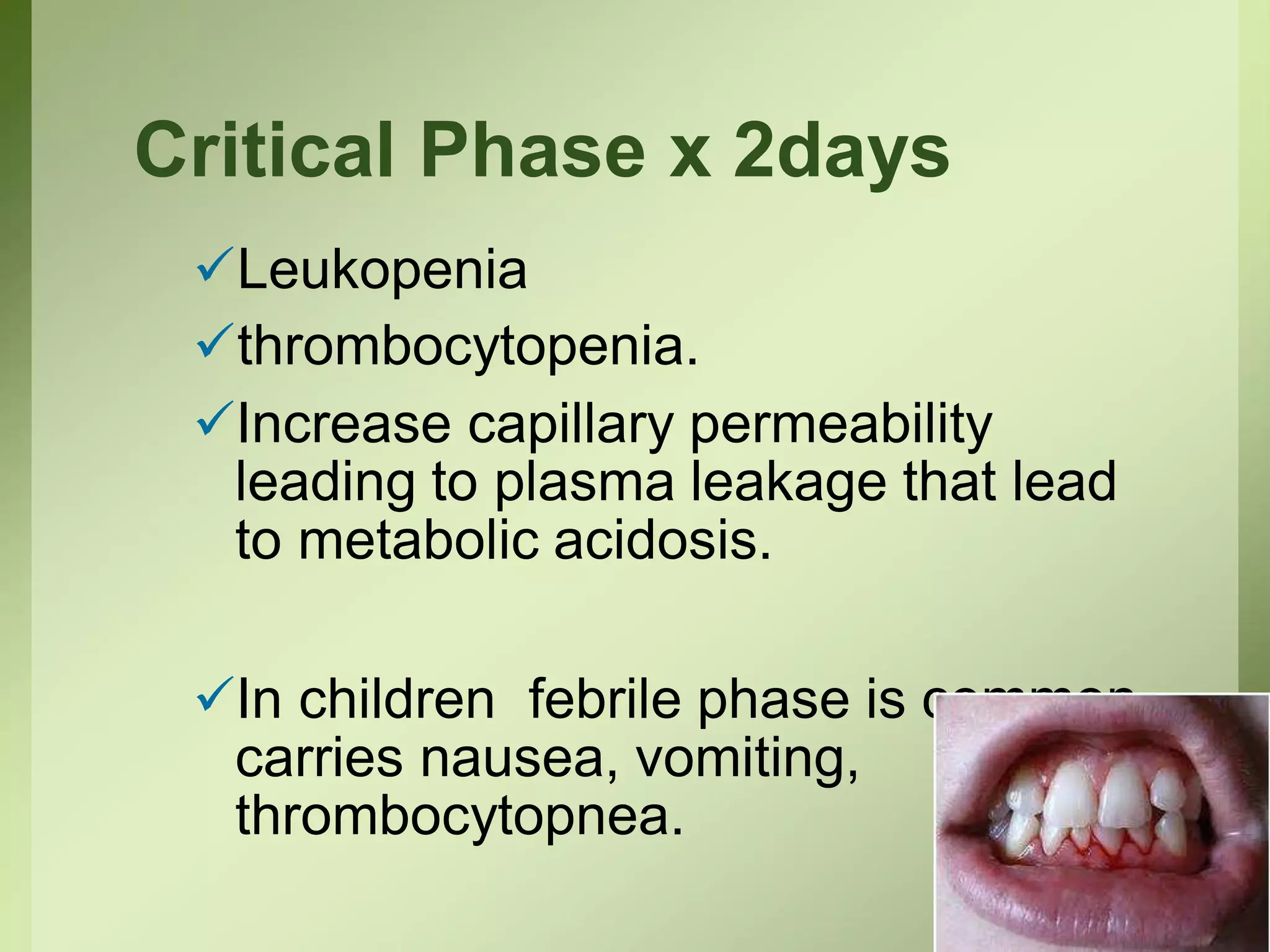
Critical Phase x 2days
Leukopenia
thrombocytopenia.
Increase capillary permeability
leading to plasma leakage that lead
to metabolic acidosis.
In children febrile phase is common
carries nausea, vomiting,
thrombocytopnea.
Recovery phase x 2-3 days
Stabilize hemodynamic status
increase urine output
overall clinical improvement.
Increase in fluid overload can cause
cerebral edema.
SIGN & SYMPTOMS
• Fever ( more than 105 )
• Headache
• Muscle, joint pain
• skin rash ( appear 4-5 days after fever )
• Pain behind eyes
• Nausea
• Vomiting
• Mild bleeding
WARNING SIGNS
• Severe abdominal pain
• Persistent vomiting
• Vomit with blood
• Drowsiness or irritability
• Dyspnoea
• Swollen lymph node
• Prostration
• diarrhea
Dengue with warning signs
• Probable dengue plus one of:
• Abdominal pain or tenderness
• Persistent vomiting
• Signs of fluid accumulation, e.g. pleural effusion or
• ascites
• Mucosal bleed
• Lethargy
• Hepatomegaly > 2 cm
• Rapid increase in haematocrit with fall in platelet
• count
• Needs medical intervention, e.g. intravenous fluid
• Severe dengue
• • Severe plasma leakage leading to:
• Shock (dengue shock syndrome)
• Fluid accumulation with respiratory distress
• • Severe haemorrhagic manifestations, e.g. GI
• haemorrhage
• • Severe organ involvement:
• Liver AST or ALT ≥ 1000U/L
• CNS: impaired consciousness
• Cardiomyopathy
• Other organs, e.g. renal impairment
• Needs emergency medical treatment and specialist care with
DIAGNOSTIC
TEST
WHO-proposed clinical
definition of dengue
PROBABLE DENGUE
• • Exposure in an endemic area
• • Fever
Two of:
• Nausea/vomiting
• Rash
• Aches/pains
• Positive tourniquet test
• Leucopenia
• Any warning sign
• Laboratory confirmation important
• Needs regular medical observation and
instruction in the
warning signs
• If there are no warning signs,
need for hospitalisation is
• influenced by age,
comorbidities, pregnancy and
social factors
LABORATORY FEATURES
• include leucopenia, neutropenia, thrombocytopenia
• elevated alanine aminotransferase (ALT) or
aspartate aminotransferase (AST)
• serology or detection of dengue viral material in
blood by RT-PCR
• Dengue-specific IgG and IgM ELISA { positive for IgM
antibodies on or after day 5 of the fever}
IgM ELISA has a sensitivity of 83.9–98.4% and
a specificity of 100%
Dengue 2 virus enhancement in asthmatic
and non asthmatic individual.Guzman MG,
Kouri G, Soler M, Bravo J, Rodríguez de
La Vega A, Vazquez S, Mune M
• Extravasation of fluid due to vascular leakage can be
detected radiologically (chest radiography for pleural
effusions, echocardiography for pericardial effusions,
ultrasonography for ascites).
[Dengue haemorrhagic fever in children:
ten years of clinical experience].Méndez A,
González G
Biomedica. 2003 Jun; 23(2):180-93.
MANAGEMENT
• Bleeding prevention & control.
• Fluid & water replacement.
• Symptoms relief & fever control.
NURSING MANAGEMENT
• Increased body temperature related to infection as evidence
by vital sign monitoring.
• Hypovolemic shock related to hemorrhage.
• Fluid volume deficit related to migration of intravascular fluid
into extravascular fluid.
• Impaired nutrition less than body requirement related to
decreased appetite.
PROGNOSIS
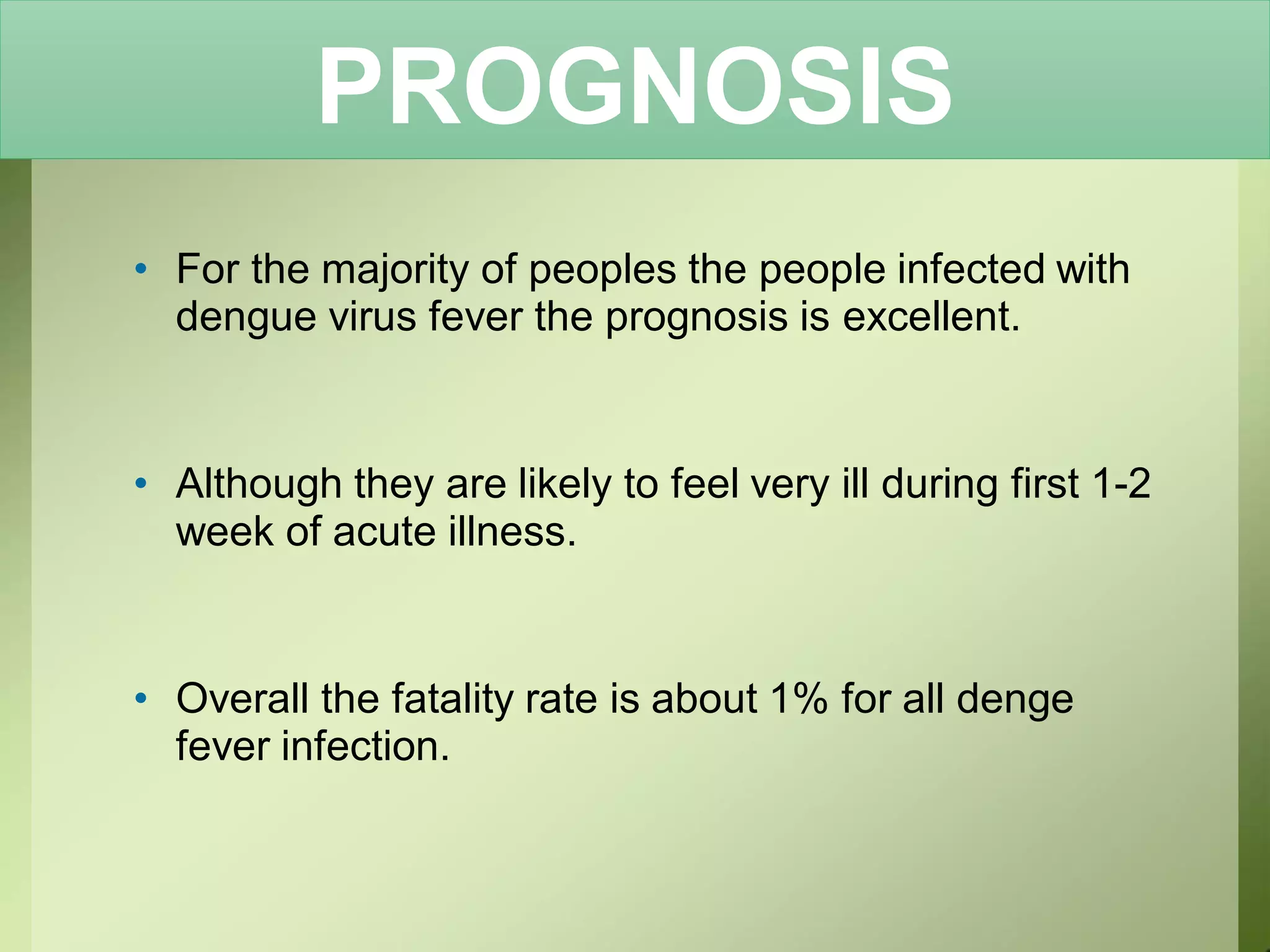
• For the majority of peoples the people infected with
dengue virus fever the prognosis is excellent.
• Although they are likely to feel very ill during first 1-2
week of acute illness.
• Overall the fatality rate is about 1% for all denge
fever infection.
COMPLICATION
• A small percentage of individual who have dengue fever can develop
a more serious form of disease.
• Dengue haemorrhagic fever and disseminated intravascular
• coagulation
• Dengue shock syndrome
• Hepatitis, cerebral haemorrhage or oedema, encephalitis,
• cranial nerve palsies, rhabdomyolysis, myocarditis
• Vertical transmission if infection within 5 wks of delivery
Dengue
Dengue

Dengue

  • 1.
    PRESENTED BY:- OM VERMA ASSISTANTPROFESSOR RELIANCE INSTITUTE OF NURSING
  • 2.
    INTRODUCTION Dengue fever isa painful debilitating mosquito born disease caused by any one of four closely related dengue virus
  • 3.
    DEFINITION Dengue fever istransmitted by the bite of an Aedes mosquito infected with a dengue virus. The mosquito becomes infected when it bites a person with dengue virus in their blood. It can’t be spread directly from one person to another person.
  • 4.
    DEFINITION • Dengue feveris also known as breakbone fever is a mosquito born tropical disease caused by the mosquito bite. • The alternative name for dengue, "breakbone fever", comes from the associated muscle and joint pains. • It is caused by the female aedes aegypti mosquito bite, which transmit the dengue virus to human.
  • 5.
    INCIDENCE Each year anestimated 100 millions cases of dengue occur world wide. • The global incidence of dengue has grown dramatically in recent decades. • In INDIA the cases has increase sharply over past five years there have been 38,000 so far in 2013.
  • 6.
    Tropical regions are:-  Indian sub continent  Mexico  Africa  Southern China
  • 9.
  • 10.
    Febrile Phase x7days High fever 40 °C (104 °F) headache generalized arthalgia myalgia petechiae bleeding from mucus membrane. A rash occurs in 50–80%
  • 11.
    Critical Phase x2days Leukopenia thrombocytopenia. Increase capillary permeability leading to plasma leakage that lead to metabolic acidosis. In children febrile phase is common carries nausea, vomiting, thrombocytopnea.
  • 12.
    Recovery phase x2-3 days Stabilize hemodynamic status increase urine output overall clinical improvement. Increase in fluid overload can cause cerebral edema.
  • 14.
    SIGN & SYMPTOMS •Fever ( more than 105 ) • Headache • Muscle, joint pain • skin rash ( appear 4-5 days after fever ) • Pain behind eyes • Nausea • Vomiting • Mild bleeding
  • 16.
    WARNING SIGNS • Severeabdominal pain • Persistent vomiting • Vomit with blood • Drowsiness or irritability • Dyspnoea • Swollen lymph node • Prostration • diarrhea
  • 17.
    Dengue with warningsigns • Probable dengue plus one of: • Abdominal pain or tenderness • Persistent vomiting • Signs of fluid accumulation, e.g. pleural effusion or • ascites • Mucosal bleed • Lethargy • Hepatomegaly > 2 cm • Rapid increase in haematocrit with fall in platelet • count • Needs medical intervention, e.g. intravenous fluid
  • 18.
    • Severe dengue •• Severe plasma leakage leading to: • Shock (dengue shock syndrome) • Fluid accumulation with respiratory distress • • Severe haemorrhagic manifestations, e.g. GI • haemorrhage • • Severe organ involvement: • Liver AST or ALT ≥ 1000U/L • CNS: impaired consciousness • Cardiomyopathy • Other organs, e.g. renal impairment • Needs emergency medical treatment and specialist care with
  • 22.
  • 23.
    WHO-proposed clinical definition ofdengue PROBABLE DENGUE • • Exposure in an endemic area • • Fever Two of: • Nausea/vomiting • Rash • Aches/pains • Positive tourniquet test • Leucopenia • Any warning sign • Laboratory confirmation important • Needs regular medical observation and instruction in the warning signs • If there are no warning signs, need for hospitalisation is • influenced by age, comorbidities, pregnancy and social factors
  • 25.
    LABORATORY FEATURES • includeleucopenia, neutropenia, thrombocytopenia • elevated alanine aminotransferase (ALT) or aspartate aminotransferase (AST) • serology or detection of dengue viral material in blood by RT-PCR
  • 26.
    • Dengue-specific IgGand IgM ELISA { positive for IgM antibodies on or after day 5 of the fever} IgM ELISA has a sensitivity of 83.9–98.4% and a specificity of 100% Dengue 2 virus enhancement in asthmatic and non asthmatic individual.Guzman MG, Kouri G, Soler M, Bravo J, Rodríguez de La Vega A, Vazquez S, Mune M
  • 27.
    • Extravasation offluid due to vascular leakage can be detected radiologically (chest radiography for pleural effusions, echocardiography for pericardial effusions, ultrasonography for ascites). [Dengue haemorrhagic fever in children: ten years of clinical experience].Méndez A, González G Biomedica. 2003 Jun; 23(2):180-93.
  • 30.
    MANAGEMENT • Bleeding prevention& control. • Fluid & water replacement. • Symptoms relief & fever control.
  • 40.
    NURSING MANAGEMENT • Increasedbody temperature related to infection as evidence by vital sign monitoring. • Hypovolemic shock related to hemorrhage. • Fluid volume deficit related to migration of intravascular fluid into extravascular fluid. • Impaired nutrition less than body requirement related to decreased appetite.
  • 42.
    PROGNOSIS • For themajority of peoples the people infected with dengue virus fever the prognosis is excellent. • Although they are likely to feel very ill during first 1-2 week of acute illness. • Overall the fatality rate is about 1% for all denge fever infection.
  • 43.
    COMPLICATION • A smallpercentage of individual who have dengue fever can develop a more serious form of disease. • Dengue haemorrhagic fever and disseminated intravascular • coagulation • Dengue shock syndrome • Hepatitis, cerebral haemorrhage or oedema, encephalitis, • cranial nerve palsies, rhabdomyolysis, myocarditis • Vertical transmission if infection within 5 wks of delivery