CH 10 CHEMICAL REACTIONS
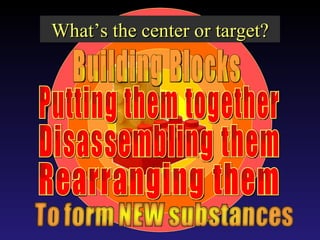
What’s the center or target? Building Blocks Putting them together Rearranging them Disassembling them
Chemical Reactions
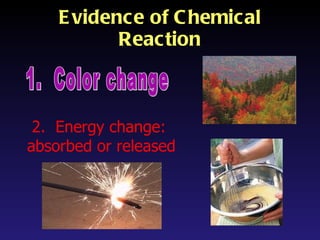
Evidence of Chemical Reaction 1.  Color change 2.  Energy change:  absorbed or released
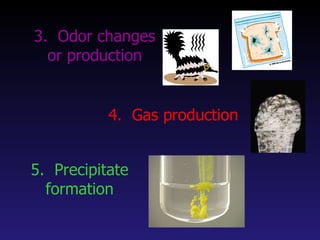
3.  Odor changes or production 4.  Gas production 5.  Precipitate formation
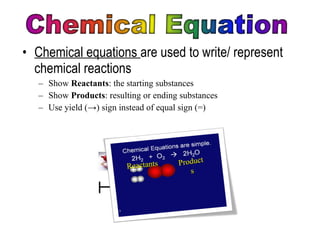
Chemical equations  are used to write/ represent  chemical reactions Show  Reactants : the starting substances  Show  Products : resulting or ending substances Use yield ( ->)  sign instead of equal sign (=) Reactants Products
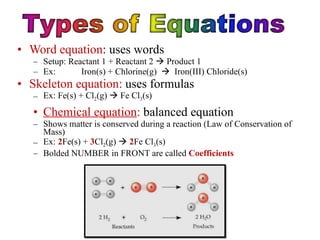
Word equation : uses words Setup: Reactant 1 + Reactant 2    Product 1 Ex:  Iron(s) + Chlorine(g)     Iron(III) Chloride(s) Skeleton equation:  uses formulas Ex: Fe(s) + Cl 2 (g)    Fe Cl 3 (s) Chemical equation :  balanced equation Shows matter is conserved during a reaction (Law of Conservation of Mass) Ex:  2 Fe(s) +  3 Cl 2 (g)     2 Fe Cl 3 (s) Bolded NUMBER in FRONT are called   Coefficients
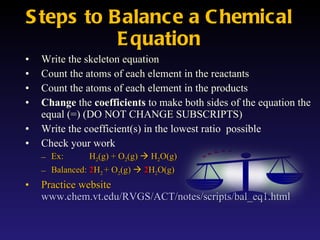
Write the skeleton equation Count the atoms of each element in the reactants Count the atoms of each element in the products Change  the  coefficients  to make both sides of the equation the equal (=) (DO NOT CHANGE SUBSCRIPTS) Write the coefficient(s) in the lowest ratio  possible Check your work Ex: H 2 (g) + O 2 (g)    H 2 O(g)  Balanced:  2 H 2  + O 2 (g)     2 H 2 O(g)  Practice website  www.chem.vt.edu/RVGS/ACT/notes/scripts/bal_eq1.html   Steps to Balance a Chemical Equation
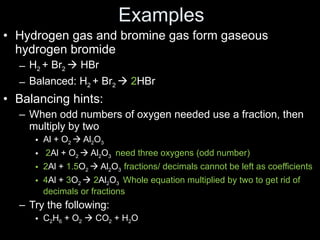
Examples Hydrogen gas and bromine gas form gaseous hydrogen bromide H 2  + Br 2    HBr Balanced: H 2  + Br 2     2 HBr Balancing hints: When odd numbers of oxygen needed use a fraction, then multiply by two Al + O 2    Al 2 O 3 2 Al + O 2    Al 2 O 3  need three oxygens (odd number) 2 Al +  1.5 O 2    Al 2 O 3  fractions/ decimals cannot be left as coefficients 4 Al +  3 O 2     2 Al 2 O 3  Whole equation multiplied by two to get rid of decimals or fractions Try the following: C 2 H 6  + O 2     CO 2  + H 2 O
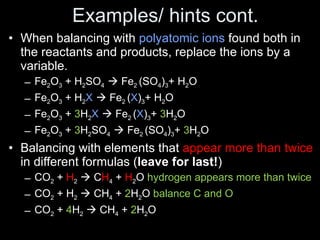
Examples/ hints cont. When balancing with  polyatomic ions  found both in the reactants and products, replace the ions by a variable. Fe 2 O 3  + H 2 SO 4    Fe 2  (SO 4 ) 3 + H 2 O Fe 2 O 3  + H 2 X     Fe 2  ( X ) 3 + H 2 O Fe 2 O 3  +  3 H 2 X     Fe 2  ( X ) 3 +  3 H 2 O Fe 2 O 3  +  3 H 2 SO 4    Fe 2  (SO 4 ) 3 +  3 H 2 O Balancing with elements that  appear more than twice  in different formulas ( leave for last! ) CO 2  +  H 2     C H 4  +  H 2 O  hydrogen appears more than twice CO 2  + H 2     CH 4  +  2 H 2 O  balance C and O CO 2  +  4 H 2     CH 4  +  2 H 2 O
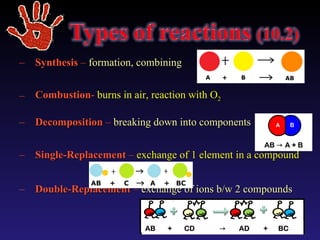
Synthesis  –  formation, combining Combustion -  burns in air, reaction with O 2 Decomposition  –  breaking down into components Single-Replacement  –  exchange of 1 element in a compound Double-Replacement  –  exchange of ions b/w 2 compounds AB  ->  A + B AB  +  CD  ->  AD  +  BC
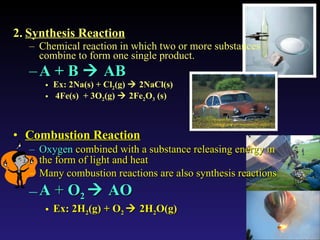
Synthesis Reaction Chemical reaction in which two or more substances combine to form one single product.  A + B    AB Ex: 2Na(s) + Cl 2 (g)    2NaCl(s) 4Fe(s)  + 3O 2 (g)    2Fe 2 O 3  (s)  Combustion Reaction Oxygen  combined with a substance releasing energy in the form of light and heat  Many combustion reactions are also synthesis reactions A  +  O 2    AO Ex: 2H 2 (g) + O 2    2H 2 O(g)
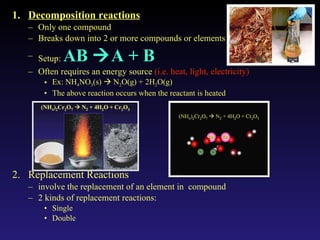
Decomposition reactions Only one compound Breaks down into 2 or more compounds or elements Setup:  AB   A + B Often requires an energy source  (i.e. heat, light, electricity) Ex: NH 4 NO 3 (s)    N 2 O(g) + 2H 2 O(g) The above reaction occurs when the reactant is heated Replacement Reactions involve the replacement of an element in  compound 2 kinds of replacement reactions: Single  Double
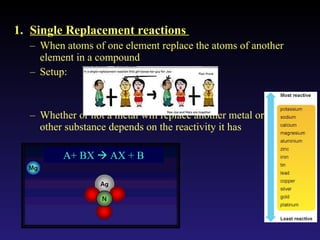
Single Replacement reactions  When atoms of one element replace the atoms of another element in a compound Setup:  Whether or not a metal will replace another metal or  any other substance depends on the reactivity it has A+ BX    AX + B
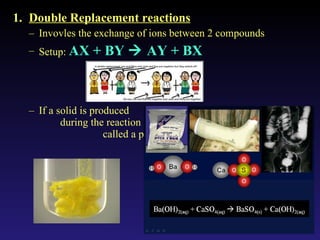
Double Replacement reactions Invovles the exchange of ions between 2 compounds Setup:  AX + BY    AY + BX If a solid is produced  during the reaction it is  called a precipitate
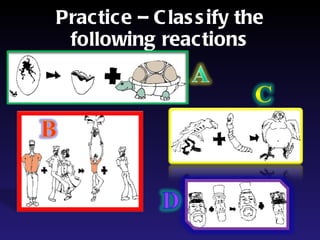
Practice – Classify the following reactions
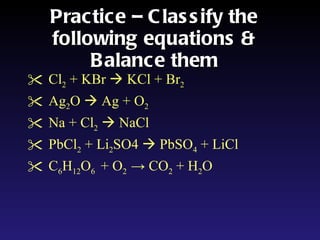
Practice – Classify the following equations & Balance them Cl 2  + KBr    KCl + Br 2   Ag 2 O    Ag + O 2 Na + Cl 2     NaCl PbCl 2  + Li 2 SO4    PbSO 4  + LiCl C 6 H 12 O 6  + O 2  -> C O 2  + H 2 O

Types reactions2012

  • 1.
    CH 10 CHEMICALREACTIONS
  • 2.
    What’s the centeror target? Building Blocks Putting them together Rearranging them Disassembling them
  • 3.
  • 4.
    Evidence of ChemicalReaction 1. Color change 2. Energy change: absorbed or released
  • 5.
    3. Odorchanges or production 4. Gas production 5. Precipitate formation
  • 6.
    Chemical equations are used to write/ represent chemical reactions Show Reactants : the starting substances Show Products : resulting or ending substances Use yield ( ->) sign instead of equal sign (=) Reactants Products
  • 7.
    Word equation :uses words Setup: Reactant 1 + Reactant 2  Product 1 Ex: Iron(s) + Chlorine(g)  Iron(III) Chloride(s) Skeleton equation: uses formulas Ex: Fe(s) + Cl 2 (g)  Fe Cl 3 (s) Chemical equation : balanced equation Shows matter is conserved during a reaction (Law of Conservation of Mass) Ex: 2 Fe(s) + 3 Cl 2 (g)  2 Fe Cl 3 (s) Bolded NUMBER in FRONT are called Coefficients
  • 8.
    Write the skeletonequation Count the atoms of each element in the reactants Count the atoms of each element in the products Change the coefficients to make both sides of the equation the equal (=) (DO NOT CHANGE SUBSCRIPTS) Write the coefficient(s) in the lowest ratio possible Check your work Ex: H 2 (g) + O 2 (g)  H 2 O(g) Balanced: 2 H 2 + O 2 (g)  2 H 2 O(g) Practice website www.chem.vt.edu/RVGS/ACT/notes/scripts/bal_eq1.html Steps to Balance a Chemical Equation
  • 9.
    Examples Hydrogen gasand bromine gas form gaseous hydrogen bromide H 2 + Br 2  HBr Balanced: H 2 + Br 2  2 HBr Balancing hints: When odd numbers of oxygen needed use a fraction, then multiply by two Al + O 2  Al 2 O 3 2 Al + O 2  Al 2 O 3 need three oxygens (odd number) 2 Al + 1.5 O 2  Al 2 O 3 fractions/ decimals cannot be left as coefficients 4 Al + 3 O 2  2 Al 2 O 3 Whole equation multiplied by two to get rid of decimals or fractions Try the following: C 2 H 6 + O 2  CO 2 + H 2 O
  • 10.
    Examples/ hints cont.When balancing with polyatomic ions found both in the reactants and products, replace the ions by a variable. Fe 2 O 3 + H 2 SO 4  Fe 2 (SO 4 ) 3 + H 2 O Fe 2 O 3 + H 2 X  Fe 2 ( X ) 3 + H 2 O Fe 2 O 3 + 3 H 2 X  Fe 2 ( X ) 3 + 3 H 2 O Fe 2 O 3 + 3 H 2 SO 4  Fe 2 (SO 4 ) 3 + 3 H 2 O Balancing with elements that appear more than twice in different formulas ( leave for last! ) CO 2 + H 2  C H 4 + H 2 O hydrogen appears more than twice CO 2 + H 2  CH 4 + 2 H 2 O balance C and O CO 2 + 4 H 2  CH 4 + 2 H 2 O
  • 11.
    Synthesis – formation, combining Combustion - burns in air, reaction with O 2 Decomposition – breaking down into components Single-Replacement – exchange of 1 element in a compound Double-Replacement – exchange of ions b/w 2 compounds AB -> A + B AB + CD -> AD + BC
  • 12.
    Synthesis Reaction Chemicalreaction in which two or more substances combine to form one single product. A + B  AB Ex: 2Na(s) + Cl 2 (g)  2NaCl(s) 4Fe(s) + 3O 2 (g)  2Fe 2 O 3 (s) Combustion Reaction Oxygen combined with a substance releasing energy in the form of light and heat Many combustion reactions are also synthesis reactions A + O 2  AO Ex: 2H 2 (g) + O 2  2H 2 O(g)
  • 13.
    Decomposition reactions Onlyone compound Breaks down into 2 or more compounds or elements Setup: AB  A + B Often requires an energy source (i.e. heat, light, electricity) Ex: NH 4 NO 3 (s)  N 2 O(g) + 2H 2 O(g) The above reaction occurs when the reactant is heated Replacement Reactions involve the replacement of an element in compound 2 kinds of replacement reactions: Single Double
  • 14.
    Single Replacement reactions When atoms of one element replace the atoms of another element in a compound Setup: Whether or not a metal will replace another metal or any other substance depends on the reactivity it has A+ BX  AX + B
  • 15.
    Double Replacement reactionsInvovles the exchange of ions between 2 compounds Setup: AX + BY  AY + BX If a solid is produced during the reaction it is called a precipitate
  • 16.
    Practice – Classifythe following reactions
  • 17.
    Practice – Classifythe following equations & Balance them Cl 2 + KBr  KCl + Br 2 Ag 2 O  Ag + O 2 Na + Cl 2  NaCl PbCl 2 + Li 2 SO4  PbSO 4 + LiCl C 6 H 12 O 6 + O 2 -> C O 2 + H 2 O

Editor's Notes

  • #13 Hot air balloons use large propane torches to heat the air in the balloon. Unfortunately, that much flame can cause a catastrophic fire (see bottom image). Fortunately, the 11 people in this balloon survived. All hydrocarbons (like propane) produce carbon dioxide and water as the combustion products. The unbalanced combustion reaction for propane is: C 3 H 8 + O 2 --> CO 2 + H 2 O
  • #14 DECOMPOSITION PICTURE Here's a fun decomposition reaction. The starting compound is ammonium dichromate. When heated, it begins to decompose into nitrogen gas, water vapor and powdered chromium (III) oxide. It looks like a volcano with ash being spread all over the place. This looks like the compound is burning, but looking at the chemical equation we see no oxygen is being consumed. So the flame it produces does not need oxygen. So you can't put out this kind of "fire" by smothering it like most fires. http://www.chemistryland.com/CHM130W/08-Equations/TypesReactions/TypesReactions.htm
  • #16 Here is a chemistry example that was shown in an earlier tutorial. This is also a double-replacement reaction. Here the barium atom swaps places with the calcium atom. When that happens, we make barium sulfate which is given to patients to drink, so x-rays can see the stomach and intestines. As a kid I had to drink it, and it tasted like chalk. It was bad. They could have at least sweetened it. (roll cursor over image to see the double-replacement animation) http://www.chemistryland.com/CHM130W/08-Equations/balancing/BalancingChemEq.htm
  • #17 Decomposition Single Rep Synthesis Double rep
  • #18 Cl 2 + 2KBr  KCl + Br 2 2Ag 2 O  4Ag + O 2 2Na + Cl 2  2NaCl PbCl 2 + Li 2 SO4  PbSO 4 + 2LiCl C 6 H 12 O 6 +6 O 2 -> 6C O 2 + 6H 2 O 1. Single 2. Decomposition 3. Synthesis 4. Double 5 Combustion