Chapter
 11
 (Chapter 8 in your books.)


       “Chemical Reactions”
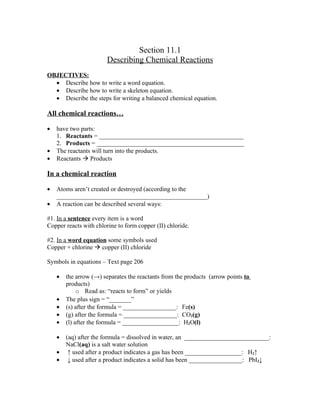
Section 11.1
                        Describing Chemical Reactions
OBJECTIVES:
  • Describe how to write a word equation.
  • Describe how to write a skeleton equation.
  • Describe the steps for writing a balanced chemical equation.

All chemical reactions…

•   have two parts:
    1. Reactants = ______________________________________________
    2. Products = _______________________________________________
•   The reactants will turn into the products.
•   Reactants  Products

In a chemical reaction

•   Atoms aren’t created or destroyed (according to the
    ________________________________________________)
•   A reaction can be described several ways:

#1. In a sentence every item is a word
Copper reacts with chlorine to form copper (II) chloride.

#2. In a word equation some symbols used
Copper + chlorine  copper (II) chloride

Symbols in equations – Text page 206

    •   the arrow (→) separates the reactants from the products (arrow points to
        products)
             o Read as: “reacts to form” or yields
    •   The plus sign = “_______”
    •   (s) after the formula = _________________: Fe(s)
    •   (g) after the formula = _________________: CO2(g)
    •   (l) after the formula = __________________: H2O(l)

    •   (aq) after the formula = dissolved in water, an ___________________________:
        NaCl(aq) is a salt water solution
    •    ↑ used after a product indicates a gas has been __________________: H2↑
    •    ↓ used after a product indicates a solid has been _________________: PbI2↓
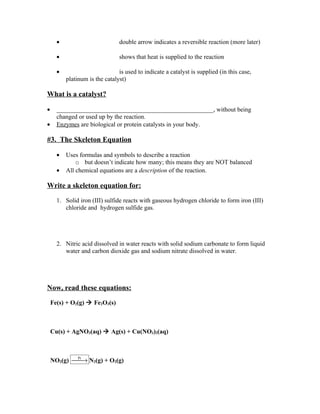
•                         double arrow indicates a reversible reaction (more later)

      •                         shows that heat is supplied to the reaction

      •                         is used to indicate a catalyst is supplied (in this case,
          platinum is the catalyst)

What is a catalyst?

•     __________________________________________________, without being
      changed or used up by the reaction.
•     Enzymes are biological or protein catalysts in your body.

#3. The Skeleton Equation

      •   Uses formulas and symbols to describe a reaction
              o but doesn’t indicate how many; this means they are NOT balanced
      •   All chemical equations are a description of the reaction.

Write a skeleton equation for:

      1. Solid iron (III) sulfide reacts with gaseous hydrogen chloride to form iron (III)
         chloride and hydrogen sulfide gas.


      2. Nitric acid dissolved in water reacts with solid sodium carbonate to form liquid
         water and carbon dioxide gas and sodium nitrate dissolved in water.


Now, read these equations:

    Fe(s) + O2(g)  Fe2O3(s)


    Cu(s) + AgNO3(aq)  Ag(s) + Cu(NO3)2(aq)


    NO2(g) Pt N2(g) + O2(g)
            →
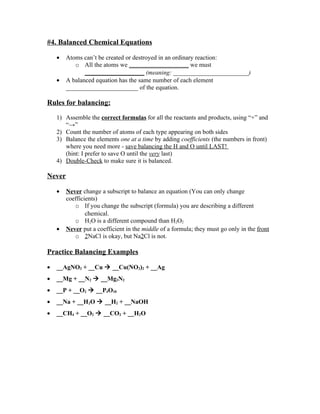
#4. Balanced Chemical Equations

    •   Atoms can’t be created or destroyed in an ordinary reaction:
           o All the atoms we ___________________ we must
               ___________________ (meaning: ________________________)
    •   A balanced equation has the same number of each element
        _______________________ of the equation.

Rules for balancing:

    1) Assemble the correct formulas for all the reactants and products, using “+” and
       “→”
    2) Count the number of atoms of each type appearing on both sides
    3) Balance the elements one at a time by adding coefficients (the numbers in front)
       where you need more - save balancing the H and O until LAST!
       (hint: I prefer to save O until the very last)
    4) Double-Check to make sure it is balanced.

Never

    •   Never change a subscript to balance an equation (You can only change
        coefficients)
           o If you change the subscript (formula) you are describing a different
                chemical.
           o H2O is a different compound than H2O2
    •   Never put a coefficient in the middle of a formula; they must go only in the front
           o 2NaCl is okay, but Na2Cl is not.

Practice Balancing Examples

•   __AgNO3 + __Cu  __Cu(NO3)2 + __Ag
•   __Mg + __N2  __Mg3N2
•   __P + __O2  __P4O10
•   __Na + __H2O  __H2 + __NaOH
•   __CH4 + __O2  __CO2 + __H2O
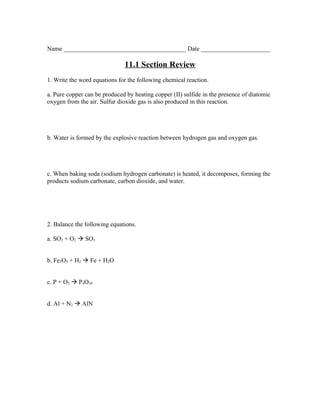
Name _______________________________________ Date ______________________

                              11.1 Section Review
1. Write the word equations for the following chemical reaction.

a. Pure copper can be produced by heating copper (II) sulfide in the presence of diatomic
oxygen from the air. Sulfur dioxide gas is also produced in this reaction.


b. Water is formed by the explosive reaction between hydrogen gas and oxygen gas.


c. When baking soda (sodium hydrogen carbonate) is heated, it decomposes, forming the
products sodium carbonate, carbon dioxide, and water.


2. Balance the following equations.

a. SO2 + O2  SO3


b. Fe2O3 + H2  Fe + H2O


c. P + O2  P4O10


d. Al + N2  AlN
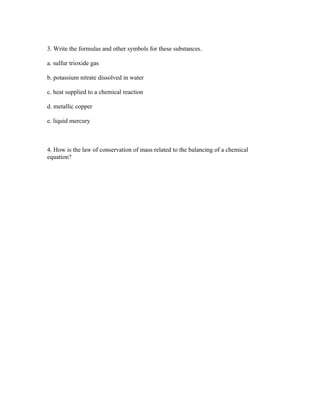
3. Write the formulas and other symbols for these substances.

a. sulfur trioxide gas

b. potassium nitrate dissolved in water

c. heat supplied to a chemical reaction

d. metallic copper

e. liquid mercury


4. How is the law of conservation of mass related to the balancing of a chemical
equation?
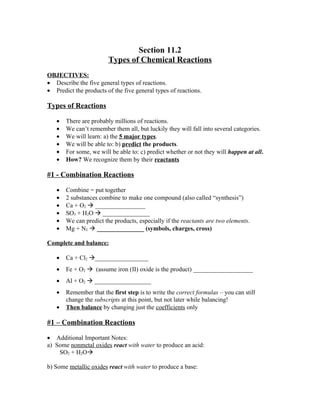
Section 11.2
                        Types of Chemical Reactions
OBJECTIVES:
• Describe the five general types of reactions.
• Predict the products of the five general types of reactions.

Types of Reactions

   •   There are probably millions of reactions.
   •   We can’t remember them all, but luckily they will fall into several categories.
   •   We will learn: a) the 5 major types.
   •   We will be able to: b) predict the products.
   •   For some, we will be able to: c) predict whether or not they will happen at all.
   •   How? We recognize them by their reactants

#1 - Combination Reactions

   •   Combine = put together
   •   2 substances combine to make one compound (also called “synthesis”)
   •   Ca + O2  ________________
   •   SO3 + H2O  _______________
   •   We can predict the products, especially if the reactants are two elements.
   •   Mg + N2  _______________ (symbols, charges, cross)

Complete and balance:

   •   Ca + Cl2 _________________
   •   Fe + O2  (assume iron (II) oxide is the product) ___________________
   •   Al + O2  __________________
   •   Remember that the first step is to write the correct formulas – you can still
       change the subscripts at this point, but not later while balancing!
   •   Then balance by changing just the coefficients only

#1 – Combination Reactions

• Additional Important Notes:
a) Some nonmetal oxides react with water to produce an acid:
    SO2 + H2O

b) Some metallic oxides react with water to produce a base:
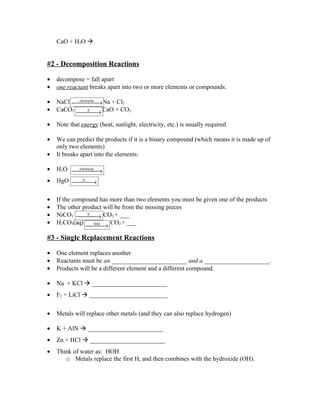
CaO + H2O 


#2 - Decomposition Reactions

•   decompose = fall apart
•   one reactant breaks apart into two or more elements or compounds.

•   NaCl  → Na + Cl2
          electricity

•   CaCO3  → CaO + CO2
                ∆


•   Note that energy (heat, sunlight, electricity, etc.) is usually required

•   We can predict the products if it is a binary compound (which means it is made up of
    only two elements)
•   It breaks apart into the elements:

•   H2O  →
         electricity


•   HgO  →
          ∆


•   If the compound has more than two elements you must be given one of the products
•   The other product will be from the missing pieces
•   NiCO3  → CO2 + ___
                ∆

•   H2CO3(aq)            CO2 + ___
                →
                  heat


#3 - Single Replacement Reactions

•   One element replaces another
•   Reactants must be an ________________________ and a _____________________.
•   Products will be a different element and a different compound.

•   Na + KCl  ________________________
•   F2 + LiCl  _________________________

•   Metals will replace other metals (and they can also replace hydrogen)

•   K + AlN  ________________________
•   Zn + HCl  ________________________
•   Think of water as: HOH
       o Metals replace the first H, and then combines with the hydroxide (OH).
•   Na + HOH  _______________________

•   We can even tell whether or not a single replacement reaction will happen:
       o Because some chemicals are more “active” than others
       o More active ________________________ less active
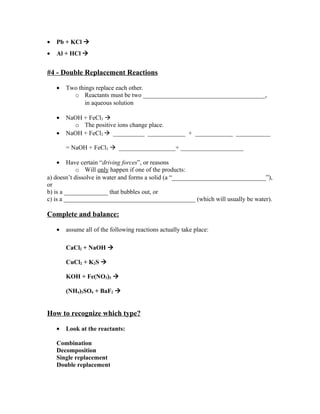
•   There is a list on page 333 - called the Activity Series of Metals
•   Higher on the list replaces those lower.

The “Activity Series” of Metals


The
“Activity Series” of Halogens

Higher Activity                    Halogens can replace other
                                   halogens in compounds, provided they are above the
       Fluorine                    halogen they are trying to replace.
       Chlorine
       Iodine

Lower activity

Example:
2NaCl(s) + F2(g) 

MgCl2(s) + Br2(g) 

#3 Single Replacement Reactions Practice:

•   Fe + CuSO4 
•   Pb + KCl 
•   Al + HCl 


#4 - Double Replacement Reactions

    •   Two things replace each other.
          o Reactants must be two _______________________________________,
               in aqueous solution

    •   NaOH + FeCl3 
          o The positive ions change place.
    •   NaOH + FeCl3  __________ ____________ + ____________ ___________

        = NaOH + FeCl3  __________________+ ____________________

    •    Have certain “driving forces”, or reasons
            o Will only happen if one of the products:
a) doesn’t dissolve in water and forms a solid (a “______________________________”),
or
b) is a ______________ that bubbles out, or
c) is a __________________________________________ (which will usually be water).

Complete and balance:

    •   assume all of the following reactions actually take place:

        CaCl2 + NaOH 

        CuCl2 + K2S 

        KOH + Fe(NO3)3 

        (NH4)2SO4 + BaF2 


How to recognize which type?

    •   Look at the reactants:

    Combination
    Decomposition
    Single replacement
    Double replacement
•   H2 + O2 

  •   H2O 

  •   Zn + H2SO4 

  •   HgO 

  •   KBr + Cl2 

  •   AgNO3 + NaCl 

  •   Mg(OH)2 + H2SO3 


#5 – Combustion Reactions

  •   Combustion means ______________________________
  •   Normally, a compound composed of only C, H, (and maybe O) is reacted with
      oxygen – usually called _________________________________
  •   If the combustion is complete, the products will be CO2 and H2O.
  •   If the combustion is incomplete, the products will be CO (or possibly just C) and
      H2O.

Combustion Reaction Examples:

  •   C4H10 + O2  (assume complete)

  •   C4H10 + O2  (incomplete)

  •   C6H12O6 + O2  (complete)

  •   C8H8 + O2  (incomplete)


SUMMARY: An equation...

  •   Describes a reaction
  •   Must be balanced in order to follow the Law of Conservation of Mass
  •   Can only be balanced by changing the __________________________
  •   Has special symbols to indicate the physical state, if a catalyst or energy is
      required, etc.

Reactions
•   Come in 5 major types.
   •   We can tell what type they are by looking at the reactants.
   •   Single Replacement happens based on the Activity Series
   •   Double Replacement happens if one product is: 1) a precipitate (an insoluble
       solid), 2) water (a molecular compound), or 3) a gas.


Name ________________________________________ Date _____________________

                            11.2 Section Review
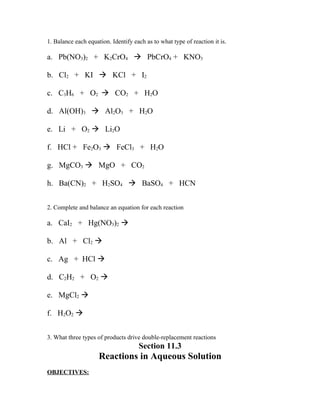
1. Balance each equation. Identify each as to what type of reaction it is.

a. Pb(NO3)2 + K2CrO4  PbCrO4 + KNO3

b. Cl2 + KI  KCl + I2

c. C3H6 + O2  CO2 + H2O

d. Al(OH)3  Al2O3 + H2O

e. Li + O2  Li2O

f. HCl + Fe2O3  FeCl3 + H2O

g. MgCO3  MgO + CO2

h. Ba(CN)2 + H2SO4  BaSO4 + HCN


2. Complete and balance an equation for each reaction

a. CaI2 + Hg(NO3)2 

b. Al + Cl2 

c. Ag + HCl 

d. C2H2 + O2 

e. MgCl2 

f. H2O2 


3. What three types of products drive double-replacement reactions
                                     Section 11.3
                     Reactions in Aqueous Solution
OBJECTIVES:
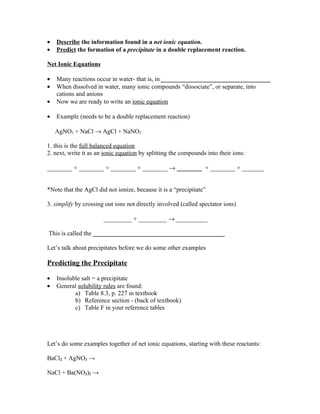
•   Describe the information found in a net ionic equation.
•   Predict the formation of a precipitate in a double replacement reaction.

Net Ionic Equations

•   Many reactions occur in water- that is, in ___________________________________
•   When dissolved in water, many ionic compounds “dissociate”, or separate, into
    cations and anions
•   Now we are ready to write an ionic equation

•   Example (needs to be a double replacement reaction)

    AgNO3 + NaCl → AgCl + NaNO3

1. this is the full balanced equation
2. next, write it as an ionic equation by splitting the compounds into their ions:

________ + ________ + ________ + ________ → ________ + ________ + _______


*Note that the AgCl did not ionize, because it is a “precipitate”

3. simplify by crossing out ions not directly involved (called spectator ions)

                       _________ + _________ → __________

This is called the __________________________________________

Let’s talk about precipitates before we do some other examples

Predicting the Precipitate

•   Insoluble salt = a precipitate
•   General solubility rules are found:
           a) Table 8.3, p. 227 in textbook
           b) Reference section - (back of textbook)
           c) Table F in your reference tables


Let’s do some examples together of net ionic equations, starting with these reactants:

BaCl2 + AgNO3 →

NaCl + Ba(NO3)2 →
Name ______________________________________ Date _______________________

                       11.3 Section Review
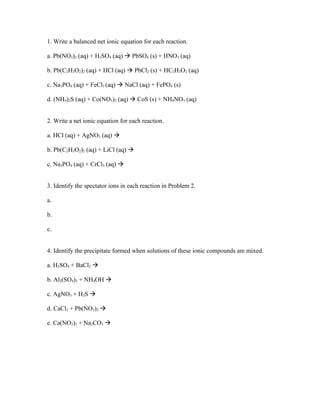
1. Write a balanced net ionic equation for each reaction.

a. Pb(NO3)2 (aq) + H2SO4 (aq)  PbSO4 (s) + HNO3 (aq)

b. Pb(C2H3O2)2 (aq) + HCl (aq)  PbCl2 (s) + HC2H3O2 (aq)

c. Na3PO4 (aq) + FeCl3 (aq)  NaCl (aq) + FePO4 (s)

d. (NH4)2S (aq) + Co(NO3)2 (aq)  CoS (s) + NH4NO3 (aq)


2. Write a net ionic equation for each reaction.

a. HCl (aq) + AgNO3 (aq) 

b. Pb(C2H3O2)2 (aq) + LiCl (aq) 

c. Na3PO4 (aq) + CrCl3 (aq) 


3. Identify the spectator ions in each reaction in Problem 2.

a.

b.

c.


4. Identify the precipitate formed when solutions of these ionic compounds are mixed.

a. H2SO4 + BaCl2 

b. Al2(SO4)3 + NH4OH 

c. AgNO3 + H2S 

d. CaCl2 + Pb(NO3)2 

e. Ca(NO3)2 + Na2CO3 
Chemistry - Chp 11 - Chemical Reactions - Notes

Chemistry - Chp 11 - Chemical Reactions - Notes

  • 1.
    Chapter 11 (Chapter8 in your books.) “Chemical Reactions”
  • 2.
    Section 11.1 Describing Chemical Reactions OBJECTIVES: • Describe how to write a word equation. • Describe how to write a skeleton equation. • Describe the steps for writing a balanced chemical equation. All chemical reactions… • have two parts: 1. Reactants = ______________________________________________ 2. Products = _______________________________________________ • The reactants will turn into the products. • Reactants  Products In a chemical reaction • Atoms aren’t created or destroyed (according to the ________________________________________________) • A reaction can be described several ways: #1. In a sentence every item is a word Copper reacts with chlorine to form copper (II) chloride. #2. In a word equation some symbols used Copper + chlorine  copper (II) chloride Symbols in equations – Text page 206 • the arrow (→) separates the reactants from the products (arrow points to products) o Read as: “reacts to form” or yields • The plus sign = “_______” • (s) after the formula = _________________: Fe(s) • (g) after the formula = _________________: CO2(g) • (l) after the formula = __________________: H2O(l) • (aq) after the formula = dissolved in water, an ___________________________: NaCl(aq) is a salt water solution • ↑ used after a product indicates a gas has been __________________: H2↑ • ↓ used after a product indicates a solid has been _________________: PbI2↓
  • 3.
    double arrow indicates a reversible reaction (more later) • shows that heat is supplied to the reaction • is used to indicate a catalyst is supplied (in this case, platinum is the catalyst) What is a catalyst? • __________________________________________________, without being changed or used up by the reaction. • Enzymes are biological or protein catalysts in your body. #3. The Skeleton Equation • Uses formulas and symbols to describe a reaction o but doesn’t indicate how many; this means they are NOT balanced • All chemical equations are a description of the reaction. Write a skeleton equation for: 1. Solid iron (III) sulfide reacts with gaseous hydrogen chloride to form iron (III) chloride and hydrogen sulfide gas. 2. Nitric acid dissolved in water reacts with solid sodium carbonate to form liquid water and carbon dioxide gas and sodium nitrate dissolved in water. Now, read these equations: Fe(s) + O2(g)  Fe2O3(s) Cu(s) + AgNO3(aq)  Ag(s) + Cu(NO3)2(aq) NO2(g) Pt N2(g) + O2(g) →
  • 4.
    #4. Balanced ChemicalEquations • Atoms can’t be created or destroyed in an ordinary reaction: o All the atoms we ___________________ we must ___________________ (meaning: ________________________) • A balanced equation has the same number of each element _______________________ of the equation. Rules for balancing: 1) Assemble the correct formulas for all the reactants and products, using “+” and “→” 2) Count the number of atoms of each type appearing on both sides 3) Balance the elements one at a time by adding coefficients (the numbers in front) where you need more - save balancing the H and O until LAST! (hint: I prefer to save O until the very last) 4) Double-Check to make sure it is balanced. Never • Never change a subscript to balance an equation (You can only change coefficients) o If you change the subscript (formula) you are describing a different chemical. o H2O is a different compound than H2O2 • Never put a coefficient in the middle of a formula; they must go only in the front o 2NaCl is okay, but Na2Cl is not. Practice Balancing Examples • __AgNO3 + __Cu  __Cu(NO3)2 + __Ag • __Mg + __N2  __Mg3N2 • __P + __O2  __P4O10 • __Na + __H2O  __H2 + __NaOH • __CH4 + __O2  __CO2 + __H2O
  • 5.
    Name _______________________________________ Date______________________ 11.1 Section Review 1. Write the word equations for the following chemical reaction. a. Pure copper can be produced by heating copper (II) sulfide in the presence of diatomic oxygen from the air. Sulfur dioxide gas is also produced in this reaction. b. Water is formed by the explosive reaction between hydrogen gas and oxygen gas. c. When baking soda (sodium hydrogen carbonate) is heated, it decomposes, forming the products sodium carbonate, carbon dioxide, and water. 2. Balance the following equations. a. SO2 + O2  SO3 b. Fe2O3 + H2  Fe + H2O c. P + O2  P4O10 d. Al + N2  AlN
  • 6.
    3. Write theformulas and other symbols for these substances. a. sulfur trioxide gas b. potassium nitrate dissolved in water c. heat supplied to a chemical reaction d. metallic copper e. liquid mercury 4. How is the law of conservation of mass related to the balancing of a chemical equation?
  • 7.
    Section 11.2 Types of Chemical Reactions OBJECTIVES: • Describe the five general types of reactions. • Predict the products of the five general types of reactions. Types of Reactions • There are probably millions of reactions. • We can’t remember them all, but luckily they will fall into several categories. • We will learn: a) the 5 major types. • We will be able to: b) predict the products. • For some, we will be able to: c) predict whether or not they will happen at all. • How? We recognize them by their reactants #1 - Combination Reactions • Combine = put together • 2 substances combine to make one compound (also called “synthesis”) • Ca + O2  ________________ • SO3 + H2O  _______________ • We can predict the products, especially if the reactants are two elements. • Mg + N2  _______________ (symbols, charges, cross) Complete and balance: • Ca + Cl2 _________________ • Fe + O2  (assume iron (II) oxide is the product) ___________________ • Al + O2  __________________ • Remember that the first step is to write the correct formulas – you can still change the subscripts at this point, but not later while balancing! • Then balance by changing just the coefficients only #1 – Combination Reactions • Additional Important Notes: a) Some nonmetal oxides react with water to produce an acid: SO2 + H2O b) Some metallic oxides react with water to produce a base:
  • 8.
    CaO + H2O #2 - Decomposition Reactions • decompose = fall apart • one reactant breaks apart into two or more elements or compounds. • NaCl  → Na + Cl2 electricity • CaCO3  → CaO + CO2 ∆ • Note that energy (heat, sunlight, electricity, etc.) is usually required • We can predict the products if it is a binary compound (which means it is made up of only two elements) • It breaks apart into the elements: • H2O  → electricity • HgO  → ∆ • If the compound has more than two elements you must be given one of the products • The other product will be from the missing pieces • NiCO3  → CO2 + ___ ∆ • H2CO3(aq) CO2 + ___  → heat #3 - Single Replacement Reactions • One element replaces another • Reactants must be an ________________________ and a _____________________. • Products will be a different element and a different compound. • Na + KCl  ________________________ • F2 + LiCl  _________________________ • Metals will replace other metals (and they can also replace hydrogen) • K + AlN  ________________________ • Zn + HCl  ________________________ • Think of water as: HOH o Metals replace the first H, and then combines with the hydroxide (OH).
  • 9.
    Na + HOH  _______________________ • We can even tell whether or not a single replacement reaction will happen: o Because some chemicals are more “active” than others o More active ________________________ less active • There is a list on page 333 - called the Activity Series of Metals • Higher on the list replaces those lower. The “Activity Series” of Metals The “Activity Series” of Halogens Higher Activity Halogens can replace other halogens in compounds, provided they are above the Fluorine halogen they are trying to replace. Chlorine Iodine Lower activity Example: 2NaCl(s) + F2(g)  MgCl2(s) + Br2(g)  #3 Single Replacement Reactions Practice: • Fe + CuSO4 
  • 10.
    Pb + KCl  • Al + HCl  #4 - Double Replacement Reactions • Two things replace each other. o Reactants must be two _______________________________________, in aqueous solution • NaOH + FeCl3  o The positive ions change place. • NaOH + FeCl3  __________ ____________ + ____________ ___________ = NaOH + FeCl3  __________________+ ____________________ • Have certain “driving forces”, or reasons o Will only happen if one of the products: a) doesn’t dissolve in water and forms a solid (a “______________________________”), or b) is a ______________ that bubbles out, or c) is a __________________________________________ (which will usually be water). Complete and balance: • assume all of the following reactions actually take place: CaCl2 + NaOH  CuCl2 + K2S  KOH + Fe(NO3)3  (NH4)2SO4 + BaF2  How to recognize which type? • Look at the reactants: Combination Decomposition Single replacement Double replacement
  • 11.
    H2 + O2  • H2O  • Zn + H2SO4  • HgO  • KBr + Cl2  • AgNO3 + NaCl  • Mg(OH)2 + H2SO3  #5 – Combustion Reactions • Combustion means ______________________________ • Normally, a compound composed of only C, H, (and maybe O) is reacted with oxygen – usually called _________________________________ • If the combustion is complete, the products will be CO2 and H2O. • If the combustion is incomplete, the products will be CO (or possibly just C) and H2O. Combustion Reaction Examples: • C4H10 + O2  (assume complete) • C4H10 + O2  (incomplete) • C6H12O6 + O2  (complete) • C8H8 + O2  (incomplete) SUMMARY: An equation... • Describes a reaction • Must be balanced in order to follow the Law of Conservation of Mass • Can only be balanced by changing the __________________________ • Has special symbols to indicate the physical state, if a catalyst or energy is required, etc. Reactions
  • 12.
    Come in 5 major types. • We can tell what type they are by looking at the reactants. • Single Replacement happens based on the Activity Series • Double Replacement happens if one product is: 1) a precipitate (an insoluble solid), 2) water (a molecular compound), or 3) a gas. Name ________________________________________ Date _____________________ 11.2 Section Review
  • 13.
    1. Balance eachequation. Identify each as to what type of reaction it is. a. Pb(NO3)2 + K2CrO4  PbCrO4 + KNO3 b. Cl2 + KI  KCl + I2 c. C3H6 + O2  CO2 + H2O d. Al(OH)3  Al2O3 + H2O e. Li + O2  Li2O f. HCl + Fe2O3  FeCl3 + H2O g. MgCO3  MgO + CO2 h. Ba(CN)2 + H2SO4  BaSO4 + HCN 2. Complete and balance an equation for each reaction a. CaI2 + Hg(NO3)2  b. Al + Cl2  c. Ag + HCl  d. C2H2 + O2  e. MgCl2  f. H2O2  3. What three types of products drive double-replacement reactions Section 11.3 Reactions in Aqueous Solution OBJECTIVES:
  • 14.
    Describe the information found in a net ionic equation. • Predict the formation of a precipitate in a double replacement reaction. Net Ionic Equations • Many reactions occur in water- that is, in ___________________________________ • When dissolved in water, many ionic compounds “dissociate”, or separate, into cations and anions • Now we are ready to write an ionic equation • Example (needs to be a double replacement reaction) AgNO3 + NaCl → AgCl + NaNO3 1. this is the full balanced equation 2. next, write it as an ionic equation by splitting the compounds into their ions: ________ + ________ + ________ + ________ → ________ + ________ + _______ *Note that the AgCl did not ionize, because it is a “precipitate” 3. simplify by crossing out ions not directly involved (called spectator ions) _________ + _________ → __________ This is called the __________________________________________ Let’s talk about precipitates before we do some other examples Predicting the Precipitate • Insoluble salt = a precipitate • General solubility rules are found: a) Table 8.3, p. 227 in textbook b) Reference section - (back of textbook) c) Table F in your reference tables Let’s do some examples together of net ionic equations, starting with these reactants: BaCl2 + AgNO3 → NaCl + Ba(NO3)2 →
  • 15.
    Name ______________________________________ Date_______________________ 11.3 Section Review
  • 16.
    1. Write abalanced net ionic equation for each reaction. a. Pb(NO3)2 (aq) + H2SO4 (aq)  PbSO4 (s) + HNO3 (aq) b. Pb(C2H3O2)2 (aq) + HCl (aq)  PbCl2 (s) + HC2H3O2 (aq) c. Na3PO4 (aq) + FeCl3 (aq)  NaCl (aq) + FePO4 (s) d. (NH4)2S (aq) + Co(NO3)2 (aq)  CoS (s) + NH4NO3 (aq) 2. Write a net ionic equation for each reaction. a. HCl (aq) + AgNO3 (aq)  b. Pb(C2H3O2)2 (aq) + LiCl (aq)  c. Na3PO4 (aq) + CrCl3 (aq)  3. Identify the spectator ions in each reaction in Problem 2. a. b. c. 4. Identify the precipitate formed when solutions of these ionic compounds are mixed. a. H2SO4 + BaCl2  b. Al2(SO4)3 + NH4OH  c. AgNO3 + H2S  d. CaCl2 + Pb(NO3)2  e. Ca(NO3)2 + Na2CO3 