Chapter 3: Matter—Properties
        and Changes
    Section 3.4 Types of Matter
      Elements & Compounds
What is matter?
• Anything that has mass and
  takes up space
• Mass is a measurement of the
  amount of matter in an object. It
  is different than weight which
  measures the amount of matter
  AND the gravitational pull on an
  object.
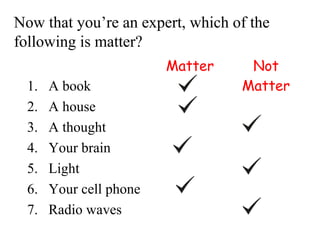
Now that you’re an expert, which of the
following is matter?
                         Matter    Not
  1.   A book                     Matter
  2.   A house
  3.   A thought
  4.   Your brain
  5.   Light
  6.   Your cell phone
  7.   Radio waves
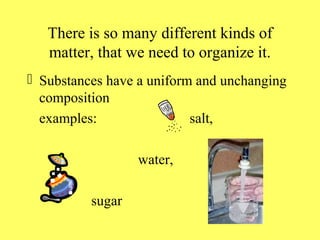
There is so many different kinds of
   matter, that we need to organize it.
 Substances have a uniform and unchanging
  composition
  examples:                salt,

                  water,

          sugar
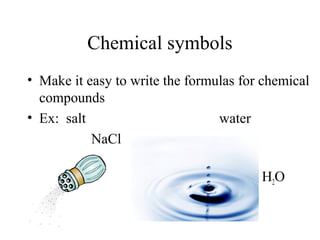
Chemical symbols
• Make it easy to write the formulas for chemical
  compounds
• Ex: salt                       water
           NaCl

                                        H 2O
Elements
• A pure substance that cannot be broken down
  into simpler substances by physical or
  chemical means
• 91 naturally occurring elements
• Symbolized by one capital letter or one
  capital letter and 1 lower case
  – ex: S = sulfur
  – Na = sodium
• In mid 1800’s, no chart for organizing the
  elements that were known at the time
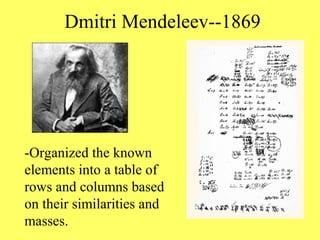
Dmitri Mendeleev--1869


-Organized the known
elements into a table of
rows and columns based
on their similarities and
masses.
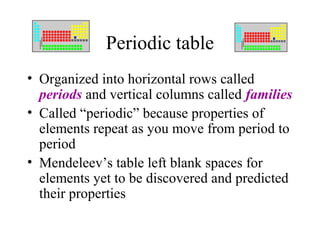
Periodic table
• Organized into horizontal rows called
  periods and vertical columns called families
• Called “periodic” because properties of
  elements repeat as you move from period to
  period
• Mendeleev’s table left blank spaces for
  elements yet to be discovered and predicted
  their properties
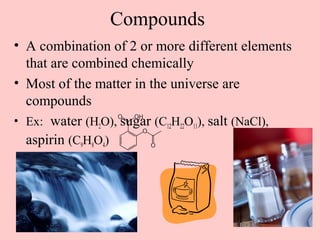
Compounds
• A combination of 2 or more different elements
  that are combined chemically
• Most of the matter in the universe are
  compounds
• Ex: water (H2O), sugar (C12H22O11), salt (NaCl),
  aspirin (C9H8O4)
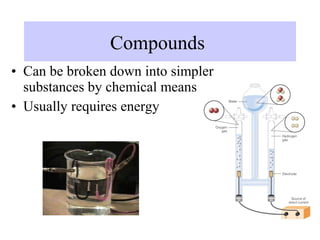
Compounds
• Can be broken down into simpler
  substances by chemical means
• Usually requires energy
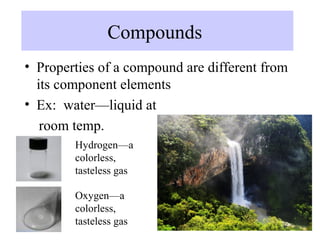
Compounds
• Properties of a compound are different from
  its component elements
• Ex: water—liquid at
   room temp.
        Hydrogen—a
        colorless,
        tasteless gas

        Oxygen—a
        colorless,
        tasteless gas
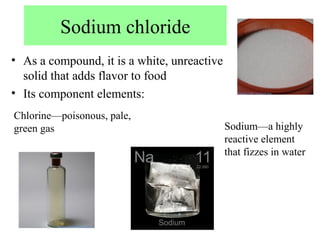
Sodium chloride
• As a compound, it is a white, unreactive
  solid that adds flavor to food
• Its component elements:
Chlorine—poisonous, pale,
green gas                                    Sodium—a highly
                                             reactive element
                                             that fizzes in water
States of Matter
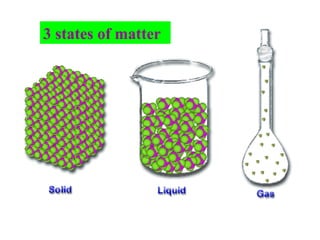
Classification based upon the following:
 Particle arrangement
 Energy of particles
 Distance between particles
State of matter is dependent on
  temperature and pressure of the
  surroundings
3 states of matter
States of Matter
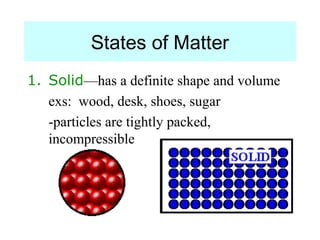
1. Solid—has a definite shape and volume
   exs: wood, desk, shoes, sugar
   -particles are tightly packed,
   incompressible
States of Matter
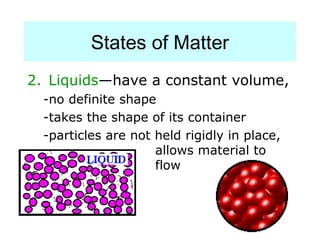
2. Liquids—have a constant volume,
  -no definite shape
  -takes the shape of its container
  -particles are not held rigidly in place,
                     allows material to
                     flow
States of Matter
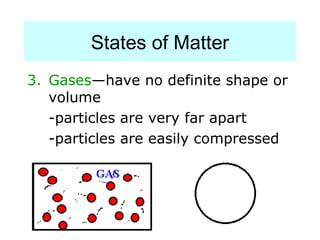
3. Gases—have no definite shape or
   volume
   -particles are very far apart
   -particles are easily compressed
Section 3.3

Mixtures of Matter
Mixtures
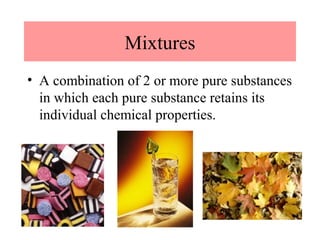
• A combination of 2 or more pure substances
  in which each pure substance retains its
  individual chemical properties.
Types of Mixtures
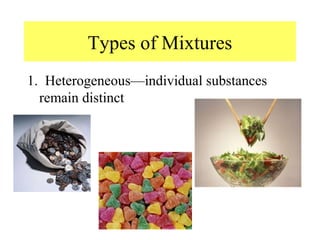
1. Heterogeneous—individual substances
  remain distinct
Types of Mixtures
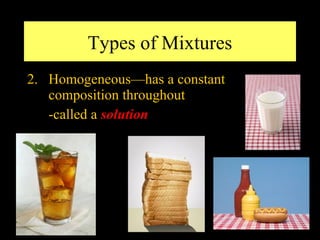
2. Homogeneous—has a constant
   composition throughout
   -called a solution
Types of Solutions
•   Gas-gas: air
•   Gas-liquid: soft drinks
•   Liquid-gas: moist air
•   Liquid-liquid: vinegar
•   Solid-liquid: Crystal Light
•   Solid-solid: steel (called
    “alloys”—mixture of metals
    producing greater strength)
Separating Mixtures
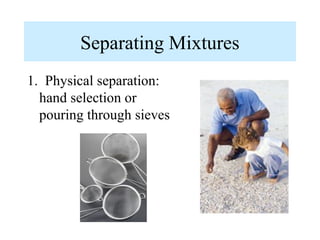
1. Physical separation:
  hand selection or
  pouring through sieves
Separating Mixtures
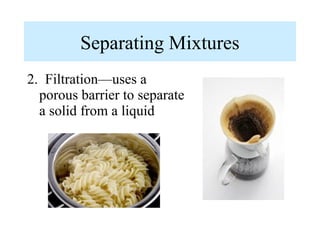
2. Filtration—uses a
  porous barrier to separate
  a solid from a liquid
Separating Mixtures
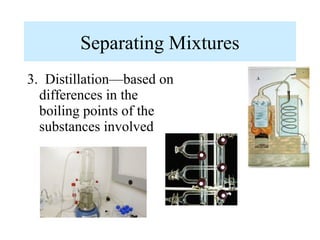
3. Distillation—based on
  differences in the
  boiling points of the
  substances involved
Separating Mixtures
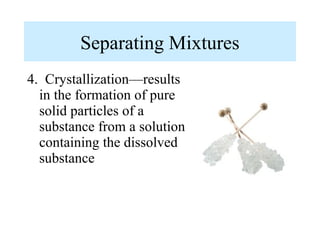
4. Crystallization—results
  in the formation of pure
  solid particles of a
  substance from a solution
  containing the dissolved
  substance
Separating Mixtures
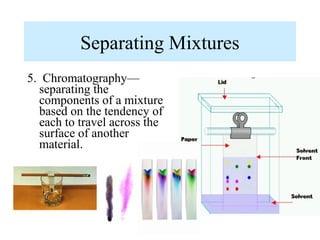
5. Chromatography—
  separating the
  components of a mixture
  based on the tendency of
  each to travel across the
  surface of another
  material.
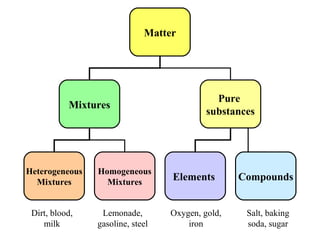
Matter


                                             Pure
           Mixtures
                                           substances


Heterogeneous   Homogeneous
  Mixtures        Mixtures
                                  Elements        Compounds


 Dirt, blood,    Lemonade,        Oxygen, gold,    Salt, baking
    milk        gasoline, steel       iron         soda, sugar
Section 3.1

Properties of Matter
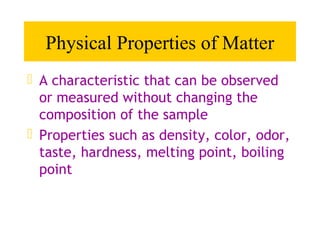
Physical Properties of Matter
 A characteristic that can be observed
  or measured without changing the
  composition of the sample
 Properties such as density, color, odor,
  taste, hardness, melting point, boiling
  point
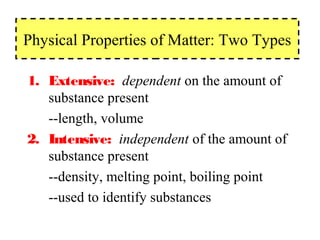
Physical Properties of Matter: Two Types

1. Extensive: dependent on the amount of
   substance present
   --length, volume
2. Intensive: independent of the amount of
   substance present
   --density, melting point, boiling point
   --used to identify substances
Chemical Properties
 Ability or inability of a substance to
  combine with or change into one or
  more other substances
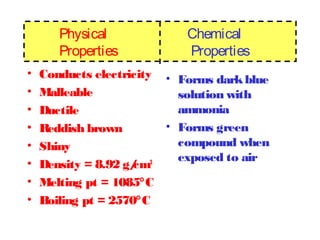
Physical             Chemical
       Properties           Properties
•   Conducts electricity • Forms dark blue
•   Malleable               solution with
•   Ductile                 ammonia
•   Reddish brown         • Forms green
•   Shiny                   compound when
                            exposed to air
•   Density = 8.92 g/cm 3

•   Melting pt = 1085°C
•   Boiling pt = 2570°C
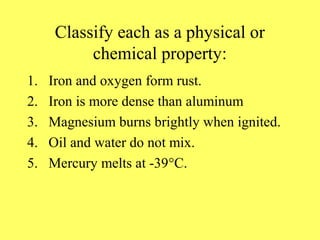
Classify each as a physical or
           chemical property:
1.   Iron and oxygen form rust.
2.   Iron is more dense than aluminum
3.   Magnesium burns brightly when ignited.
4.   Oil and water do not mix.
5.   Mercury melts at -39°C.
Section 3.2

Changes in Matter
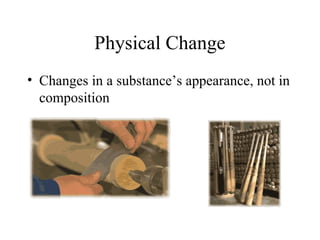
Physical Change
• Changes in a substance’s appearance, not in
  composition
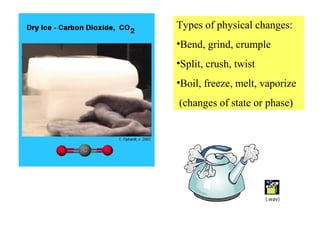
Types of physical changes:
•Bend, grind, crumple
•Split, crush, twist
•Boil, freeze, melt, vaporize
(changes of state or phase)


                       (.wav)
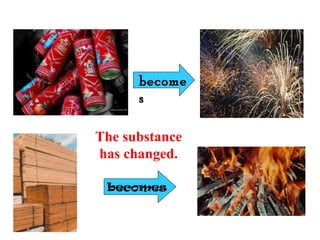
Chemical Changes
• A change in the composition of a
  substance
• Also called a chemical change or
  chemical reaction
• Ex: rust, corrode, tarnish, rot, burn,
  ferment, explode, oxidize
become
      s

The substance
has changed.

 becomes
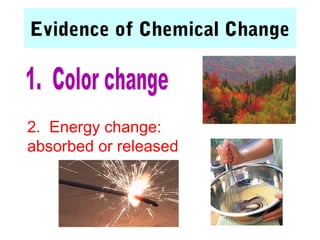
Evidence of Chemical Change


2. Energy change:
absorbed or released
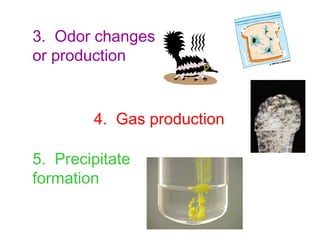
3. Odor changes
or production


        4. Gas production

5. Precipitate
formation
Classify each as a physical or
            chemical change:
1.   A dead fish rotting
2.   Dissolving salt in water
3.   Boiling salt water until only salt remains
4.   Melting steel
5.   Bending steel
6.   Cracking ice
Section 3.3 & 3.4

   Laws of Matter
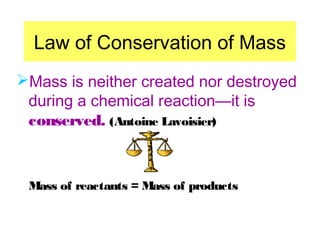
Law of Conservation of Mass
Mass is neither created nor destroyed
 during a chemical reaction—it is
 conserved. (Antoine Lavoisier)


 Mass of reactants = Mass of products
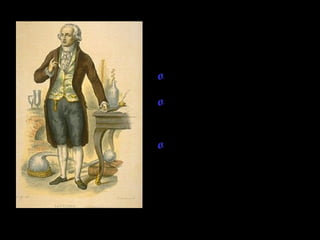
Antoine Lavoisier—a
French scientist
o 1743-1794
o Father of Modern
Chemistry
o One of the first to use
an analytical balance
When you burn a big pile of wood, why do
you only end up with a tiny pile of ashes?
In an experiment, 10.00 g of red mercury (II) oxide
powder is placed in an open flask and heated until it
is converted to liquid mercury and oxygen gas. The
  liquid mercury has a mass of 9.26 g. What is the
       mass of oxygen formed in the reaction?
Practice problems—pg. 65 #6, 7, 9
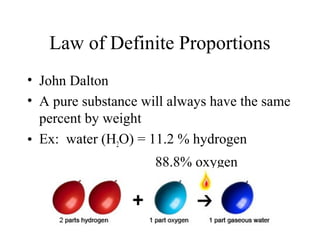
Law of Definite Proportions
• John Dalton
• A pure substance will always have the same
  percent by weight
• Ex: water (H2O) = 11.2 % hydrogen
                     88.8% oxygen
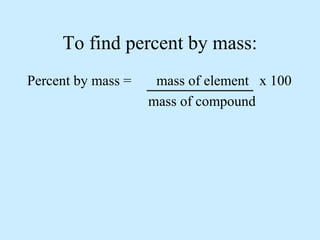
To find percent by mass:
Percent by mass =    mass of element x 100
                    mass of compound
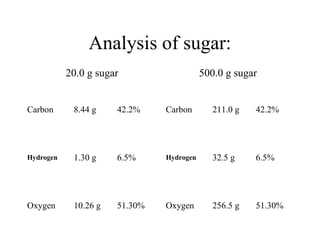
Analysis of sugar:
           20.0 g sugar                   500.0 g sugar


Carbon      8.44 g    42.2%    Carbon        211.0 g   42.2%


Hydrogen    1.30 g    6.5%     Hydrogen      32.5 g    6.5%


Oxygen      10.26 g   51.30%   Oxygen        256.5 g   51.30%
Therefore…
• Sugar always has the same proportions of
  ingredients
• If a substance has different proportions, it is
  a different substance
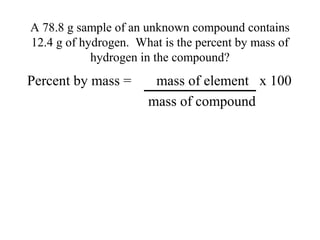
A 78.8 g sample of an unknown compound contains
12.4 g of hydrogen. What is the percent by mass of
            hydrogen in the compound?
Percent by mass =      mass of element x 100
                      mass of compound
Practice problems—pg. 76 #21-24
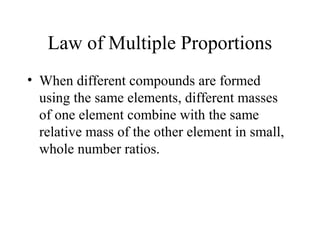
Law of Multiple Proportions
• When different compounds are formed
  using the same elements, different masses
  of one element combine with the same
  relative mass of the other element in small,
  whole number ratios.
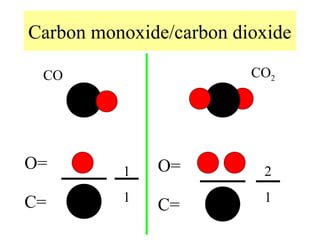
Carbon monoxide/carbon dioxide

 CO                      CO2


O=        1   O=          2

C=        1               1
              C=
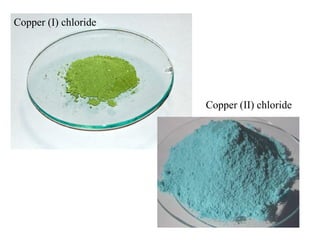
Copper (I) chloride


                      Copper (II) chloride
PS CH 10 matter properties and changes edited

PS CH 10 matter properties and changes edited

  • 1.
    Chapter 3: Matter—Properties and Changes Section 3.4 Types of Matter Elements & Compounds
  • 2.
    What is matter? •Anything that has mass and takes up space • Mass is a measurement of the amount of matter in an object. It is different than weight which measures the amount of matter AND the gravitational pull on an object.
  • 3.
    Now that you’rean expert, which of the following is matter? Matter Not 1. A book Matter 2. A house 3. A thought 4. Your brain 5. Light 6. Your cell phone 7. Radio waves
  • 4.
    There is somany different kinds of matter, that we need to organize it.  Substances have a uniform and unchanging composition examples: salt, water, sugar
  • 5.
    Chemical symbols • Makeit easy to write the formulas for chemical compounds • Ex: salt water NaCl H 2O
  • 6.
    Elements • A puresubstance that cannot be broken down into simpler substances by physical or chemical means • 91 naturally occurring elements • Symbolized by one capital letter or one capital letter and 1 lower case – ex: S = sulfur – Na = sodium • In mid 1800’s, no chart for organizing the elements that were known at the time
  • 7.
    Dmitri Mendeleev--1869 -Organized theknown elements into a table of rows and columns based on their similarities and masses.
  • 8.
    Periodic table • Organizedinto horizontal rows called periods and vertical columns called families • Called “periodic” because properties of elements repeat as you move from period to period • Mendeleev’s table left blank spaces for elements yet to be discovered and predicted their properties
  • 9.
    Compounds • A combinationof 2 or more different elements that are combined chemically • Most of the matter in the universe are compounds • Ex: water (H2O), sugar (C12H22O11), salt (NaCl), aspirin (C9H8O4)
  • 10.
    Compounds • Can bebroken down into simpler substances by chemical means • Usually requires energy
  • 11.
    Compounds • Properties ofa compound are different from its component elements • Ex: water—liquid at room temp. Hydrogen—a colorless, tasteless gas Oxygen—a colorless, tasteless gas
  • 12.
    Sodium chloride • Asa compound, it is a white, unreactive solid that adds flavor to food • Its component elements: Chlorine—poisonous, pale, green gas Sodium—a highly reactive element that fizzes in water
  • 13.
    States of Matter Classificationbased upon the following:  Particle arrangement  Energy of particles  Distance between particles State of matter is dependent on temperature and pressure of the surroundings
  • 14.
  • 15.
    States of Matter 1.Solid—has a definite shape and volume exs: wood, desk, shoes, sugar -particles are tightly packed, incompressible
  • 16.
    States of Matter 2.Liquids—have a constant volume, -no definite shape -takes the shape of its container -particles are not held rigidly in place, allows material to flow
  • 17.
    States of Matter 3.Gases—have no definite shape or volume -particles are very far apart -particles are easily compressed
  • 18.
  • 19.
    Mixtures • A combinationof 2 or more pure substances in which each pure substance retains its individual chemical properties.
  • 20.
    Types of Mixtures 1.Heterogeneous—individual substances remain distinct
  • 21.
    Types of Mixtures 2.Homogeneous—has a constant composition throughout -called a solution
  • 22.
    Types of Solutions • Gas-gas: air • Gas-liquid: soft drinks • Liquid-gas: moist air • Liquid-liquid: vinegar • Solid-liquid: Crystal Light • Solid-solid: steel (called “alloys”—mixture of metals producing greater strength)
  • 23.
    Separating Mixtures 1. Physicalseparation: hand selection or pouring through sieves
  • 24.
    Separating Mixtures 2. Filtration—usesa porous barrier to separate a solid from a liquid
  • 25.
    Separating Mixtures 3. Distillation—basedon differences in the boiling points of the substances involved
  • 26.
    Separating Mixtures 4. Crystallization—results in the formation of pure solid particles of a substance from a solution containing the dissolved substance
  • 27.
    Separating Mixtures 5. Chromatography— separating the components of a mixture based on the tendency of each to travel across the surface of another material.
  • 28.
    Matter Pure Mixtures substances Heterogeneous Homogeneous Mixtures Mixtures Elements Compounds Dirt, blood, Lemonade, Oxygen, gold, Salt, baking milk gasoline, steel iron soda, sugar
  • 29.
  • 30.
    Physical Properties ofMatter  A characteristic that can be observed or measured without changing the composition of the sample  Properties such as density, color, odor, taste, hardness, melting point, boiling point
  • 31.
    Physical Properties ofMatter: Two Types 1. Extensive: dependent on the amount of substance present --length, volume 2. Intensive: independent of the amount of substance present --density, melting point, boiling point --used to identify substances
  • 32.
    Chemical Properties  Abilityor inability of a substance to combine with or change into one or more other substances
  • 33.
    Physical Chemical Properties Properties • Conducts electricity • Forms dark blue • Malleable solution with • Ductile ammonia • Reddish brown • Forms green • Shiny compound when exposed to air • Density = 8.92 g/cm 3 • Melting pt = 1085°C • Boiling pt = 2570°C
  • 34.
    Classify each asa physical or chemical property: 1. Iron and oxygen form rust. 2. Iron is more dense than aluminum 3. Magnesium burns brightly when ignited. 4. Oil and water do not mix. 5. Mercury melts at -39°C.
  • 35.
  • 36.
    Physical Change • Changesin a substance’s appearance, not in composition
  • 37.
    Types of physicalchanges: •Bend, grind, crumple •Split, crush, twist •Boil, freeze, melt, vaporize (changes of state or phase) (.wav)
  • 38.
    Chemical Changes • Achange in the composition of a substance • Also called a chemical change or chemical reaction • Ex: rust, corrode, tarnish, rot, burn, ferment, explode, oxidize
  • 39.
    become s The substance has changed. becomes
  • 40.
    Evidence of ChemicalChange 2. Energy change: absorbed or released
  • 41.
    3. Odor changes orproduction 4. Gas production 5. Precipitate formation
  • 42.
    Classify each asa physical or chemical change: 1. A dead fish rotting 2. Dissolving salt in water 3. Boiling salt water until only salt remains 4. Melting steel 5. Bending steel 6. Cracking ice
  • 43.
    Section 3.3 &3.4 Laws of Matter
  • 44.
    Law of Conservationof Mass Mass is neither created nor destroyed during a chemical reaction—it is conserved. (Antoine Lavoisier) Mass of reactants = Mass of products
  • 45.
    Antoine Lavoisier—a French scientist o1743-1794 o Father of Modern Chemistry o One of the first to use an analytical balance
  • 46.
    When you burna big pile of wood, why do you only end up with a tiny pile of ashes?
  • 47.
    In an experiment,10.00 g of red mercury (II) oxide powder is placed in an open flask and heated until it is converted to liquid mercury and oxygen gas. The liquid mercury has a mass of 9.26 g. What is the mass of oxygen formed in the reaction?
  • 48.
  • 49.
    Law of DefiniteProportions • John Dalton • A pure substance will always have the same percent by weight • Ex: water (H2O) = 11.2 % hydrogen 88.8% oxygen
  • 50.
    To find percentby mass: Percent by mass = mass of element x 100 mass of compound
  • 51.
    Analysis of sugar: 20.0 g sugar 500.0 g sugar Carbon 8.44 g 42.2% Carbon 211.0 g 42.2% Hydrogen 1.30 g 6.5% Hydrogen 32.5 g 6.5% Oxygen 10.26 g 51.30% Oxygen 256.5 g 51.30%
  • 52.
    Therefore… • Sugar alwayshas the same proportions of ingredients • If a substance has different proportions, it is a different substance
  • 53.
    A 78.8 gsample of an unknown compound contains 12.4 g of hydrogen. What is the percent by mass of hydrogen in the compound? Percent by mass = mass of element x 100 mass of compound
  • 54.
  • 55.
    Law of MultipleProportions • When different compounds are formed using the same elements, different masses of one element combine with the same relative mass of the other element in small, whole number ratios.
  • 56.
    Carbon monoxide/carbon dioxide CO CO2 O= 1 O= 2 C= 1 1 C=
  • 57.
    Copper (I) chloride Copper (II) chloride