Chemical Reactions
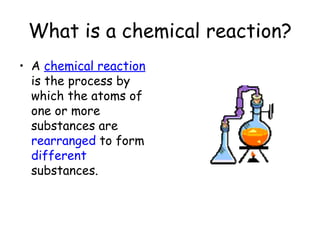
What is a chemical reaction?
• A chemical reaction
  is the process by
  which the atoms of
  one or more
  substances are
  rearranged to form
  different
  substances.
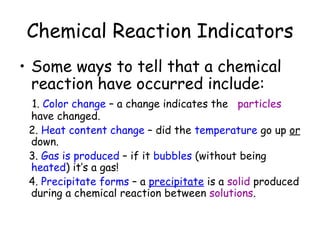
Chemical Reaction Indicators
• Some ways to tell that a chemical
  reaction have occurred include:
 1. Color change – a change indicates the particles
 have changed.
 2. Heat content change – did the temperature go up or
 down.
 3. Gas is produced – if it bubbles (without being
 heated) it’s a gas!
 4. Precipitate forms – a precipitate is a solid produced
 during a chemical reaction between solutions.
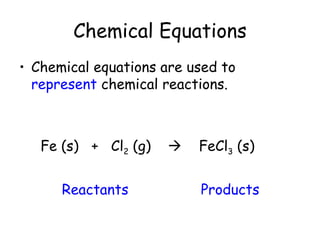
Chemical Equations
• Chemical equations are used to
  represent chemical reactions.


   Fe (s) + Cl2 (g)      FeCl3 (s)


      Reactants           Products
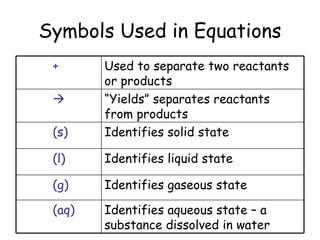
Symbols Used in Equations
 +      Used to separate two reactants
        or products
       “Yields” separates reactants
        from products
 (s)    Identifies solid state

 (l)    Identifies liquid state

 (g)    Identifies gaseous state

 (aq)   Identifies aqueous state – a
        substance dissolved in water
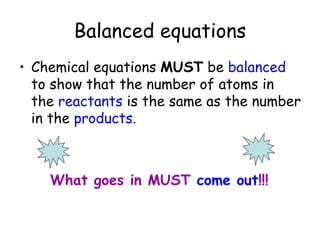
Balanced equations
• Chemical equations MUST be balanced
  to show that the number of atoms in
  the reactants is the same as the number
  in the products.


    What goes in MUST come out!!!
Rules for Balancing
• The only place you can change any
  number is the coefficient.
• A coefficient is a number written in
  front of a chemical formula.
• Don’t forget diatomic molecules.
• Use the smallest ratio of coefficients
  possible.
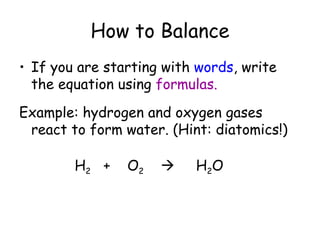
How to Balance
• If you are starting with words, write
  the equation using formulas.
Example: hydrogen and oxygen gases
 react to form water. (Hint: diatomics!)

        H2 +    O2       H 2O
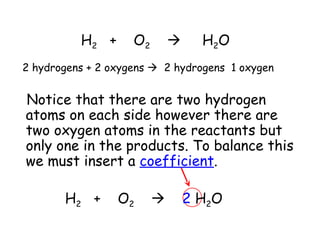
H2 +      O2             H 2O
2 hydrogens + 2 oxygens  2 hydrogens 1 oxygen


Notice that there are two hydrogen
atoms on each side however there are
two oxygen atoms in the reactants but
only one in the products. To balance this
we must insert a coefficient.

       H2 +      O2             2 H 2O
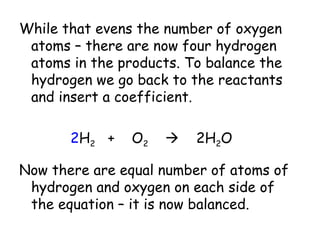
While that evens the number of oxygen
 atoms – there are now four hydrogen
 atoms in the products. To balance the
 hydrogen we go back to the reactants
 and insert a coefficient.

       2H2 +    O2      2H2O

Now there are equal number of atoms of
 hydrogen and oxygen on each side of
 the equation – it is now balanced.
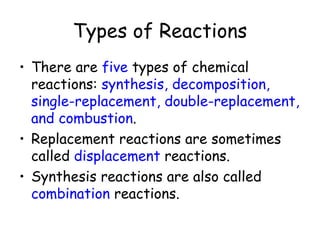
Types of Reactions
• There are five types of chemical
  reactions: synthesis, decomposition,
  single-replacement, double-replacement,
  and combustion.
• Replacement reactions are sometimes
  called displacement reactions.
• Synthesis reactions are also called
  combination reactions.
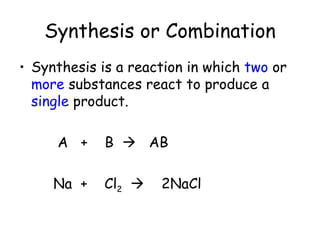
Synthesis or Combination
• Synthesis is a reaction in which two or
  more substances react to produce a
  single product.

     A +     B  AB

     Na +    Cl2    2NaCl
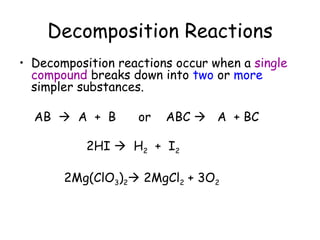
Decomposition Reactions
• Decomposition reactions occur when a single
  compound breaks down into two or more
  simpler substances.

  AB  A + B       or   ABC  A + BC

           2HI  H2 + I2

       2Mg(ClO3)2 2MgCl2 + 3O2
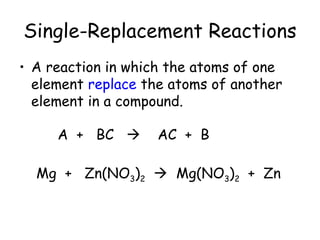
Single-Replacement Reactions
• A reaction in which the atoms of one
  element replace the atoms of another
  element in a compound.

     A + BC       AC + B

  Mg + Zn(NO3)2  Mg(NO3)2 + Zn
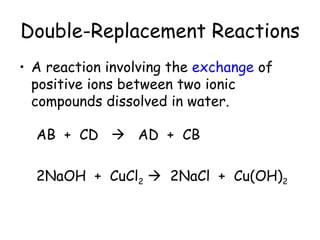
Double-Replacement Reactions
• A reaction involving the exchange of
  positive ions between two ionic
  compounds dissolved in water.

  AB + CD  AD + CB

  2NaOH + CuCl2  2NaCl + Cu(OH)2
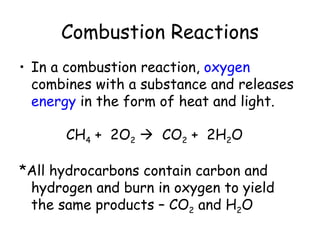
Combustion Reactions
• In a combustion reaction, oxygen
  combines with a substance and releases
  energy in the form of heat and light.

      CH4 + 2O2  CO2 + 2H2O

*All hydrocarbons contain carbon and
 hydrogen and burn in oxygen to yield
 the same products – CO2 and H2O
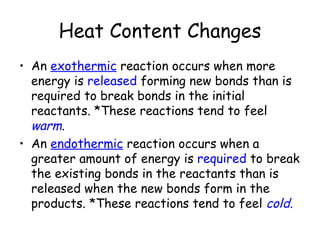
Heat Content Changes
• An exothermic reaction occurs when more
  energy is released forming new bonds than is
  required to break bonds in the initial
  reactants. *These reactions tend to feel
  warm.
• An endothermic reaction occurs when a
  greater amount of energy is required to break
  the existing bonds in the reactants than is
  released when the new bonds form in the
  products. *These reactions tend to feel cold.

Chemical reactions

  • 1.
  • 2.
    What is achemical reaction? • A chemical reaction is the process by which the atoms of one or more substances are rearranged to form different substances.
  • 3.
    Chemical Reaction Indicators •Some ways to tell that a chemical reaction have occurred include: 1. Color change – a change indicates the particles have changed. 2. Heat content change – did the temperature go up or down. 3. Gas is produced – if it bubbles (without being heated) it’s a gas! 4. Precipitate forms – a precipitate is a solid produced during a chemical reaction between solutions.
  • 4.
    Chemical Equations • Chemicalequations are used to represent chemical reactions. Fe (s) + Cl2 (g)  FeCl3 (s) Reactants Products
  • 5.
    Symbols Used inEquations + Used to separate two reactants or products  “Yields” separates reactants from products (s) Identifies solid state (l) Identifies liquid state (g) Identifies gaseous state (aq) Identifies aqueous state – a substance dissolved in water
  • 6.
    Balanced equations • Chemicalequations MUST be balanced to show that the number of atoms in the reactants is the same as the number in the products. What goes in MUST come out!!!
  • 7.
    Rules for Balancing •The only place you can change any number is the coefficient. • A coefficient is a number written in front of a chemical formula. • Don’t forget diatomic molecules. • Use the smallest ratio of coefficients possible.
  • 8.
    How to Balance •If you are starting with words, write the equation using formulas. Example: hydrogen and oxygen gases react to form water. (Hint: diatomics!) H2 + O2  H 2O
  • 9.
    H2 + O2  H 2O 2 hydrogens + 2 oxygens  2 hydrogens 1 oxygen Notice that there are two hydrogen atoms on each side however there are two oxygen atoms in the reactants but only one in the products. To balance this we must insert a coefficient. H2 + O2  2 H 2O
  • 10.
    While that evensthe number of oxygen atoms – there are now four hydrogen atoms in the products. To balance the hydrogen we go back to the reactants and insert a coefficient. 2H2 + O2  2H2O Now there are equal number of atoms of hydrogen and oxygen on each side of the equation – it is now balanced.
  • 11.
    Types of Reactions •There are five types of chemical reactions: synthesis, decomposition, single-replacement, double-replacement, and combustion. • Replacement reactions are sometimes called displacement reactions. • Synthesis reactions are also called combination reactions.
  • 12.
    Synthesis or Combination •Synthesis is a reaction in which two or more substances react to produce a single product. A + B  AB Na + Cl2  2NaCl
  • 13.
    Decomposition Reactions • Decompositionreactions occur when a single compound breaks down into two or more simpler substances. AB  A + B or ABC  A + BC 2HI  H2 + I2 2Mg(ClO3)2 2MgCl2 + 3O2
  • 14.
    Single-Replacement Reactions • Areaction in which the atoms of one element replace the atoms of another element in a compound. A + BC  AC + B Mg + Zn(NO3)2  Mg(NO3)2 + Zn
  • 15.
    Double-Replacement Reactions • Areaction involving the exchange of positive ions between two ionic compounds dissolved in water. AB + CD  AD + CB 2NaOH + CuCl2  2NaCl + Cu(OH)2
  • 16.
    Combustion Reactions • Ina combustion reaction, oxygen combines with a substance and releases energy in the form of heat and light. CH4 + 2O2  CO2 + 2H2O *All hydrocarbons contain carbon and hydrogen and burn in oxygen to yield the same products – CO2 and H2O
  • 17.
    Heat Content Changes •An exothermic reaction occurs when more energy is released forming new bonds than is required to break bonds in the initial reactants. *These reactions tend to feel warm. • An endothermic reaction occurs when a greater amount of energy is required to break the existing bonds in the reactants than is released when the new bonds form in the products. *These reactions tend to feel cold.