Balancing Equations Balancing, Writing, and Naming Equations
Balancing Equations
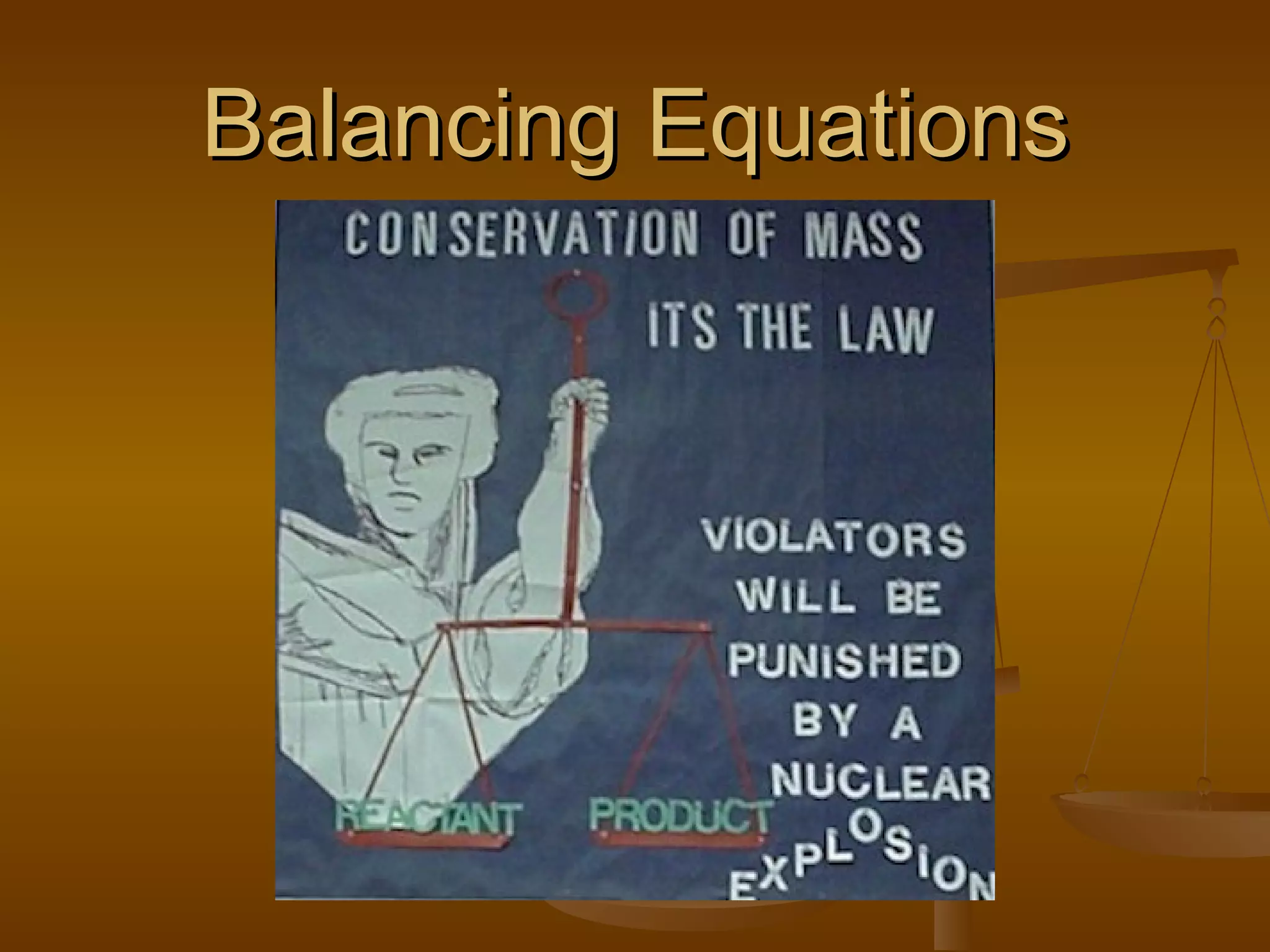
Balancing Equations Law of Conservation of Matter: In a chemical reaction, matter can be neither created nor destroyed. In a chemical reaction, the amount of reactants equal the amount of products.
Balancing Equations Paraphrase: Law of Conservation of  Atoms : The number of atoms of each type of element must be the same on each side of the equation.
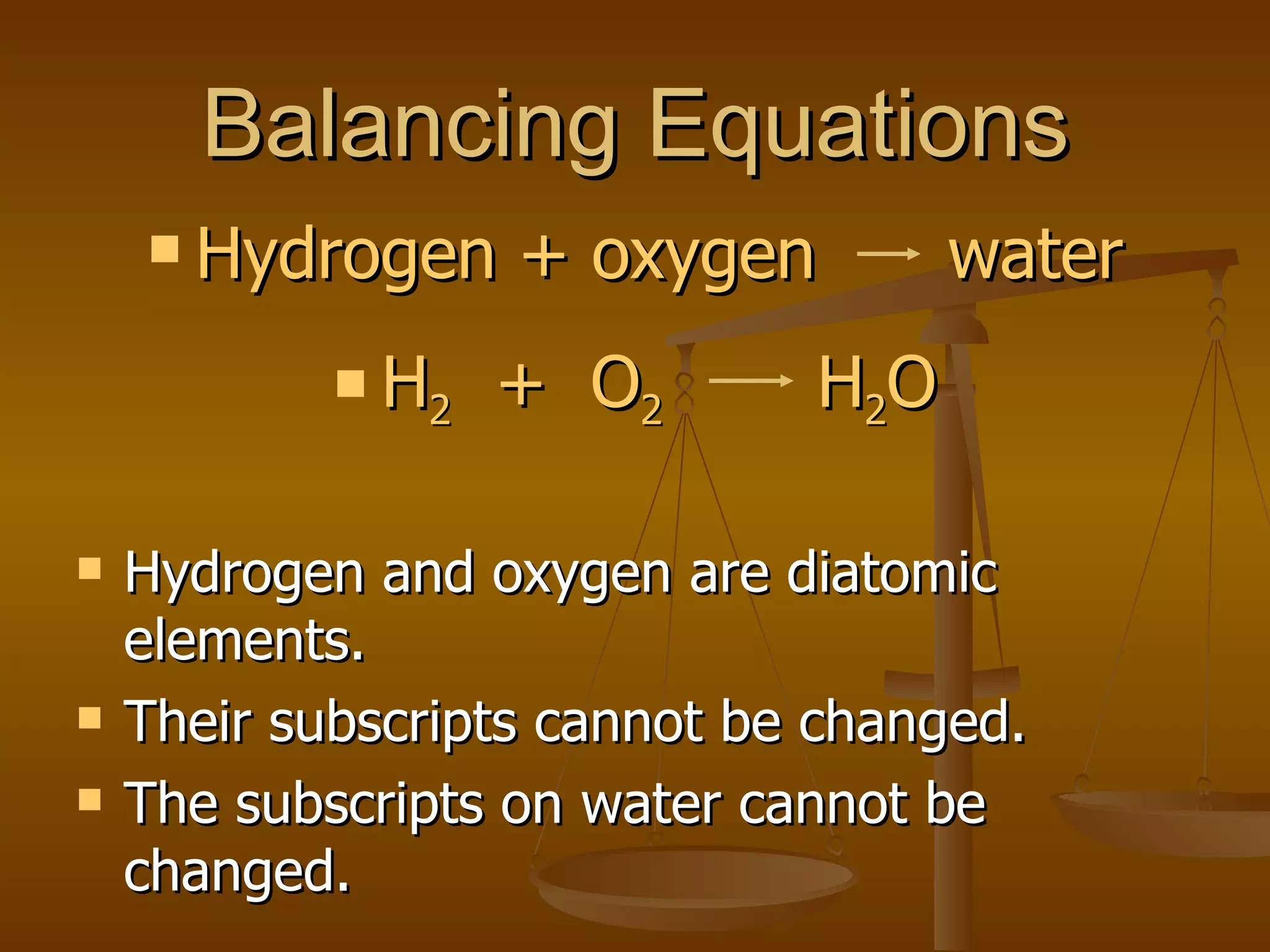
Balancing Equations Hydrogen and oxygen are diatomic elements. Their subscripts cannot be changed. The subscripts on water cannot be changed. Hydrogen + oxygen  water H 2   +  O 2   H 2 O
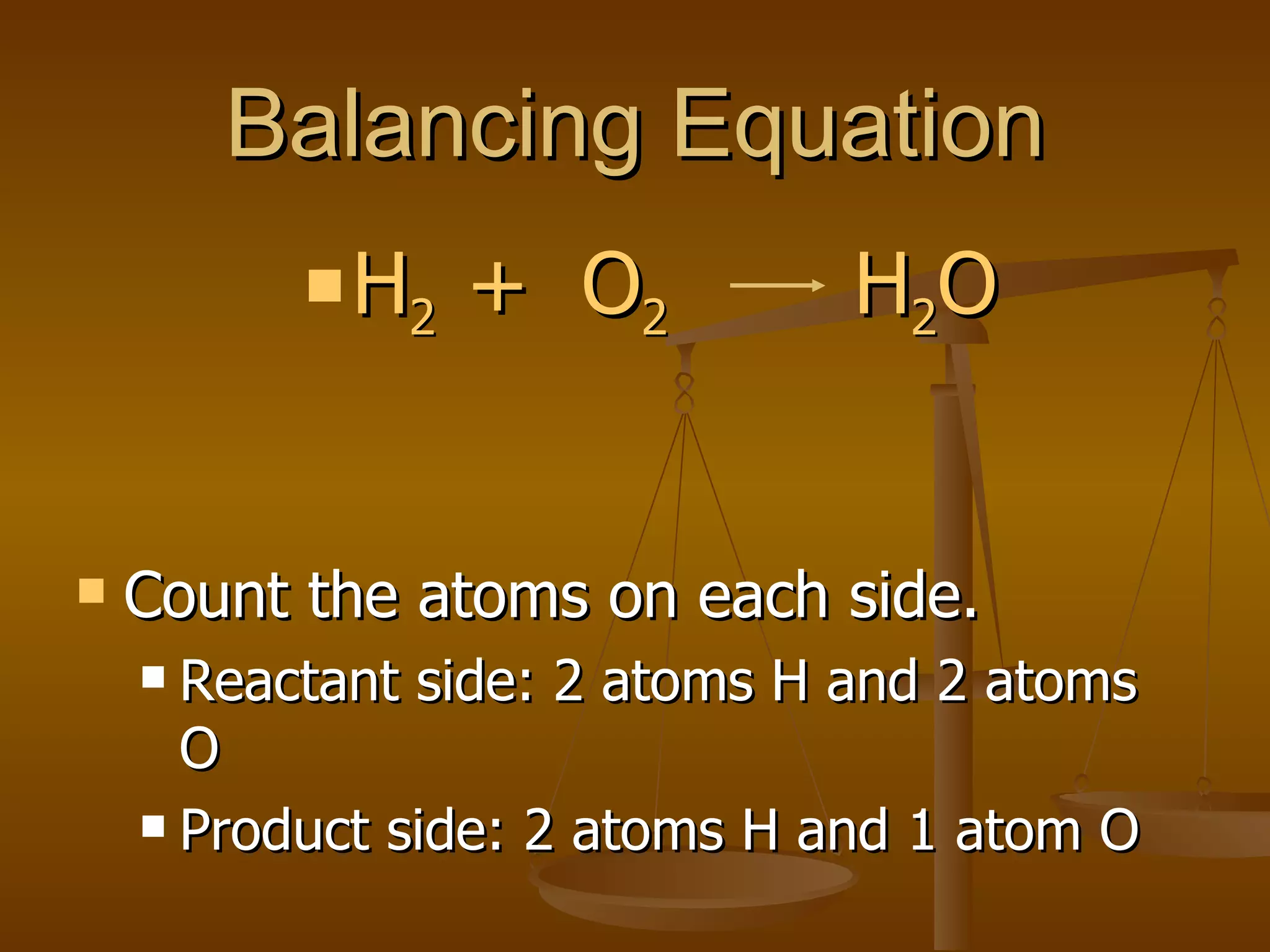
Balancing Equation Count the atoms on each side. Reactant side: 2 atoms H and 2 atoms O Product side: 2 atoms H and 1 atom O H 2  +  O 2   H 2 O
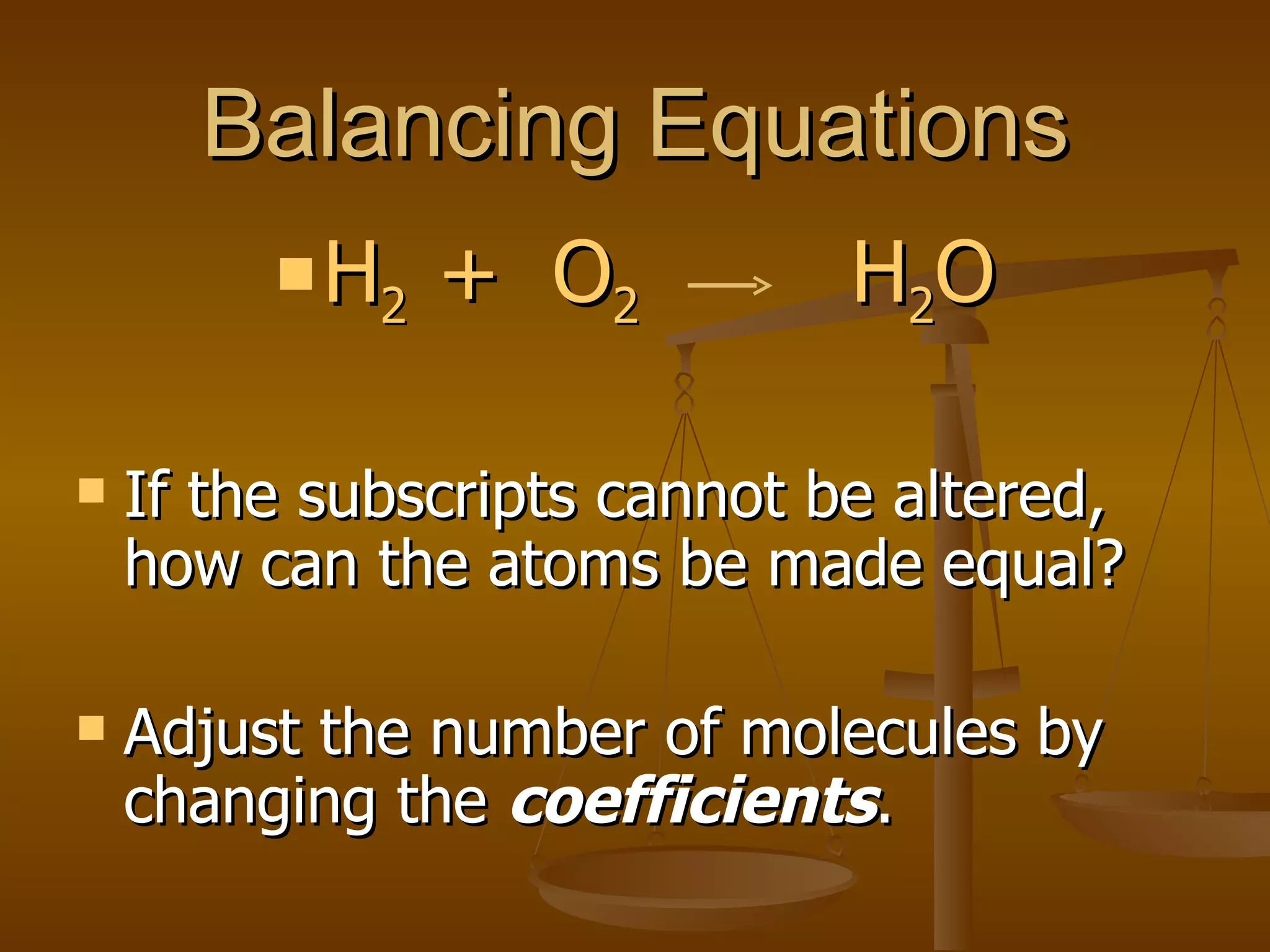
Balancing Equations H 2  +  O 2   H 2 O If the subscripts cannot be altered, how can the atoms be made equal? Adjust the number of molecules by changing the  coefficients .
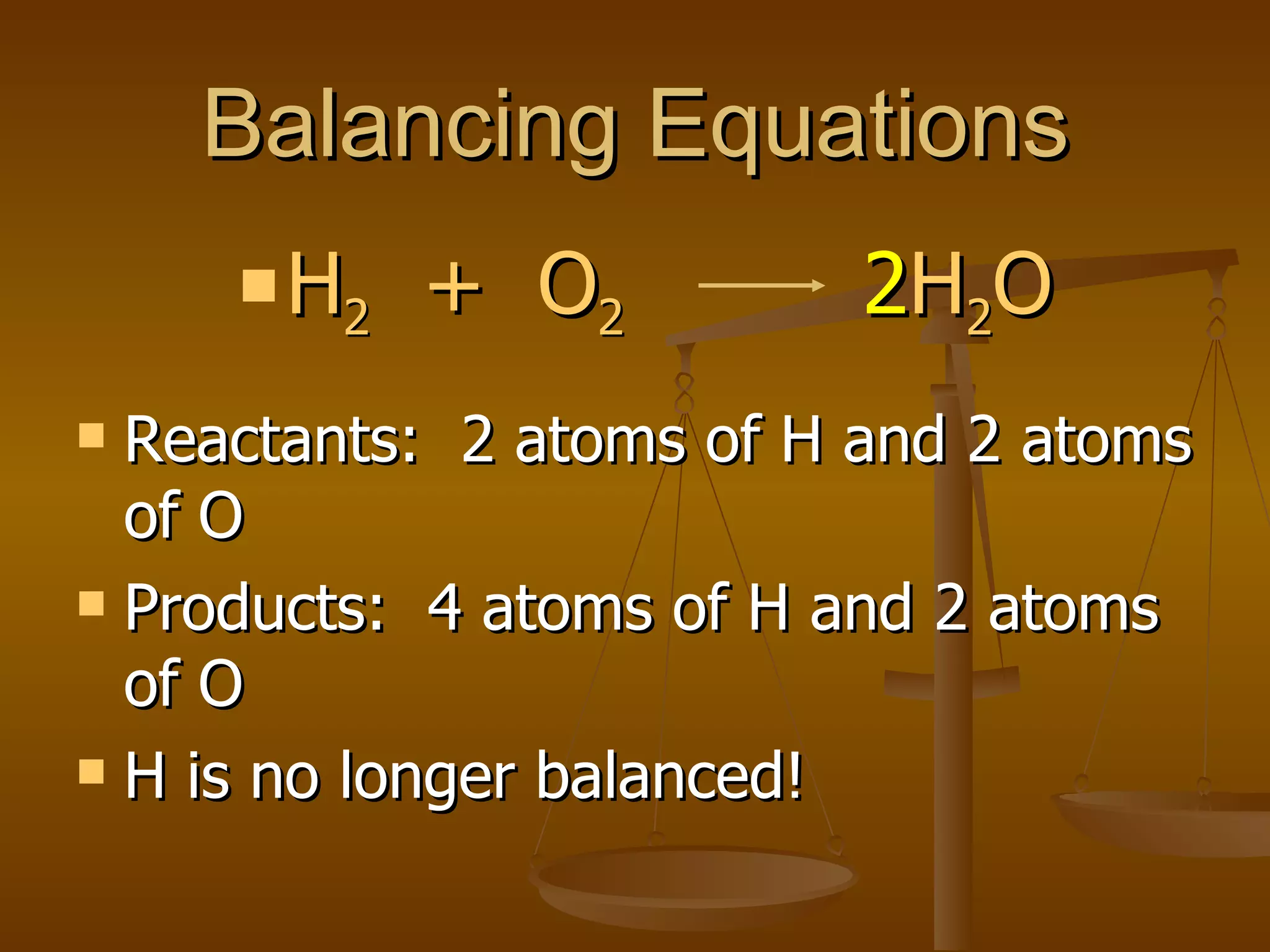
Balancing Equations Reactants:  2 atoms of H and 2 atoms of O Products:  4 atoms of H and 2 atoms of O H is no longer balanced! H 2   +  O 2   2 H 2 O
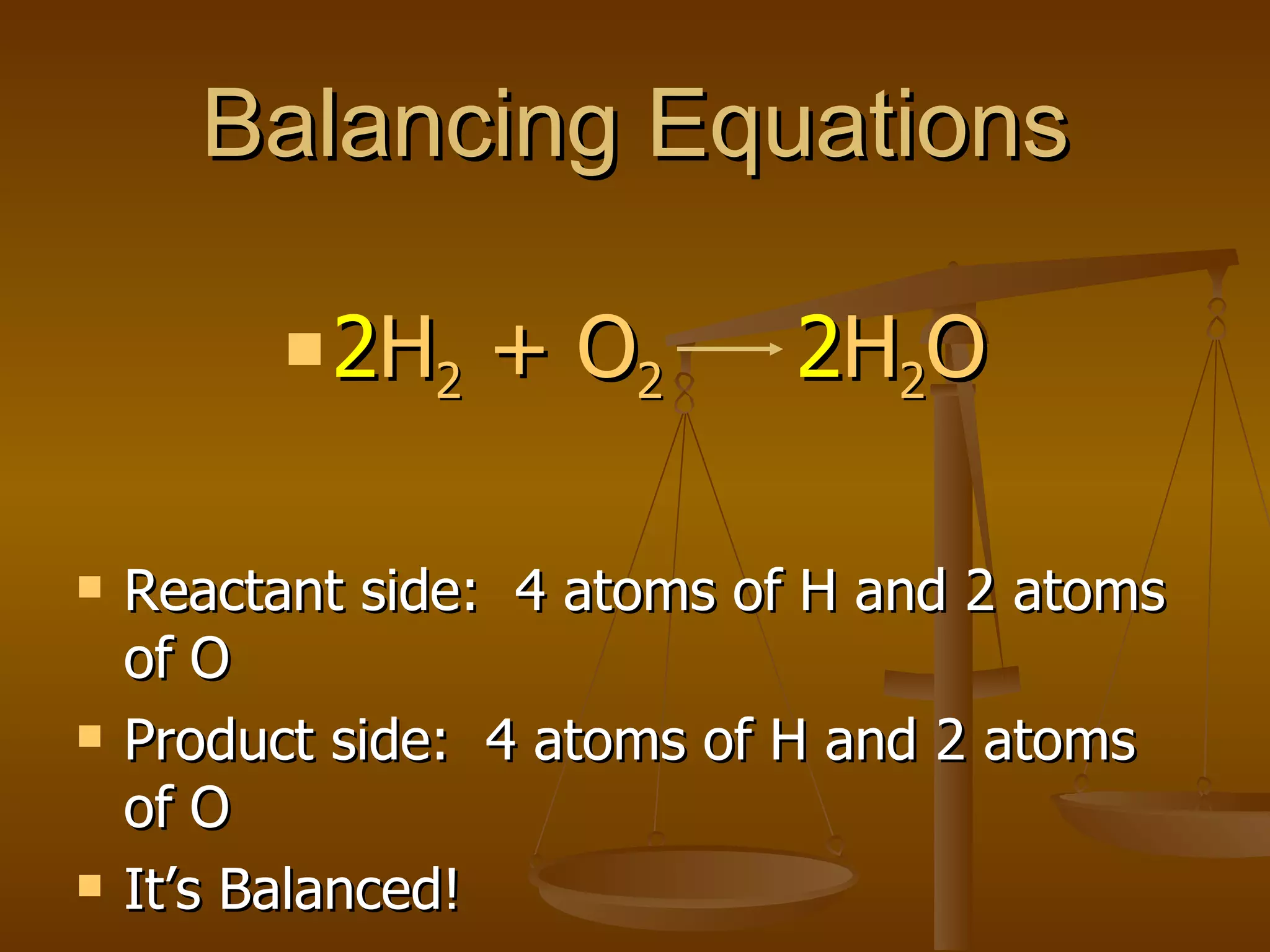
Balancing Equations Reactant side:  4 atoms of H and 2 atoms of O Product side:  4 atoms of H and 2 atoms of O It’s Balanced! 2 H 2  + O 2   2 H 2 O
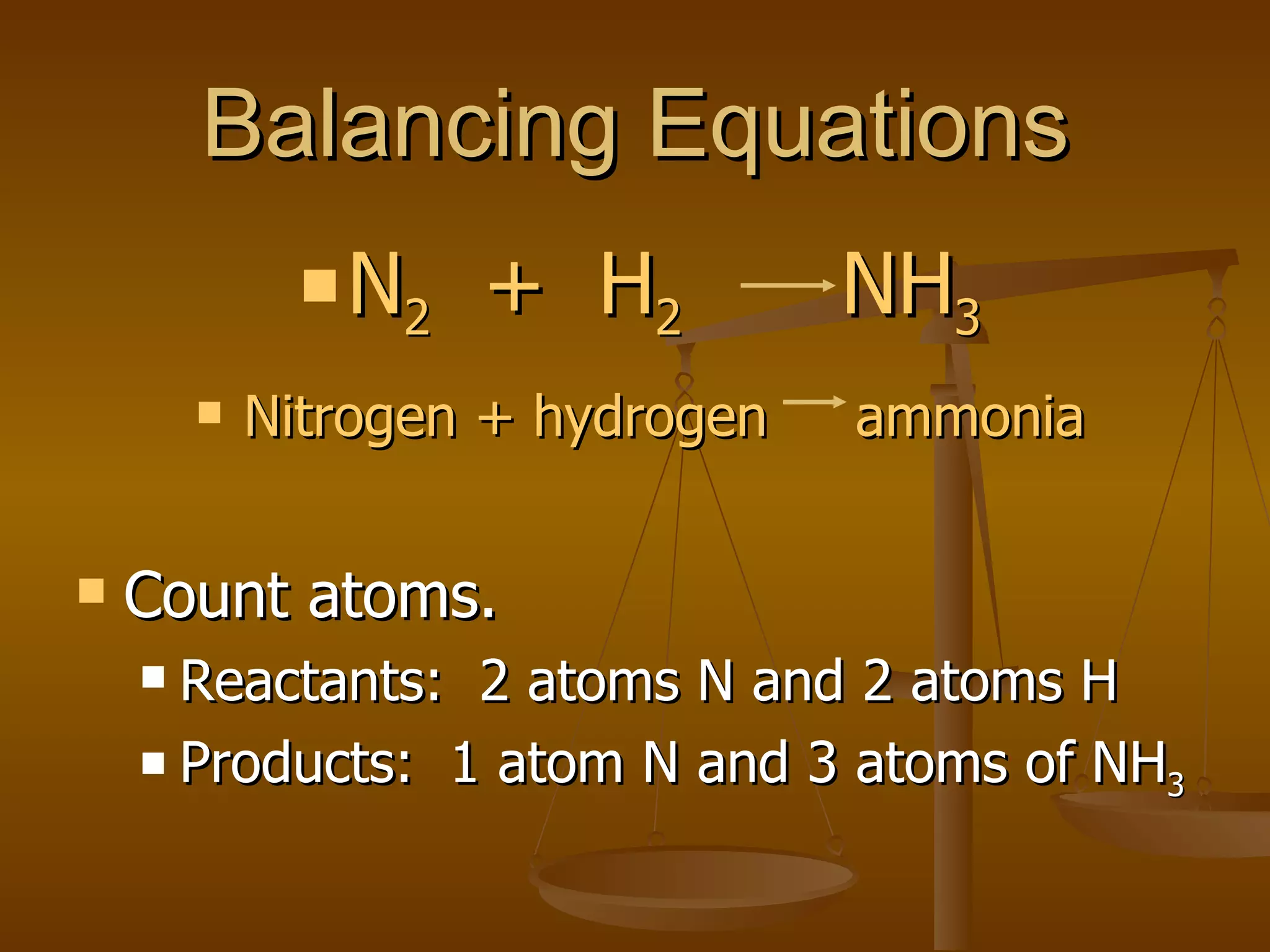
Balancing Equations Count atoms. Reactants:  2 atoms N and 2 atoms H Products:  1 atom N and 3 atoms of NH 3 N 2   +  H 2   NH 3 Nitrogen + hydrogen  ammonia
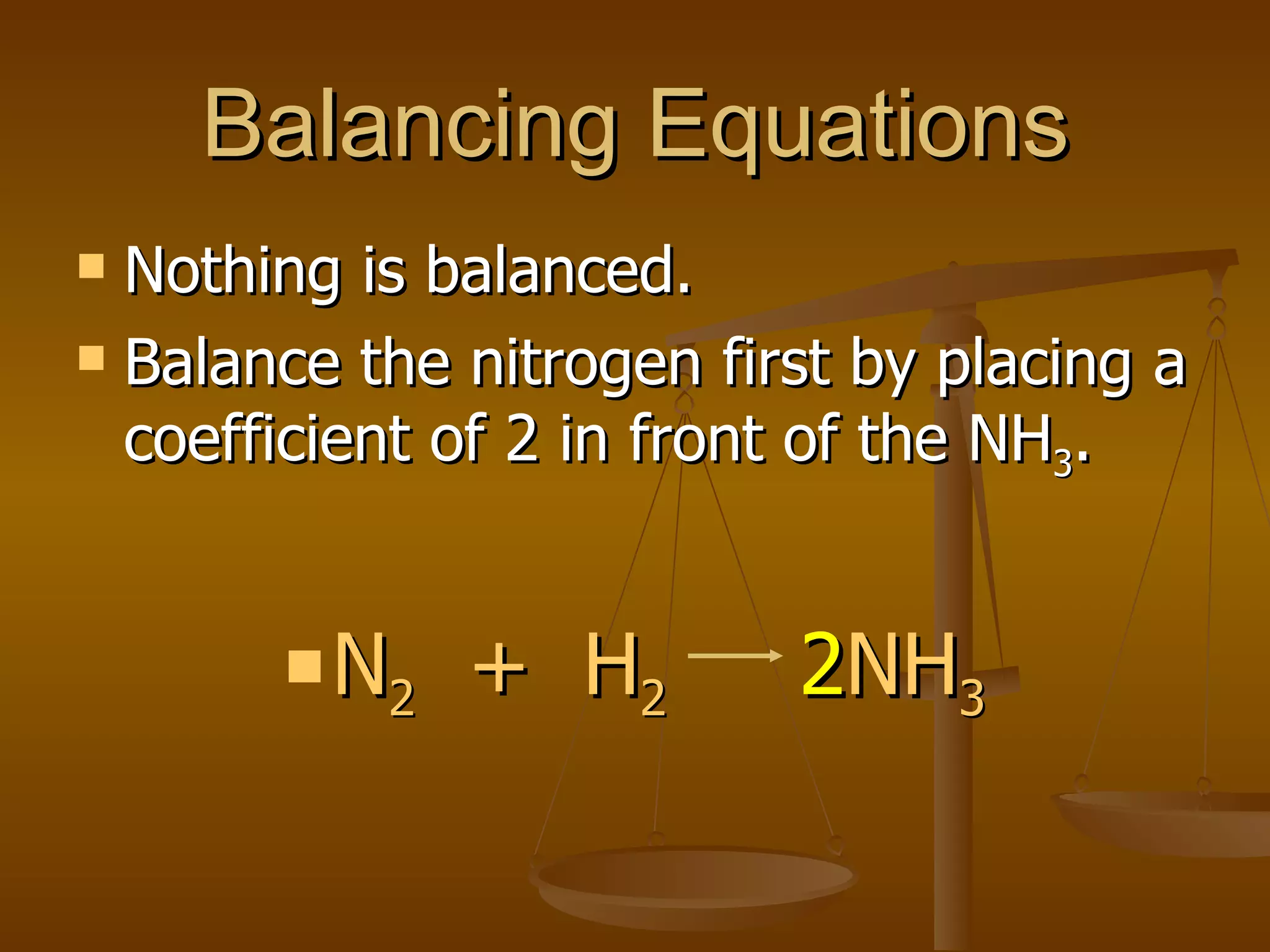
Balancing Equations Nothing is balanced. Balance the nitrogen first by placing a coefficient of 2 in front of the NH 3 . N 2   +  H 2   2 NH 3
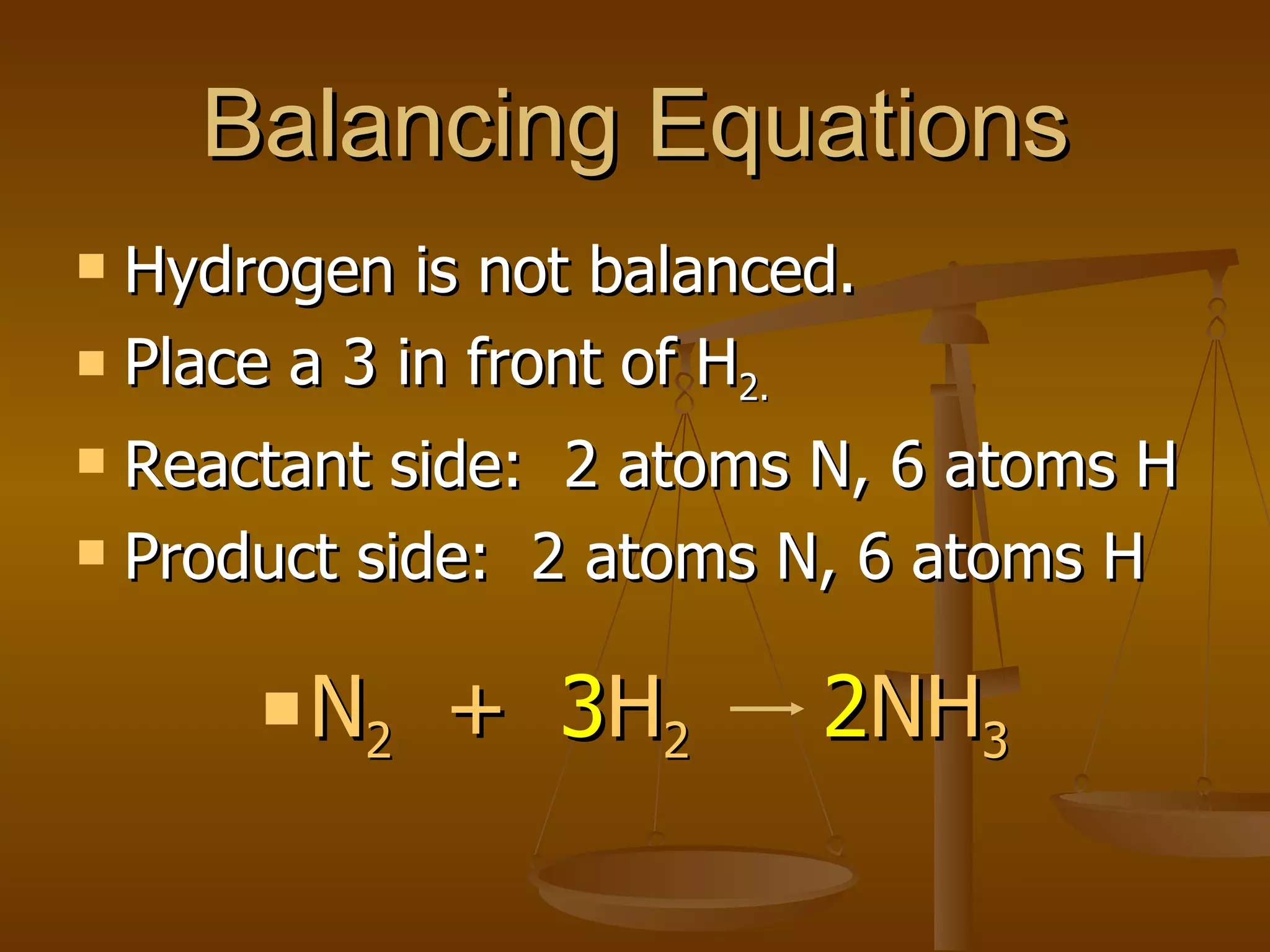
Balancing Equations Hydrogen is not balanced. Place a 3 in front of H 2. Reactant side:  2 atoms N, 6 atoms H Product side:  2 atoms N, 6 atoms H N 2   +  3 H 2   2 NH 3
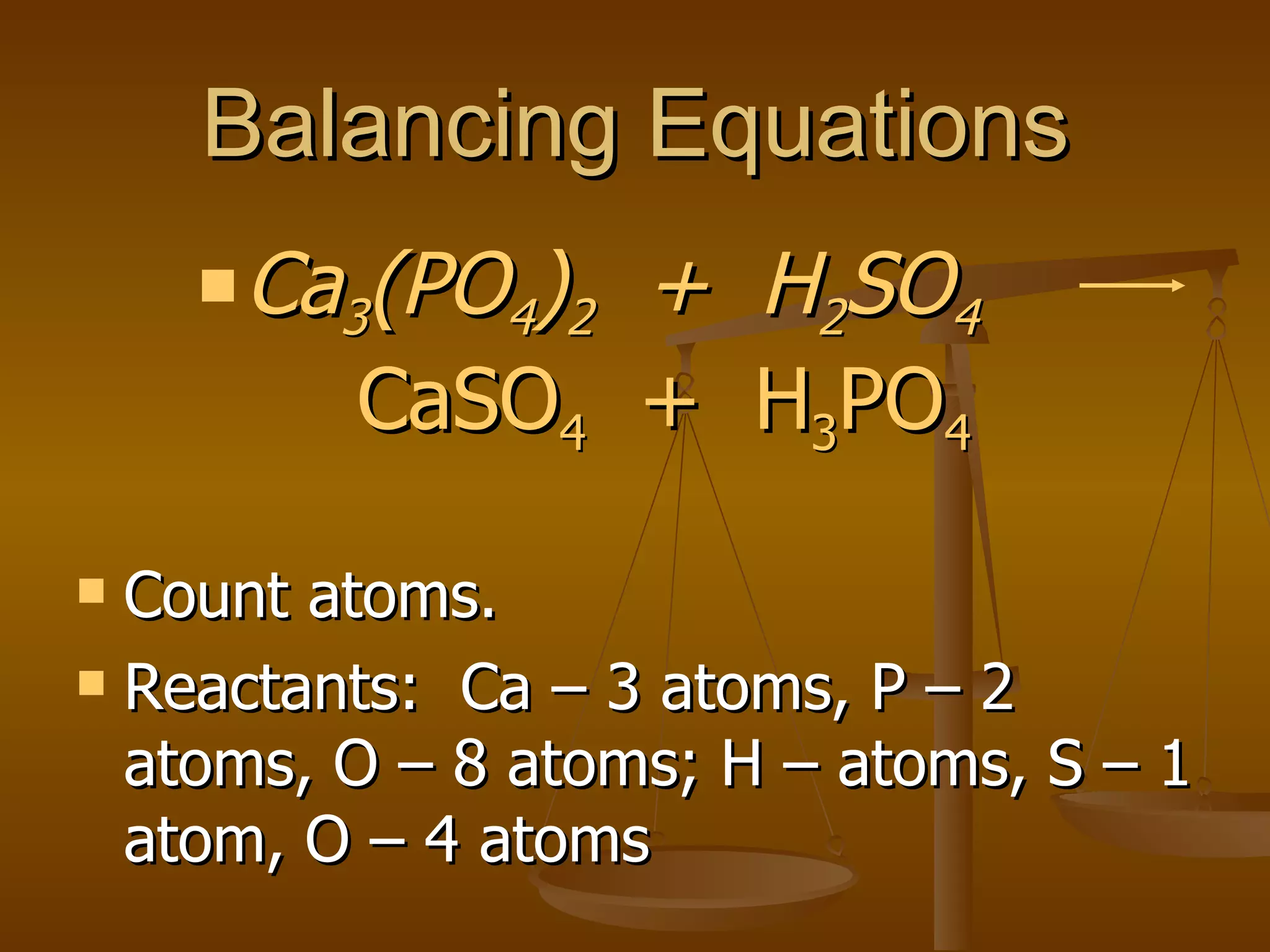
Balancing Equations Count atoms. Reactants:  Ca – 3 atoms, P – 2 atoms, O – 8 atoms; H – atoms, S – 1 atom, O – 4 atoms Ca 3 (PO 4 ) 2   +  H 2 SO 4   CaSO 4   +  H 3 PO 4
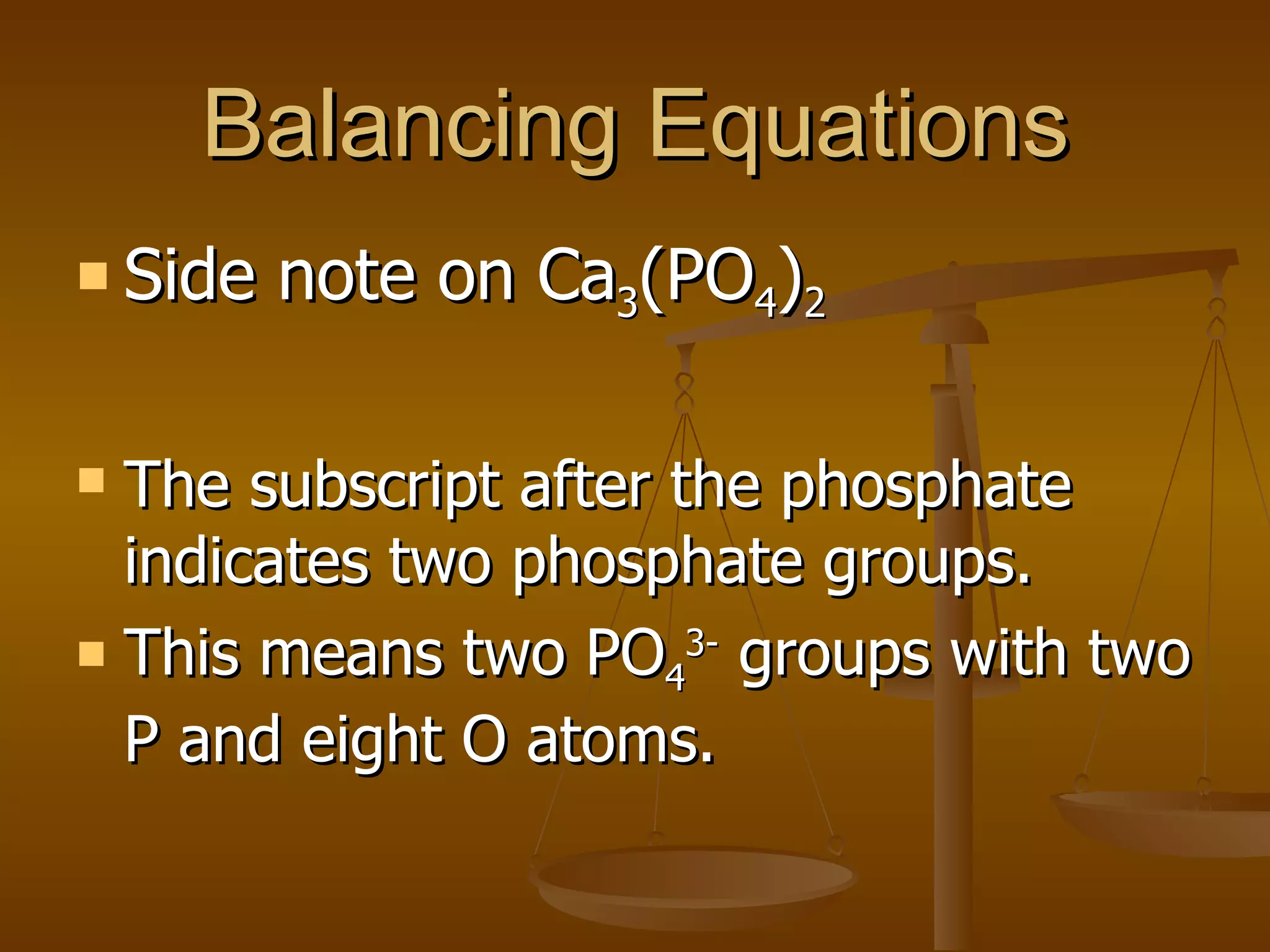
Balancing Equations Side note on Ca 3 (PO 4 ) 2 The subscript after the phosphate indicates two phosphate groups. This means two PO 4 3-  groups with two P and eight O atoms.
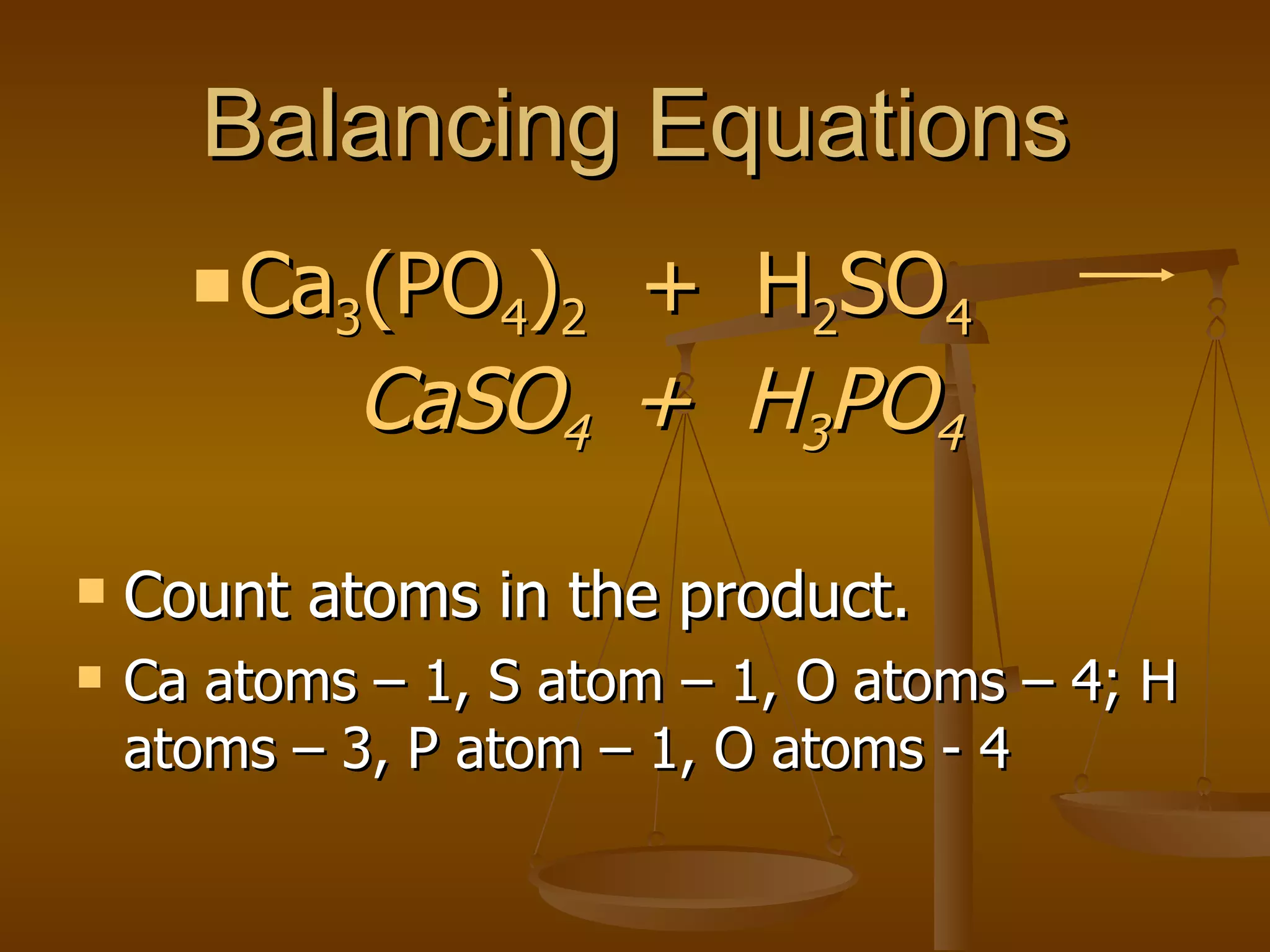
Balancing Equations Ca 3 (PO 4 ) 2   +  H 2 SO 4   CaSO 4  +  H 3 PO 4 Count atoms in the product. Ca atoms – 1, S atom – 1, O atoms – 4; H atoms – 3, P atom – 1, O atoms - 4
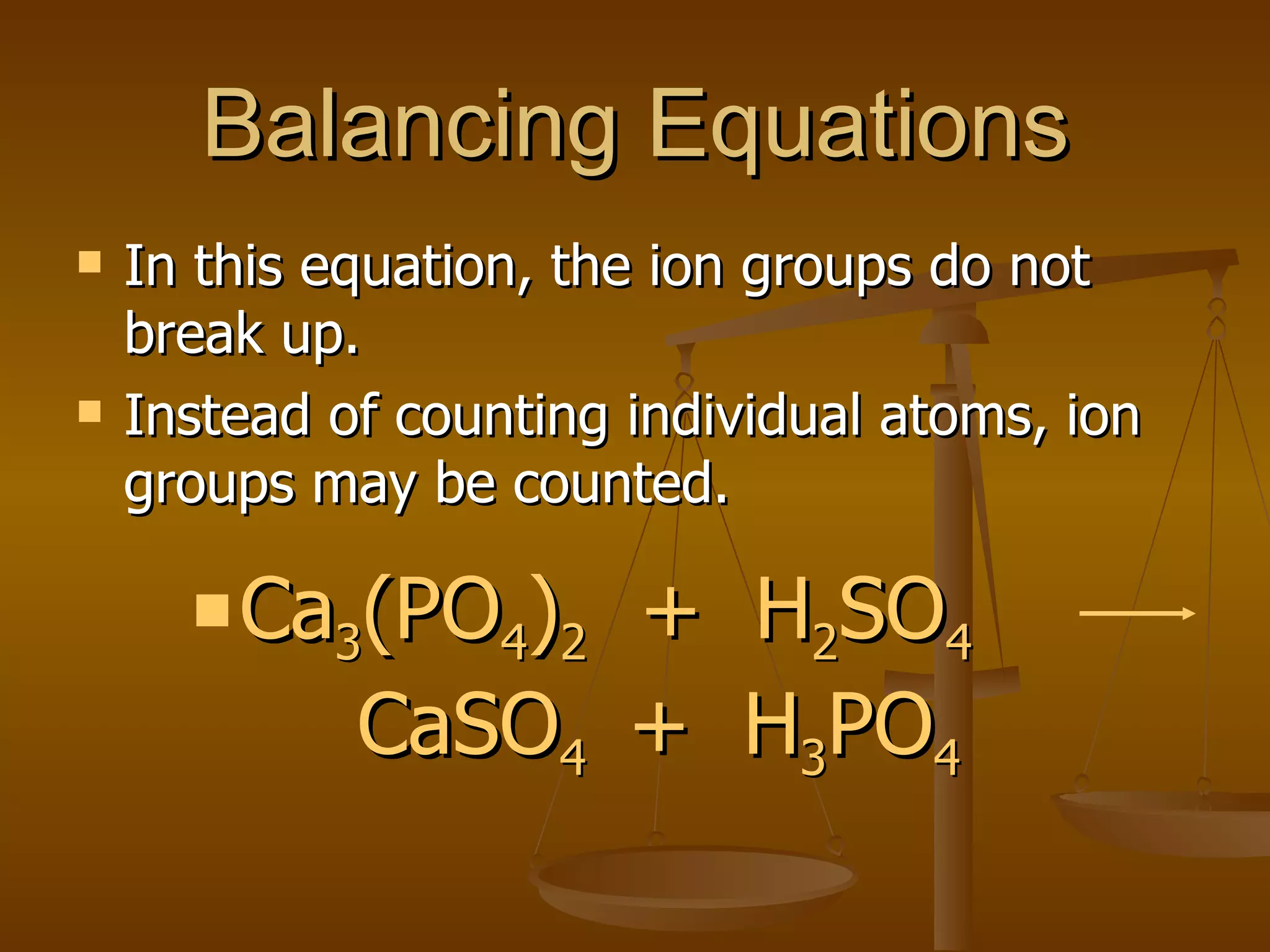
Balancing Equations In this equation, the ion groups do not break up. Instead of counting individual atoms, ion groups may be counted. Ca 3 (PO 4 ) 2   +  H 2 SO 4   CaSO 4  +  H 3 PO 4
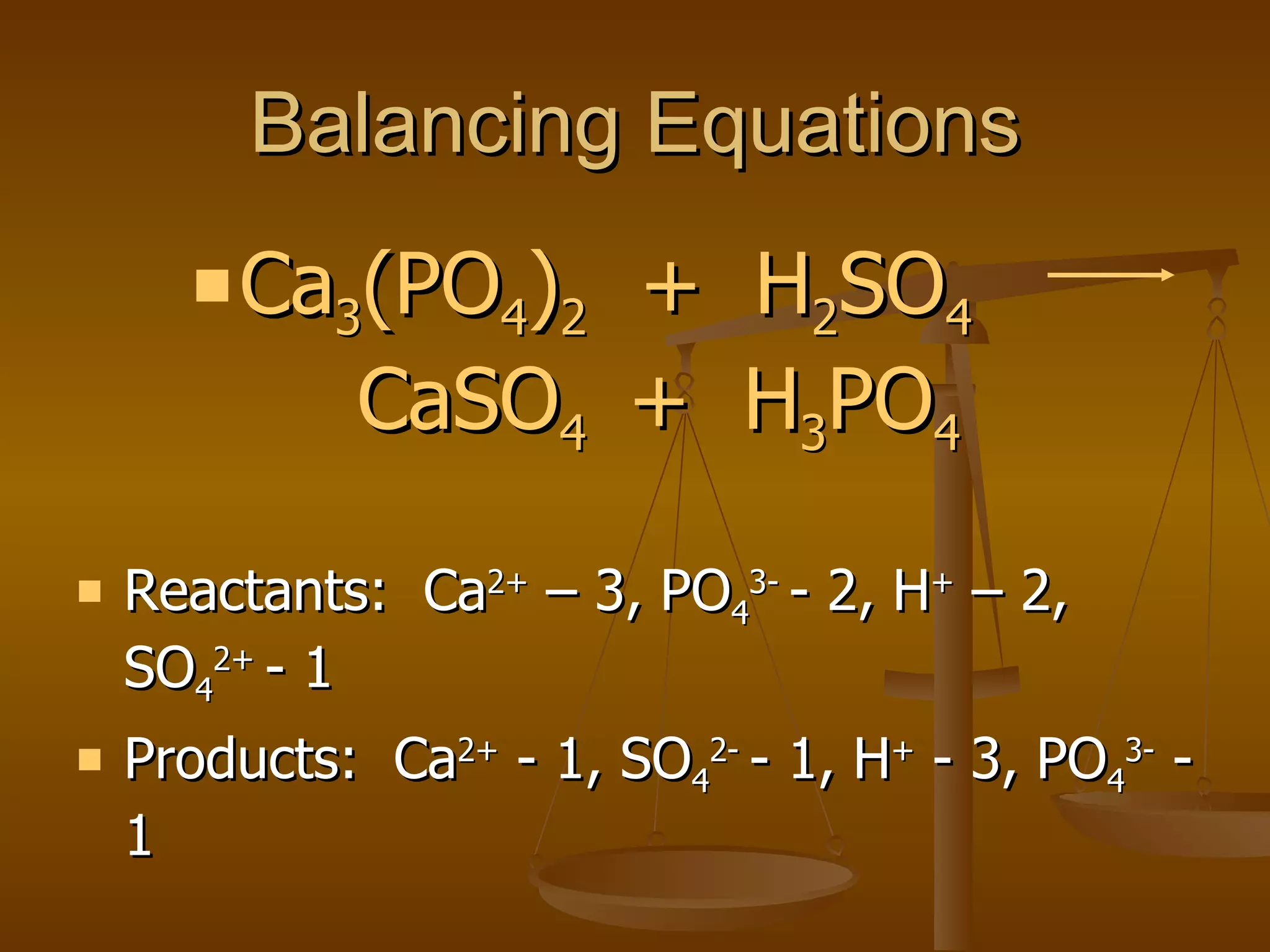
Balancing Equations Ca 3 (PO 4 ) 2   +  H 2 SO 4   CaSO 4  +  H 3 PO 4 Reactants:  Ca 2+  – 3, PO 4 3-  - 2, H +  – 2, SO 4 2+  - 1 Products:  Ca 2+  - 1, SO 4 2-  - 1, H +  - 3, PO 4 3-  - 1
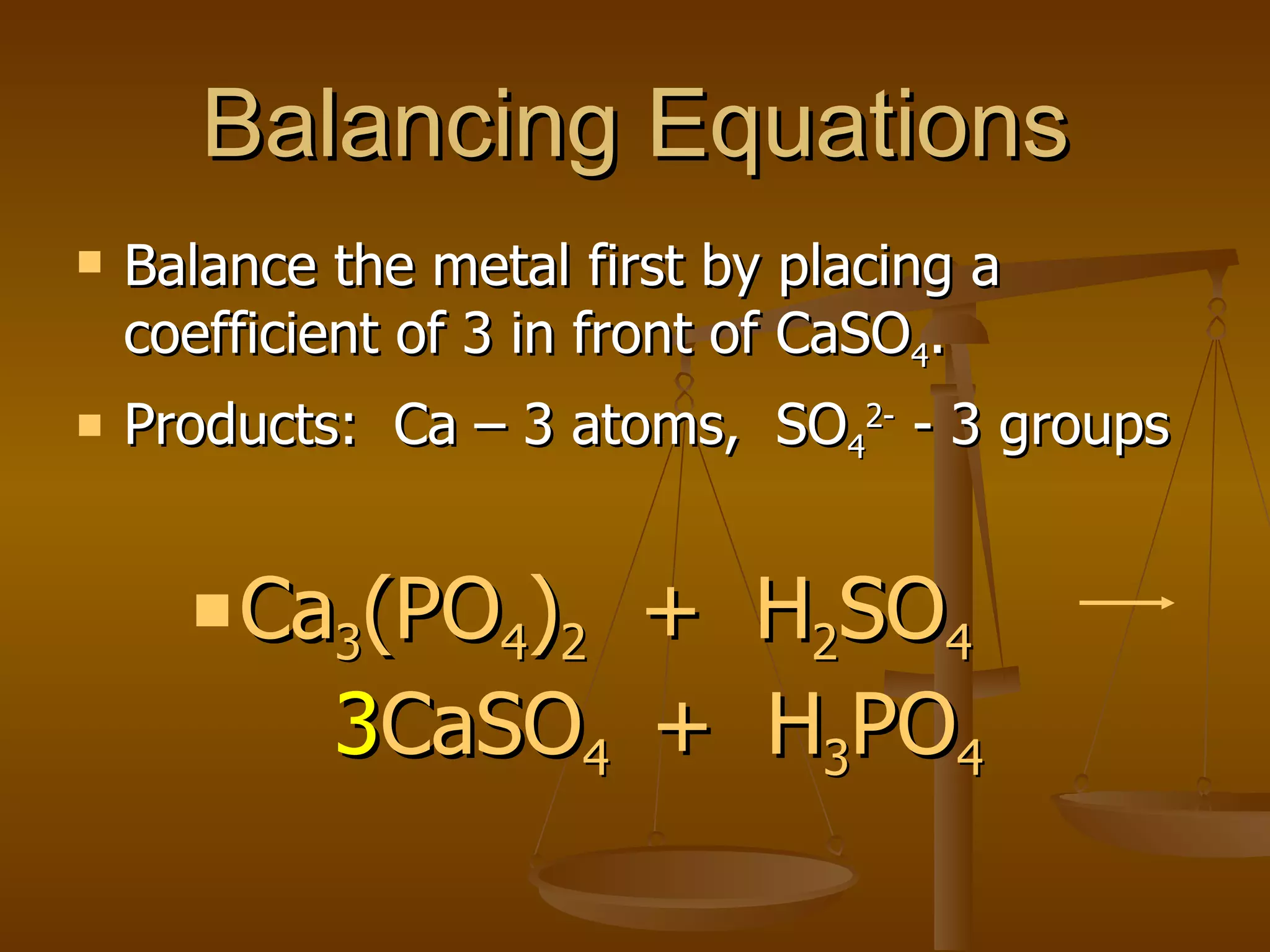
Balancing Equations Balance the metal first by placing a coefficient of 3 in front of CaSO 4 . Products:  Ca – 3 atoms,  SO 4 2-  - 3 groups Ca 3 (PO 4 ) 2   +  H 2 SO 4   3 CaSO 4  +  H 3 PO 4
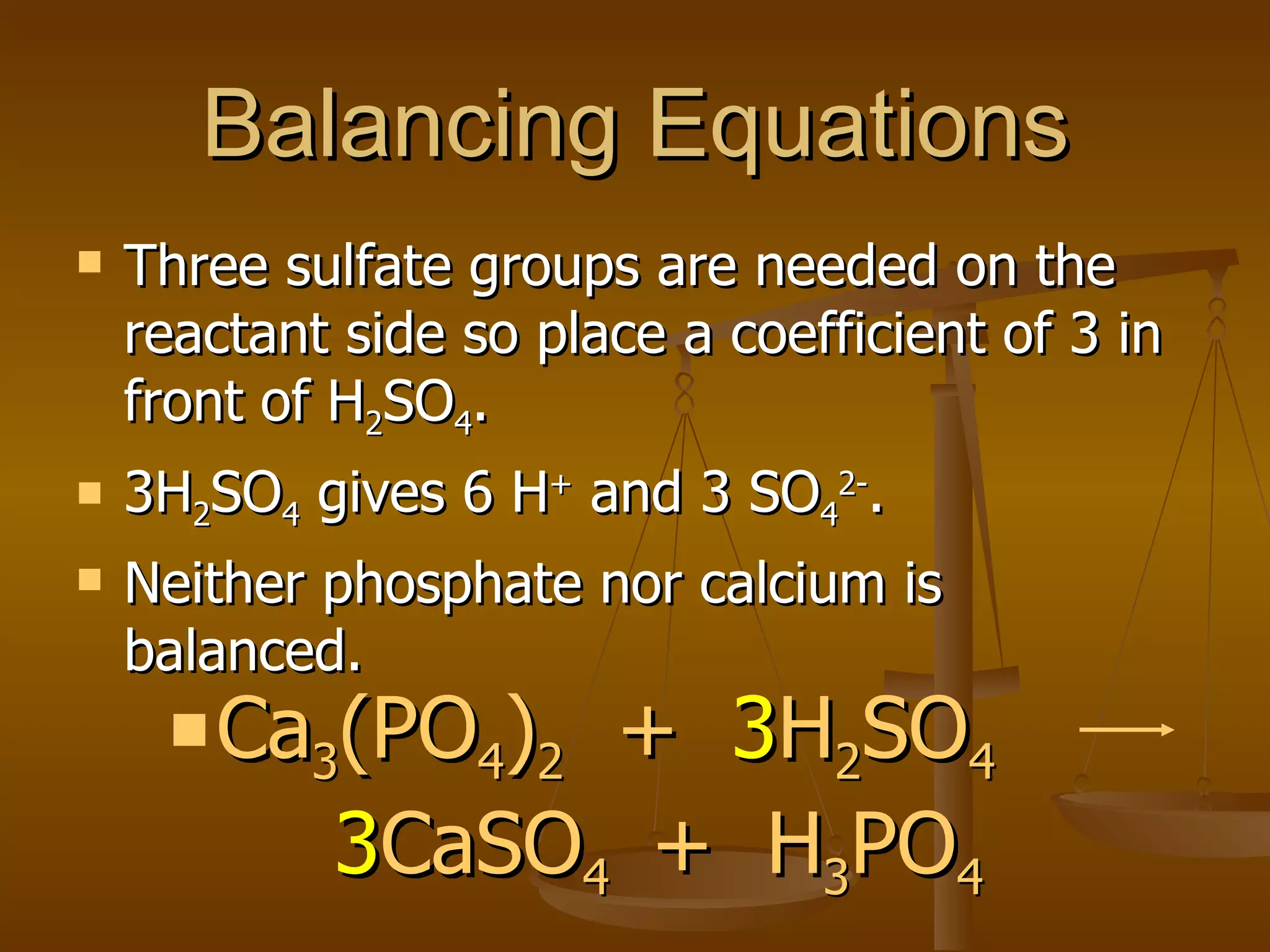
Balancing Equations Three sulfate groups are needed on the reactant side so place a coefficient of 3 in front of H 2 SO 4 . 3H 2 SO 4  gives 6 H +  and 3 SO 4 2- . Neither phosphate nor calcium is balanced. Ca 3 (PO 4 ) 2   +  3 H 2 SO 4   3 CaSO 4  +  H 3 PO 4
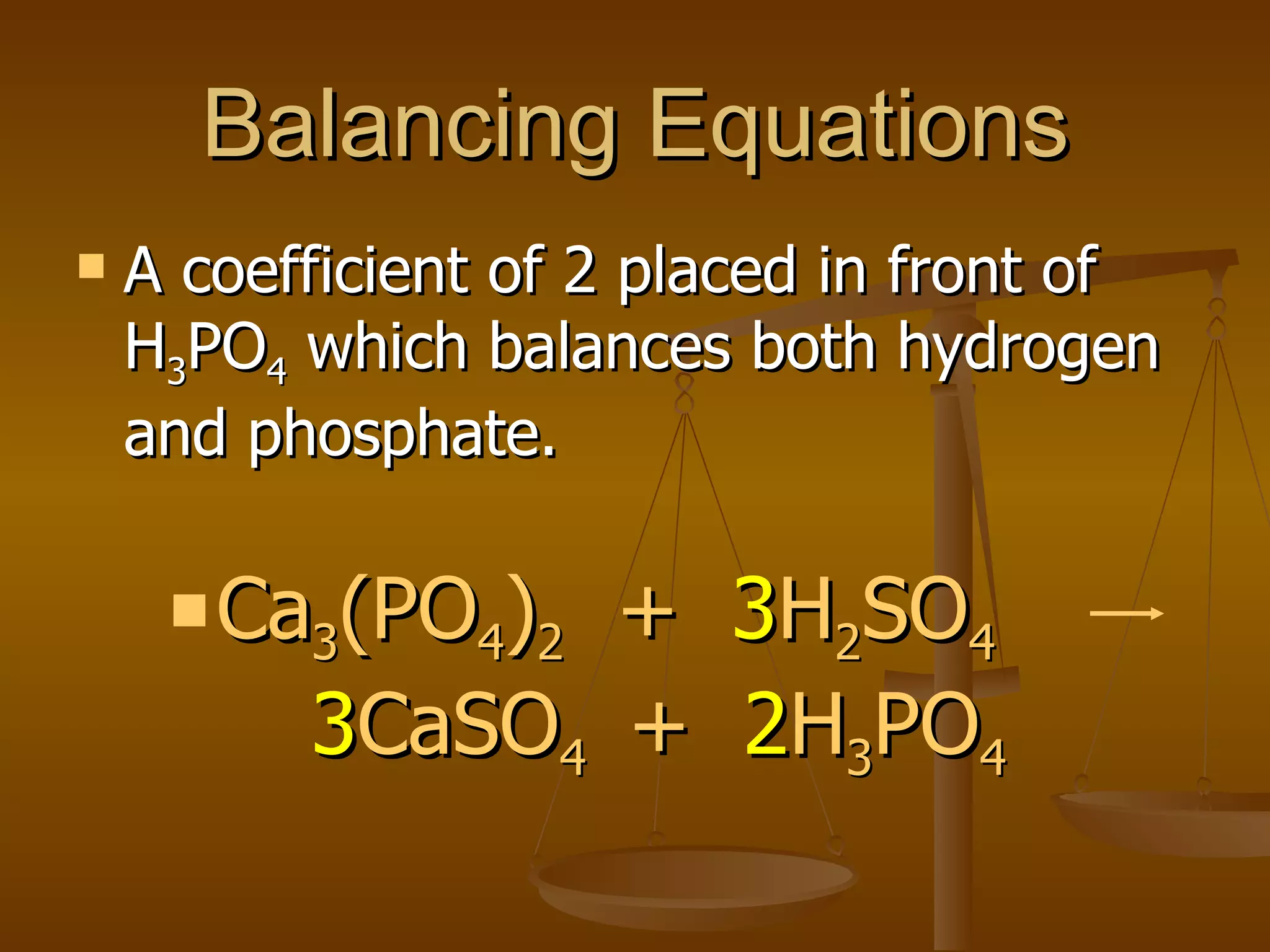
Balancing Equations A coefficient of 2 placed in front of H 3 PO 4  which balances both hydrogen and phosphate. Ca 3 (PO 4 ) 2   +  3 H 2 SO 4   3 CaSO 4  +  2 H 3 PO 4
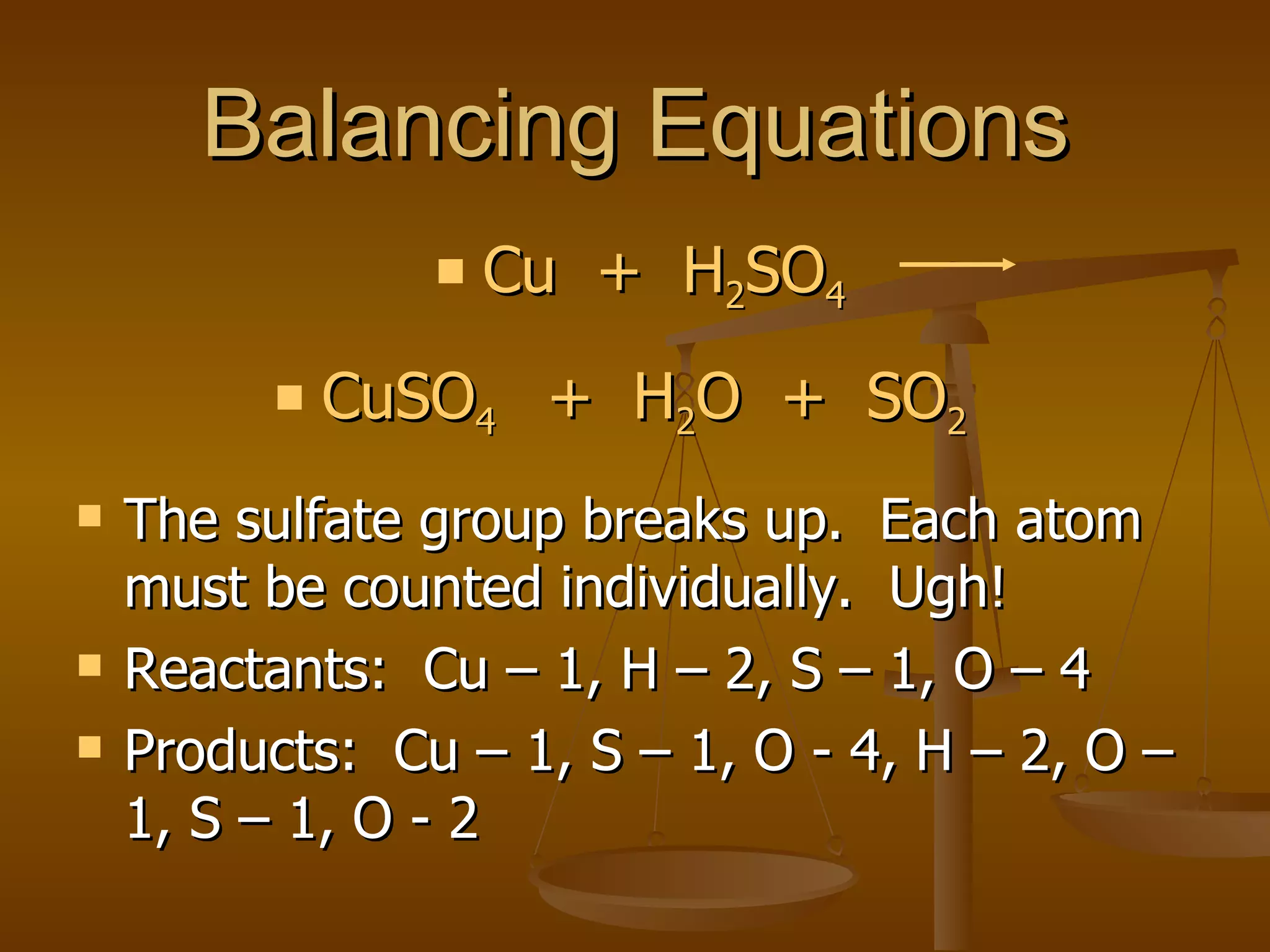
Balancing Equations The sulfate group breaks up.  Each atom must be counted individually.  Ugh! Reactants:  Cu – 1, H – 2, S – 1, O – 4 Products:  Cu – 1, S – 1, O - 4, H – 2, O – 1, S – 1, O - 2 Cu  +  H 2 SO 4 CuSO 4  +  H 2 O  +  SO 2
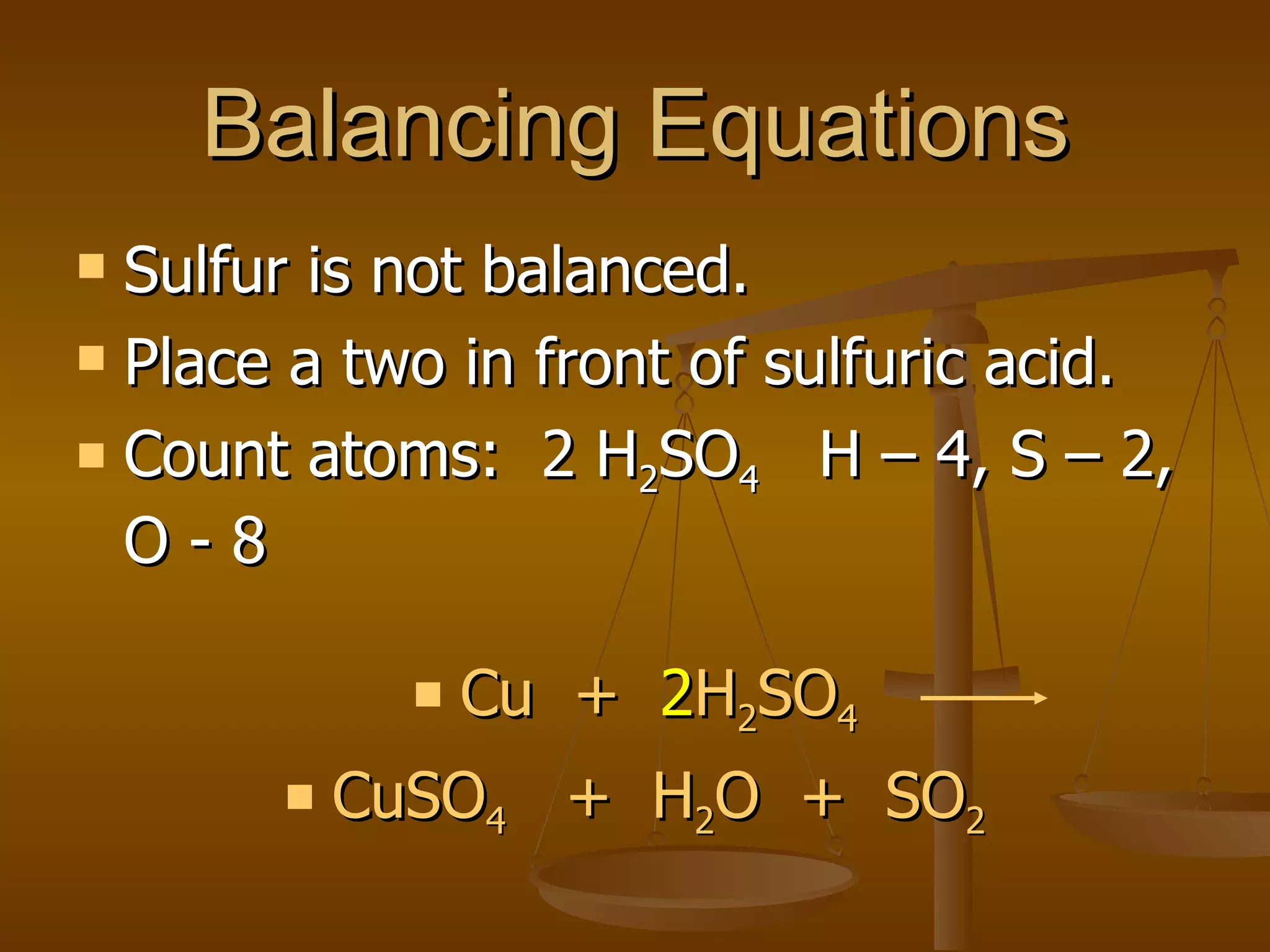
Balancing Equations Sulfur is not balanced. Place a two in front of sulfuric acid. Count atoms:  2 H 2 SO 4   H – 4, S – 2, O - 8 Cu  +  2 H 2 SO 4 CuSO 4   +  H 2 O  +  SO 2
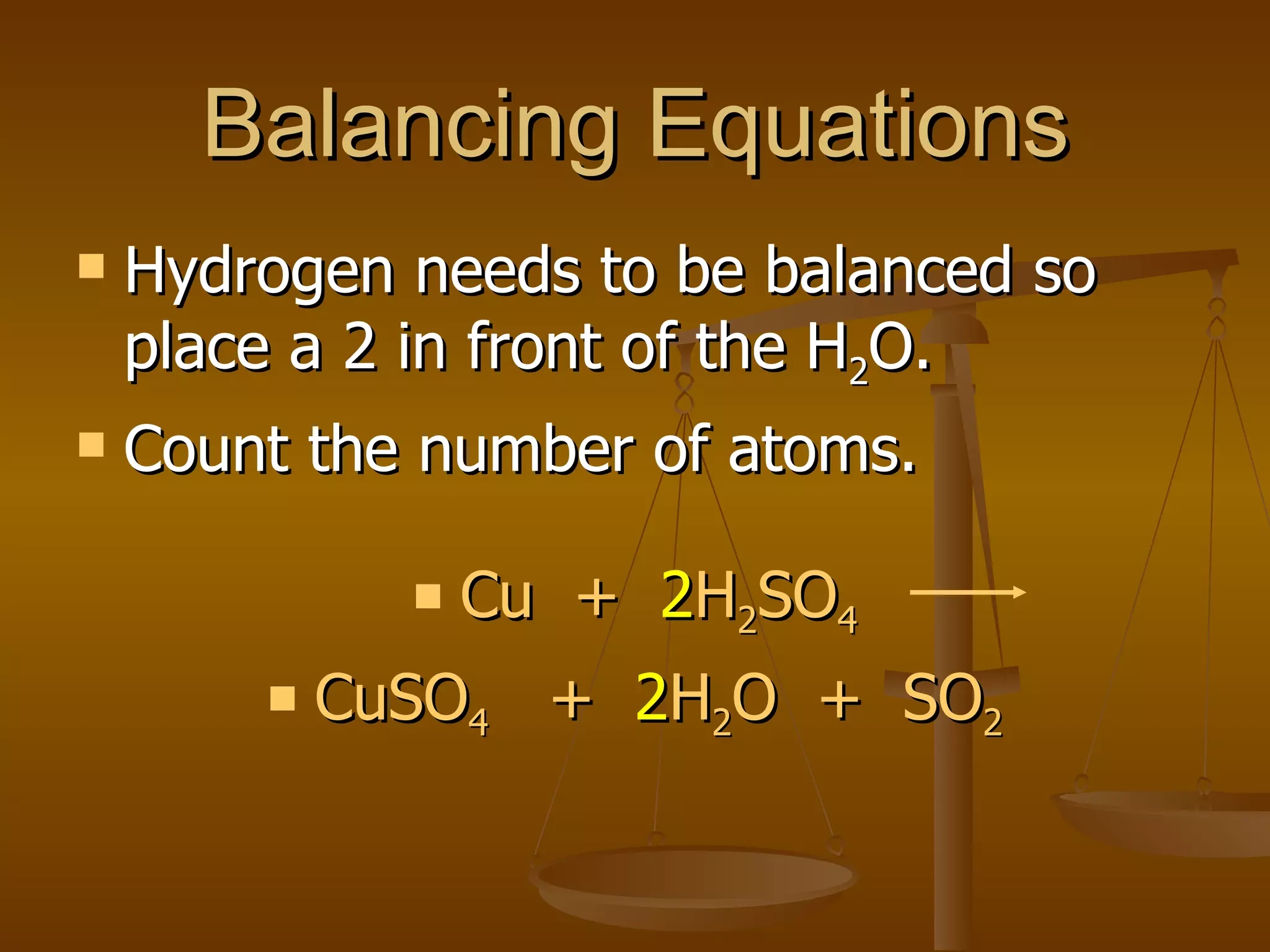
Balancing Equations Hydrogen needs to be balanced so place a 2 in front of the H 2 O.  Count the number of atoms. Cu  +  2 H 2 SO 4 CuSO 4   +  2 H 2 O  +  SO 2
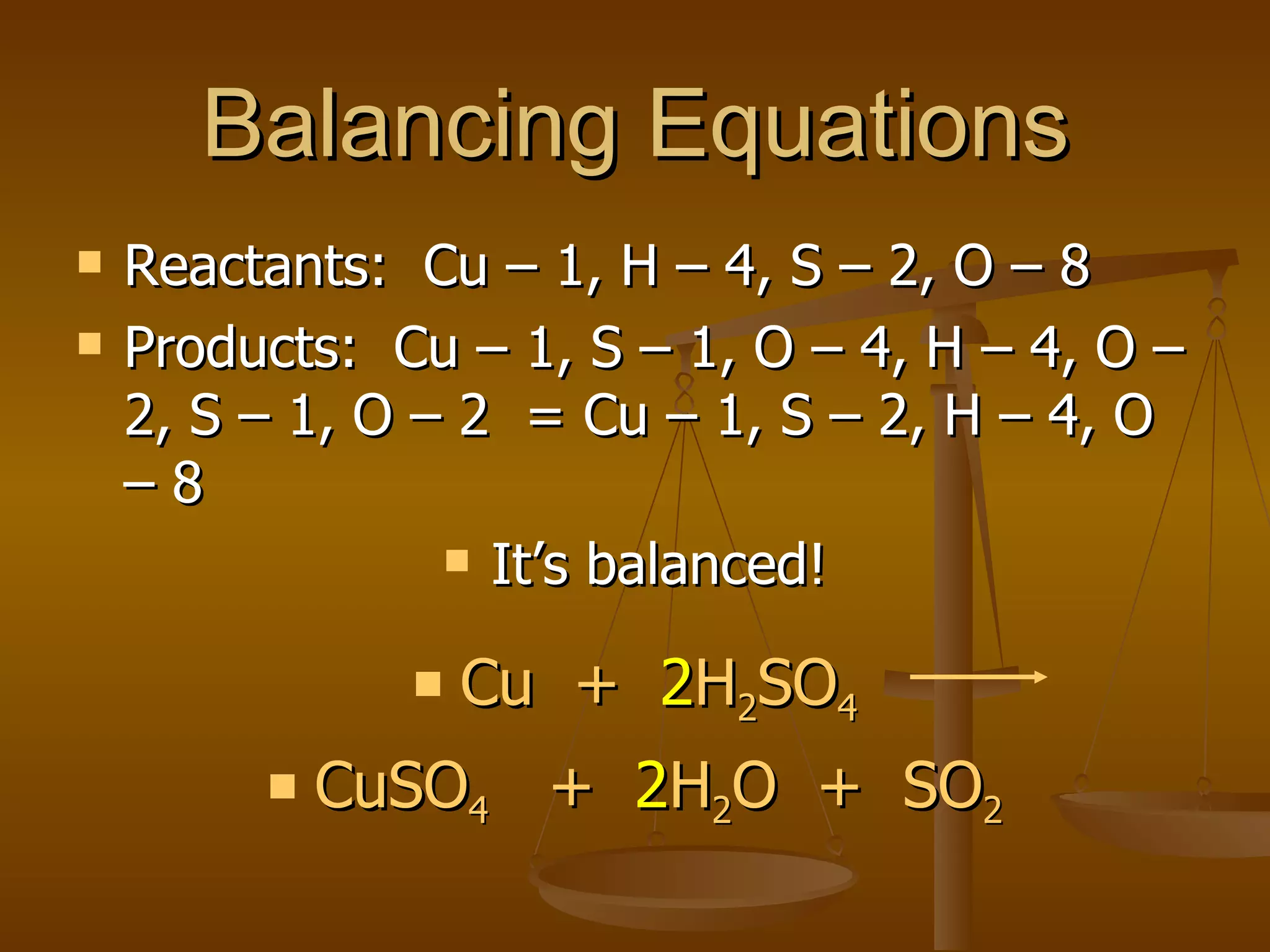
Balancing Equations Reactants:  Cu – 1, H – 4, S – 2, O – 8 Products:  Cu – 1, S – 1, O – 4, H – 4, O – 2, S – 1, O – 2  = Cu – 1, S – 2, H – 4, O – 8 It’s balanced! Cu  +  2 H 2 SO 4 CuSO 4   +  2 H 2 O  +  SO 2
Balancing Equations Balancing hints: Balance the metals first. Balance the ion groups next. Balance the other atoms. Save the non ion group oxygen and hydrogen until the end.
Balancing Equations This method of balancing equations is the inspection method. The method is trial and error. Practice.

Balancing Equations #1

  • 1.
    Balancing Equations Balancing,Writing, and Naming Equations
  • 2.
  • 3.
    Balancing Equations Lawof Conservation of Matter: In a chemical reaction, matter can be neither created nor destroyed. In a chemical reaction, the amount of reactants equal the amount of products.
  • 4.
    Balancing Equations Paraphrase:Law of Conservation of Atoms : The number of atoms of each type of element must be the same on each side of the equation.
  • 5.
    Balancing Equations Hydrogenand oxygen are diatomic elements. Their subscripts cannot be changed. The subscripts on water cannot be changed. Hydrogen + oxygen water H 2 + O 2 H 2 O
  • 6.
    Balancing Equation Countthe atoms on each side. Reactant side: 2 atoms H and 2 atoms O Product side: 2 atoms H and 1 atom O H 2 + O 2 H 2 O
  • 7.
    Balancing Equations H2 + O 2 H 2 O If the subscripts cannot be altered, how can the atoms be made equal? Adjust the number of molecules by changing the coefficients .
  • 8.
    Balancing Equations Reactants: 2 atoms of H and 2 atoms of O Products: 4 atoms of H and 2 atoms of O H is no longer balanced! H 2 + O 2 2 H 2 O
  • 9.
    Balancing Equations Reactantside: 4 atoms of H and 2 atoms of O Product side: 4 atoms of H and 2 atoms of O It’s Balanced! 2 H 2 + O 2 2 H 2 O
  • 10.
    Balancing Equations Countatoms. Reactants: 2 atoms N and 2 atoms H Products: 1 atom N and 3 atoms of NH 3 N 2 + H 2 NH 3 Nitrogen + hydrogen ammonia
  • 11.
    Balancing Equations Nothingis balanced. Balance the nitrogen first by placing a coefficient of 2 in front of the NH 3 . N 2 + H 2 2 NH 3
  • 12.
    Balancing Equations Hydrogenis not balanced. Place a 3 in front of H 2. Reactant side: 2 atoms N, 6 atoms H Product side: 2 atoms N, 6 atoms H N 2 + 3 H 2 2 NH 3
  • 13.
    Balancing Equations Countatoms. Reactants: Ca – 3 atoms, P – 2 atoms, O – 8 atoms; H – atoms, S – 1 atom, O – 4 atoms Ca 3 (PO 4 ) 2 + H 2 SO 4 CaSO 4 + H 3 PO 4
  • 14.
    Balancing Equations Sidenote on Ca 3 (PO 4 ) 2 The subscript after the phosphate indicates two phosphate groups. This means two PO 4 3- groups with two P and eight O atoms.
  • 15.
    Balancing Equations Ca3 (PO 4 ) 2 + H 2 SO 4 CaSO 4 + H 3 PO 4 Count atoms in the product. Ca atoms – 1, S atom – 1, O atoms – 4; H atoms – 3, P atom – 1, O atoms - 4
  • 16.
    Balancing Equations Inthis equation, the ion groups do not break up. Instead of counting individual atoms, ion groups may be counted. Ca 3 (PO 4 ) 2 + H 2 SO 4 CaSO 4 + H 3 PO 4
  • 17.
    Balancing Equations Ca3 (PO 4 ) 2 + H 2 SO 4 CaSO 4 + H 3 PO 4 Reactants: Ca 2+ – 3, PO 4 3- - 2, H + – 2, SO 4 2+ - 1 Products: Ca 2+ - 1, SO 4 2- - 1, H + - 3, PO 4 3- - 1
  • 18.
    Balancing Equations Balancethe metal first by placing a coefficient of 3 in front of CaSO 4 . Products: Ca – 3 atoms, SO 4 2- - 3 groups Ca 3 (PO 4 ) 2 + H 2 SO 4 3 CaSO 4 + H 3 PO 4
  • 19.
    Balancing Equations Threesulfate groups are needed on the reactant side so place a coefficient of 3 in front of H 2 SO 4 . 3H 2 SO 4 gives 6 H + and 3 SO 4 2- . Neither phosphate nor calcium is balanced. Ca 3 (PO 4 ) 2 + 3 H 2 SO 4 3 CaSO 4 + H 3 PO 4
  • 20.
    Balancing Equations Acoefficient of 2 placed in front of H 3 PO 4 which balances both hydrogen and phosphate. Ca 3 (PO 4 ) 2 + 3 H 2 SO 4 3 CaSO 4 + 2 H 3 PO 4
  • 21.
    Balancing Equations Thesulfate group breaks up. Each atom must be counted individually. Ugh! Reactants: Cu – 1, H – 2, S – 1, O – 4 Products: Cu – 1, S – 1, O - 4, H – 2, O – 1, S – 1, O - 2 Cu + H 2 SO 4 CuSO 4 + H 2 O + SO 2
  • 22.
    Balancing Equations Sulfuris not balanced. Place a two in front of sulfuric acid. Count atoms: 2 H 2 SO 4 H – 4, S – 2, O - 8 Cu + 2 H 2 SO 4 CuSO 4 + H 2 O + SO 2
  • 23.
    Balancing Equations Hydrogenneeds to be balanced so place a 2 in front of the H 2 O. Count the number of atoms. Cu + 2 H 2 SO 4 CuSO 4 + 2 H 2 O + SO 2
  • 24.
    Balancing Equations Reactants: Cu – 1, H – 4, S – 2, O – 8 Products: Cu – 1, S – 1, O – 4, H – 4, O – 2, S – 1, O – 2 = Cu – 1, S – 2, H – 4, O – 8 It’s balanced! Cu + 2 H 2 SO 4 CuSO 4 + 2 H 2 O + SO 2
  • 25.
    Balancing Equations Balancinghints: Balance the metals first. Balance the ion groups next. Balance the other atoms. Save the non ion group oxygen and hydrogen until the end.
  • 26.
    Balancing Equations Thismethod of balancing equations is the inspection method. The method is trial and error. Practice.