Third Quarter Assessment

      Review Material
The Scientific Method
• Scientists are always faced with the task of properly
  designing an experiment to test any and all variables.
   – Example: You decide to test what happens to a balloon when
     placed in a warm environment (like a moderately hot oven)
     versus what happens to a balloon placed in a cold environment
     (like the freezer).
• Several important key terms in designing an experiment:
   – Constants - The variables that never change in the experiment.
      • Ex: The size of the balloon, the type of balloon, etc.
   – Control - The "normal" in an experiment. This is usually what you compare your experiment
     to.
        •   Ex: A balloon placed at room temperature.
   – Independent Variable – The variable that you directly control.
        •   Ex: Where you placed the balloon (oven or freezer).
   – Dependent Variable – The variable that changes because of the independent variable.
        • Ex: The size of the balloon
Covalent vs. Ionic Bonds
• Know the difference between covalent and
  ionic bonds.
  – Covalent bonds are always between a non-metal
    and a non-metal. (groups 4-7)
     • Ex: CCl4
     • These are ALWAYS referred to as molecules.
  – Ionic bonds are always between a metal with a
    non-metal. (groups 1-3 with groups 4-7)
     • Ex: LiF
     • These are usually referred to as compounds.
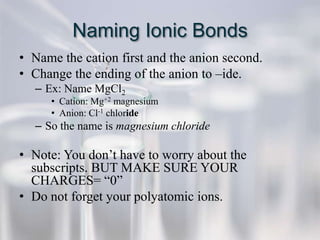
Naming Ionic Bonds
• Name the cation first and the anion second.
• Change the ending of the anion to –ide.
  – Ex: Name MgCl2
     • Cation: Mg+2 magnesium
     • Anion: Cl-1 chloride
  – So the name is magnesium chloride

• Note: You don’t have to worry about the
  subscripts. BUT MAKE SURE YOUR
  CHARGES= “0”
• Do not forget your polyatomic ions.
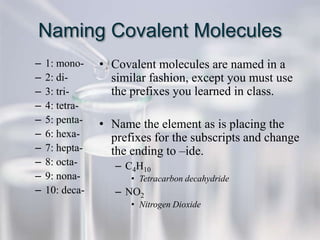
Naming Covalent Molecules
–   1: mono-    • Covalent molecules are named in a
–   2: di-        similar fashion, except you must use
–   3: tri-       the prefixes you learned in class.
–   4: tetra-
–   5: penta-   • Name the element as is placing the
–   6: hexa-      prefixes for the subscripts and change
–   7: hepta-     the ending to –ide.
–   8: octa-       – C4H10
–   9: nona-          • Tetracarbon decahydride
–   10: deca-      – NO2
                      • Nitrogen Dioxide
Mixtures
• Mixtures are             • Filtration
  combinations of
  substances that retain   • Distillation
  their physical and
  chemical properties.
• You can separate         • Chromatography
  mixtures by using
  different techniques.    • Crystallization
• See if you can
  remember these
  separation techniques:
The Mole
• The mole is the SI unit used to measure the
  amount of a substance.
• You should be able to convert back and forth
  between atoms, moles, and grams.
• You should be able to do this for elements and
  for compounds.
• Remember this roadmap:
        Atoms       moles        mass (g)
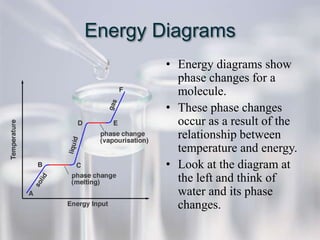
Energy Diagrams
        • Energy diagrams show
          phase changes for a
          molecule.
        • These phase changes
          occur as a result of the
          relationship between
          temperature and energy.
        • Look at the diagram at
          the left and think of
          water and its phase
          changes.
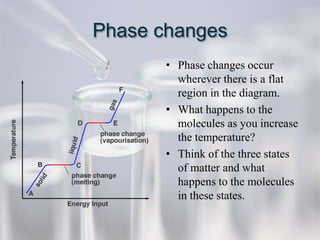
Phase changes
       • Phase changes occur
         wherever there is a flat
         region in the diagram.
       • What happens to the
         molecules as you increase
         the temperature?
       • Think of the three states
         of matter and what
         happens to the molecules
         in these states.
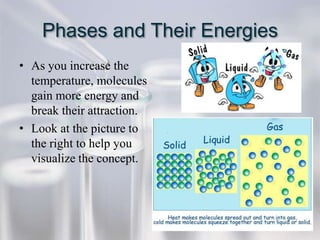
Phases and Their Energies
• As you increase the
  temperature, molecules
  gain more energy and
  break their attraction.
• Look at the picture to
  the right to help you
  visualize the concept.
Reaction Rates
• Chemists can increase the rate of reactions by
  doing one of several things:
  – Increase the temperature of the substance
  – Agitate the mixture
  – Increase the surface area of a substance
  – Decrease the volume of the container
  – Increase the pressure of the container
Reaction Rates
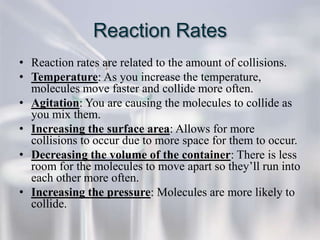
• Reaction rates are related to the amount of collisions.
• Temperature: As you increase the temperature,
  molecules move faster and collide more often.
• Agitation: You are causing the molecules to collide as
  you mix them.
• Increasing the surface area: Allows for more
  collisions to occur due to more space for them to occur.
• Decreasing the volume of the container: There is less
  room for the molecules to move apart so they’ll run into
  each other more often.
• Increasing the pressure: Molecules are more likely to
  collide.
Gas Laws
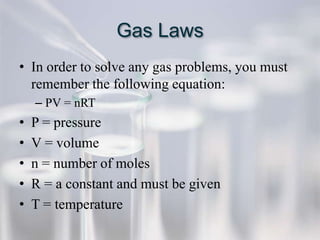
• In order to solve any gas problems, you must
  remember the following equation:
    – PV = nRT
•   P = pressure
•   V = volume
•   n = number of moles
•   R = a constant and must be given
•   T = temperature

Third quarter review

  • 1.
  • 2.
    The Scientific Method •Scientists are always faced with the task of properly designing an experiment to test any and all variables. – Example: You decide to test what happens to a balloon when placed in a warm environment (like a moderately hot oven) versus what happens to a balloon placed in a cold environment (like the freezer). • Several important key terms in designing an experiment: – Constants - The variables that never change in the experiment. • Ex: The size of the balloon, the type of balloon, etc. – Control - The "normal" in an experiment. This is usually what you compare your experiment to. • Ex: A balloon placed at room temperature. – Independent Variable – The variable that you directly control. • Ex: Where you placed the balloon (oven or freezer). – Dependent Variable – The variable that changes because of the independent variable. • Ex: The size of the balloon
  • 3.
    Covalent vs. IonicBonds • Know the difference between covalent and ionic bonds. – Covalent bonds are always between a non-metal and a non-metal. (groups 4-7) • Ex: CCl4 • These are ALWAYS referred to as molecules. – Ionic bonds are always between a metal with a non-metal. (groups 1-3 with groups 4-7) • Ex: LiF • These are usually referred to as compounds.
  • 4.
    Naming Ionic Bonds •Name the cation first and the anion second. • Change the ending of the anion to –ide. – Ex: Name MgCl2 • Cation: Mg+2 magnesium • Anion: Cl-1 chloride – So the name is magnesium chloride • Note: You don’t have to worry about the subscripts. BUT MAKE SURE YOUR CHARGES= “0” • Do not forget your polyatomic ions.
  • 5.
    Naming Covalent Molecules – 1: mono- • Covalent molecules are named in a – 2: di- similar fashion, except you must use – 3: tri- the prefixes you learned in class. – 4: tetra- – 5: penta- • Name the element as is placing the – 6: hexa- prefixes for the subscripts and change – 7: hepta- the ending to –ide. – 8: octa- – C4H10 – 9: nona- • Tetracarbon decahydride – 10: deca- – NO2 • Nitrogen Dioxide
  • 6.
    Mixtures • Mixtures are • Filtration combinations of substances that retain • Distillation their physical and chemical properties. • You can separate • Chromatography mixtures by using different techniques. • Crystallization • See if you can remember these separation techniques:
  • 7.
    The Mole • Themole is the SI unit used to measure the amount of a substance. • You should be able to convert back and forth between atoms, moles, and grams. • You should be able to do this for elements and for compounds. • Remember this roadmap: Atoms moles mass (g)
  • 8.
    Energy Diagrams • Energy diagrams show phase changes for a molecule. • These phase changes occur as a result of the relationship between temperature and energy. • Look at the diagram at the left and think of water and its phase changes.
  • 9.
    Phase changes • Phase changes occur wherever there is a flat region in the diagram. • What happens to the molecules as you increase the temperature? • Think of the three states of matter and what happens to the molecules in these states.
  • 10.
    Phases and TheirEnergies • As you increase the temperature, molecules gain more energy and break their attraction. • Look at the picture to the right to help you visualize the concept.
  • 11.
    Reaction Rates • Chemistscan increase the rate of reactions by doing one of several things: – Increase the temperature of the substance – Agitate the mixture – Increase the surface area of a substance – Decrease the volume of the container – Increase the pressure of the container
  • 12.
    Reaction Rates • Reactionrates are related to the amount of collisions. • Temperature: As you increase the temperature, molecules move faster and collide more often. • Agitation: You are causing the molecules to collide as you mix them. • Increasing the surface area: Allows for more collisions to occur due to more space for them to occur. • Decreasing the volume of the container: There is less room for the molecules to move apart so they’ll run into each other more often. • Increasing the pressure: Molecules are more likely to collide.
  • 13.
    Gas Laws • Inorder to solve any gas problems, you must remember the following equation: – PV = nRT • P = pressure • V = volume • n = number of moles • R = a constant and must be given • T = temperature