Classifying Equations The Five Types of Chemical Equations Chapter 11.2
Objectives Describe the five types of chemical equations. Predict the products of the five types of chemical equations.
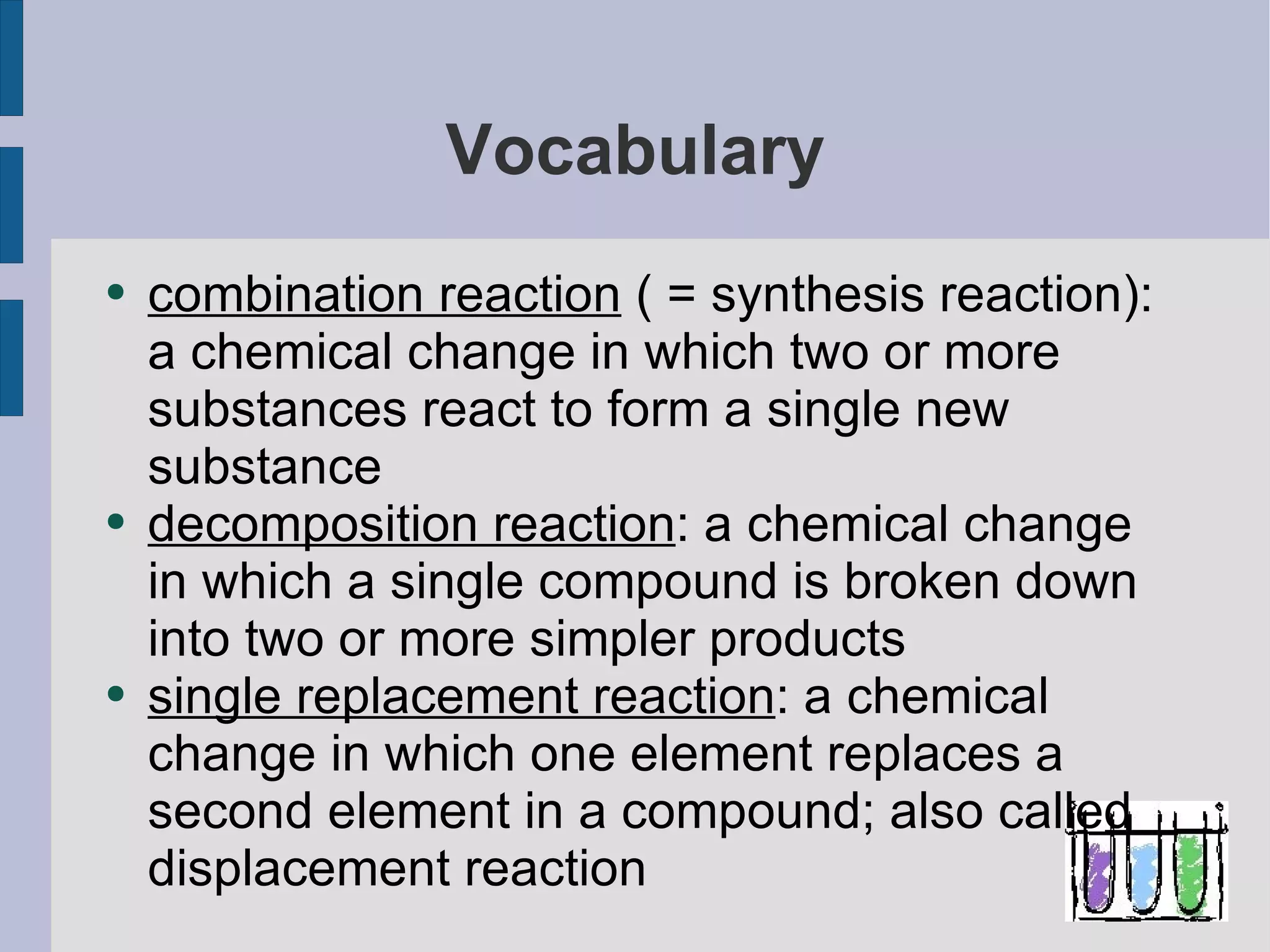
Vocabulary combination reaction  ( = synthesis reaction): a chemical change in which two or more substances react to form a single new substance decomposition reaction : a chemical change in which a single compound is broken down into two or more simpler products single replacement reaction : a chemical change in which one element replaces a second element in a compound; also called displacement reaction
Vocabulary Continued activity series : a list of elements in order of decreasing activity (found on p. 7 of your chemistry reference tables) double replacement reaction : a chemical change that involves an exchange of positive ions between two compounds combustion reaction : a chemical change in which an element or compound reacts with oxygen, often producing energy in the form of heat and light
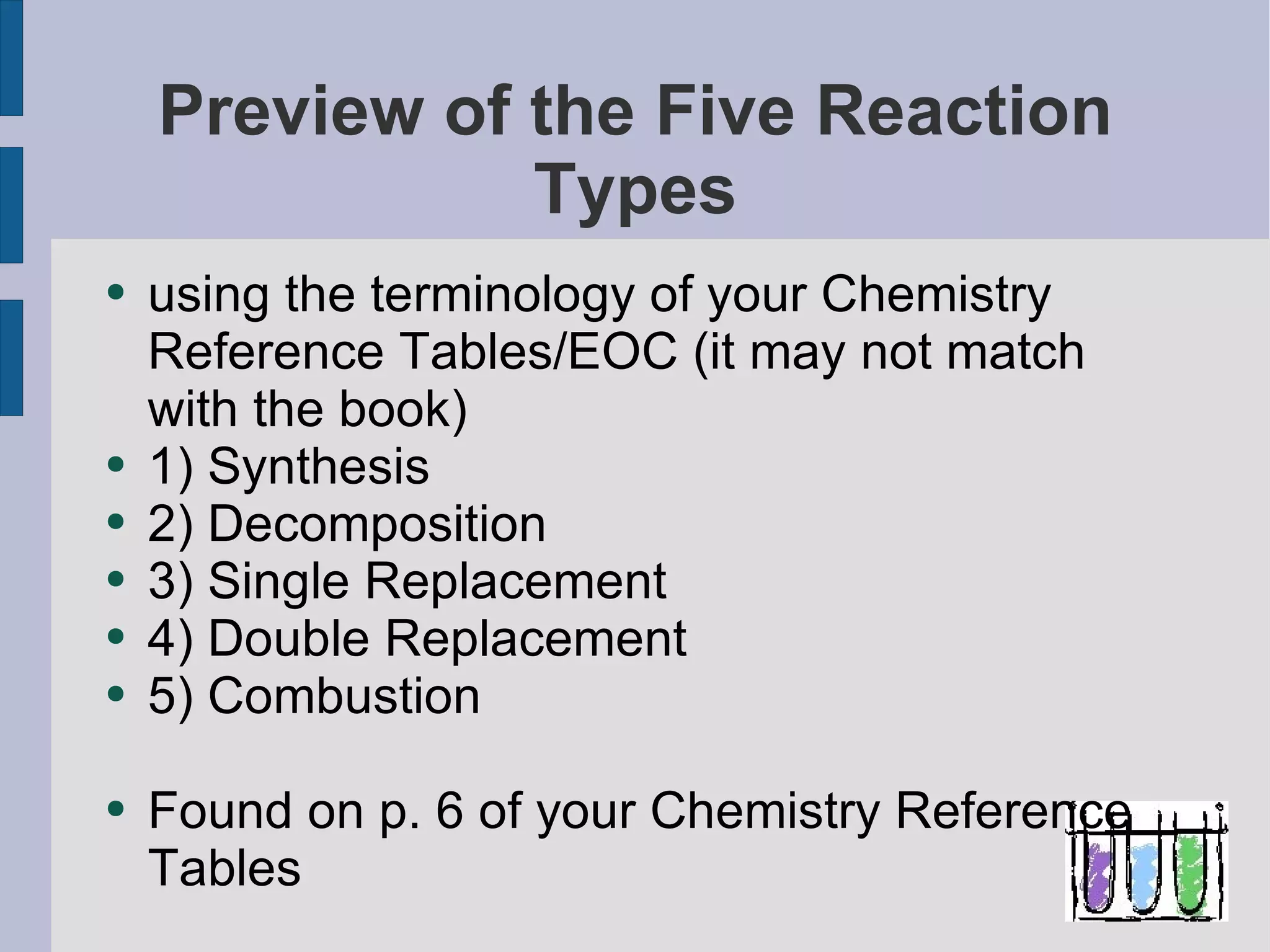
Preview of the Five Reaction Types using the terminology of your Chemistry Reference Tables/EOC (it may not match with the book) 1) Synthesis 2) Decomposition 3) Single Replacement 4) Double Replacement 5) Combustion Found on p. 6 of your Chemistry Reference Tables
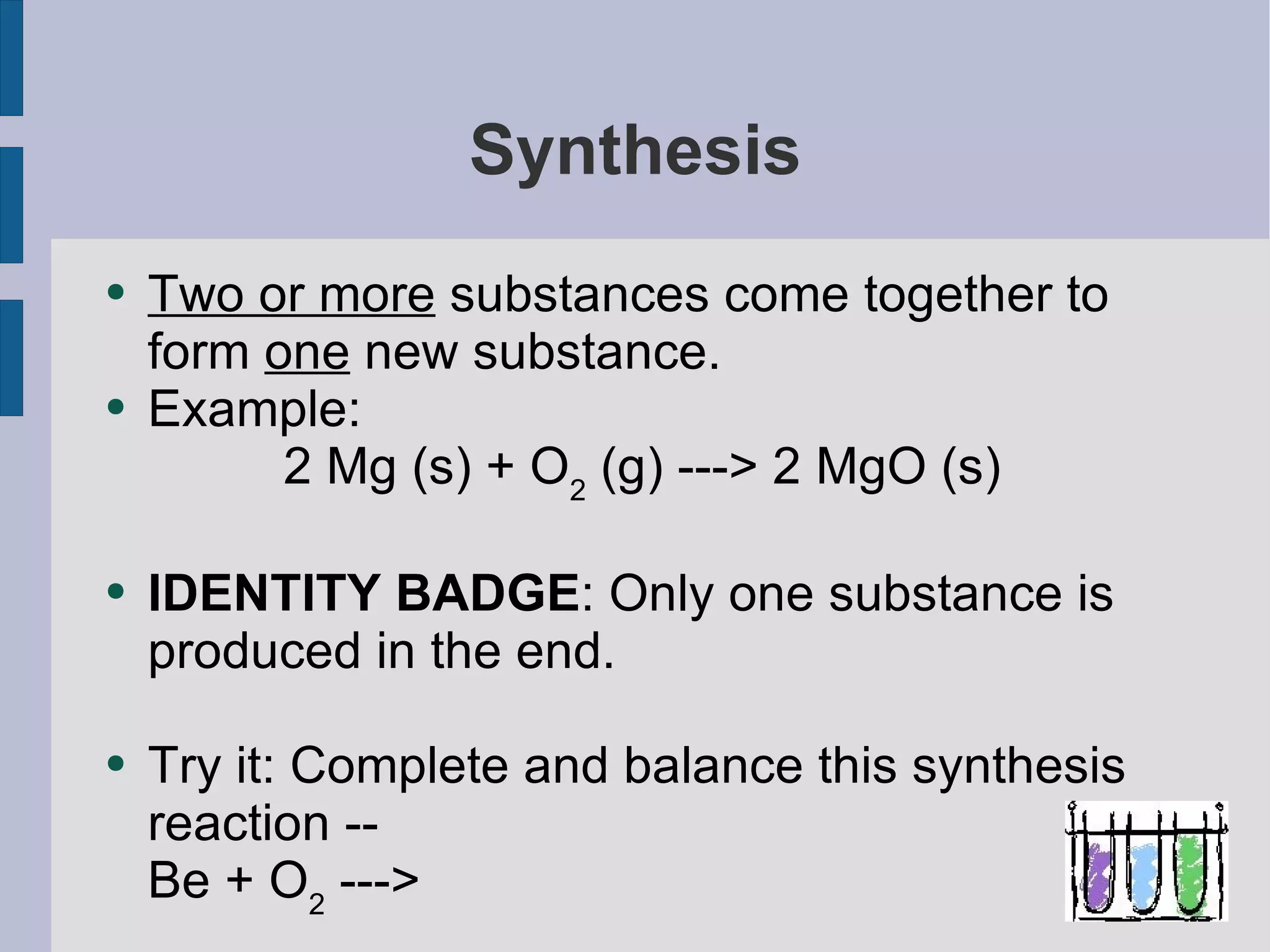
Synthesis Two or more  substances come together to form  one  new substance. Example: 2 Mg (s) + O 2  (g) ---> 2 MgO (s) IDENTITY BADGE : Only one substance is produced in the end. Try it: Complete and balance this synthesis reaction -- Be + O 2  --->
Synthesis Try It Be + O 2  ---> Be 2+  + O 2-  = Be 2 O 2  = BeO ? Be + ? O 2  ---> ? BeO Balanced: 2 Be + O 2  ---> 2 BeO
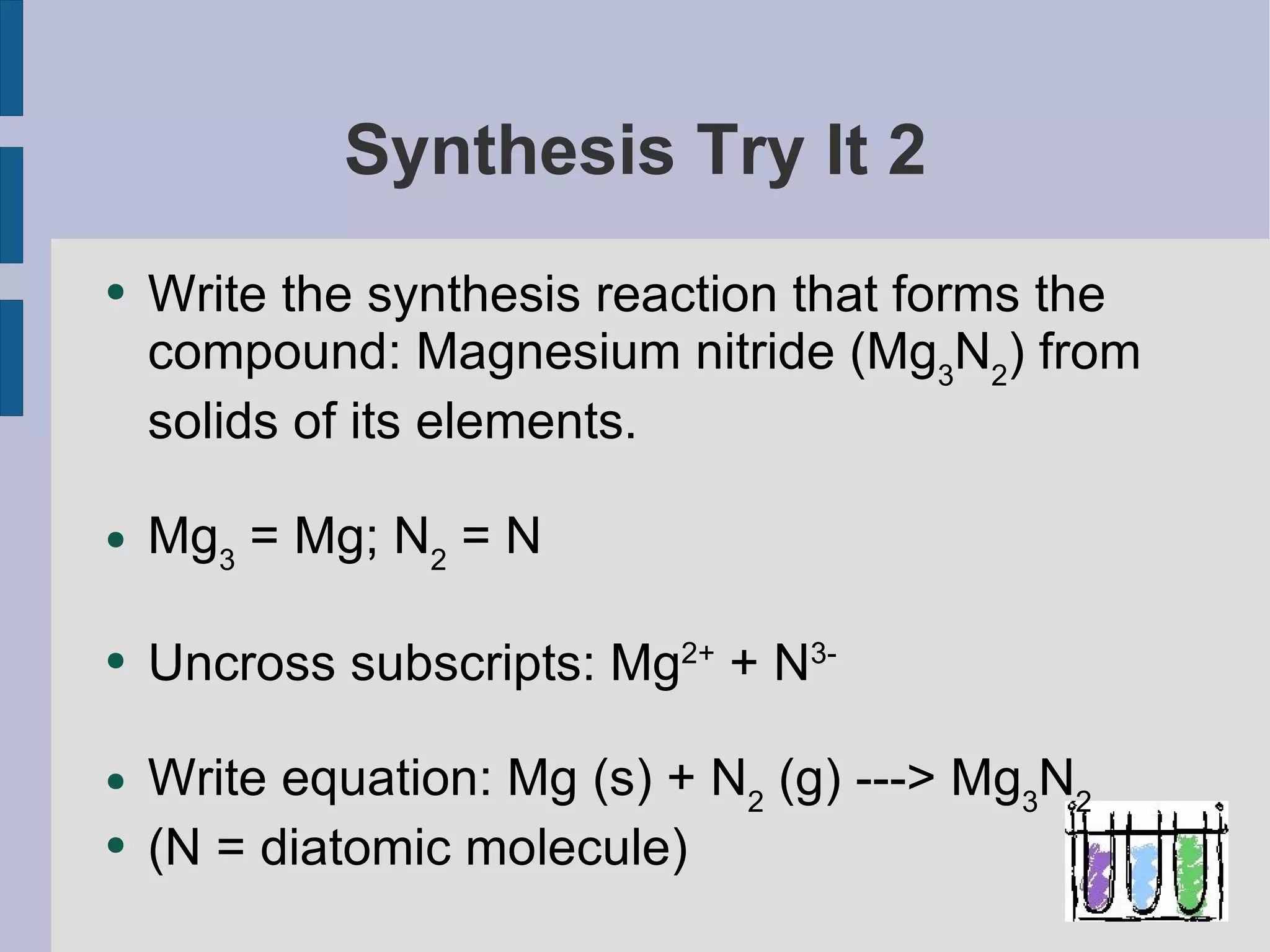
Synthesis Try It 2 Write the synthesis reaction that forms the compound: Magnesium nitride (Mg 3 N 2 ) from solids of its elements. Mg 3  = Mg; N 2  = N Uncross subscripts: Mg 2+  + N 3- Write equation: Mg (s) + N 2  (g) ---> Mg 3 N 2 (N = diatomic molecule)
Synthesis Try It 2 Balance: 3Mg + N 2  ---> Mg 3 N 2

Types of Reactions: Synthesis

  • 1.
    Classifying Equations TheFive Types of Chemical Equations Chapter 11.2
  • 2.
    Objectives Describe thefive types of chemical equations. Predict the products of the five types of chemical equations.
  • 3.
    Vocabulary combination reaction ( = synthesis reaction): a chemical change in which two or more substances react to form a single new substance decomposition reaction : a chemical change in which a single compound is broken down into two or more simpler products single replacement reaction : a chemical change in which one element replaces a second element in a compound; also called displacement reaction
  • 4.
    Vocabulary Continued activityseries : a list of elements in order of decreasing activity (found on p. 7 of your chemistry reference tables) double replacement reaction : a chemical change that involves an exchange of positive ions between two compounds combustion reaction : a chemical change in which an element or compound reacts with oxygen, often producing energy in the form of heat and light
  • 5.
    Preview of theFive Reaction Types using the terminology of your Chemistry Reference Tables/EOC (it may not match with the book) 1) Synthesis 2) Decomposition 3) Single Replacement 4) Double Replacement 5) Combustion Found on p. 6 of your Chemistry Reference Tables
  • 6.
    Synthesis Two ormore substances come together to form one new substance. Example: 2 Mg (s) + O 2 (g) ---> 2 MgO (s) IDENTITY BADGE : Only one substance is produced in the end. Try it: Complete and balance this synthesis reaction -- Be + O 2 --->
  • 7.
    Synthesis Try ItBe + O 2 ---> Be 2+ + O 2- = Be 2 O 2 = BeO ? Be + ? O 2 ---> ? BeO Balanced: 2 Be + O 2 ---> 2 BeO
  • 8.
    Synthesis Try It2 Write the synthesis reaction that forms the compound: Magnesium nitride (Mg 3 N 2 ) from solids of its elements. Mg 3 = Mg; N 2 = N Uncross subscripts: Mg 2+ + N 3- Write equation: Mg (s) + N 2 (g) ---> Mg 3 N 2 (N = diatomic molecule)
  • 9.
    Synthesis Try It2 Balance: 3Mg + N 2 ---> Mg 3 N 2