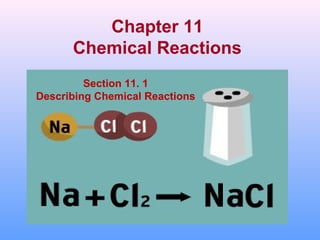
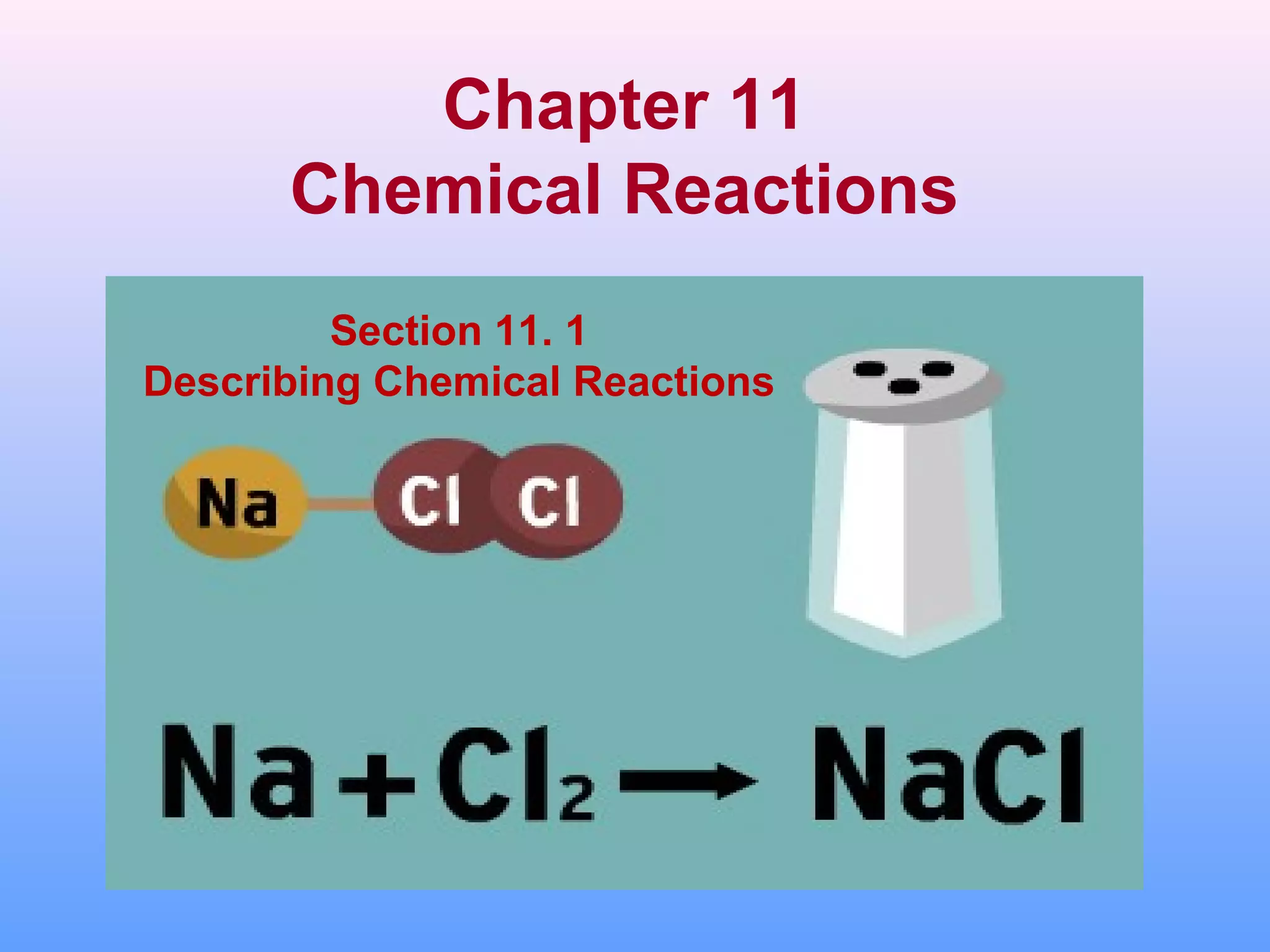
Chapter 11
Chemical Reactions
Section 11. 1
Describing Chemical Reactions
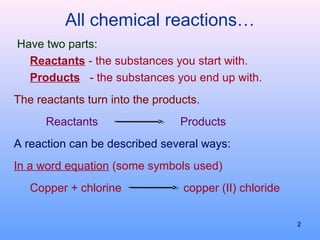
All chemical reactions…
Have two parts:
Reactants - the substances you start with.
Products - the substances you end up with.
The reactants turn into the products.
Reactants Products
A reaction can be described several ways:
In a word equation (some symbols used)
Copper + chlorine copper (II) chloride
2
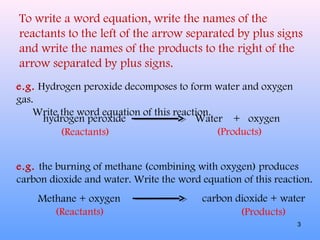
To write a word equation, write the names of the
reactants to the left of the arrow separated by plus signs
and write the names of the products to the right of the
arrow separated by plus signs.
e.g. Hydrogen peroxide decomposes to form water and oxygen
gas.
Write the word equation of this reaction.
hydrogen peroxide Water + oxygen
(Reactants) (Products)
e.g. the burning of methane (combining with oxygen) produces
carbon dioxide and water. Write the word equation of this reaction.
Methane + oxygen carbon dioxide + water
(Reactants) (Products)
3
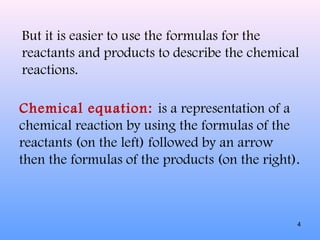
But it is easier to use the formulas for the
reactants and products to describe the chemical
reactions.
Chemical equation: is a representation of a
chemical reaction by using the formulas of the
reactants (on the left) followed by an arrow
then the formulas of the products (on the right).
4
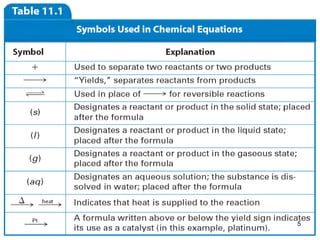
5
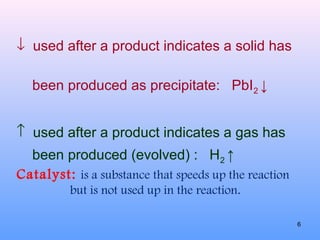
↓ used after a product indicates a solid has
been produced as precipitate: PbI2 ↓
↑ used after a product indicates a gas has
been produced (evolved) : H2 ↑
Catalyst: is a substance that speeds up the reaction
but is not used up in the reaction.
6
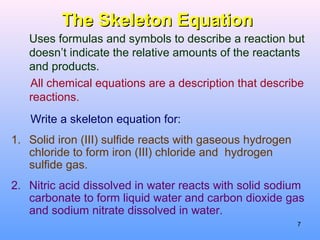
The Skeleton EquationThe Skeleton Equation
Uses formulas and symbols to describe a reaction but
doesn’t indicate the relative amounts of the reactants
and products.
All chemical equations are a description that describe
reactions.
Write a skeleton equation for:
1. Solid iron (III) sulfide reacts with gaseous hydrogen
chloride to form iron (III) chloride and hydrogen
sulfide gas.
2. Nitric acid dissolved in water reacts with solid sodium
carbonate to form liquid water and carbon dioxide gas
and sodium nitrate dissolved in water.
7
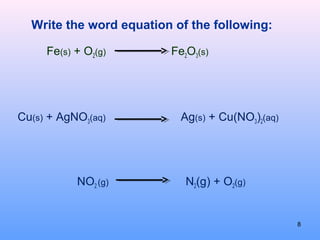
Write the word equation of the following:
Fe(s) + O2(g) Fe2O3(s)
Cu(s) + AgNO3(aq) Ag(s) + Cu(NO3)2(aq)
NO2 (g) N2(g) + O2(g)
8
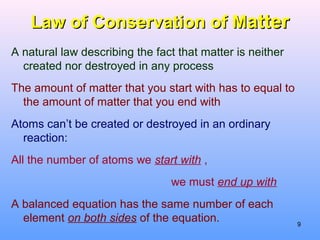
Law of Conservation of MLaw of Conservation of Matteratter
A natural law describing the fact that matter is neither
created nor destroyed in any process
The amount of matter that you start with has to equal to
the amount of matter that you end with
Atoms can’t be created or destroyed in an ordinary
reaction:
All the number of atoms we start with ,
we must end up with
A balanced equation has the same number of each
element on both sides of the equation. 9
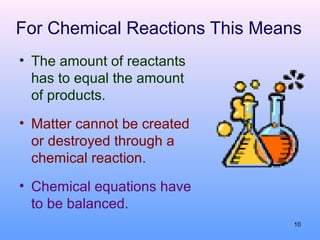
For Chemical Reactions This Means
• The amount of reactants
has to equal the amount
of products.
• Matter cannot be created
or destroyed through a
chemical reaction.
• Chemical equations have
to be balanced.
10
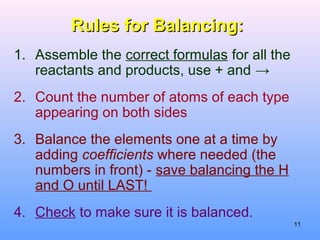
Rules for Balancing:Rules for Balancing:
1. Assemble the correct formulas for all the
reactants and products, use + and →
2. Count the number of atoms of each type
appearing on both sides
3. Balance the elements one at a time by
adding coefficients where needed (the
numbers in front) - save balancing the H
and O until LAST!
4. Check to make sure it is balanced.
11
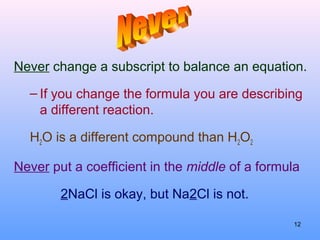
Never change a subscript to balance an equation.
– If you change the formula you are describing
a different reaction.
H2O is a different compound than H2O2
Never put a coefficient in the middle of a formula
2NaCl is okay, but Na2Cl is not.
12
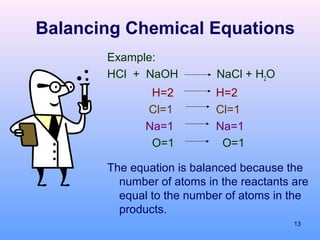
Balancing Chemical Equations
Example:
HCl + NaOH NaCl + H2O
H=2 H=2
Cl=1 Cl=1
Na=1 Na=1
O=1 O=1
The equation is balanced because the
number of atoms in the reactants are
equal to the number of atoms in the
products.
13
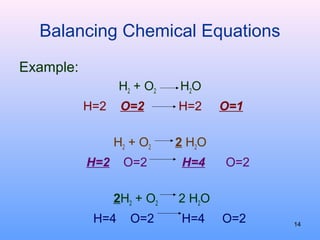
Balancing Chemical Equations
Example:
H2 + O2 H2O
H=2 O=2 H=2 O=1
H2 + O2 2 H2O
H=2 O=2 H=4 O=2
2H2 + O2 2 H2O
H=4 O=2 H=4 O=2 14
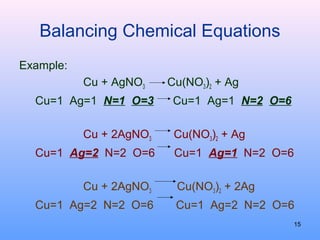
Balancing Chemical Equations
Example:
Cu + AgNO3 Cu(NO3)2 + Ag
Cu=1 Ag=1 N=1 O=3 Cu=1 Ag=1 N=2 O=6
Cu + 2AgNO3 Cu(NO3)2 + Ag
Cu=1 Ag=2 N=2 O=6 Cu=1 Ag=1 N=2 O=6
Cu + 2AgNO3 Cu(NO3)2 + 2Ag
Cu=1 Ag=2 N=2 O=6 Cu=1 Ag=2 N=2 O=6
15
Balancing Chemical Equations
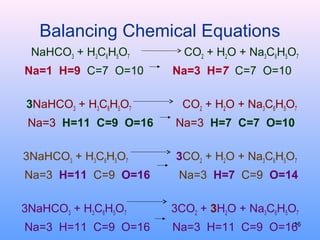
NaHCO3 + H3C6H5O7 CO2 + H2O + Na3C6H5O7
Na=1 H=9 C=7 O=10 Na=3 H=7 C=7 O=10
3NaHCO3 + H3C6H5O7 CO2 + H2O + Na3C6H5O7
Na=3 H=11 C=9 O=16 Na=3 H=7 C=7 O=10
3NaHCO3 + H3C6H5O7 3CO2 + H2O + Na3C6H5O7
Na=3 H=11 C=9 O=16 Na=3 H=7 C=9 O=14
3NaHCO3 + H3C6H5O7 3CO2 + 3H2O + Na3C6H5O7
Na=3 H=11 C=9 O=16 Na=3 H=11 C=9 O=1616
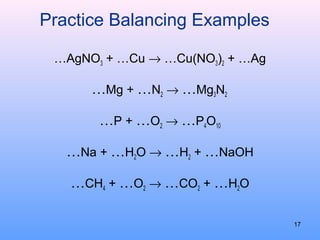
Practice Balancing Examples
…AgNO3 + …Cu → …Cu(NO3)2 + …Ag
…Mg + …N2 → …Mg3N2
…P + …O2 → …P4O10
…Na + …H2O → …H2 + …NaOH
…CH4 + …O2 → …CO2 + …H2O
17
End of Section 11.1
Section 11.2
Types of Chemical Reactions
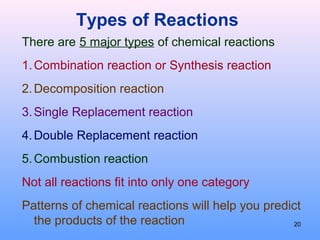
Types of Reactions
There are 5 major types of chemical reactions
1.Combination reaction or Synthesis reaction
2.Decomposition reaction
3.Single Replacement reaction
4.Double Replacement reaction
5.Combustion reaction
Not all reactions fit into only one category
Patterns of chemical reactions will help you predict
the products of the reaction 20
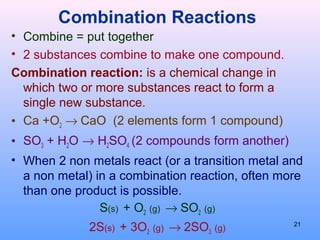
Combination Reactions
• Combine = put together
• 2 substances combine to make one compound.
Combination reaction: is a chemical change in
which two or more substances react to form a
single new substance.
• Ca +O2 → CaO (2 elements form 1 compound)
• SO3 + H2O → H2SO4 (2 compounds form another)
• When 2 non metals react (or a transition metal and
a non metal) in a combination reaction, often more
than one product is possible.
S(s) + O2 (g) → SO2 (g)
2S(s) + 3O2 (g) → 2SO3 (g)
21
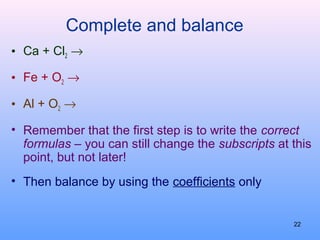
Complete and balance
• Ca + Cl2 →
• Fe + O2 →
• Al + O2 →
• Remember that the first step is to write the correct
formulas – you can still change the subscripts at this
point, but not later!
• Then balance by using the coefficients only
22
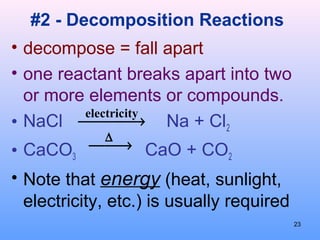
#2 - Decomposition Reactions
• decompose = fall apart
• one reactant breaks apart into two
or more elements or compounds.
• NaCl Na + Cl2
• CaCO3 CaO + CO2
• Note that energy (heat, sunlight,
electricity, etc.) is usually required
electricity
 →
∆
 →
23
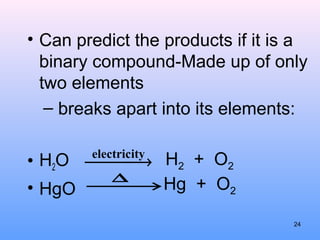
• Can predict the products if it is a
binary compound-Made up of only
two elements
– breaks apart into its elements:
• H2O
• HgO
electricity
 →
∆
 →
H2 + O2
Hg + O2
24
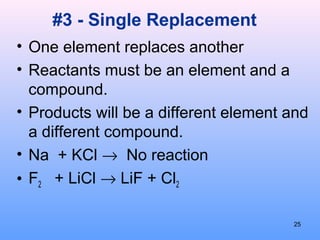
#3 - Single Replacement
• One element replaces another
• Reactants must be an element and a
compound.
• Products will be a different element and
a different compound.
• Na + KCl → No reaction
• F2 + LiCl → LiF + Cl2
25
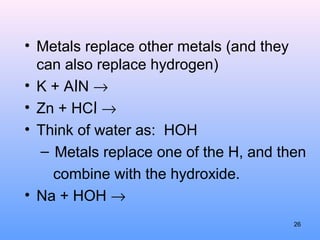
• Metals replace other metals (and they
can also replace hydrogen)
• K + AlN →
• Zn + HCl →
• Think of water as: HOH
– Metals replace one of the H, and then
combine with the hydroxide.
• Na + HOH →
26
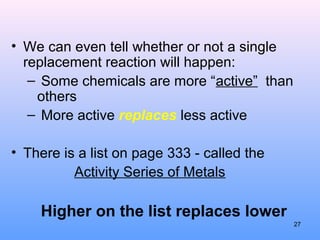
• We can even tell whether or not a single
replacement reaction will happen:
– Some chemicals are more “active” than
others
– More active replaces less active
• There is a list on page 333 - called the
Activity Series of Metals
Higher on the list replaces lower
27
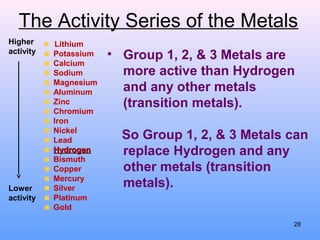
The Activity Series of the Metals
Lithium
Potassium
Calcium
Sodium
Magnesium
Aluminum
Zinc
Chromium
Iron
Nickel
Lead
HydrogenHydrogen
Bismuth
Copper
Mercury
Silver
Platinum
Gold
• Group 1, 2, & 3 Metals are
more active than Hydrogen
and any other metals
(transition metals).
So Group 1, 2, & 3 Metals can
replace Hydrogen and any
other metals (transition
metals).
Higher
activity
Lower
activity
28
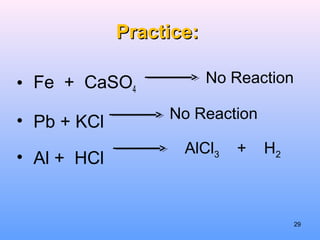
Practice:Practice:
• Fe + CaSO4
• Pb + KCl
• Al + HCl
No Reaction
No Reaction
AlCl3 + H2
29
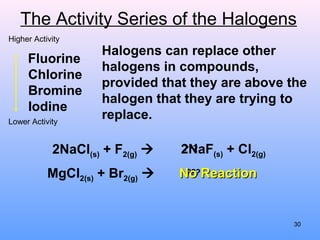
The Activity Series of the Halogens
Fluorine
Chlorine
Bromine
Iodine
Halogens can replace other
halogens in compounds,
provided that they are above the
halogen that they are trying to
replace.
2NaCl(s) + F2(g)  2NaF(s) + Cl2(g)
MgCl2(s) + Br2(g)  ???No ReactionNo Reaction
???
Higher Activity
Lower Activity
30
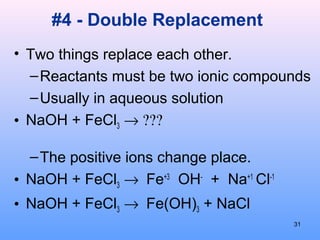
#4 - Double Replacement
• Two things replace each other.
–Reactants must be two ionic compounds
–Usually in aqueous solution
• NaOH + FeCl3 → ???
–The positive ions change place.
• NaOH + FeCl3 → Fe+3
OH-
+ Na+1
Cl-1
• NaOH + FeCl3 → Fe(OH)3 + NaCl
31
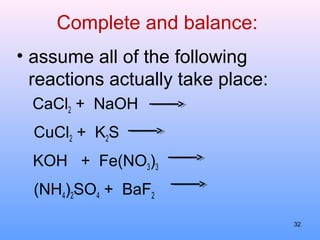
Complete and balance:
• assume all of the following
reactions actually take place:
CaCl2 + NaOH
CuCl2 + K2S
KOH + Fe(NO3)3
(NH4)2SO4 + BaF2
32
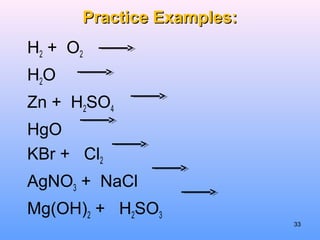
Practice Examples:Practice Examples:
H2 + O2
H2O
Zn + H2SO4
HgO
KBr + Cl2
AgNO3 + NaCl
Mg(OH)2 + H2SO3
33
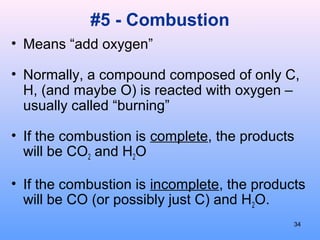
#5 - Combustion
• Means “add oxygen”
• Normally, a compound composed of only C,
H, (and maybe O) is reacted with oxygen –
usually called “burning”
• If the combustion is complete, the products
will be CO2 and H2O
• If the combustion is incomplete, the products
will be CO (or possibly just C) and H2O.
34
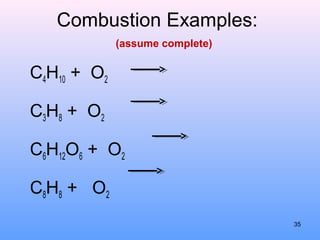
Combustion Examples:
C4H10 + O2
C3H8 + O2
C6H12O6 + O2
C8H8 + O2
35
(assume complete)
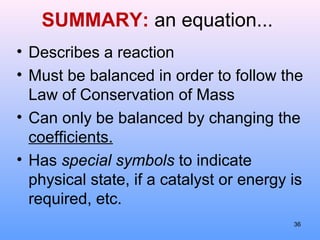
SUMMARY: an equation...
• Describes a reaction
• Must be balanced in order to follow the
Law of Conservation of Mass
• Can only be balanced by changing the
coefficients.
• Has special symbols to indicate
physical state, if a catalyst or energy is
required, etc.
36
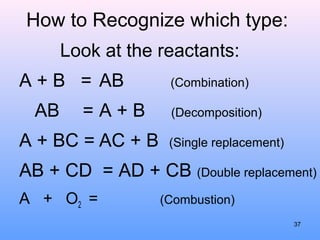
How to Recognize which type:
Look at the reactants:
A + B = AB (Combination)
AB = A + B (Decomposition)
A + BC = AC + B (Single replacement)
AB + CD = AD + CB (Double replacement)
A + O2 = (Combustion)
37
End of Section 11.2
Section 11.3
Reactions in Aqueous Solution
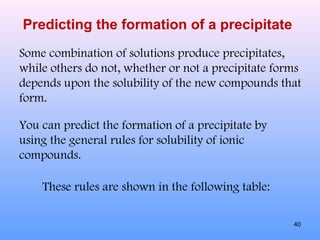
Predicting the formation of a precipitate
Some combination of solutions produce precipitates,
while others do not, whether or not a precipitate forms
depends upon the solubility of the new compounds that
form.
You can predict the formation of a precipitate by
using the general rules for solubility of ionic
compounds.
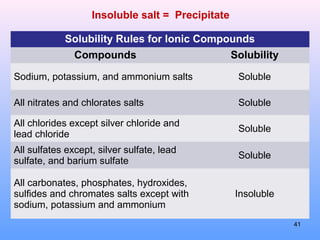
These rules are shown in the following table:
40
Solubility Rules for Ionic Compounds
Compounds Solubility
Sodium, potassium, and ammonium salts Soluble
All nitrates and chlorates salts Soluble
All chlorides except silver chloride and
lead chloride
Soluble
All sulfates except, silver sulfate, lead
sulfate, and barium sulfate
Soluble
All carbonates, phosphates, hydroxides,
sulfides and chromates salts except with
sodium, potassium and ammonium
Insoluble
Insoluble salt = Precipitate
41
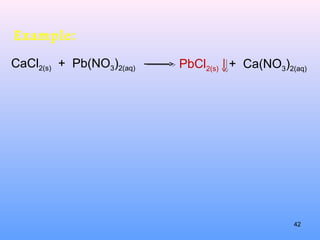
Example:
CaCl2(s) + Pb(NO3)2(aq) PbCl2(s) + Ca(NO3)2(aq)
42

Chapter 11

  • 1.
    Chapter 11 Chemical Reactions Section11. 1 Describing Chemical Reactions
  • 2.
    All chemical reactions… Havetwo parts: Reactants - the substances you start with. Products - the substances you end up with. The reactants turn into the products. Reactants Products A reaction can be described several ways: In a word equation (some symbols used) Copper + chlorine copper (II) chloride 2
  • 3.
    To write aword equation, write the names of the reactants to the left of the arrow separated by plus signs and write the names of the products to the right of the arrow separated by plus signs. e.g. Hydrogen peroxide decomposes to form water and oxygen gas. Write the word equation of this reaction. hydrogen peroxide Water + oxygen (Reactants) (Products) e.g. the burning of methane (combining with oxygen) produces carbon dioxide and water. Write the word equation of this reaction. Methane + oxygen carbon dioxide + water (Reactants) (Products) 3
  • 4.
    But it iseasier to use the formulas for the reactants and products to describe the chemical reactions. Chemical equation: is a representation of a chemical reaction by using the formulas of the reactants (on the left) followed by an arrow then the formulas of the products (on the right). 4
  • 5.
  • 6.
    ↓ used aftera product indicates a solid has been produced as precipitate: PbI2 ↓ ↑ used after a product indicates a gas has been produced (evolved) : H2 ↑ Catalyst: is a substance that speeds up the reaction but is not used up in the reaction. 6
  • 7.
    The Skeleton EquationTheSkeleton Equation Uses formulas and symbols to describe a reaction but doesn’t indicate the relative amounts of the reactants and products. All chemical equations are a description that describe reactions. Write a skeleton equation for: 1. Solid iron (III) sulfide reacts with gaseous hydrogen chloride to form iron (III) chloride and hydrogen sulfide gas. 2. Nitric acid dissolved in water reacts with solid sodium carbonate to form liquid water and carbon dioxide gas and sodium nitrate dissolved in water. 7
  • 8.
    Write the wordequation of the following: Fe(s) + O2(g) Fe2O3(s) Cu(s) + AgNO3(aq) Ag(s) + Cu(NO3)2(aq) NO2 (g) N2(g) + O2(g) 8
  • 9.
    Law of Conservationof MLaw of Conservation of Matteratter A natural law describing the fact that matter is neither created nor destroyed in any process The amount of matter that you start with has to equal to the amount of matter that you end with Atoms can’t be created or destroyed in an ordinary reaction: All the number of atoms we start with , we must end up with A balanced equation has the same number of each element on both sides of the equation. 9
  • 10.
    For Chemical ReactionsThis Means • The amount of reactants has to equal the amount of products. • Matter cannot be created or destroyed through a chemical reaction. • Chemical equations have to be balanced. 10
  • 11.
    Rules for Balancing:Rulesfor Balancing: 1. Assemble the correct formulas for all the reactants and products, use + and → 2. Count the number of atoms of each type appearing on both sides 3. Balance the elements one at a time by adding coefficients where needed (the numbers in front) - save balancing the H and O until LAST! 4. Check to make sure it is balanced. 11
  • 12.
    Never change asubscript to balance an equation. – If you change the formula you are describing a different reaction. H2O is a different compound than H2O2 Never put a coefficient in the middle of a formula 2NaCl is okay, but Na2Cl is not. 12
  • 13.
    Balancing Chemical Equations Example: HCl+ NaOH NaCl + H2O H=2 H=2 Cl=1 Cl=1 Na=1 Na=1 O=1 O=1 The equation is balanced because the number of atoms in the reactants are equal to the number of atoms in the products. 13
  • 14.
    Balancing Chemical Equations Example: H2+ O2 H2O H=2 O=2 H=2 O=1 H2 + O2 2 H2O H=2 O=2 H=4 O=2 2H2 + O2 2 H2O H=4 O=2 H=4 O=2 14
  • 15.
    Balancing Chemical Equations Example: Cu+ AgNO3 Cu(NO3)2 + Ag Cu=1 Ag=1 N=1 O=3 Cu=1 Ag=1 N=2 O=6 Cu + 2AgNO3 Cu(NO3)2 + Ag Cu=1 Ag=2 N=2 O=6 Cu=1 Ag=1 N=2 O=6 Cu + 2AgNO3 Cu(NO3)2 + 2Ag Cu=1 Ag=2 N=2 O=6 Cu=1 Ag=2 N=2 O=6 15
  • 16.
    Balancing Chemical Equations NaHCO3+ H3C6H5O7 CO2 + H2O + Na3C6H5O7 Na=1 H=9 C=7 O=10 Na=3 H=7 C=7 O=10 3NaHCO3 + H3C6H5O7 CO2 + H2O + Na3C6H5O7 Na=3 H=11 C=9 O=16 Na=3 H=7 C=7 O=10 3NaHCO3 + H3C6H5O7 3CO2 + H2O + Na3C6H5O7 Na=3 H=11 C=9 O=16 Na=3 H=7 C=9 O=14 3NaHCO3 + H3C6H5O7 3CO2 + 3H2O + Na3C6H5O7 Na=3 H=11 C=9 O=16 Na=3 H=11 C=9 O=1616
  • 17.
    Practice Balancing Examples …AgNO3+ …Cu → …Cu(NO3)2 + …Ag …Mg + …N2 → …Mg3N2 …P + …O2 → …P4O10 …Na + …H2O → …H2 + …NaOH …CH4 + …O2 → …CO2 + …H2O 17
  • 18.
  • 19.
    Section 11.2 Types ofChemical Reactions
  • 20.
    Types of Reactions Thereare 5 major types of chemical reactions 1.Combination reaction or Synthesis reaction 2.Decomposition reaction 3.Single Replacement reaction 4.Double Replacement reaction 5.Combustion reaction Not all reactions fit into only one category Patterns of chemical reactions will help you predict the products of the reaction 20
  • 21.
    Combination Reactions • Combine= put together • 2 substances combine to make one compound. Combination reaction: is a chemical change in which two or more substances react to form a single new substance. • Ca +O2 → CaO (2 elements form 1 compound) • SO3 + H2O → H2SO4 (2 compounds form another) • When 2 non metals react (or a transition metal and a non metal) in a combination reaction, often more than one product is possible. S(s) + O2 (g) → SO2 (g) 2S(s) + 3O2 (g) → 2SO3 (g) 21
  • 22.
    Complete and balance •Ca + Cl2 → • Fe + O2 → • Al + O2 → • Remember that the first step is to write the correct formulas – you can still change the subscripts at this point, but not later! • Then balance by using the coefficients only 22
  • 23.
    #2 - DecompositionReactions • decompose = fall apart • one reactant breaks apart into two or more elements or compounds. • NaCl Na + Cl2 • CaCO3 CaO + CO2 • Note that energy (heat, sunlight, electricity, etc.) is usually required electricity  → ∆  → 23
  • 24.
    • Can predictthe products if it is a binary compound-Made up of only two elements – breaks apart into its elements: • H2O • HgO electricity  → ∆  → H2 + O2 Hg + O2 24
  • 25.
    #3 - SingleReplacement • One element replaces another • Reactants must be an element and a compound. • Products will be a different element and a different compound. • Na + KCl → No reaction • F2 + LiCl → LiF + Cl2 25
  • 26.
    • Metals replaceother metals (and they can also replace hydrogen) • K + AlN → • Zn + HCl → • Think of water as: HOH – Metals replace one of the H, and then combine with the hydroxide. • Na + HOH → 26
  • 27.
    • We caneven tell whether or not a single replacement reaction will happen: – Some chemicals are more “active” than others – More active replaces less active • There is a list on page 333 - called the Activity Series of Metals Higher on the list replaces lower 27
  • 28.
    The Activity Seriesof the Metals Lithium Potassium Calcium Sodium Magnesium Aluminum Zinc Chromium Iron Nickel Lead HydrogenHydrogen Bismuth Copper Mercury Silver Platinum Gold • Group 1, 2, & 3 Metals are more active than Hydrogen and any other metals (transition metals). So Group 1, 2, & 3 Metals can replace Hydrogen and any other metals (transition metals). Higher activity Lower activity 28
  • 29.
    Practice:Practice: • Fe +CaSO4 • Pb + KCl • Al + HCl No Reaction No Reaction AlCl3 + H2 29
  • 30.
    The Activity Seriesof the Halogens Fluorine Chlorine Bromine Iodine Halogens can replace other halogens in compounds, provided that they are above the halogen that they are trying to replace. 2NaCl(s) + F2(g)  2NaF(s) + Cl2(g) MgCl2(s) + Br2(g)  ???No ReactionNo Reaction ??? Higher Activity Lower Activity 30
  • 31.
    #4 - DoubleReplacement • Two things replace each other. –Reactants must be two ionic compounds –Usually in aqueous solution • NaOH + FeCl3 → ??? –The positive ions change place. • NaOH + FeCl3 → Fe+3 OH- + Na+1 Cl-1 • NaOH + FeCl3 → Fe(OH)3 + NaCl 31
  • 32.
    Complete and balance: •assume all of the following reactions actually take place: CaCl2 + NaOH CuCl2 + K2S KOH + Fe(NO3)3 (NH4)2SO4 + BaF2 32
  • 33.
    Practice Examples:Practice Examples: H2+ O2 H2O Zn + H2SO4 HgO KBr + Cl2 AgNO3 + NaCl Mg(OH)2 + H2SO3 33
  • 34.
    #5 - Combustion •Means “add oxygen” • Normally, a compound composed of only C, H, (and maybe O) is reacted with oxygen – usually called “burning” • If the combustion is complete, the products will be CO2 and H2O • If the combustion is incomplete, the products will be CO (or possibly just C) and H2O. 34
  • 35.
    Combustion Examples: C4H10 +O2 C3H8 + O2 C6H12O6 + O2 C8H8 + O2 35 (assume complete)
  • 36.
    SUMMARY: an equation... •Describes a reaction • Must be balanced in order to follow the Law of Conservation of Mass • Can only be balanced by changing the coefficients. • Has special symbols to indicate physical state, if a catalyst or energy is required, etc. 36
  • 37.
    How to Recognizewhich type: Look at the reactants: A + B = AB (Combination) AB = A + B (Decomposition) A + BC = AC + B (Single replacement) AB + CD = AD + CB (Double replacement) A + O2 = (Combustion) 37
  • 38.
  • 39.
    Section 11.3 Reactions inAqueous Solution
  • 40.
    Predicting the formationof a precipitate Some combination of solutions produce precipitates, while others do not, whether or not a precipitate forms depends upon the solubility of the new compounds that form. You can predict the formation of a precipitate by using the general rules for solubility of ionic compounds. These rules are shown in the following table: 40
  • 41.

    Solubility Rules forIonic Compounds Compounds Solubility Sodium, potassium, and ammonium salts Soluble All nitrates and chlorates salts Soluble All chlorides except silver chloride and lead chloride Soluble All sulfates except, silver sulfate, lead sulfate, and barium sulfate Soluble All carbonates, phosphates, hydroxides, sulfides and chromates salts except with sodium, potassium and ammonium Insoluble Insoluble salt = Precipitate 41
  • 42.
    Example: CaCl2(s) + Pb(NO3)2(aq)PbCl2(s) + Ca(NO3)2(aq) 42