Chapter 8 QBA Miguel A. Castro Ramírez


                    Describing Chemical
                    Reactions
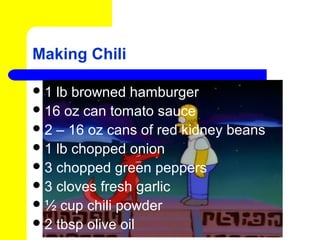
Making Chili

1  lb browned hamburger
 16 oz can tomato sauce
 2 – 16 oz cans of red kidney beans
 1 lb chopped onion
 3 chopped green peppers
 3 cloves fresh garlic
 ½ cup chili powder
 2 tbsp olive oil
Chemical Reactions

A  chemical reaction is the process by
 which one or more substances change
 into one or more new substances.

 Reactants are the original substances
 in a chemical reaction.

 Products  are the substances that are
 created in a chemical reaction.
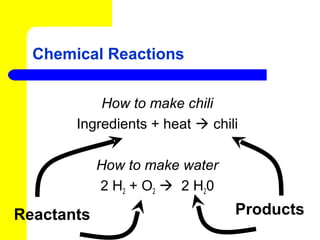
Chemical Reactions


           How to make chili
       Ingredients + heat  chili

            How to make water
            2 H 2 + O 2  2 H 20

Reactants                          Products
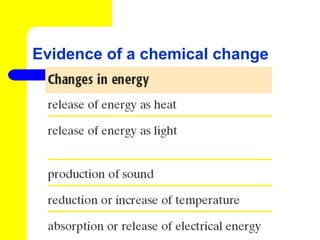
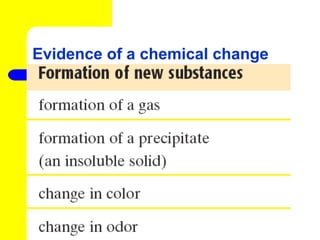
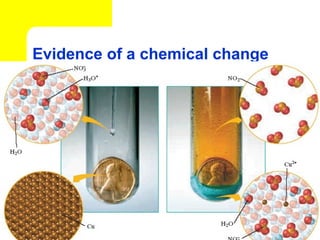
Evidence of a chemical change
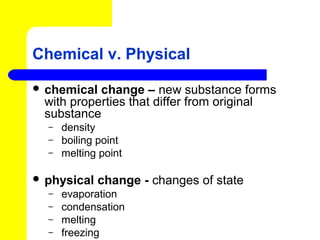
Chemical v. Physical

 chemical change – new substance forms
 with properties that differ from original
 substance
  –   density
  –   boiling point
  –   melting point

 physical   change - changes of state
  –   evaporation
  –   condensation
  –   melting
  –   freezing
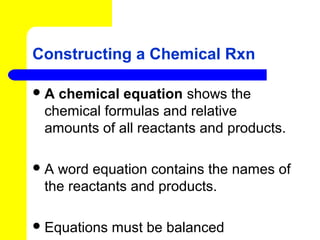
Constructing a Chemical Rxn

A chemical equation shows the
 chemical formulas and relative
 amounts of all reactants and products.

A word equation contains the names of
 the reactants and products.

 Equations   must be balanced.
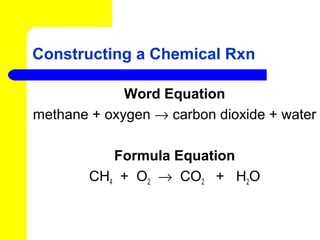
Constructing a Chemical Rxn

             Word Equation
methane + oxygen → carbon dioxide + water

           Formula Equation
        CH4 + O2 → CO2 + H2O
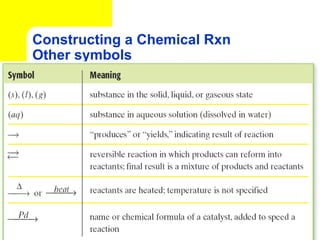
Constructing a Chemical Rxn
Other symbols
Chapter 8


    The Great Balancing
    Act
Think…

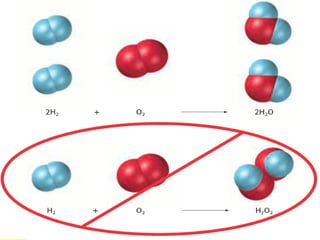
 Law of Conservation of Mass states
 that mass cannot be created or
 destroyed by a chemical or physical
 change

 Therefore,
           ALL chemical equations
 must be balanced. That is, having the
 same number of atoms on both sides of
 the arrow
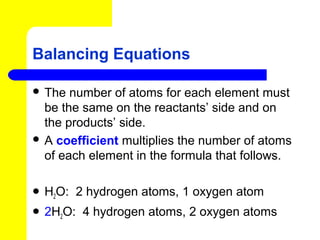
Balancing Equations

 The  number of atoms for each element must
  be the same on the reactants’ side and on
  the products’ side.
 A coefficient multiplies the number of atoms
  of each element in the formula that follows.

 H2O:   2 hydrogen atoms, 1 oxygen atom
 2H2O:   4 hydrogen atoms, 2 oxygen atoms
Sample Problem

•   Balance the equation for the
    reaction of iron (III) oxide with
    hydrogen to form iron and
    water.
Sample Problem

•   Aluminum reacts with arsenic
    acid, HAsO3, to form H2 and
    aluminum arsenate. Write a
    balanced equation for this
    reaction.
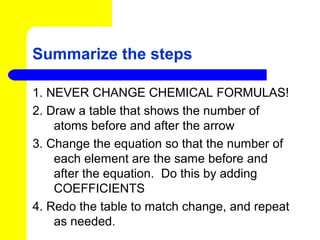
Summarize the steps

1. NEVER CHANGE CHEMICAL FORMULAS!
2. Draw a table that shows the number of
    atoms before and after the arrow
3. Change the equation so that the number of
    each element are the same before and
    after the equation. Do this by adding
    COEFFICIENTS
4. Redo the table to match change, and repeat
    as needed.
Chapter 8


    Reaction Types
The 5 Reaction Types
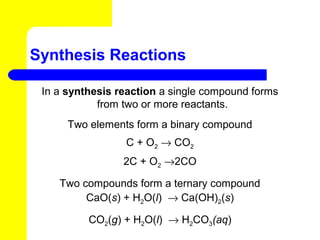
Synthesis Reactions

 In a synthesis reaction a single compound forms
            from two or more reactants.
      Two elements form a binary compound
                 C + O2 → CO2
                 2C + O2 →2CO

    Two compounds form a ternary compound
         CaO(s) + H2O(l) → Ca(OH)2(s)

          CO2(g) + H2O(l) → H2CO3(aq)
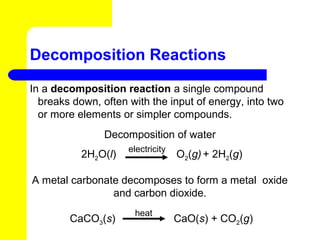
Decomposition Reactions

In a decomposition reaction a single compound
  breaks down, often with the input of energy, into two
  or more elements or simpler compounds.
                Decomposition of water
                     electricity
           2H2O(l)                 O2(g) + 2H2(g)

A metal carbonate decomposes to form a metal oxide
                and carbon dioxide.
                      heat
        CaCO3(s)                   CaO(s) + CO2(g)
Sample Problem

 Predict
        the product(s) and write a
 balanced equation for the reaction of
 potassium with chlorine.
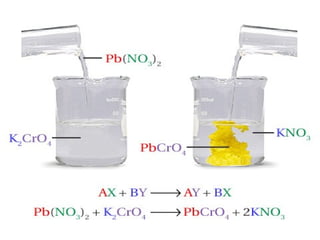
Double-Displacement Reactions

• In a double-displacement reaction two
  compounds in aqueous solution appear to
  exchange ions and form two new
  compounds.

• One of the products must be a solid
  precipitate, a gas, or a molecular compound,
  such as water.

  HCl(aq) + NaOH(aq) → HOH(l) + NaCl(aq)
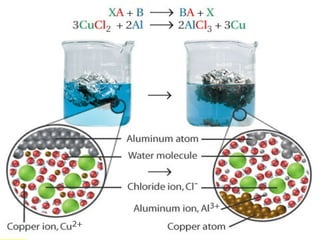
Displacement Reactions

  In a displacement reaction a single
  element reacts with a compound and
   displaces another element from the
               compound.
2Al(s) + 3CuCl2(aq) → 2AlCl3(aq) + 3Cu(s)

     Aluminum displaces copper.
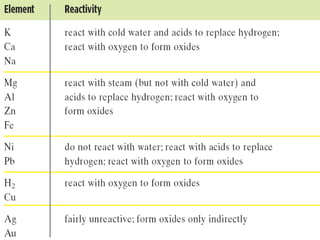
Sample Problem

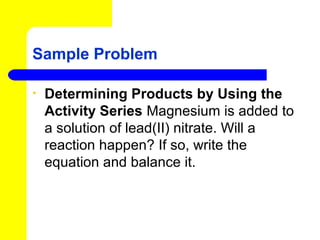
•   Determining Products by Using the
    Activity Series Magnesium is added to
    a solution of lead(II) nitrate. Will a
    reaction happen? If so, write the
    equation and balance it.
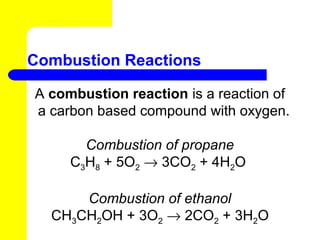
Combustion Reactions

A combustion reaction is a reaction of
a carbon based compound with oxygen.

       Combustion of propane
     C3H8 + 5O2 → 3CO2 + 4H2O

      Combustion of ethanol
  CH3CH2OH + 3O2 → 2CO2 + 3H2O
DESCRIBING CHEMICALS REACTIONS

DESCRIBING CHEMICALS REACTIONS

  • 1.
    Chapter 8 QBAMiguel A. Castro Ramírez Describing Chemical Reactions
  • 2.
    Making Chili 1 lb browned hamburger  16 oz can tomato sauce  2 – 16 oz cans of red kidney beans  1 lb chopped onion  3 chopped green peppers  3 cloves fresh garlic  ½ cup chili powder  2 tbsp olive oil
  • 3.
    Chemical Reactions A chemical reaction is the process by which one or more substances change into one or more new substances.  Reactants are the original substances in a chemical reaction.  Products are the substances that are created in a chemical reaction.
  • 4.
    Chemical Reactions How to make chili Ingredients + heat  chili How to make water 2 H 2 + O 2  2 H 20 Reactants Products
  • 6.
    Evidence of achemical change
  • 7.
    Evidence of achemical change
  • 8.
    Evidence of achemical change
  • 9.
    Chemical v. Physical chemical change – new substance forms with properties that differ from original substance – density – boiling point – melting point  physical change - changes of state – evaporation – condensation – melting – freezing
  • 10.
    Constructing a ChemicalRxn A chemical equation shows the chemical formulas and relative amounts of all reactants and products. A word equation contains the names of the reactants and products.  Equations must be balanced.
  • 11.
    Constructing a ChemicalRxn Word Equation methane + oxygen → carbon dioxide + water Formula Equation CH4 + O2 → CO2 + H2O
  • 12.
    Constructing a ChemicalRxn Other symbols
  • 14.
    Chapter 8 The Great Balancing Act
  • 16.
    Think…  Law ofConservation of Mass states that mass cannot be created or destroyed by a chemical or physical change  Therefore, ALL chemical equations must be balanced. That is, having the same number of atoms on both sides of the arrow
  • 18.
    Balancing Equations  The number of atoms for each element must be the same on the reactants’ side and on the products’ side.  A coefficient multiplies the number of atoms of each element in the formula that follows.  H2O: 2 hydrogen atoms, 1 oxygen atom  2H2O: 4 hydrogen atoms, 2 oxygen atoms
  • 21.
    Sample Problem • Balance the equation for the reaction of iron (III) oxide with hydrogen to form iron and water.
  • 22.
    Sample Problem • Aluminum reacts with arsenic acid, HAsO3, to form H2 and aluminum arsenate. Write a balanced equation for this reaction.
  • 23.
    Summarize the steps 1.NEVER CHANGE CHEMICAL FORMULAS! 2. Draw a table that shows the number of atoms before and after the arrow 3. Change the equation so that the number of each element are the same before and after the equation. Do this by adding COEFFICIENTS 4. Redo the table to match change, and repeat as needed.
  • 24.
    Chapter 8 Reaction Types
  • 25.
  • 26.
    Synthesis Reactions Ina synthesis reaction a single compound forms from two or more reactants. Two elements form a binary compound C + O2 → CO2 2C + O2 →2CO Two compounds form a ternary compound CaO(s) + H2O(l) → Ca(OH)2(s) CO2(g) + H2O(l) → H2CO3(aq)
  • 28.
    Decomposition Reactions In adecomposition reaction a single compound breaks down, often with the input of energy, into two or more elements or simpler compounds. Decomposition of water electricity 2H2O(l) O2(g) + 2H2(g) A metal carbonate decomposes to form a metal oxide and carbon dioxide. heat CaCO3(s) CaO(s) + CO2(g)
  • 31.
    Sample Problem  Predict the product(s) and write a balanced equation for the reaction of potassium with chlorine.
  • 32.
    Double-Displacement Reactions • Ina double-displacement reaction two compounds in aqueous solution appear to exchange ions and form two new compounds. • One of the products must be a solid precipitate, a gas, or a molecular compound, such as water. HCl(aq) + NaOH(aq) → HOH(l) + NaCl(aq)
  • 35.
    Displacement Reactions In a displacement reaction a single element reacts with a compound and displaces another element from the compound. 2Al(s) + 3CuCl2(aq) → 2AlCl3(aq) + 3Cu(s) Aluminum displaces copper.
  • 39.
    Sample Problem • Determining Products by Using the Activity Series Magnesium is added to a solution of lead(II) nitrate. Will a reaction happen? If so, write the equation and balance it.
  • 40.
    Combustion Reactions A combustionreaction is a reaction of a carbon based compound with oxygen. Combustion of propane C3H8 + 5O2 → 3CO2 + 4H2O Combustion of ethanol CH3CH2OH + 3O2 → 2CO2 + 3H2O