PROTECTION RELAY
M.ABDUR REHMAN
13004102003
What is relaying?
Definition of Protective Relay
 A relay is automatic device which
senses an abnormal condition of
electrical circuit and closes its
contacts. These contacts in turns
close and complete the circuit breaker
trip coil circuit hence make the circuit
breaker tripped for disconnecting the
faulty portion of the electrical circuit
from rest of the healthy circuit.
Types of relay
 Definite time
relays
 Differential relay
 Solid state
relays.
 Electromechinical
relay
 Backup relay
 Current relays.
 Voltage relays.
 Restricted earth
fault.
 Bus bar
protection.
 Frequency relays.
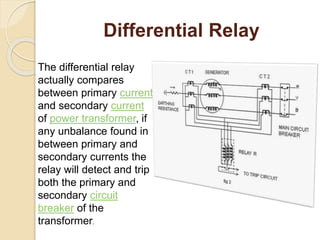
The differential relay
actually compares
between primary current
and secondary current
of power transformer, if
any unbalance found in
between primary and
secondary currents the
relay will detect and trip
both the primary and
secondary circuit
breaker of the
transformer.
Differential Relay
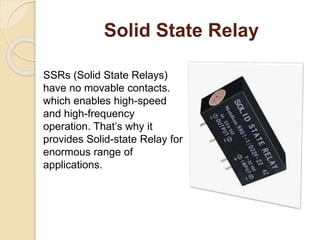
Solid State Relay
SSRs (Solid State Relays)
have no movable contacts.
which enables high-speed
and high-frequency
operation. That’s why it
provides Solid-state Relay for
enormous range of
applications.
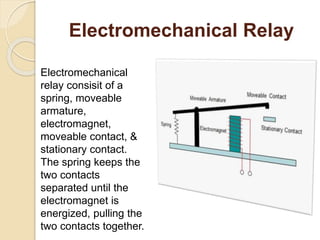
Electromechanical Relay
Electromechanical
relay consisit of a
spring, moveable
armature,
electromagnet,
moveable contact, &
stationary contact.
The spring keeps the
two contacts
separated until the
electromagnet is
energized, pulling the
two contacts together.
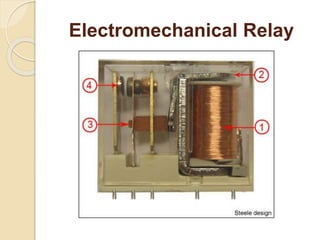
Electromechanical Relay
The nature of relaying
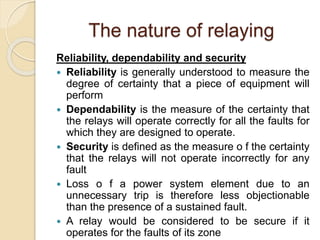
Reliability, dependability and security
 Reliability is generally understood to measure the
degree of certainty that a piece of equipment will
perform
 Dependability is the measure of the certainty that
the relays will operate correctly for all the faults for
which they are designed to operate.
 Security is defined as the measure o f the certainty
that the relays will not operate incorrectly for any
fault
 Loss o f a power system element due to an
unnecessary trip is therefore less objectionable
than the presence of a sustained fault.
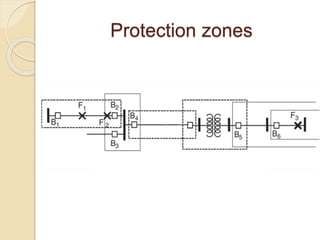
 A relay would be considered to be secure if it
operates for the faults of its zone
Protection zones
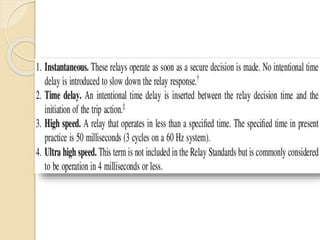
 A relay must:
◦ Operate quickly
◦ Extract significant information from
distorted current and voltage waveforms
Relay speed
Primary and backup
protection The main protection system for a given zone of
protection i s called the primary protection
system.
 It operates in the fastest time possible and
removes the least amount of equipment from
service.
 If primary protection fails duplicate, backup or
breaker-failure protection operates and save
the system
 Backup relays are generally slower than the
primary relays and remove more system
elements than may be necessary to clear a
fault
 Breaker failure relays are a subset of local
Single- and three-phase tripping
and reclosing
 large proportion of faults on a power system are of
a temporary nature, the power system can be
returned to its pre-fault state if the tripped circuit
breakers are reclosed as soon as possible.
 Reclosing can be manual or automatic. Some of
the common interlocks for reclosing are the
following:
◦ Voltage check: Used when good operating practice
demands that a certain piece of equipment be energized
from a specific side
◦ Synchronizing check: This check may be used when the
reclosing operation is likely to energize a piece of
equipment from both sides.
◦ Equipment check: This check is to ensure that some piece
of equipment is not energized unintentionally.
 High speed reclosing is in less than a second and
Elements of a protection
system
Battery and DC supply
 Tripping power, as well as the power required by
the relays, sometimes cannot be obtained from the
AC system, so it is usually provided by the station
battery
 Battery is rated to maintain adequate DC power for
8 – 12 hours following a station blackout
Questions

Types of relay

  • 1.
  • 2.
  • 3.
    Definition of ProtectiveRelay  A relay is automatic device which senses an abnormal condition of electrical circuit and closes its contacts. These contacts in turns close and complete the circuit breaker trip coil circuit hence make the circuit breaker tripped for disconnecting the faulty portion of the electrical circuit from rest of the healthy circuit.
  • 4.
    Types of relay Definite time relays  Differential relay  Solid state relays.  Electromechinical relay  Backup relay  Current relays.  Voltage relays.  Restricted earth fault.  Bus bar protection.  Frequency relays.
  • 5.
    The differential relay actuallycompares between primary current and secondary current of power transformer, if any unbalance found in between primary and secondary currents the relay will detect and trip both the primary and secondary circuit breaker of the transformer. Differential Relay
  • 6.
    Solid State Relay SSRs(Solid State Relays) have no movable contacts. which enables high-speed and high-frequency operation. That’s why it provides Solid-state Relay for enormous range of applications.
  • 7.
    Electromechanical Relay Electromechanical relay consisitof a spring, moveable armature, electromagnet, moveable contact, & stationary contact. The spring keeps the two contacts separated until the electromagnet is energized, pulling the two contacts together.
  • 8.
  • 9.
    The nature ofrelaying Reliability, dependability and security  Reliability is generally understood to measure the degree of certainty that a piece of equipment will perform  Dependability is the measure of the certainty that the relays will operate correctly for all the faults for which they are designed to operate.  Security is defined as the measure o f the certainty that the relays will not operate incorrectly for any fault  Loss o f a power system element due to an unnecessary trip is therefore less objectionable than the presence of a sustained fault.  A relay would be considered to be secure if it operates for the faults of its zone
  • 10.
  • 11.
     A relaymust: ◦ Operate quickly ◦ Extract significant information from distorted current and voltage waveforms Relay speed
  • 13.
    Primary and backup protectionThe main protection system for a given zone of protection i s called the primary protection system.  It operates in the fastest time possible and removes the least amount of equipment from service.  If primary protection fails duplicate, backup or breaker-failure protection operates and save the system  Backup relays are generally slower than the primary relays and remove more system elements than may be necessary to clear a fault  Breaker failure relays are a subset of local
  • 14.
    Single- and three-phasetripping and reclosing  large proportion of faults on a power system are of a temporary nature, the power system can be returned to its pre-fault state if the tripped circuit breakers are reclosed as soon as possible.  Reclosing can be manual or automatic. Some of the common interlocks for reclosing are the following: ◦ Voltage check: Used when good operating practice demands that a certain piece of equipment be energized from a specific side ◦ Synchronizing check: This check may be used when the reclosing operation is likely to energize a piece of equipment from both sides. ◦ Equipment check: This check is to ensure that some piece of equipment is not energized unintentionally.  High speed reclosing is in less than a second and
  • 15.
    Elements of aprotection system Battery and DC supply  Tripping power, as well as the power required by the relays, sometimes cannot be obtained from the AC system, so it is usually provided by the station battery  Battery is rated to maintain adequate DC power for 8 – 12 hours following a station blackout
  • 16.