INTRODUCTION TO
PROTECTIVE RELAYING
EMK42003 – POWER SYSTEM PROTECTION & SWITCHGEAR
MUHD HAFIZI IDRIS
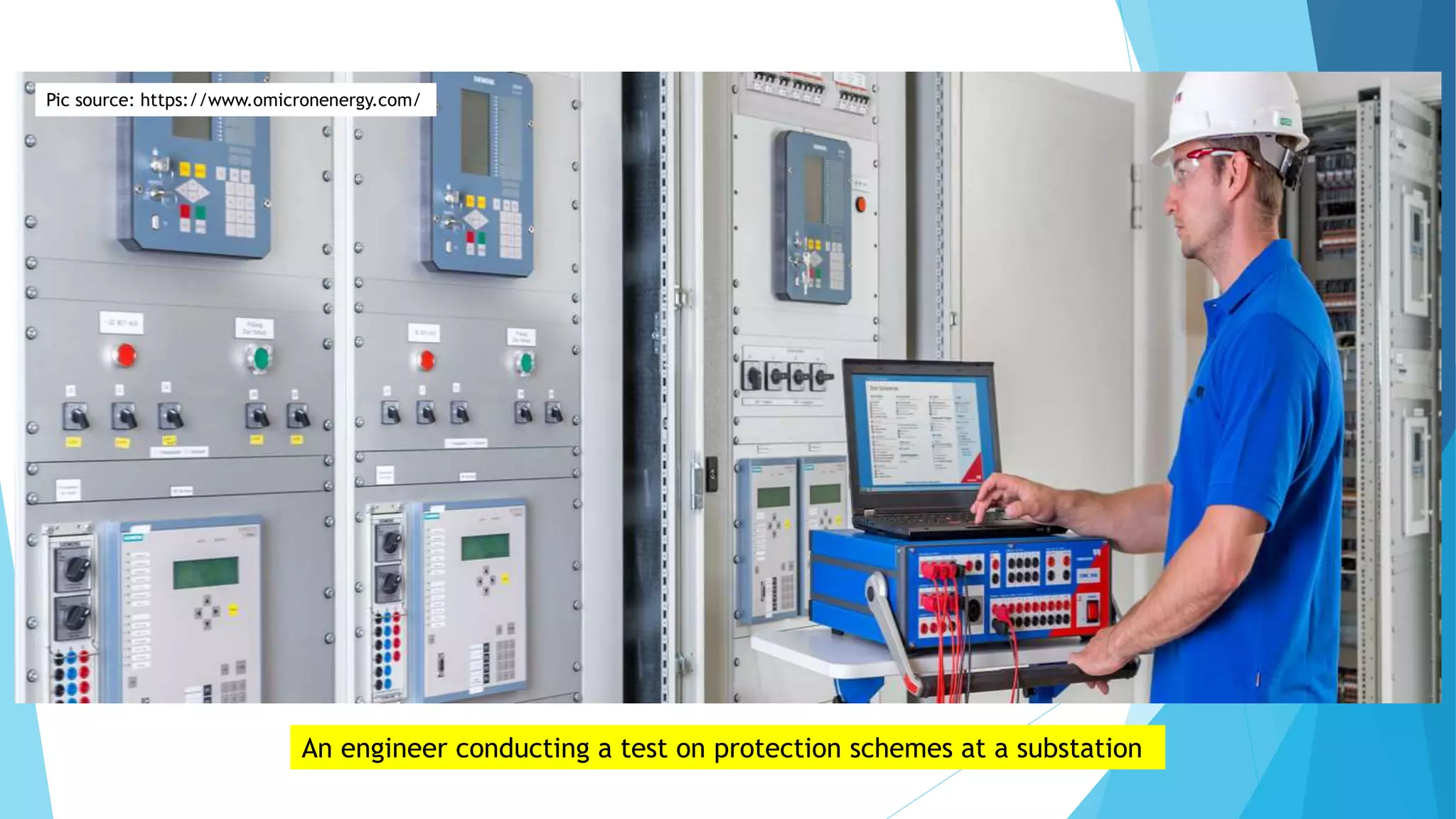
An engineer conducting a test on protection schemes at a substation
Pic source: https://www.omicronenergy.com/
FUNCTIONS OF PROTECTION SCHEMES
ZONES OF PROTECTION
REQUIREMENTS OF PROTECTION SCHEMES
UNIT AND NON-UNIT PROTECTIONS
PRIMARY AND BACKUP PROTECTIONS
COMPONENTS OF A PROTECTION SYSTEM
CLASSIFICATION OF PROTECTIVE RELAYS BASED ON
TECHNOLOGY
ANSI STANDARD DEVICE NUMBERS & COMMON
ACRONYMS
FUNCTIONS OF PROTECTION SCHEMES
 To sense/detect the fault occurrence and other abnormal conditions
at the protected equipment/area/section.
 To operate the correct circuit breakers so as to disconnect only the
faulty equipment/area/section as quickly as possible, thus
minimizing the damage caused by the faults.
 To operate the correct circuit breakers to isolate the faulty
equipment/area/section from the healthy system in the case of
abnormalities like overloads, unbalance, undervoltage, etc.
 To clear the fault before the system becomes unstable.
 To identify distinctly where the fault has occurred.
ZONES OF PROTECTION
 Power system is segmented into a number of protective zones.
 Each zone is protected by a system of relays, circuit breakers (CBs) and
associated equipment.
 The CBs are arranged in a manner that makes it possible to isolate the
protected zone while the remaining systems continues in operation.
 Each zone covers one or more components.
 The neighboring zones are overlapped to each other for complete
protection and to avoid unprotected component (blind zone).
 When abnormal condition occurs at a protected zone, the relays for the
protection zone will identity this condition and send trip signals to
appropriate CBs to isolate the affected zone.
ZONES OF PROTECTION
Zones of protection
REQUIREMENTS OF PROTECTION SCHEMES
1. SELECTIVITY
 Ability to isolate only the faulty part from healthy part to minimize outage area and
to maintain power supply for the rest of power system.
 Possibility of failure to operate and failure of protection relays and circuit breakers
should be considered.
 Selectivity also known as relay coordination.
 Coordination of primary and backup relays.
2. RELIABILITY
 Depicts the quality of the protective system.
 Less the probability of failure, better the reliability.
 Failure can occur in relays, circuit breakers, control circuits and due to erroneous
conversion by system transducers.
REQUIREMENTS OF PROTECTION SCHEMES
3. SPEED
 Quick isolation of faulted area can improve power system stability, reduce outage
duration and minimize damage of faulted elements.
 Protective relays should identity the fault and operate as fast as possible.
 Total time to remove the fault is the sum of operation time of relays and circuit
breakers.
4. DISCRIMINATION
 Ability to discriminate between fault and loading conditions even when the minimum
fault current is less than maximum full load current.
REQUIREMENTS OF PROTECTION SCHEMES
5. SIMPLICITY
 Used to refer the design quality of a protection relay system.
 The protection system should be as simple and straightforward as possible without disturbing its
basic task.
 As consequence improves system reliability and require less maintenance.
6. SENSITIVITY
 Ability to operate correctly to the faults or abnormal conditions inside zone of protection.
 It refers to the minimum level of fault current at which the protective device operates.
 It can sense any fault within the protected zone irrespective of fault location, fault type and fault
resistance.
7. ECONOMICS
 A good protection system should have both features which are maximum protection and minimum
cost.
UNIT AND NON-UNIT PROTECTIONS
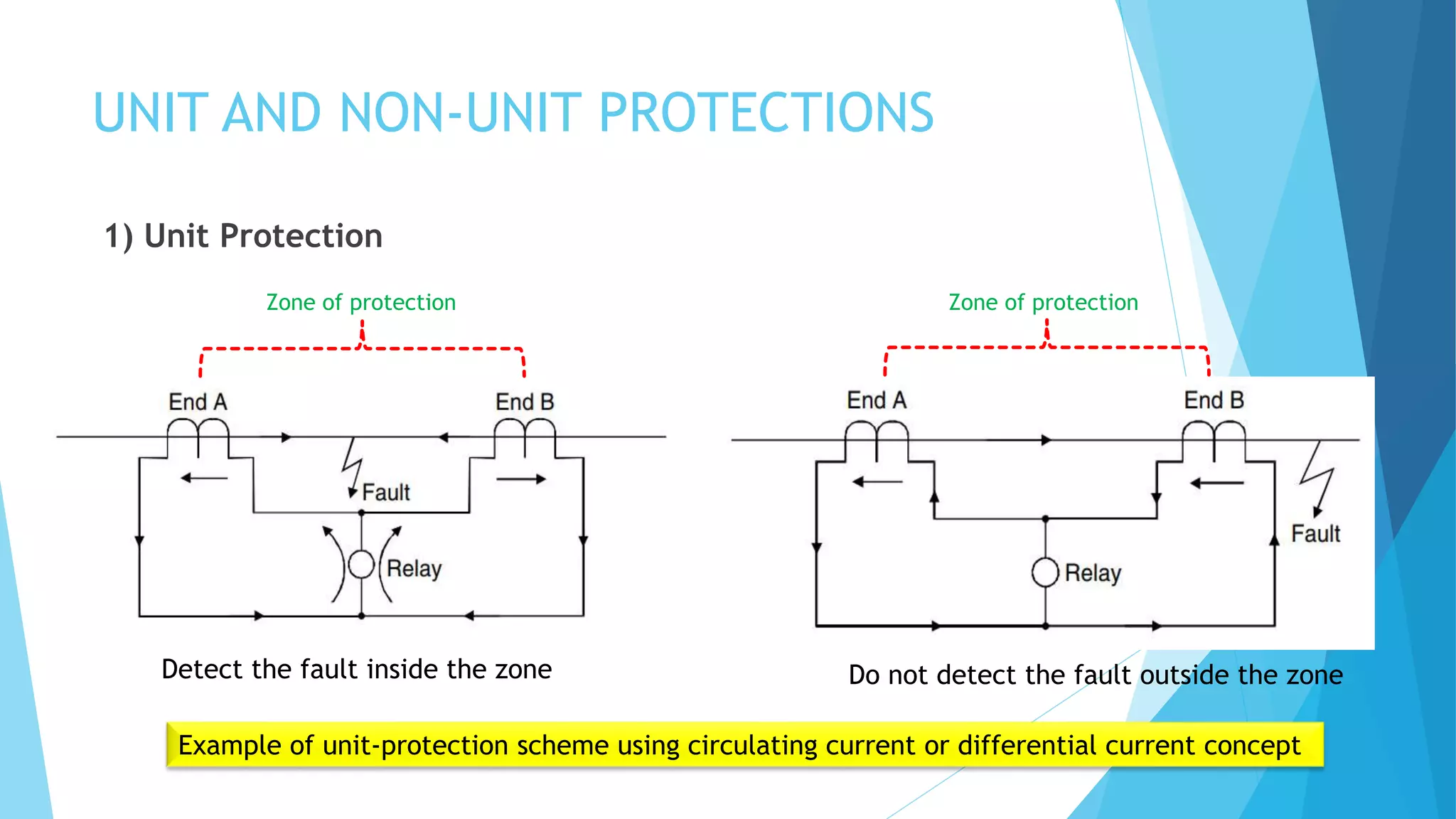
1) Unit Protection
 Definition – a scheme that operates only for faults within its zone
 Zone of protection – decided on the basis of current transformer
(CTs) locations
 It does not detect and respond to the faults outside its zone of
protection.
 Normally used as main protection.
 The best example is differential protection scheme.
UNIT AND NON-UNIT PROTECTIONS
1) Unit Protection
Example of unit-protection scheme using circulating current or differential current concept
Detect the fault inside the zone Do not detect the fault outside the zone
Zone of protection Zone of protection
UNIT AND NON-UNIT PROTECTIONS
2) Non-Unit Protection
 Definition – a scheme that achieves protection using grading of
successive relays.
 The discrimination is obtained by time grading, a combination
current and time grading, or distance grading of the relays of
several zones.
 Best examples are overcurrent and distance protection schemes.
UNIT AND NON-UNIT PROTECTIONS
2) Non-Unit Protection
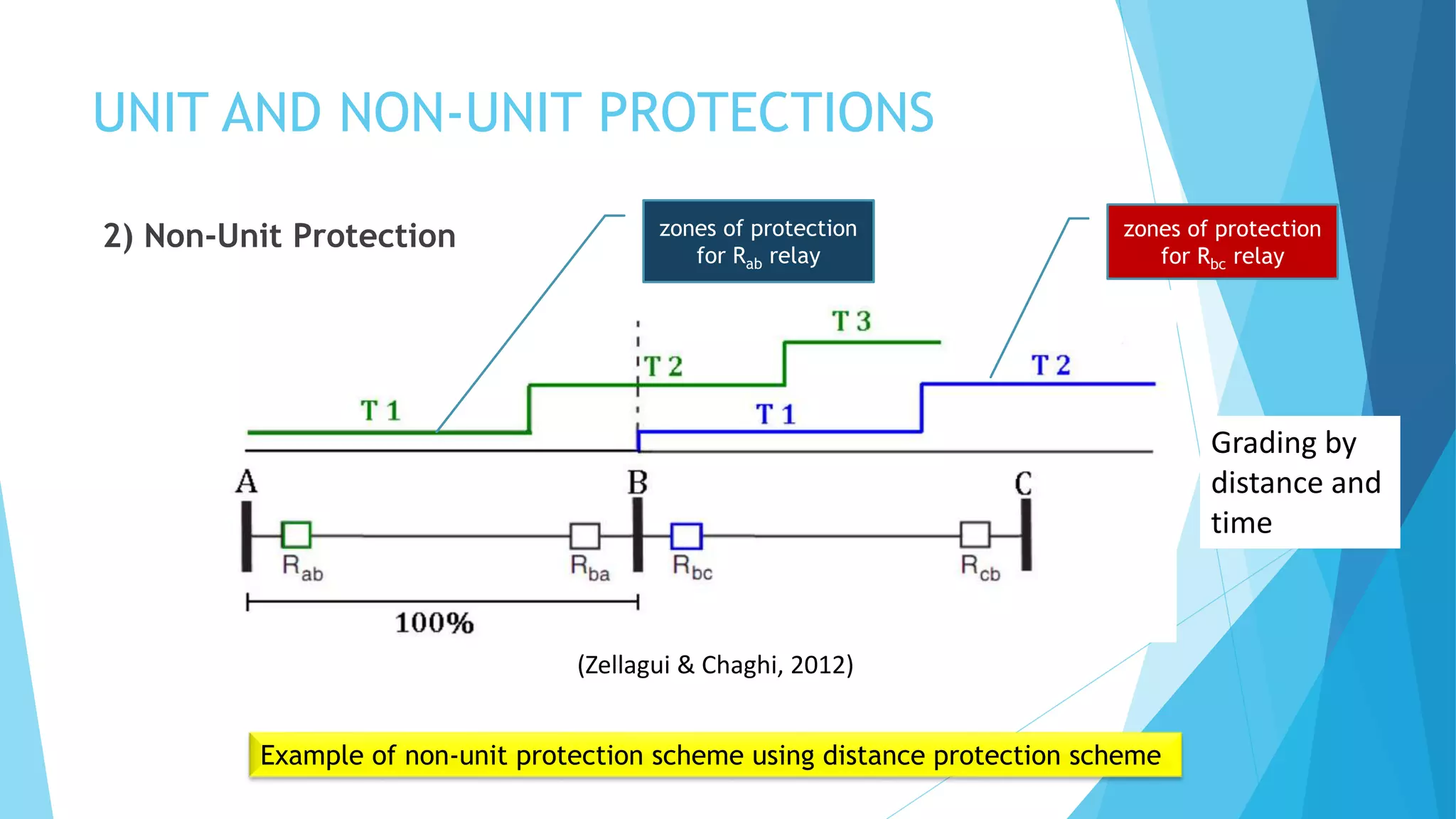
Example of non-unit protection scheme using distance protection scheme
(Zellagui & Chaghi, 2012)
zones of protection
for Rab relay
zones of protection
for Rbc relay
Grading by
distance and
time
PRIMARY AND BACKUP PROTECTIONS
 Both primary and backup relays usually provided for each zone of protection.
 Main / Primary protection:
 Always there as the first line of defense to the clear the fault
 Usually instantaneous to clear the fault as soon as possible
 Normally has small operation zone
 Backup protection
 Second line of defense
 Clear the fault if the primary protection scheme / relay fail to operate
 Normally time delayed to give ample time for primary protection to make decision.
 Normally has large operation zone
PRIMARY AND BACKUP PROTECTIONS
 Example of main and backup protections to protect a line.
Main protection scheme:
- Current differential protection scheme
- Combination of relay 1A and relay 2A
- Unit protection
Backup protection scheme:
- Directional overcurrent relay
- Separated relay 1B and 2B
- Non-unit protection
For faults within the
protected line, both 1B
and 2B relays will
operate and isolate the
fault if the main
protection scheme
(combination of relay
1A and 2A) fails to
operate to isolate the
fault
COMPONENTS OF A PROTECTION SYSTEM
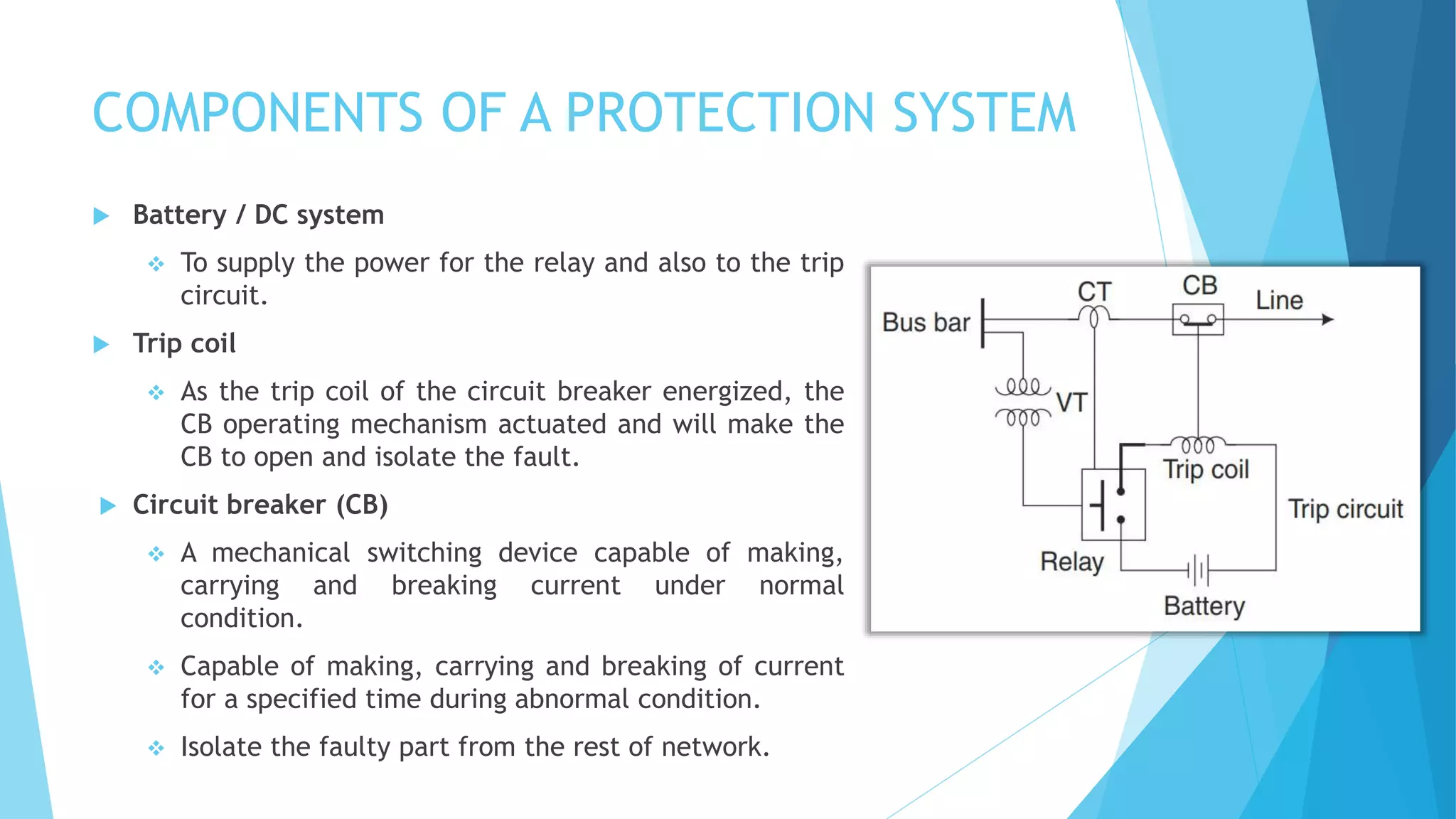
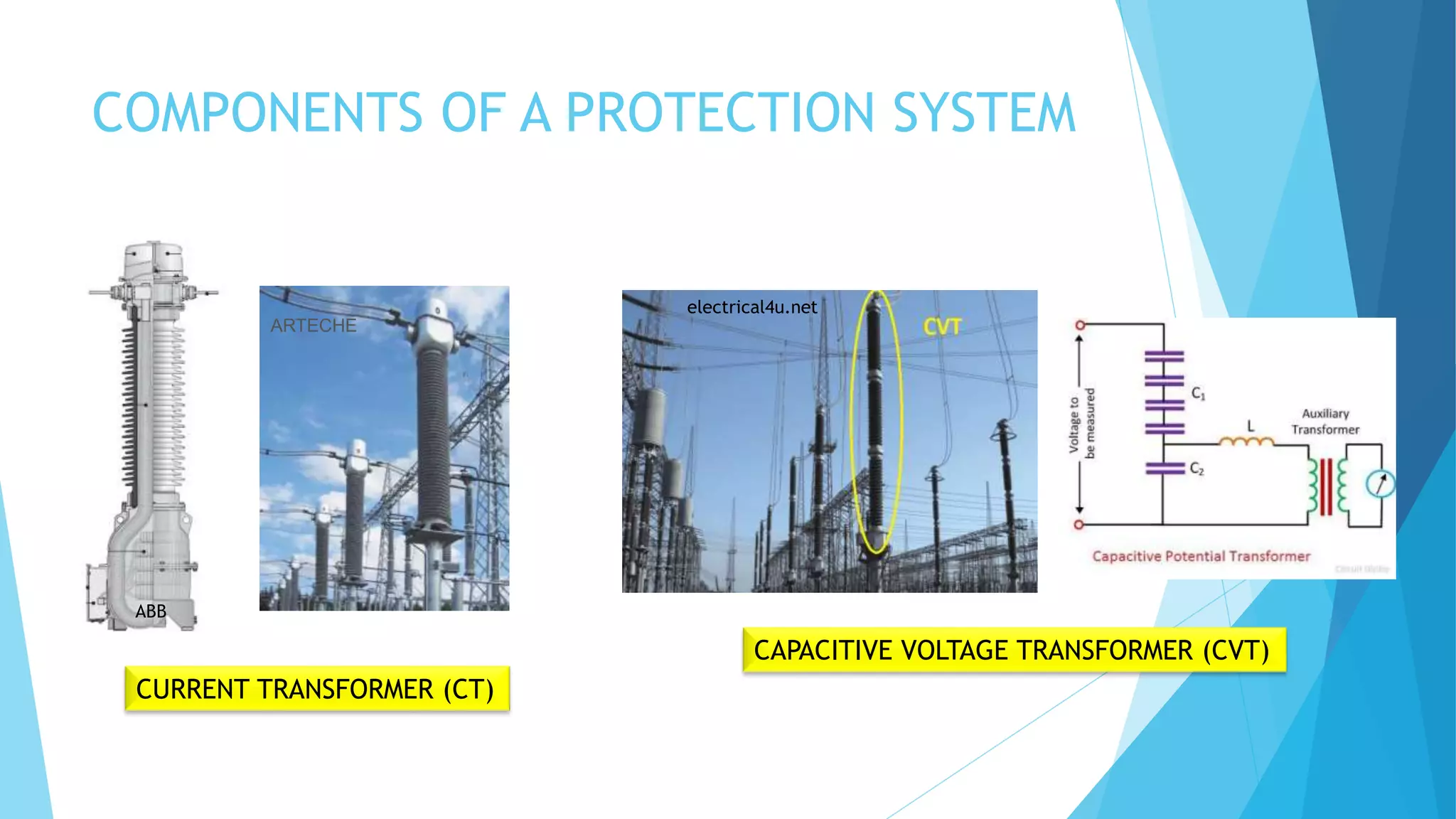
 CT (current transformer)
 Convert the primary current to secondary current
and transmit the secondary current to protective
relay.
 VT (voltage transformer)
 Convert the primary voltage to secondary voltage
and transmit the secondary voltage to protective
relay.
 Protective relay
 Detect and locate the fault and send a trip signal to
the circuit breaker.
 When a fault occurred, the relay will operate by
closing the relay contact to complete the trip
circuit.
COMPONENTS OF A PROTECTION SYSTEM
 Battery / DC system
 To supply the power for the relay and also to the trip
circuit.
 Trip coil
 As the trip coil of the circuit breaker energized, the
CB operating mechanism actuated and will make the
CB to open and isolate the fault.
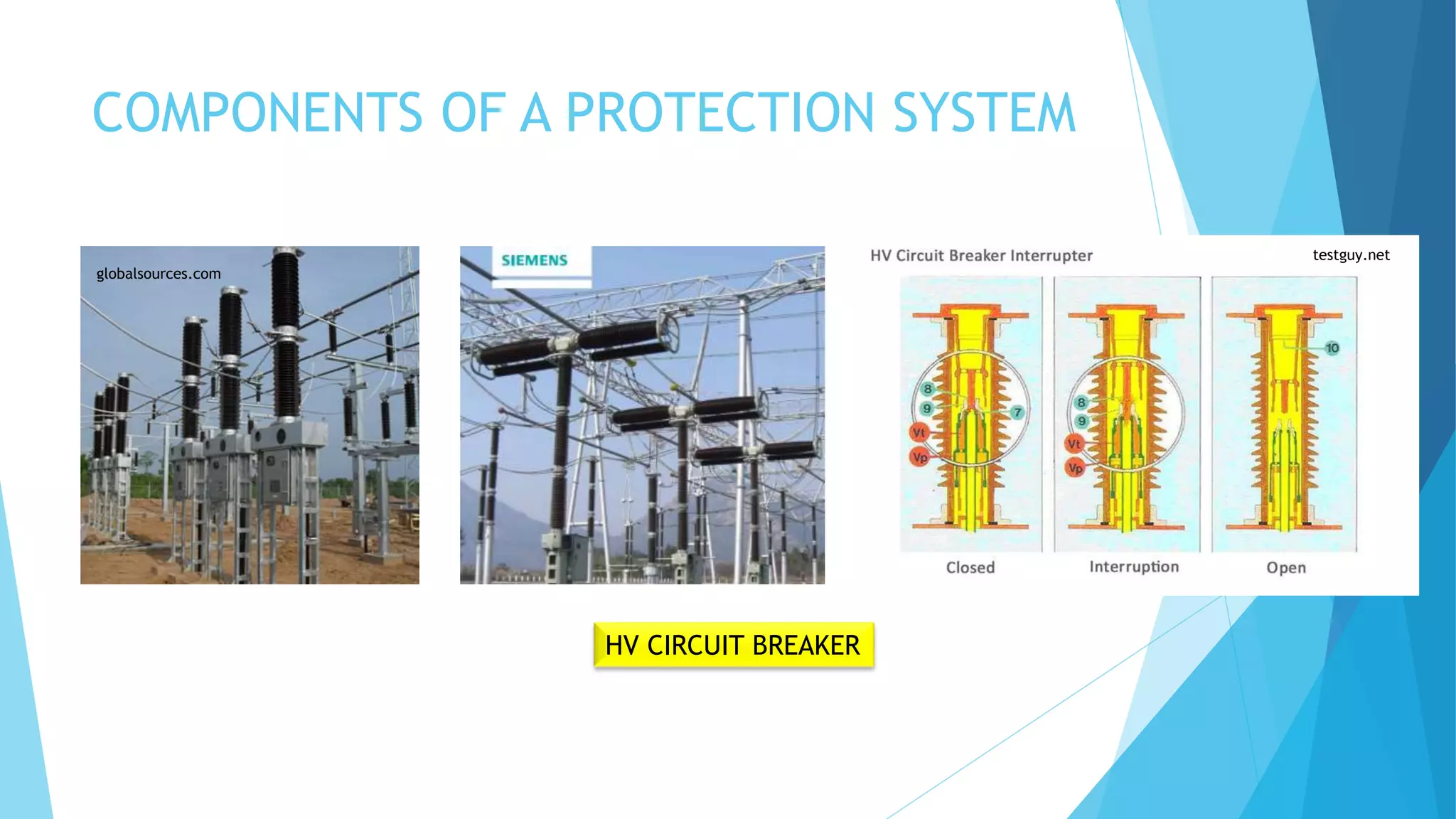
 Circuit breaker (CB)
 A mechanical switching device capable of making,
carrying and breaking current under normal
condition.
 Capable of making, carrying and breaking of current
for a specified time during abnormal condition.
 Isolate the faulty part from the rest of network.
COMPONENTS OF A PROTECTION SYSTEM
ABB
ARTECHE
CURRENT TRANSFORMER (CT)
electrical4u.net
CAPACITIVE VOLTAGE TRANSFORMER (CVT)
COMPONENTS OF A PROTECTION SYSTEM
PROTECTION RELAY BATTERY BANK
COMPONENTS OF A PROTECTION SYSTEM
HV CIRCUIT BREAKER
testguy.net
globalsources.com
CLASSIFICATION OF PROTECTIVE RELAYS
BASED ON TECHNOLOGY
 Protective relays can be broadly classified into the following three
categories, depending on the technology they use for their
construction and operation.
1. Electromechanical relays
2. Solid state (static) relays
3. Digital / numerical relays
CLASSIFICATION OF PROTECTIVE RELAYS
BASED ON TECHNOLOGY
1. Electromechanical relays
 The oldest type of relay.
 First generation of electromechanical relay which came in 1901.
 Operate based on the regulation of mechanical force generated
through the flow of current in windings wounded on magnetic
core.
CLASSIFICATION OF PROTECTIVE RELAYS
BASED ON TECHNOLOGY
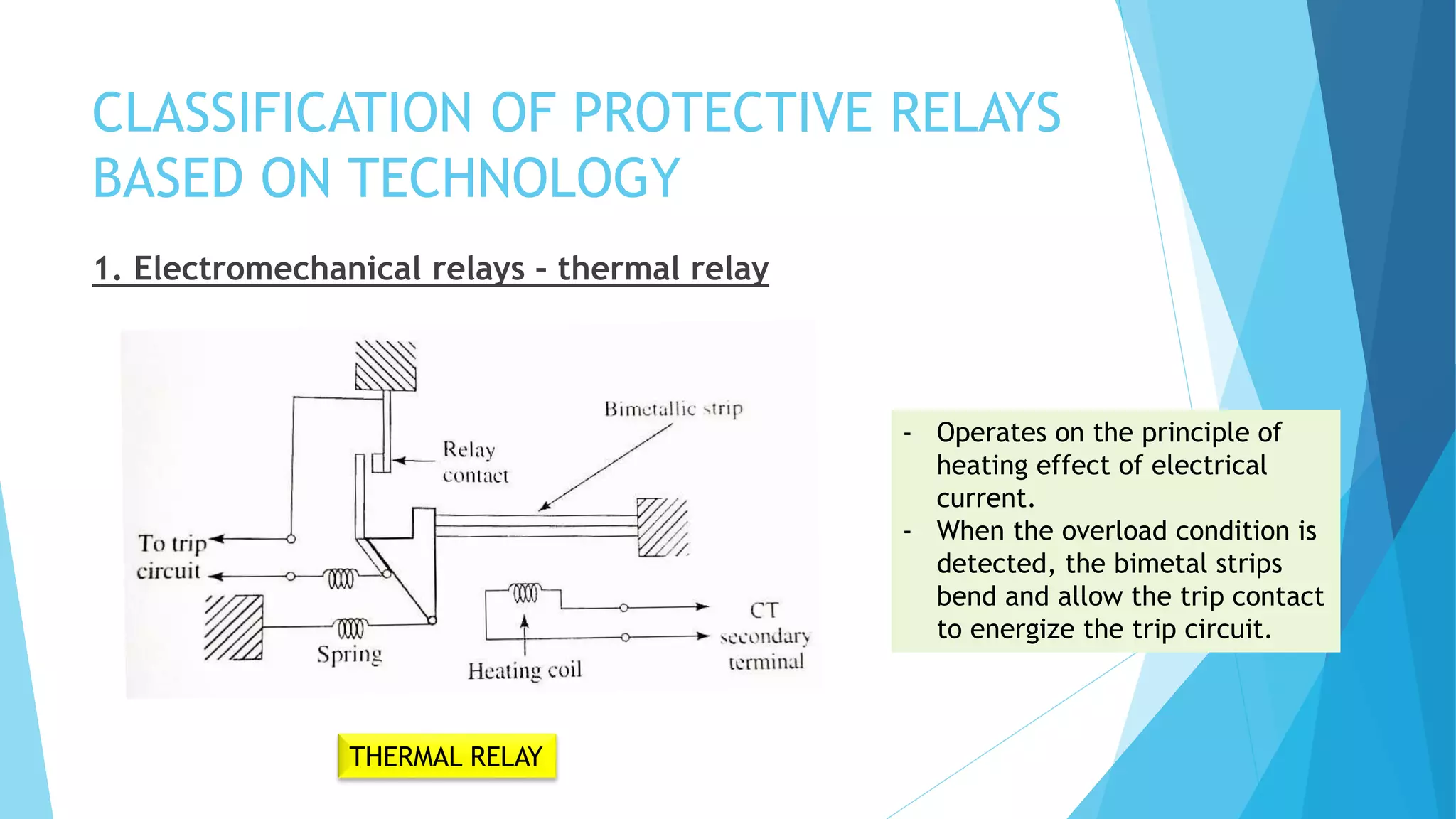
1. Electromechanical relays – thermal relay
- Operates on the principle of
heating effect of electrical
current.
- When the overload condition is
detected, the bimetal strips
bend and allow the trip contact
to energize the trip circuit.
THERMAL RELAY
CLASSIFICATION OF PROTECTIVE RELAYS
BASED ON TECHNOLOGY
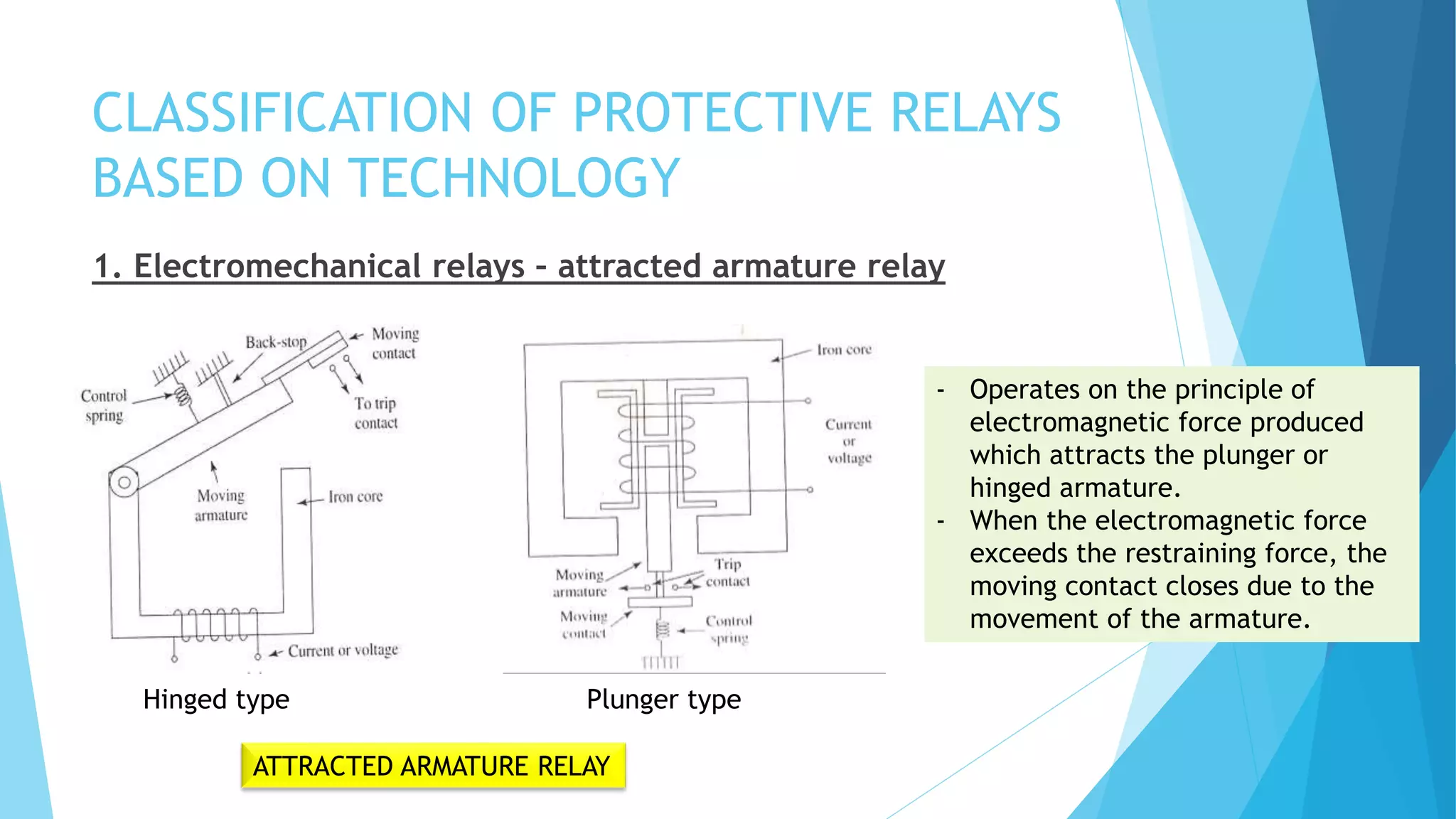
1. Electromechanical relays – attracted armature relay
- Operates on the principle of
electromagnetic force produced
which attracts the plunger or
hinged armature.
- When the electromagnetic force
exceeds the restraining force, the
moving contact closes due to the
movement of the armature.
ATTRACTED ARMATURE RELAY
Hinged type Plunger type
CLASSIFICATION OF PROTECTIVE RELAYS
BASED ON TECHNOLOGY
1. Electromechanical relays – induction relay
- Operates on the principle of
electromagnetic induction.
- Operating force is developed
due to the interaction of two
AC flux displaced in time and
space in movable element
(rotor).
INDUCTION RELAY
Induction disc relay Induction cup relay
CLASSIFICATION OF PROTECTIVE RELAYS
BASED ON TECHNOLOGY
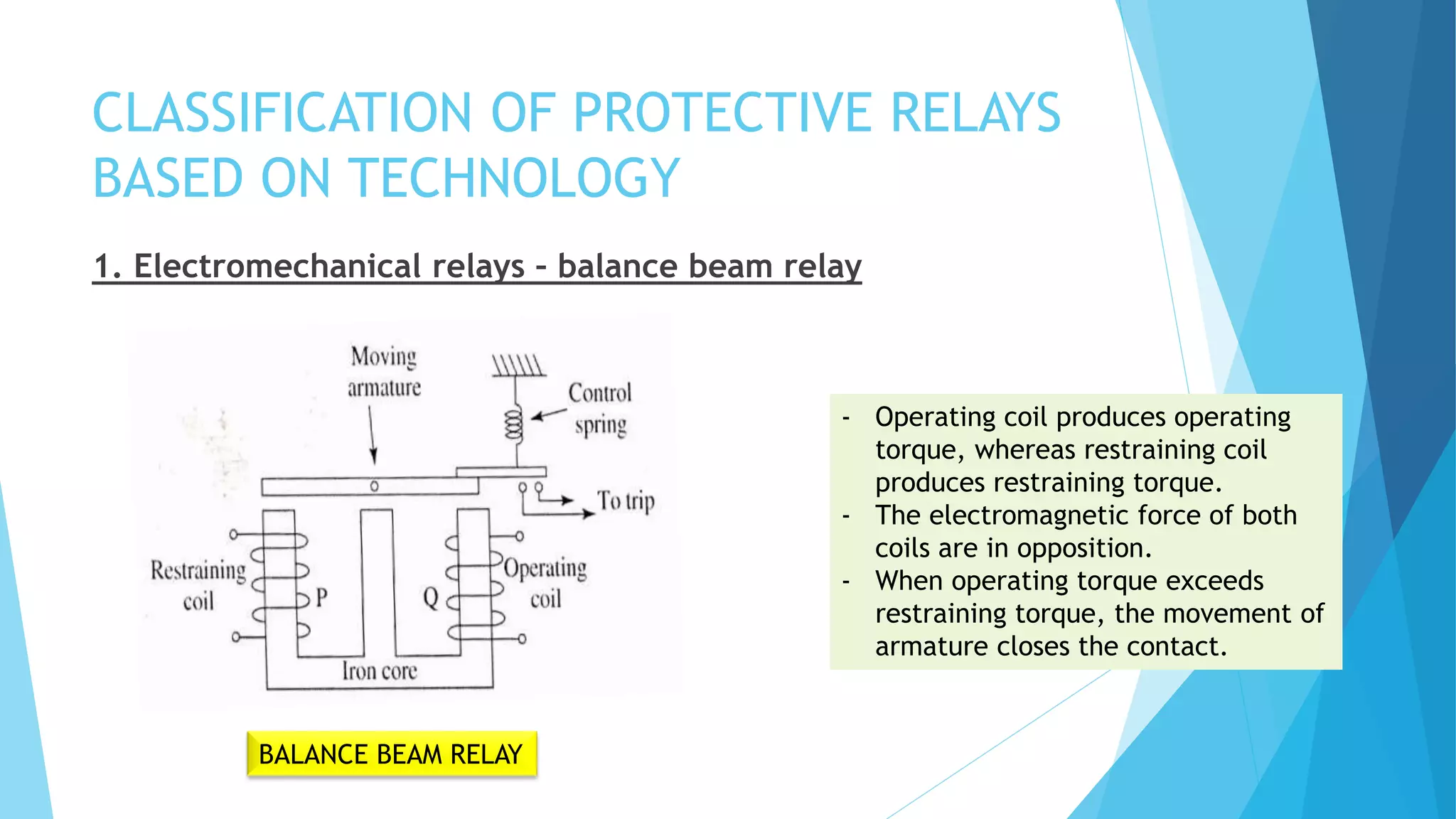
1. Electromechanical relays – balance beam relay
- Operating coil produces operating
torque, whereas restraining coil
produces restraining torque.
- The electromagnetic force of both
coils are in opposition.
- When operating torque exceeds
restraining torque, the movement of
armature closes the contact.
BALANCE BEAM RELAY
CLASSIFICATION OF PROTECTIVE RELAYS
BASED ON TECHNOLOGY
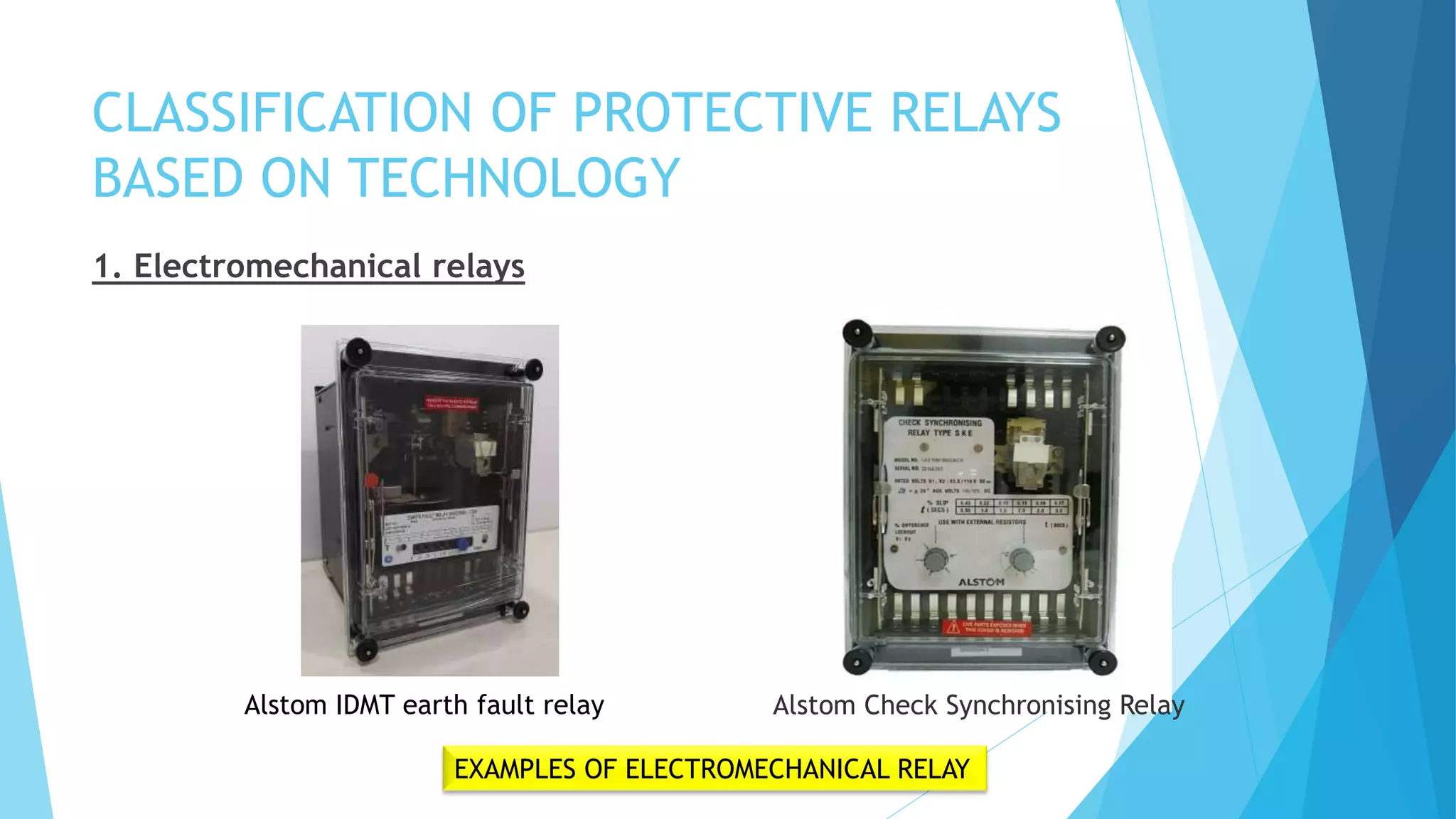
1. Electromechanical relays
EXAMPLES OF ELECTROMECHANICAL RELAY
Alstom IDMT earth fault relay Alstom Check Synchronising Relay
CLASSIFICATION OF PROTECTIVE RELAYS
BASED ON TECHNOLOGY
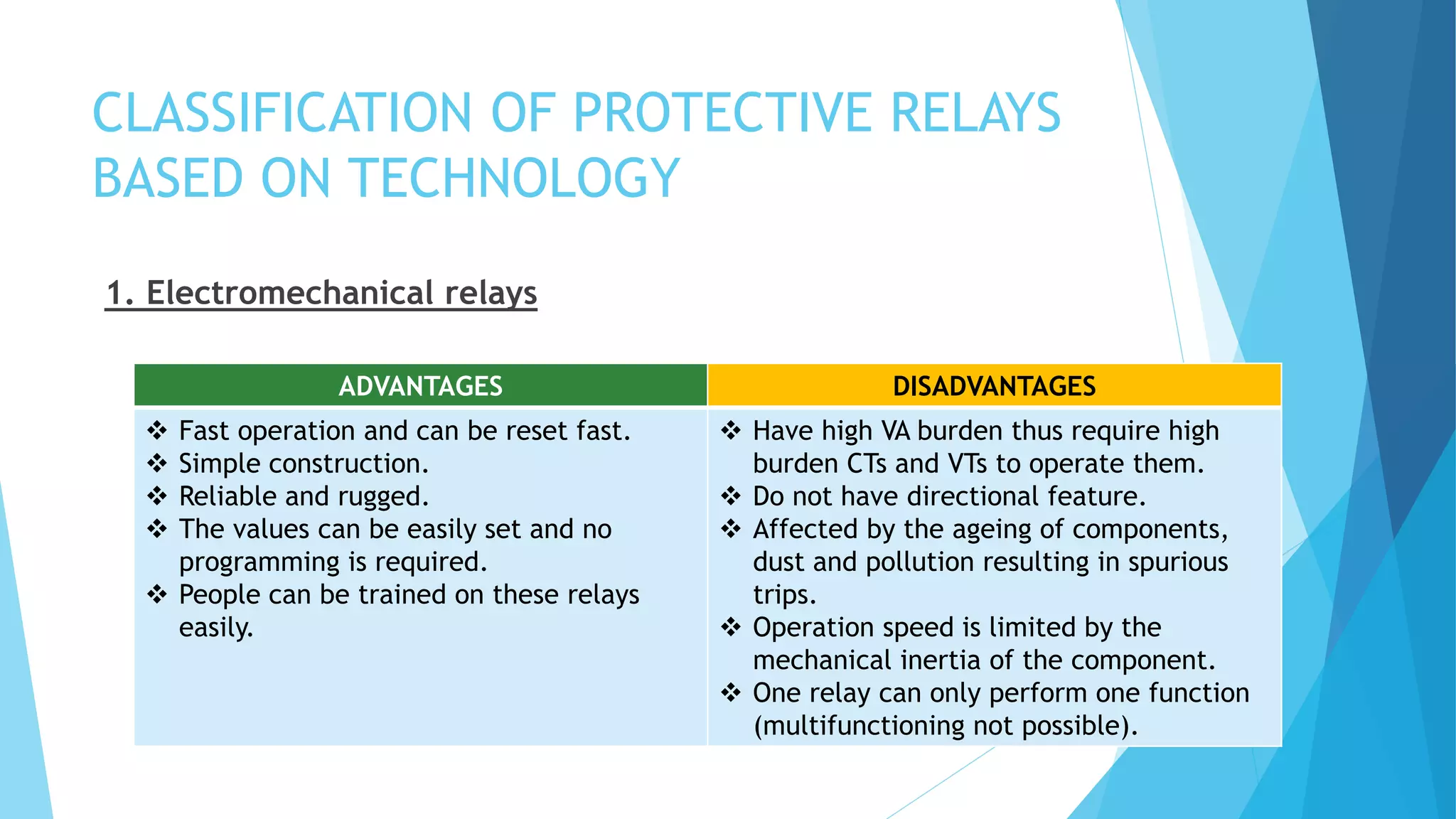
1. Electromechanical relays
ADVANTAGES DISADVANTAGES
 Fast operation and can be reset fast.
 Simple construction.
 Reliable and rugged.
 The values can be easily set and no
programming is required.
 People can be trained on these relays
easily.
 Have high VA burden thus require high
burden CTs and VTs to operate them.
 Do not have directional feature.
 Affected by the ageing of components,
dust and pollution resulting in spurious
trips.
 Operation speed is limited by the
mechanical inertia of the component.
 One relay can only perform one function
(multifunctioning not possible).
CLASSIFICATION OF PROTECTIVE RELAYS
BASED ON TECHNOLOGY
2. Solid state (static) relays
 Due to the advent of electronic devices such as diode,
transistor, ICs, chips etc.
 Second generation of relays.
 Came into operation in 1950s.
 More accurate and higher reliability compared with
electromechanical relays.
CLASSIFICATION OF PROTECTIVE RELAYS
BASED ON TECHNOLOGY
2. Solid state (static) relays
 The static means the relay has no moving part.
 The semiconductor devices are used for data processing and also
to create relay characteristic.
 Lower relay burden due to no moving parts thus further reduces
the CT/VT requirement.
 Require separate DC power supply.
CLASSIFICATION OF PROTECTIVE RELAYS
BASED ON TECHNOLOGY
2. Solid state (static) relays
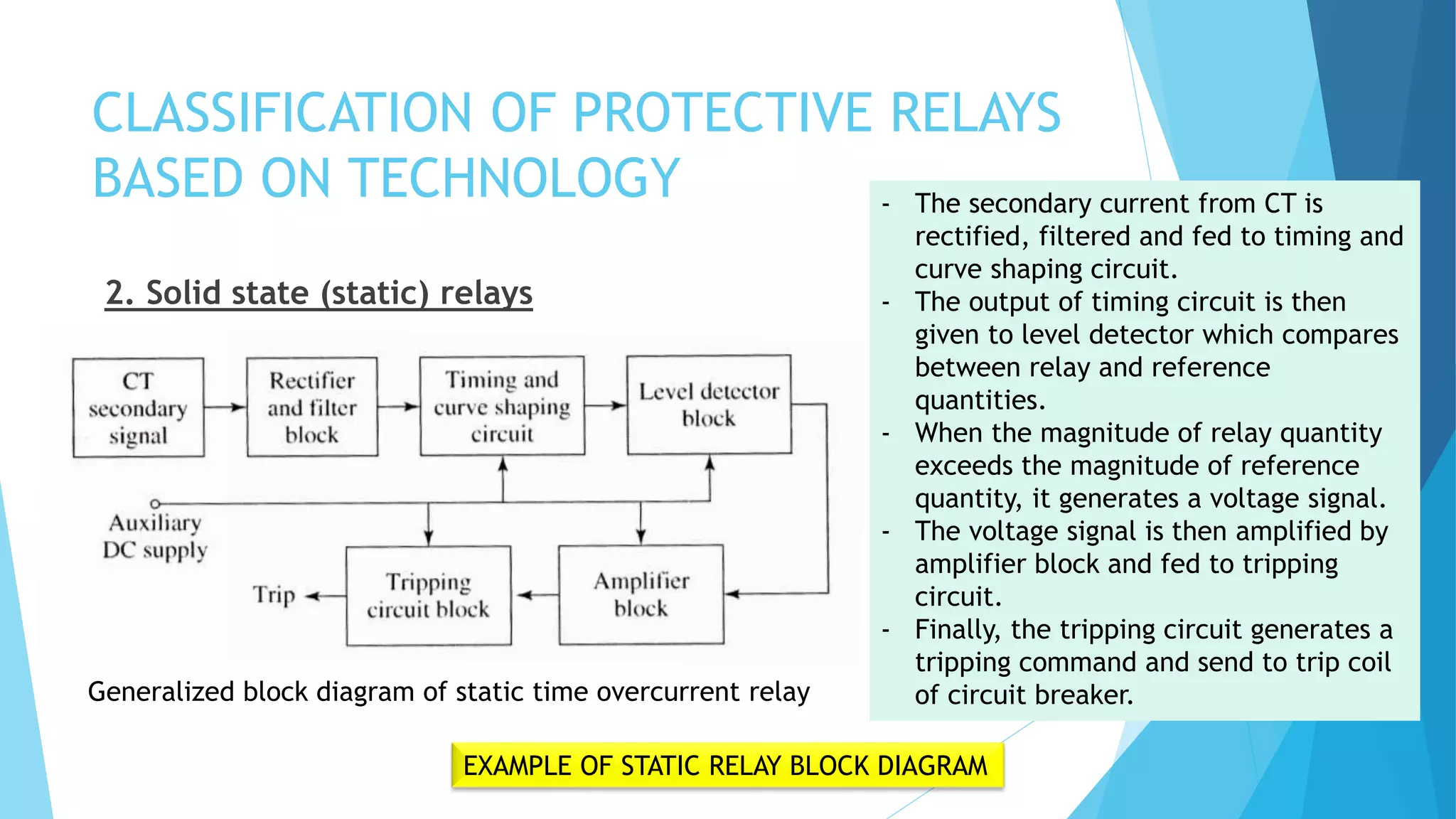
EXAMPLE OF STATIC RELAY BLOCK DIAGRAM
Generalized block diagram of static time overcurrent relay
- The secondary current from CT is
rectified, filtered and fed to timing and
curve shaping circuit.
- The output of timing circuit is then
given to level detector which compares
between relay and reference
quantities.
- When the magnitude of relay quantity
exceeds the magnitude of reference
quantity, it generates a voltage signal.
- The voltage signal is then amplified by
amplifier block and fed to tripping
circuit.
- Finally, the tripping circuit generates a
tripping command and send to trip coil
of circuit breaker.
CLASSIFICATION OF PROTECTIVE RELAYS
BASED ON TECHNOLOGY
GEC Alstom Static Distance Protection Relay GEC Static Differential Protection Relay
EXAMPLES OF STATIC RELAY
2. Solid state (static) relays
CLASSIFICATION OF PROTECTIVE RELAYS
BASED ON TECHNOLOGY
ADVANTAGES DISADVANTAGES
 Do not contain moving parts – thus free from
problems such as contact bouncing, arcing,
erosion and friction.
 Significantly less burden on instrument
transformers (CT/VT).
 Can incorporate variety of functions in a single
unit.
 Quick response and reset action.
 Greater sensitivity can be obtained by using
amplification block.
 Superior characteristic and accuracy.
 Electronic devices are more sensitive to
voltage spike and other transients that can
cause malfunction.
 Require auxiliary DC to operate.
 Has low short time overload capacity.
 The characteristic of electronic devices are
affected by temperature and ageing of
semiconductor devices.
 Costlier compared to electromechanical relay.
 Require highly trained persons to service static
relay which has complex protective functions.
3. Digital / numerical relays
 Entered the market around 1980s.
 Based on microprocessors and microcontrollers.
 Instead of using analog signals, this relay converts all measured
analogue quantities into digital signals.
 Microcontrollers are used in replacement of analogue circuits used in
static relays.
 Digital / numerical relays introduce Analogue to Digital Convertor (A/D
conversion) of all measured analogue quantities and use a
microprocessor to implement the protection algorithm.
CLASSIFICATION OF PROTECTIVE RELAYS
BASED ON TECHNOLOGY
3. Digital / numerical relays
CLASSIFICATION OF PROTECTIVE RELAYS
BASED ON TECHNOLOGY
BASIC BLOK DIAGRAM OF
A DIGITAL / NUMERICAL RELAY
Anti aliasing
filter
3. Digital / numerical relays
CLASSIFICATION OF PROTECTIVE RELAYS
BASED ON TECHNOLOGY
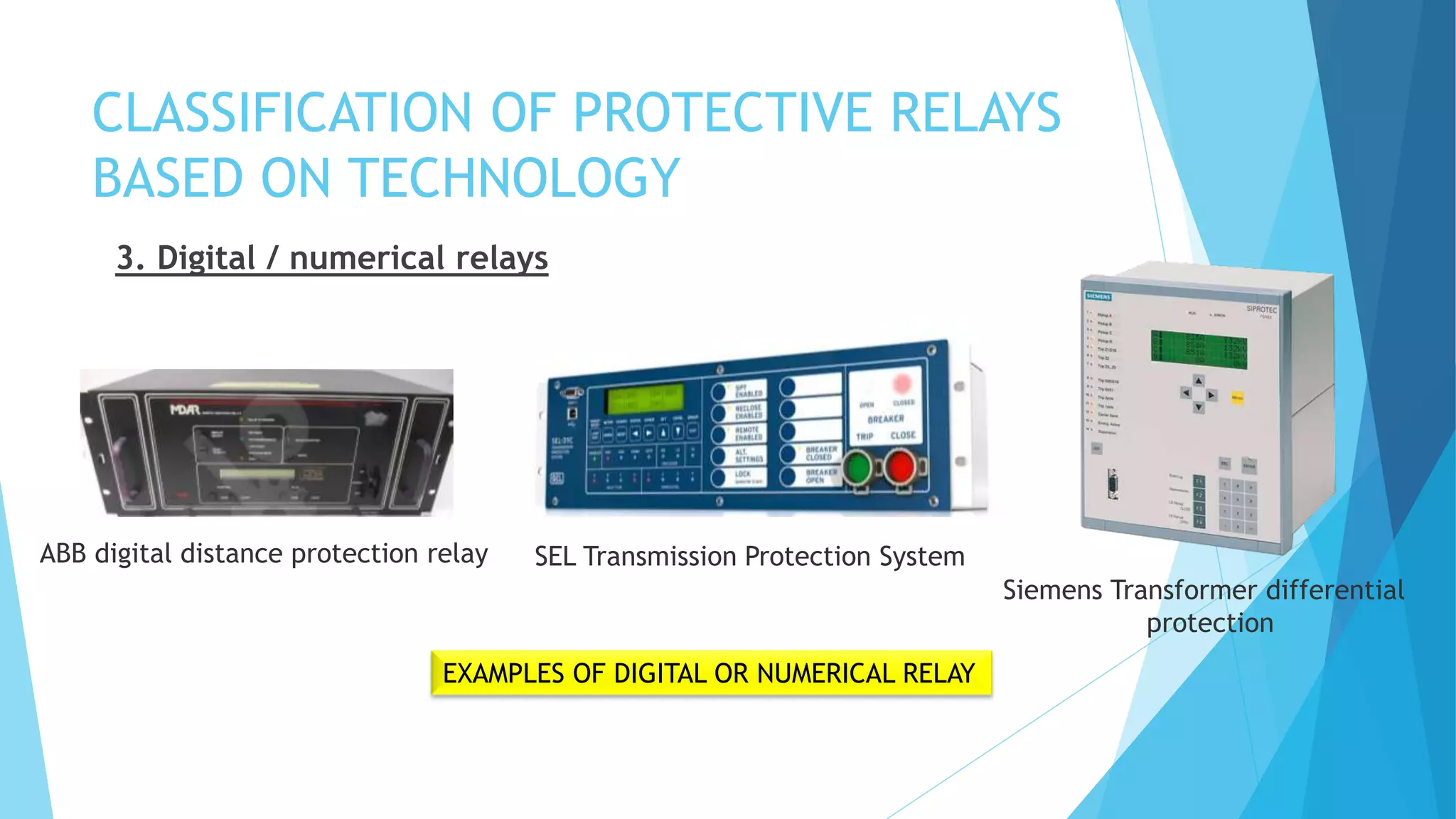
ABB digital distance protection relay
EXAMPLES OF DIGITAL OR NUMERICAL RELAY
SEL Transmission Protection System
Siemens Transformer differential
protection
3. Digital / numerical relays
CLASSIFICATION OF PROTECTIVE RELAYS
BASED ON TECHNOLOGY
ADVANTAGES DISADVANTAGES
 Various functions such as multiple setting groups,
programmable logic, events recording and
oscillography.
 Has the ability of self monitoring and self testing.
 Ability to communicate with other relays and
control computers.
 Cost per function is lower.
 User can develop their own logic schemes.
 Less burden on instrument transformers.
 Less panel space because it can provide many
functions in a single relay.
 Short life cycles due to fast advancement in
microprocessor and microcontroller technology.
 Because it can provide many functions in a single
relay, all the functions will share a common
failure. For example, failure of a power supply or
an input signal processor may disable the entire
relay functions.
 Not immune to electrical transients such as
electromagnetic interference (EMI) and radio
frequency interference (RFI).
 The increased number of settings may pose
problems in managing the settings and in
conducting functional tests.
ANSI STANDARD DEVICE NUMBERS &
COMMON ACRONYMS
 The ANSI (American National Standards Institute) standard
device numbers denote what features a protective device
supports (such as a relay or circuit breaker).
 The device numbers are used to identify the functions of
devices shown on a schematic diagram.
 One physical device may correspond to one function number or
may have many function numbers associated with it, such as
for numerical protective relay.
 Suffix and prefix letters may be added to further specify the
purpose and function of a device.
3. INTRODUCTION TO PROTECTIVE RELAYING.pptx

3. INTRODUCTION TO PROTECTIVE RELAYING.pptx

  • 1.
    INTRODUCTION TO PROTECTIVE RELAYING EMK42003– POWER SYSTEM PROTECTION & SWITCHGEAR MUHD HAFIZI IDRIS
  • 2.
    An engineer conductinga test on protection schemes at a substation Pic source: https://www.omicronenergy.com/
  • 3.
    FUNCTIONS OF PROTECTIONSCHEMES ZONES OF PROTECTION REQUIREMENTS OF PROTECTION SCHEMES UNIT AND NON-UNIT PROTECTIONS PRIMARY AND BACKUP PROTECTIONS COMPONENTS OF A PROTECTION SYSTEM CLASSIFICATION OF PROTECTIVE RELAYS BASED ON TECHNOLOGY ANSI STANDARD DEVICE NUMBERS & COMMON ACRONYMS
  • 4.
    FUNCTIONS OF PROTECTIONSCHEMES  To sense/detect the fault occurrence and other abnormal conditions at the protected equipment/area/section.  To operate the correct circuit breakers so as to disconnect only the faulty equipment/area/section as quickly as possible, thus minimizing the damage caused by the faults.  To operate the correct circuit breakers to isolate the faulty equipment/area/section from the healthy system in the case of abnormalities like overloads, unbalance, undervoltage, etc.  To clear the fault before the system becomes unstable.  To identify distinctly where the fault has occurred.
  • 5.
    ZONES OF PROTECTION Power system is segmented into a number of protective zones.  Each zone is protected by a system of relays, circuit breakers (CBs) and associated equipment.  The CBs are arranged in a manner that makes it possible to isolate the protected zone while the remaining systems continues in operation.  Each zone covers one or more components.  The neighboring zones are overlapped to each other for complete protection and to avoid unprotected component (blind zone).  When abnormal condition occurs at a protected zone, the relays for the protection zone will identity this condition and send trip signals to appropriate CBs to isolate the affected zone.
  • 6.
  • 7.
    REQUIREMENTS OF PROTECTIONSCHEMES 1. SELECTIVITY  Ability to isolate only the faulty part from healthy part to minimize outage area and to maintain power supply for the rest of power system.  Possibility of failure to operate and failure of protection relays and circuit breakers should be considered.  Selectivity also known as relay coordination.  Coordination of primary and backup relays. 2. RELIABILITY  Depicts the quality of the protective system.  Less the probability of failure, better the reliability.  Failure can occur in relays, circuit breakers, control circuits and due to erroneous conversion by system transducers.
  • 8.
    REQUIREMENTS OF PROTECTIONSCHEMES 3. SPEED  Quick isolation of faulted area can improve power system stability, reduce outage duration and minimize damage of faulted elements.  Protective relays should identity the fault and operate as fast as possible.  Total time to remove the fault is the sum of operation time of relays and circuit breakers. 4. DISCRIMINATION  Ability to discriminate between fault and loading conditions even when the minimum fault current is less than maximum full load current.
  • 9.
    REQUIREMENTS OF PROTECTIONSCHEMES 5. SIMPLICITY  Used to refer the design quality of a protection relay system.  The protection system should be as simple and straightforward as possible without disturbing its basic task.  As consequence improves system reliability and require less maintenance. 6. SENSITIVITY  Ability to operate correctly to the faults or abnormal conditions inside zone of protection.  It refers to the minimum level of fault current at which the protective device operates.  It can sense any fault within the protected zone irrespective of fault location, fault type and fault resistance. 7. ECONOMICS  A good protection system should have both features which are maximum protection and minimum cost.
  • 10.
    UNIT AND NON-UNITPROTECTIONS 1) Unit Protection  Definition – a scheme that operates only for faults within its zone  Zone of protection – decided on the basis of current transformer (CTs) locations  It does not detect and respond to the faults outside its zone of protection.  Normally used as main protection.  The best example is differential protection scheme.
  • 11.
    UNIT AND NON-UNITPROTECTIONS 1) Unit Protection Example of unit-protection scheme using circulating current or differential current concept Detect the fault inside the zone Do not detect the fault outside the zone Zone of protection Zone of protection
  • 12.
    UNIT AND NON-UNITPROTECTIONS 2) Non-Unit Protection  Definition – a scheme that achieves protection using grading of successive relays.  The discrimination is obtained by time grading, a combination current and time grading, or distance grading of the relays of several zones.  Best examples are overcurrent and distance protection schemes.
  • 13.
    UNIT AND NON-UNITPROTECTIONS 2) Non-Unit Protection Example of non-unit protection scheme using distance protection scheme (Zellagui & Chaghi, 2012) zones of protection for Rab relay zones of protection for Rbc relay Grading by distance and time
  • 14.
    PRIMARY AND BACKUPPROTECTIONS  Both primary and backup relays usually provided for each zone of protection.  Main / Primary protection:  Always there as the first line of defense to the clear the fault  Usually instantaneous to clear the fault as soon as possible  Normally has small operation zone  Backup protection  Second line of defense  Clear the fault if the primary protection scheme / relay fail to operate  Normally time delayed to give ample time for primary protection to make decision.  Normally has large operation zone
  • 15.
    PRIMARY AND BACKUPPROTECTIONS  Example of main and backup protections to protect a line. Main protection scheme: - Current differential protection scheme - Combination of relay 1A and relay 2A - Unit protection Backup protection scheme: - Directional overcurrent relay - Separated relay 1B and 2B - Non-unit protection For faults within the protected line, both 1B and 2B relays will operate and isolate the fault if the main protection scheme (combination of relay 1A and 2A) fails to operate to isolate the fault
  • 16.
    COMPONENTS OF APROTECTION SYSTEM  CT (current transformer)  Convert the primary current to secondary current and transmit the secondary current to protective relay.  VT (voltage transformer)  Convert the primary voltage to secondary voltage and transmit the secondary voltage to protective relay.  Protective relay  Detect and locate the fault and send a trip signal to the circuit breaker.  When a fault occurred, the relay will operate by closing the relay contact to complete the trip circuit.
  • 17.
    COMPONENTS OF APROTECTION SYSTEM  Battery / DC system  To supply the power for the relay and also to the trip circuit.  Trip coil  As the trip coil of the circuit breaker energized, the CB operating mechanism actuated and will make the CB to open and isolate the fault.  Circuit breaker (CB)  A mechanical switching device capable of making, carrying and breaking current under normal condition.  Capable of making, carrying and breaking of current for a specified time during abnormal condition.  Isolate the faulty part from the rest of network.
  • 18.
    COMPONENTS OF APROTECTION SYSTEM ABB ARTECHE CURRENT TRANSFORMER (CT) electrical4u.net CAPACITIVE VOLTAGE TRANSFORMER (CVT)
  • 19.
    COMPONENTS OF APROTECTION SYSTEM PROTECTION RELAY BATTERY BANK
  • 20.
    COMPONENTS OF APROTECTION SYSTEM HV CIRCUIT BREAKER testguy.net globalsources.com
  • 21.
    CLASSIFICATION OF PROTECTIVERELAYS BASED ON TECHNOLOGY  Protective relays can be broadly classified into the following three categories, depending on the technology they use for their construction and operation. 1. Electromechanical relays 2. Solid state (static) relays 3. Digital / numerical relays
  • 22.
    CLASSIFICATION OF PROTECTIVERELAYS BASED ON TECHNOLOGY 1. Electromechanical relays  The oldest type of relay.  First generation of electromechanical relay which came in 1901.  Operate based on the regulation of mechanical force generated through the flow of current in windings wounded on magnetic core.
  • 23.
    CLASSIFICATION OF PROTECTIVERELAYS BASED ON TECHNOLOGY 1. Electromechanical relays – thermal relay - Operates on the principle of heating effect of electrical current. - When the overload condition is detected, the bimetal strips bend and allow the trip contact to energize the trip circuit. THERMAL RELAY
  • 24.
    CLASSIFICATION OF PROTECTIVERELAYS BASED ON TECHNOLOGY 1. Electromechanical relays – attracted armature relay - Operates on the principle of electromagnetic force produced which attracts the plunger or hinged armature. - When the electromagnetic force exceeds the restraining force, the moving contact closes due to the movement of the armature. ATTRACTED ARMATURE RELAY Hinged type Plunger type
  • 25.
    CLASSIFICATION OF PROTECTIVERELAYS BASED ON TECHNOLOGY 1. Electromechanical relays – induction relay - Operates on the principle of electromagnetic induction. - Operating force is developed due to the interaction of two AC flux displaced in time and space in movable element (rotor). INDUCTION RELAY Induction disc relay Induction cup relay
  • 26.
    CLASSIFICATION OF PROTECTIVERELAYS BASED ON TECHNOLOGY 1. Electromechanical relays – balance beam relay - Operating coil produces operating torque, whereas restraining coil produces restraining torque. - The electromagnetic force of both coils are in opposition. - When operating torque exceeds restraining torque, the movement of armature closes the contact. BALANCE BEAM RELAY
  • 27.
    CLASSIFICATION OF PROTECTIVERELAYS BASED ON TECHNOLOGY 1. Electromechanical relays EXAMPLES OF ELECTROMECHANICAL RELAY Alstom IDMT earth fault relay Alstom Check Synchronising Relay
  • 28.
    CLASSIFICATION OF PROTECTIVERELAYS BASED ON TECHNOLOGY 1. Electromechanical relays ADVANTAGES DISADVANTAGES  Fast operation and can be reset fast.  Simple construction.  Reliable and rugged.  The values can be easily set and no programming is required.  People can be trained on these relays easily.  Have high VA burden thus require high burden CTs and VTs to operate them.  Do not have directional feature.  Affected by the ageing of components, dust and pollution resulting in spurious trips.  Operation speed is limited by the mechanical inertia of the component.  One relay can only perform one function (multifunctioning not possible).
  • 29.
    CLASSIFICATION OF PROTECTIVERELAYS BASED ON TECHNOLOGY 2. Solid state (static) relays  Due to the advent of electronic devices such as diode, transistor, ICs, chips etc.  Second generation of relays.  Came into operation in 1950s.  More accurate and higher reliability compared with electromechanical relays.
  • 30.
    CLASSIFICATION OF PROTECTIVERELAYS BASED ON TECHNOLOGY 2. Solid state (static) relays  The static means the relay has no moving part.  The semiconductor devices are used for data processing and also to create relay characteristic.  Lower relay burden due to no moving parts thus further reduces the CT/VT requirement.  Require separate DC power supply.
  • 31.
    CLASSIFICATION OF PROTECTIVERELAYS BASED ON TECHNOLOGY 2. Solid state (static) relays EXAMPLE OF STATIC RELAY BLOCK DIAGRAM Generalized block diagram of static time overcurrent relay - The secondary current from CT is rectified, filtered and fed to timing and curve shaping circuit. - The output of timing circuit is then given to level detector which compares between relay and reference quantities. - When the magnitude of relay quantity exceeds the magnitude of reference quantity, it generates a voltage signal. - The voltage signal is then amplified by amplifier block and fed to tripping circuit. - Finally, the tripping circuit generates a tripping command and send to trip coil of circuit breaker.
  • 32.
    CLASSIFICATION OF PROTECTIVERELAYS BASED ON TECHNOLOGY GEC Alstom Static Distance Protection Relay GEC Static Differential Protection Relay EXAMPLES OF STATIC RELAY 2. Solid state (static) relays
  • 33.
    2. Solid state(static) relays CLASSIFICATION OF PROTECTIVE RELAYS BASED ON TECHNOLOGY ADVANTAGES DISADVANTAGES  Do not contain moving parts – thus free from problems such as contact bouncing, arcing, erosion and friction.  Significantly less burden on instrument transformers (CT/VT).  Can incorporate variety of functions in a single unit.  Quick response and reset action.  Greater sensitivity can be obtained by using amplification block.  Superior characteristic and accuracy.  Electronic devices are more sensitive to voltage spike and other transients that can cause malfunction.  Require auxiliary DC to operate.  Has low short time overload capacity.  The characteristic of electronic devices are affected by temperature and ageing of semiconductor devices.  Costlier compared to electromechanical relay.  Require highly trained persons to service static relay which has complex protective functions.
  • 34.
    3. Digital /numerical relays  Entered the market around 1980s.  Based on microprocessors and microcontrollers.  Instead of using analog signals, this relay converts all measured analogue quantities into digital signals.  Microcontrollers are used in replacement of analogue circuits used in static relays.  Digital / numerical relays introduce Analogue to Digital Convertor (A/D conversion) of all measured analogue quantities and use a microprocessor to implement the protection algorithm. CLASSIFICATION OF PROTECTIVE RELAYS BASED ON TECHNOLOGY
  • 35.
    3. Digital /numerical relays CLASSIFICATION OF PROTECTIVE RELAYS BASED ON TECHNOLOGY BASIC BLOK DIAGRAM OF A DIGITAL / NUMERICAL RELAY Anti aliasing filter
  • 36.
    3. Digital /numerical relays CLASSIFICATION OF PROTECTIVE RELAYS BASED ON TECHNOLOGY ABB digital distance protection relay EXAMPLES OF DIGITAL OR NUMERICAL RELAY SEL Transmission Protection System Siemens Transformer differential protection
  • 37.
    3. Digital /numerical relays CLASSIFICATION OF PROTECTIVE RELAYS BASED ON TECHNOLOGY ADVANTAGES DISADVANTAGES  Various functions such as multiple setting groups, programmable logic, events recording and oscillography.  Has the ability of self monitoring and self testing.  Ability to communicate with other relays and control computers.  Cost per function is lower.  User can develop their own logic schemes.  Less burden on instrument transformers.  Less panel space because it can provide many functions in a single relay.  Short life cycles due to fast advancement in microprocessor and microcontroller technology.  Because it can provide many functions in a single relay, all the functions will share a common failure. For example, failure of a power supply or an input signal processor may disable the entire relay functions.  Not immune to electrical transients such as electromagnetic interference (EMI) and radio frequency interference (RFI).  The increased number of settings may pose problems in managing the settings and in conducting functional tests.
  • 38.
    ANSI STANDARD DEVICENUMBERS & COMMON ACRONYMS  The ANSI (American National Standards Institute) standard device numbers denote what features a protective device supports (such as a relay or circuit breaker).  The device numbers are used to identify the functions of devices shown on a schematic diagram.  One physical device may correspond to one function number or may have many function numbers associated with it, such as for numerical protective relay.  Suffix and prefix letters may be added to further specify the purpose and function of a device.