Date of submission
25 /Aug/2016
Submitted By:
ADITYA RANJAN DAS
Rgdn.No-1301294170
Session -2013-2017
Seminar Report of 7th
Semester, EEE JULY 2016-AUGUST 2016
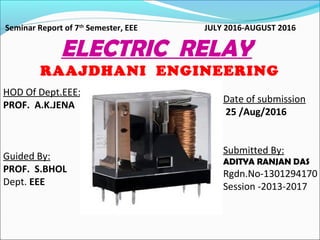
ELECTRIC RELAY
RAAJDHANI ENGINEERING
COLLEGEHOD Of Dept.EEE:
PROF. A.K.JENA
Guided By:
PROF. S.BHOL
Dept. EEE
INTRODUCTION
• Electric Relays are electrical switches that open or close another
circuit under certain conditions.
• Electric Relay is a device designed to trip a circuit breaker when
fault is detected ,Generally Relays are electromagnetic devices
• The need to act quickly to protect circuit to protect equipments and
trip a breaker with in a few thousands of seconds.
• Electromechanical Relay use at Hydroelectrical Plant.
What is Electric Relay?
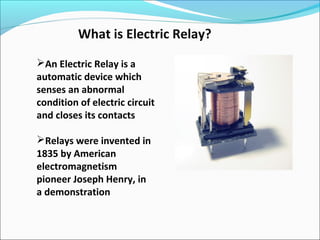
An Electric Relay is a
automatic device which
senses an abnormal
condition of electric circuit
and closes its contacts
Relays were invented in
1835 by American
electromagnetism
pioneer Joseph Henry, in
a demonstration
Electric Relay
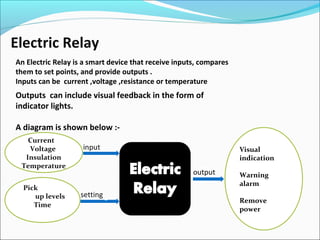
An Electric Relay is a smart device that receive inputs, compares
them to set points, and provide outputs .
Inputs can be current ,voltage ,resistance or temperature
Outputs can include visual feedback in the form of
indicator lights.
A diagram is shown below :-
PROTECTIVE
RELAY output
input
setting
PROTECTIVE RELAY
output
input
setting
Current
Voltage
Insulation
Temperature
Pick
up levels
Time
Visual
indication
Warning
alarm
Remove
power
Electric Relays Types
Electromagnetic Relays (EMRs)
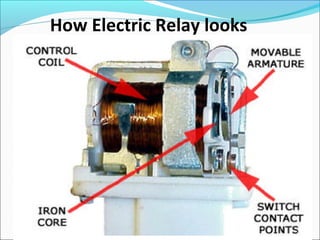
EMRs consist of an input coil that's wound to accept a
particular voltage signal, plus a set of one or more contacts
that rely on an armature (or lever) activated by the energized
coil to open or close an electrical circuit.
Solid-state Relays (SSRs)
SSRs use semiconductor output instead of mechanical
contacts to switch the circuit. The output device is optically-
coupled to an LED light source inside the relay. The relay is
turned on by energizing this LED, usually with low-voltage DC
power.
Microprocessor Based Relays
Use microprocessor for switching mechanism. Commonly
used in power system monitoring and protection.
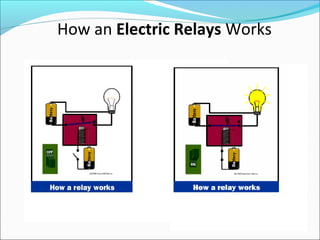
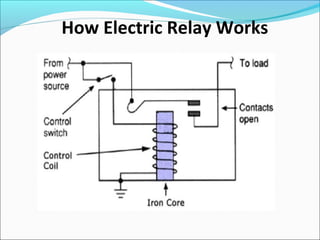
How an Electric Relays Works
 An Electric Relay is an electrically operated
switch.
Current flowing through the coil of the
Electric relay creates a magnetic field which
attracts a lever and changes the switch contacts.
Advantages/Disadvantages
ADVANTAGES :-
• Simplicity
• Mechanical Wear
• Faster than EMR
• No sparking between contacts
• Much higher precision and more reliable &
durable.
• Capable of both digital & analog I/O. Electric
Relays can switch AC and DC.
• Electric Relays can switch higher voltages.
• Electric Relays are often a better choice for
switching large currents (>5 A).
• Electric Relays can switch many contacts at
once.
DISADVANTAGE:-
•The contacts becoming worn, resulting in a limited life
span.
• That they don't perform that well when it comes to
switching high inrush currents.
•Not expensive ,No Mechanical movements & High Cost
•Electric Relay cant switch Rapidly because relay use mor
power due to the current flowing through the coil
Terms related to Electric Relay
Pick up level of actuating signal:-The value of actuating
quantity (voltage or current) which on threshold above which
the Electric Relays initiates to be operated.
Reset level:- The value of electric current or voltage below
which a Electric Relays open its contacts and comes in
original position.
Operating time of relay:-The time which elapses between the
instant when actuating quantity exceeds the pick up value to
the instant when the Electric Relays contacts close.
Reset time:-The time which elapses between the instant
when the actuating quantity becomes less than the reset
value to the instant when relay contacts return to its normal
position.
Secondary relays:- The Electric Relays which are connected in
the circuit to be protected through current and potential
transformer.
Auxiliary Relays:- The Electric Relays which operate in
response to opening or closing of its operating circuit to assist
another relay in the performance of its function.
Reach:- A distance Electric Relays operates whenever the
impedance seen by the relay is less than a pre specified value.
Under reached value:- The tendency of relay to restrain at
the set value of impedance or impedance lower than the set
value is known as under reached.
Over reached:- The tendency of the Electric Relays to operate
at impedances larger than its setting.
Primary relay:-The which are connected directly in the circuit
to be protected.
OPERATING PRINCIPLE
 There are really only two fundamentally different operating
principles,
1. Electromagnetic attraction
2. Electromagnetic induction
 Electromagnetic attraction relays operate by virtue of a
plunger being drawn into a solenoid.
 Electromagnetic induction relays use the principle of the
induction motor whereby torque is developed by induction in
a rotor.
How Electric Relay looks
How Electric Relay Works
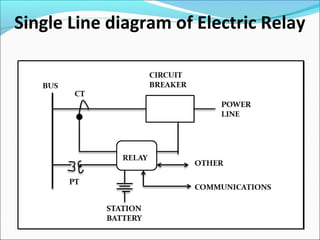
Single Line diagram of Electric Relay
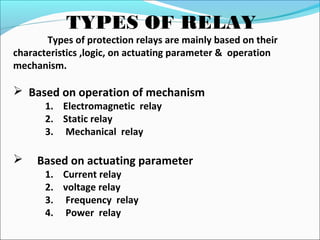
TYPES OF RELAY
Types of protection relays are mainly based on their
characteristics ,logic, on actuating parameter & operation
mechanism.
 Based on operation of mechanism
1. Electromagnetic relay
2. Static relay
3. Mechanical relay
 Based on actuating parameter
1. Current relay
2. voltage relay
3. Frequency relay
4. Power relay
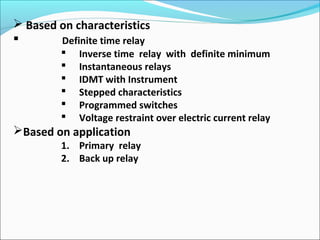
 Based on characteristics
 Definite time relay
 Inverse time relay with definite minimum
 Instantaneous relays
 IDMT with Instrument
 Stepped characteristics
 Programmed switches
 Voltage restraint over electric current relay
Based on application
1. Primary relay
2. Back up relay
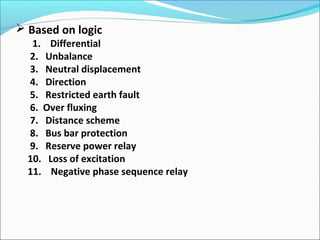
 Based on logic
1. Differential
2. Unbalance
3. Neutral displacement
4. Direction
5. Restricted earth fault
6. Over fluxing
7. Distance scheme
8. Bus bar protection
9. Reserve power relay
10. Loss of excitation
11. Negative phase sequence relay
 A protective Electric Relays may respond to the magnitude of a
quantity such as voltage or current. Induction types of relay can
respond to the product of two quantities in two fields
 Several operating coils can be used to provide "bias" to the relay,
allowing the sensitivity of response in one circuit to be controlled by
another.
By use of a permanent magnet in the magnetic circuit, an Electric
Relays can be made to respond to current in one direction differently
from in another.
. For AC circuits, the principle is extended with a polarizing winding
connected to a reference voltage source.
Operating Principles
 Electric Relays may be “Normally Open”, or “Normally Closed”.
One pair of contacts are classed as Normally Open, (NO) or
make contacts and another set which are classed as Normally
Closed, (NC) or break contacts .
 In the normally open position, the contacts are closed only when
the field current is “ON” and the switch contacts are pulled
towards the inductive coil.
 In the normally closed position, the contacts are permanently
closed when the field current is “OFF” as the switch contacts return
to their normal position.
 These terms Normally Open, Normally Closed (NONC) or Make
and Break Contacts refer to the state of the electrical contacts
when the relay coil is “de-energized”, i.e, no supply voltage
connected to the inductive coil.
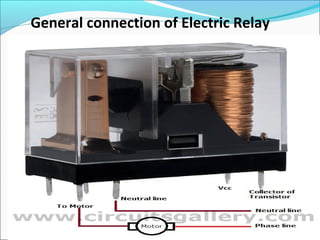
General connection of Electric Relay
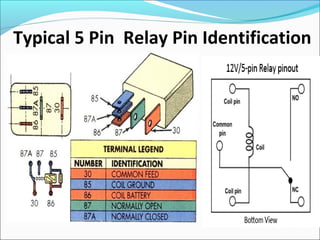
Typical 5 Pin Relay Pin Identification
Conclusion
 Electric Relays control output circuits of a much
higher power.
 Safety will increased
 Protective relays are essential for keeping faults in
the system isolated and keep equipment from being
damaged.
 Its also a protective device
electric relay

electric relay

  • 1.
    Date of submission 25/Aug/2016 Submitted By: ADITYA RANJAN DAS Rgdn.No-1301294170 Session -2013-2017 Seminar Report of 7th Semester, EEE JULY 2016-AUGUST 2016 ELECTRIC RELAY RAAJDHANI ENGINEERING COLLEGEHOD Of Dept.EEE: PROF. A.K.JENA Guided By: PROF. S.BHOL Dept. EEE
  • 2.
    INTRODUCTION • Electric Relaysare electrical switches that open or close another circuit under certain conditions. • Electric Relay is a device designed to trip a circuit breaker when fault is detected ,Generally Relays are electromagnetic devices • The need to act quickly to protect circuit to protect equipments and trip a breaker with in a few thousands of seconds. • Electromechanical Relay use at Hydroelectrical Plant.
  • 3.
    What is ElectricRelay? An Electric Relay is a automatic device which senses an abnormal condition of electric circuit and closes its contacts Relays were invented in 1835 by American electromagnetism pioneer Joseph Henry, in a demonstration
  • 4.
    Electric Relay An ElectricRelay is a smart device that receive inputs, compares them to set points, and provide outputs . Inputs can be current ,voltage ,resistance or temperature Outputs can include visual feedback in the form of indicator lights. A diagram is shown below :- PROTECTIVE RELAY output input setting PROTECTIVE RELAY output input setting Current Voltage Insulation Temperature Pick up levels Time Visual indication Warning alarm Remove power
  • 5.
    Electric Relays Types ElectromagneticRelays (EMRs) EMRs consist of an input coil that's wound to accept a particular voltage signal, plus a set of one or more contacts that rely on an armature (or lever) activated by the energized coil to open or close an electrical circuit. Solid-state Relays (SSRs) SSRs use semiconductor output instead of mechanical contacts to switch the circuit. The output device is optically- coupled to an LED light source inside the relay. The relay is turned on by energizing this LED, usually with low-voltage DC power. Microprocessor Based Relays Use microprocessor for switching mechanism. Commonly used in power system monitoring and protection.
  • 6.
    How an ElectricRelays Works
  • 7.
     An ElectricRelay is an electrically operated switch. Current flowing through the coil of the Electric relay creates a magnetic field which attracts a lever and changes the switch contacts.
  • 8.
    Advantages/Disadvantages ADVANTAGES :- • Simplicity •Mechanical Wear • Faster than EMR • No sparking between contacts • Much higher precision and more reliable & durable. • Capable of both digital & analog I/O. Electric Relays can switch AC and DC. • Electric Relays can switch higher voltages. • Electric Relays are often a better choice for switching large currents (>5 A). • Electric Relays can switch many contacts at once.
  • 9.
    DISADVANTAGE:- •The contacts becomingworn, resulting in a limited life span. • That they don't perform that well when it comes to switching high inrush currents. •Not expensive ,No Mechanical movements & High Cost •Electric Relay cant switch Rapidly because relay use mor power due to the current flowing through the coil
  • 10.
    Terms related toElectric Relay Pick up level of actuating signal:-The value of actuating quantity (voltage or current) which on threshold above which the Electric Relays initiates to be operated. Reset level:- The value of electric current or voltage below which a Electric Relays open its contacts and comes in original position. Operating time of relay:-The time which elapses between the instant when actuating quantity exceeds the pick up value to the instant when the Electric Relays contacts close. Reset time:-The time which elapses between the instant when the actuating quantity becomes less than the reset value to the instant when relay contacts return to its normal position.
  • 11.
    Secondary relays:- TheElectric Relays which are connected in the circuit to be protected through current and potential transformer. Auxiliary Relays:- The Electric Relays which operate in response to opening or closing of its operating circuit to assist another relay in the performance of its function. Reach:- A distance Electric Relays operates whenever the impedance seen by the relay is less than a pre specified value. Under reached value:- The tendency of relay to restrain at the set value of impedance or impedance lower than the set value is known as under reached. Over reached:- The tendency of the Electric Relays to operate at impedances larger than its setting. Primary relay:-The which are connected directly in the circuit to be protected.
  • 12.
    OPERATING PRINCIPLE  Thereare really only two fundamentally different operating principles, 1. Electromagnetic attraction 2. Electromagnetic induction  Electromagnetic attraction relays operate by virtue of a plunger being drawn into a solenoid.  Electromagnetic induction relays use the principle of the induction motor whereby torque is developed by induction in a rotor.
  • 13.
  • 14.
  • 15.
    Single Line diagramof Electric Relay
  • 16.
    TYPES OF RELAY Typesof protection relays are mainly based on their characteristics ,logic, on actuating parameter & operation mechanism.  Based on operation of mechanism 1. Electromagnetic relay 2. Static relay 3. Mechanical relay  Based on actuating parameter 1. Current relay 2. voltage relay 3. Frequency relay 4. Power relay
  • 17.
     Based oncharacteristics  Definite time relay  Inverse time relay with definite minimum  Instantaneous relays  IDMT with Instrument  Stepped characteristics  Programmed switches  Voltage restraint over electric current relay Based on application 1. Primary relay 2. Back up relay
  • 18.
     Based onlogic 1. Differential 2. Unbalance 3. Neutral displacement 4. Direction 5. Restricted earth fault 6. Over fluxing 7. Distance scheme 8. Bus bar protection 9. Reserve power relay 10. Loss of excitation 11. Negative phase sequence relay
  • 19.
     A protectiveElectric Relays may respond to the magnitude of a quantity such as voltage or current. Induction types of relay can respond to the product of two quantities in two fields  Several operating coils can be used to provide "bias" to the relay, allowing the sensitivity of response in one circuit to be controlled by another. By use of a permanent magnet in the magnetic circuit, an Electric Relays can be made to respond to current in one direction differently from in another. . For AC circuits, the principle is extended with a polarizing winding connected to a reference voltage source. Operating Principles
  • 20.
     Electric Relaysmay be “Normally Open”, or “Normally Closed”. One pair of contacts are classed as Normally Open, (NO) or make contacts and another set which are classed as Normally Closed, (NC) or break contacts .  In the normally open position, the contacts are closed only when the field current is “ON” and the switch contacts are pulled towards the inductive coil.  In the normally closed position, the contacts are permanently closed when the field current is “OFF” as the switch contacts return to their normal position.  These terms Normally Open, Normally Closed (NONC) or Make and Break Contacts refer to the state of the electrical contacts when the relay coil is “de-energized”, i.e, no supply voltage connected to the inductive coil.
  • 21.
    General connection ofElectric Relay
  • 22.
    Typical 5 PinRelay Pin Identification
  • 23.
    Conclusion  Electric Relayscontrol output circuits of a much higher power.  Safety will increased  Protective relays are essential for keeping faults in the system isolated and keep equipment from being damaged.  Its also a protective device