Protection and Relay Schemes   Chris Fraser Amanda Chen Wang Group#4 October 5, 2005
Agenda Introduction of Protective Relays Electrical System Protection with Protective Relays  Conclusion
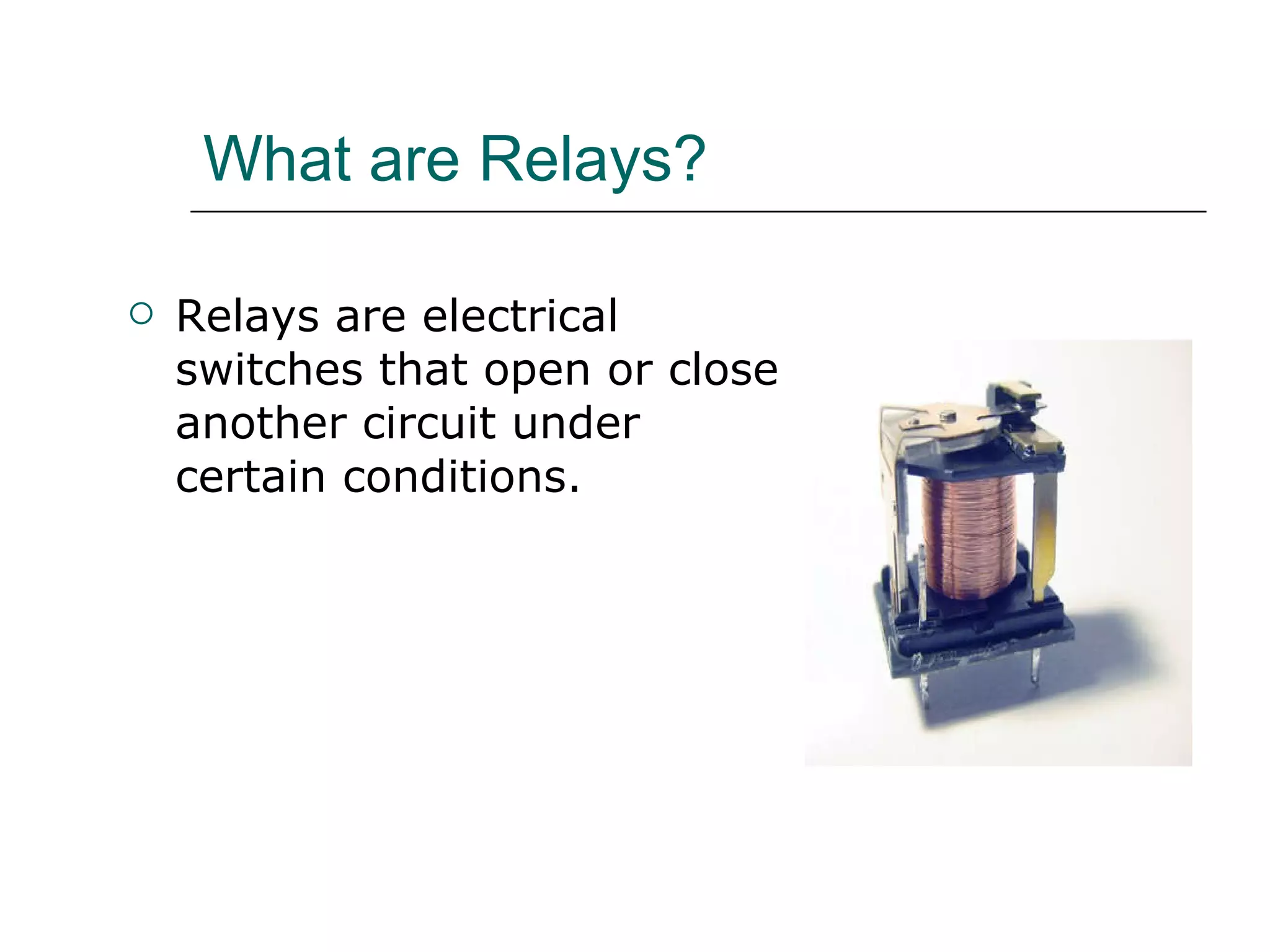
What are Relays? Relays are electrical switches that open or close another circuit under certain conditions.
Relay Purpose Isolate controlling circuit from controlled circuit. Control high voltage system with low voltage. Control high current system with low current. Logic Functions
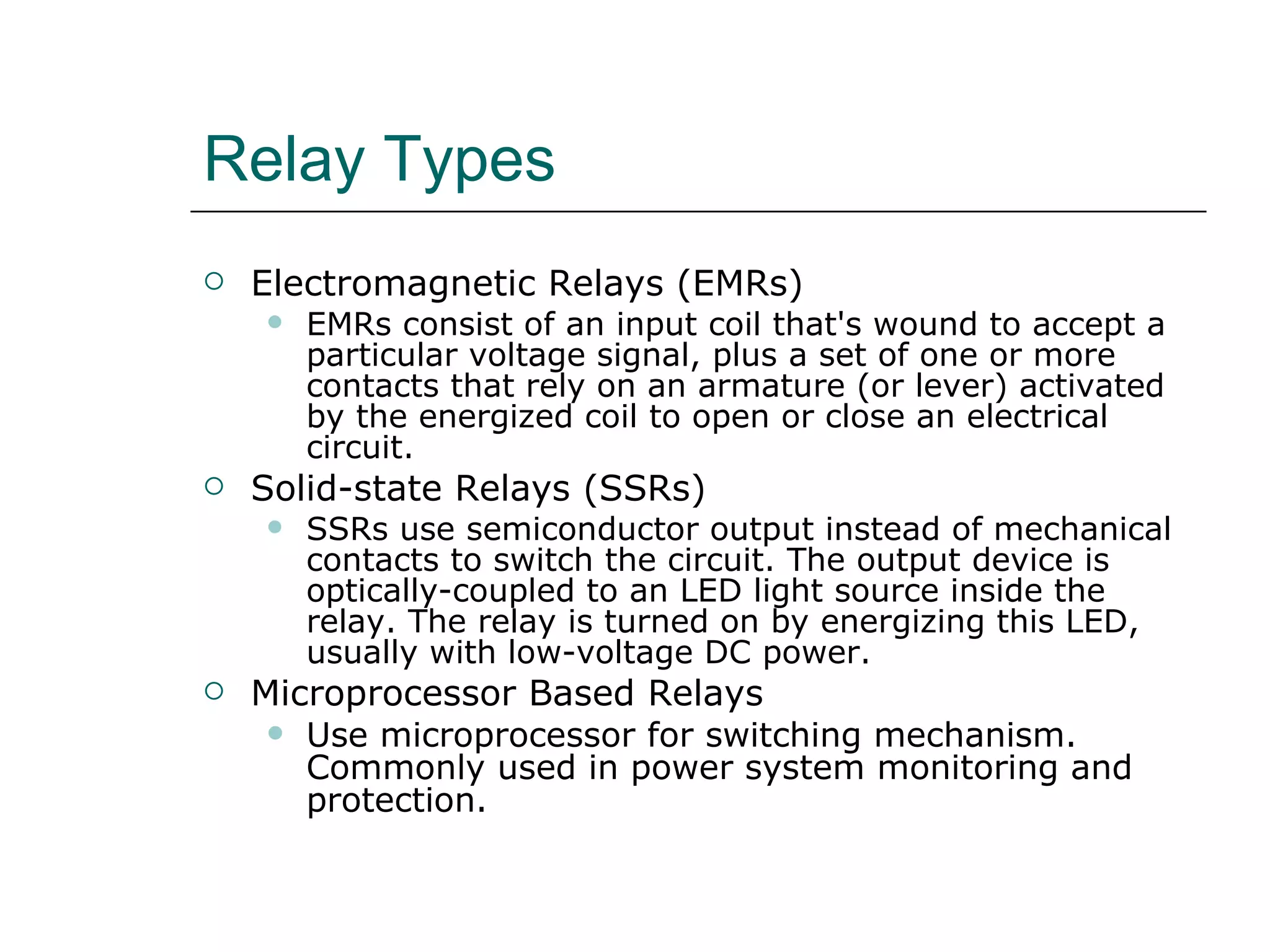
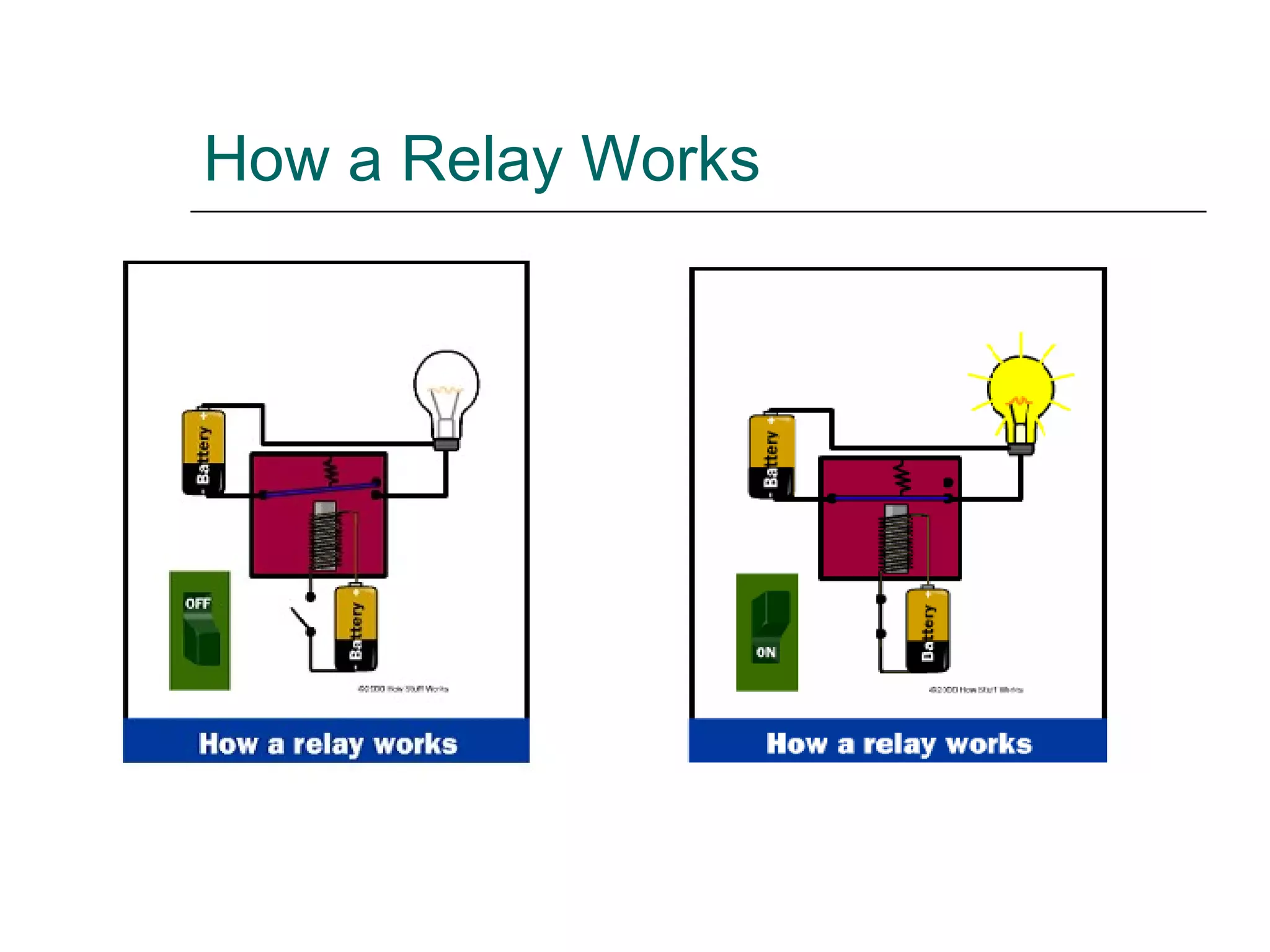
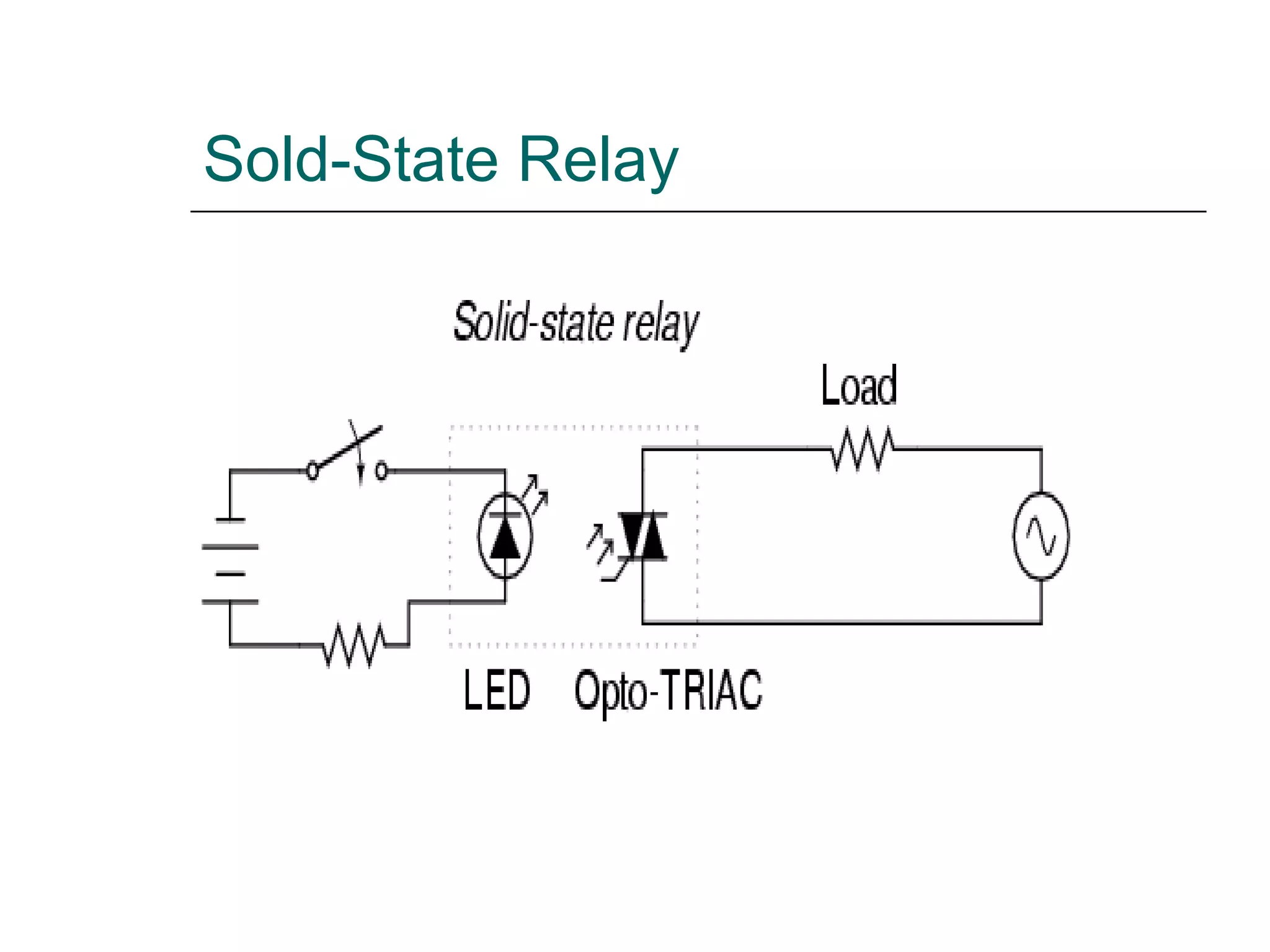
Relay Types Electromagnetic Relays (EMRs) EMRs consist of an input coil that's wound to accept a particular voltage signal, plus a set of one or more contacts that rely on an armature (or lever) activated by the energized coil to open or close an electrical circuit. Solid-state Relays (SSRs) SSRs use semiconductor output instead of mechanical contacts to switch the circuit. The output device is optically-coupled to an LED light source inside the relay. The relay is turned on by energizing this LED, usually with low-voltage DC power.  Microprocessor Based Relays Use microprocessor for switching mechanism.  Commonly used in power system monitoring and protection.
How a Relay Works
Sold-State Relay
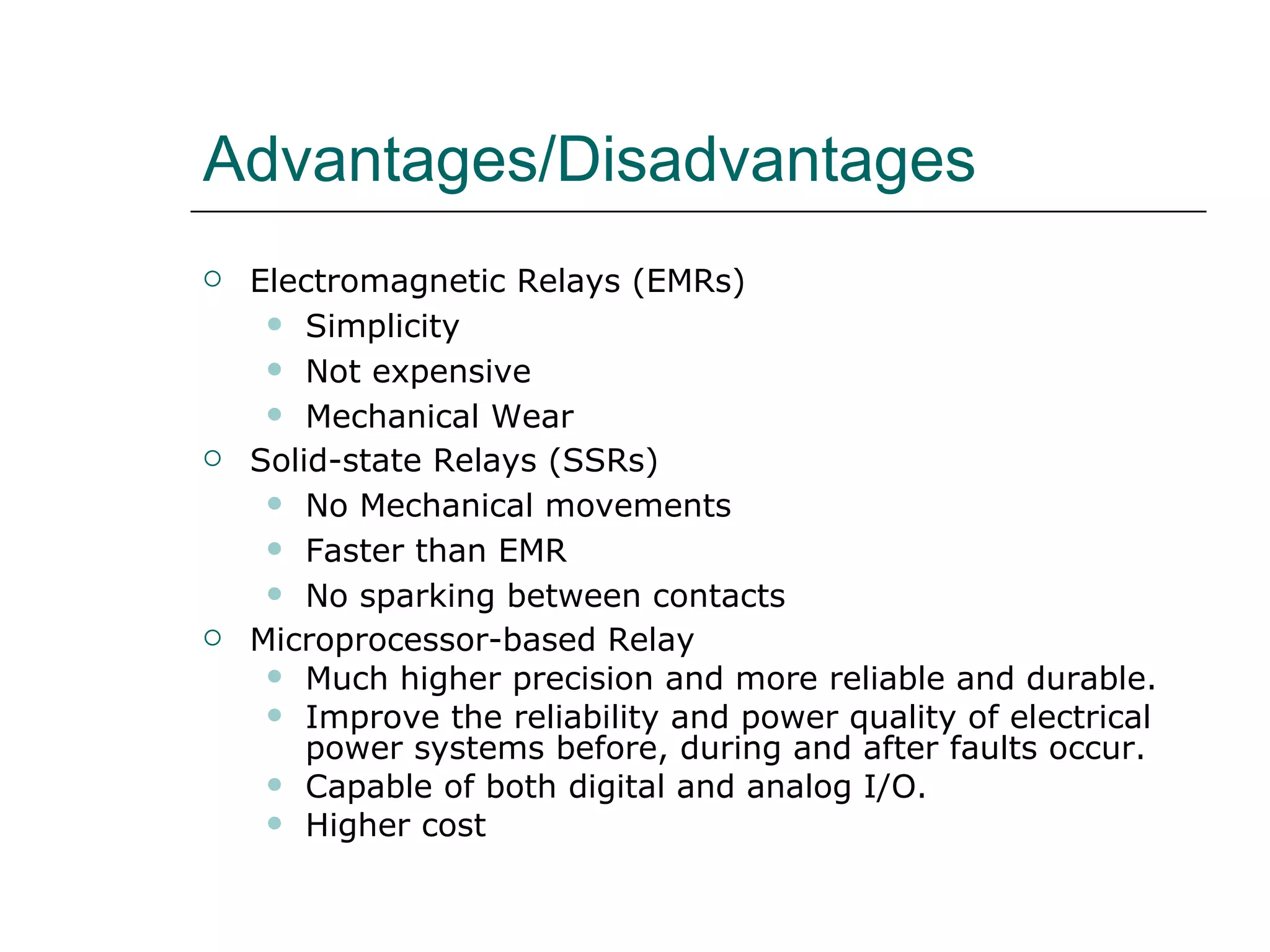
Advantages/Disadvantages Electromagnetic Relays (EMRs) Simplicity Not expensive Mechanical Wear Solid-state Relays (SSRs) No Mechanical movements Faster than EMR No sparking between contacts Microprocessor-based Relay Much higher precision and more reliable and durable.  Improve the reliability and power quality of electrical power systems before, during and after faults occur. Capable of both digital and analog I/O. Higher cost
Why A System Needs Protection? There is no ‘fault free’ system. It is neither practical nor economical to build a ‘fault free’ system. Electrical system shall tolerate certain degree of faults. Usually faults are caused by breakdown of insulation due to various reasons: system aging, lighting, etc.
Electrical Faults majority are phase-to-ground faults phase-to-phase  phase-phase-phase  double-phase-to-ground
Advantages for Using Protective Relays Detect system failures when they occur and isolate the faulted section from the remaining of the system. Mitigating the effects of failures after they occur. Minimize risk of fire, danger to personal and other high voltage systems.
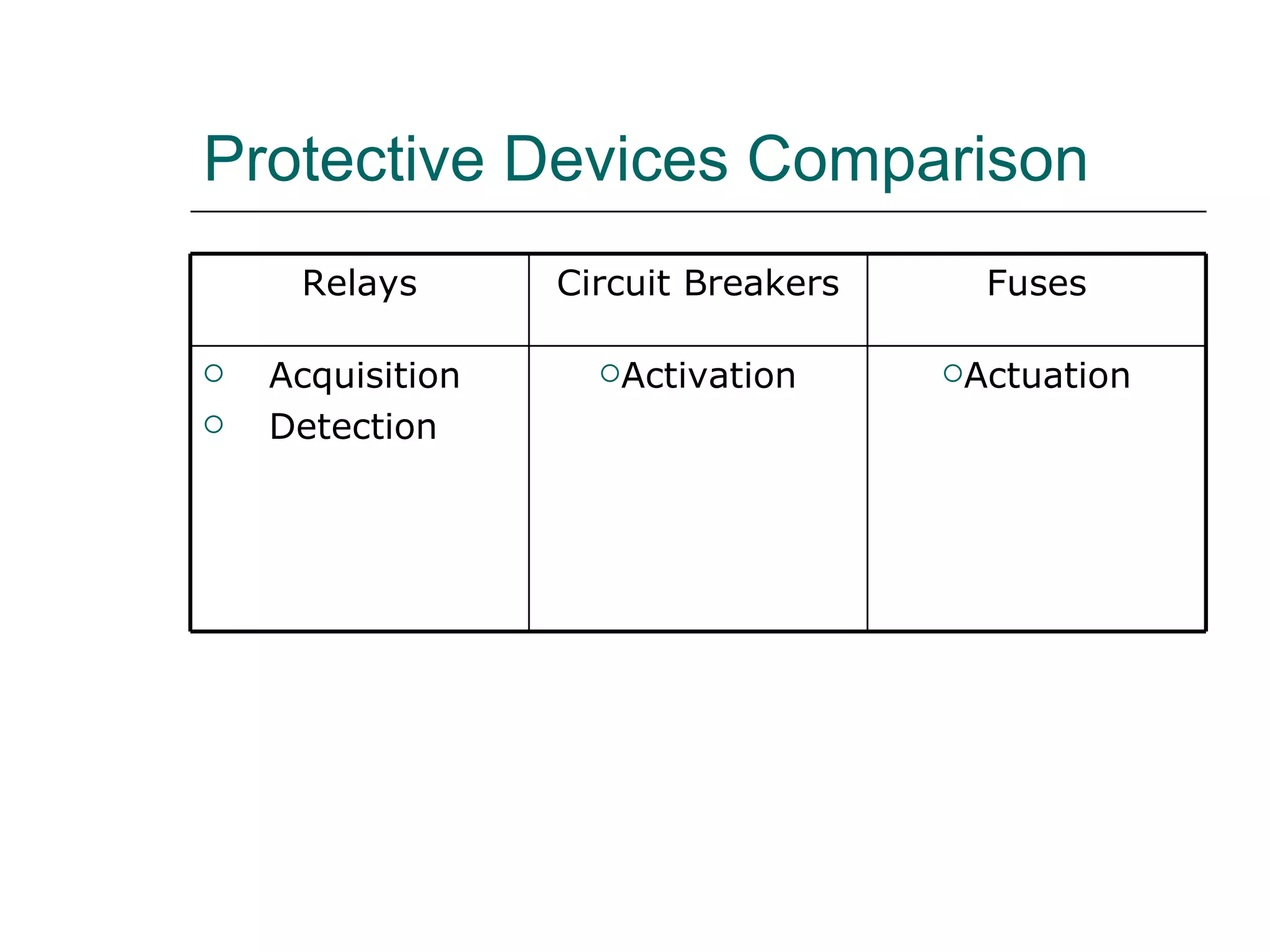
Protective Devices Comparison Relays Circuit Breakers Fuses Acquisition Detection Activation Actuation
Protective Devices Comparison Circuit Breakers V.S. Relays Relays are like human brain; circuit breakers are like human muscle. Relays ‘make decisions’ based on settings.  Relays send signals to circuit breakers. Based the sending signals circuit breakers will open/close.
Protective Devices Comparison Fuses V.S. Relays Relays have different settings and can be set based on protection requirements. Relays can be reset. Fuses only have one specific characteristic for a individual type. Fuses cannot be reset but replaced if they blow.
Protection and Relay Schemes Motor Protection Transformer Protection Generator Protection
Motor Protection Timed Overload Locked Rotor Single Phase and Phase Unbalance Other
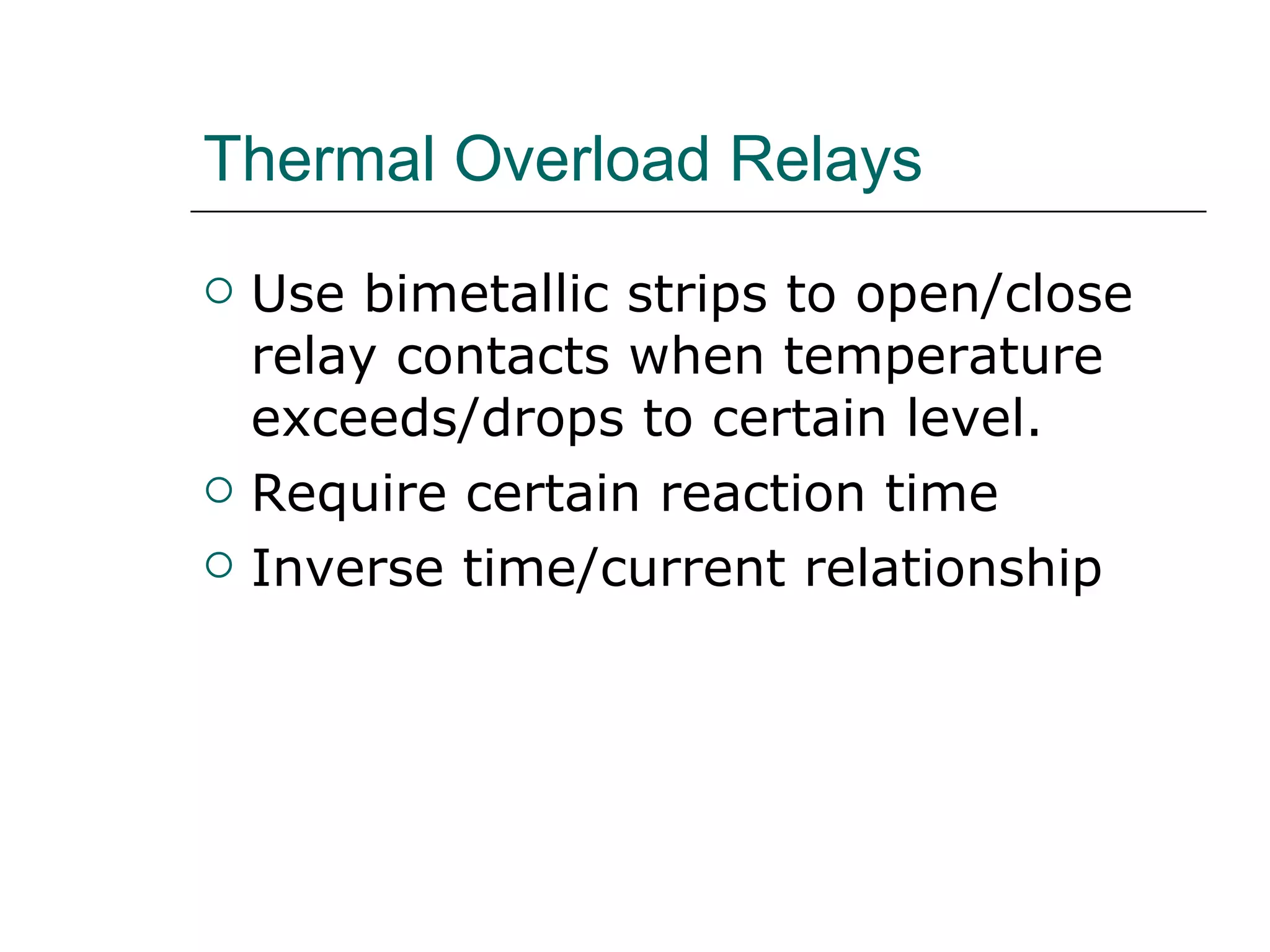
Motor Protection  Timed Overload  Solution: Thermal overload relays Plunger-type relays Induction-type relays
Motor Protection Timed Overload Protection Timed Overload Definition:  Continuously operate motor above its rated value will cause thermal damage to the motor.
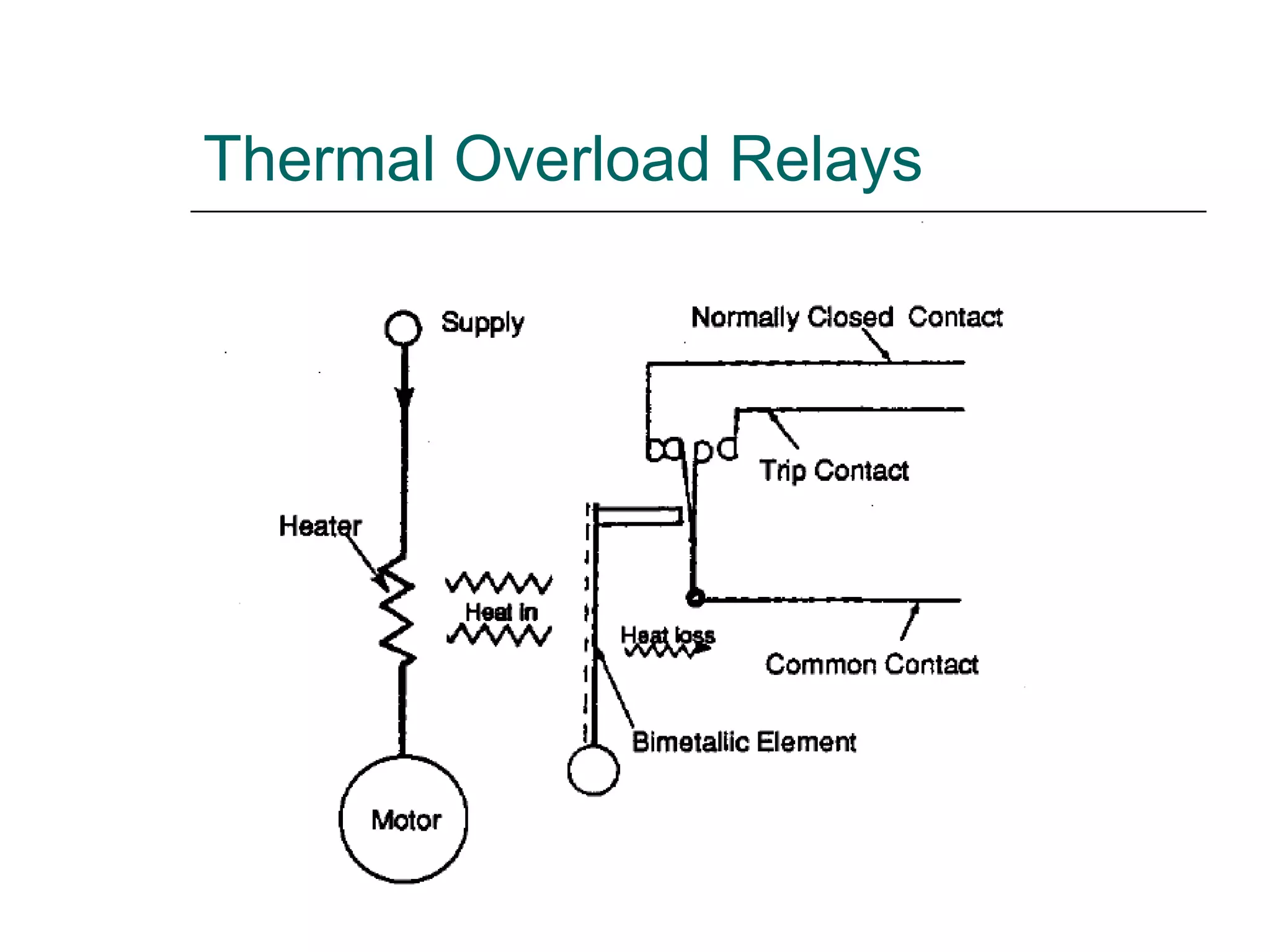
Thermal Overload Relays Use bimetallic strips to open/close  relay contacts when temperature exceeds/drops to certain level. Require certain reaction time Inverse time/current relationship
Thermal Overload Relays
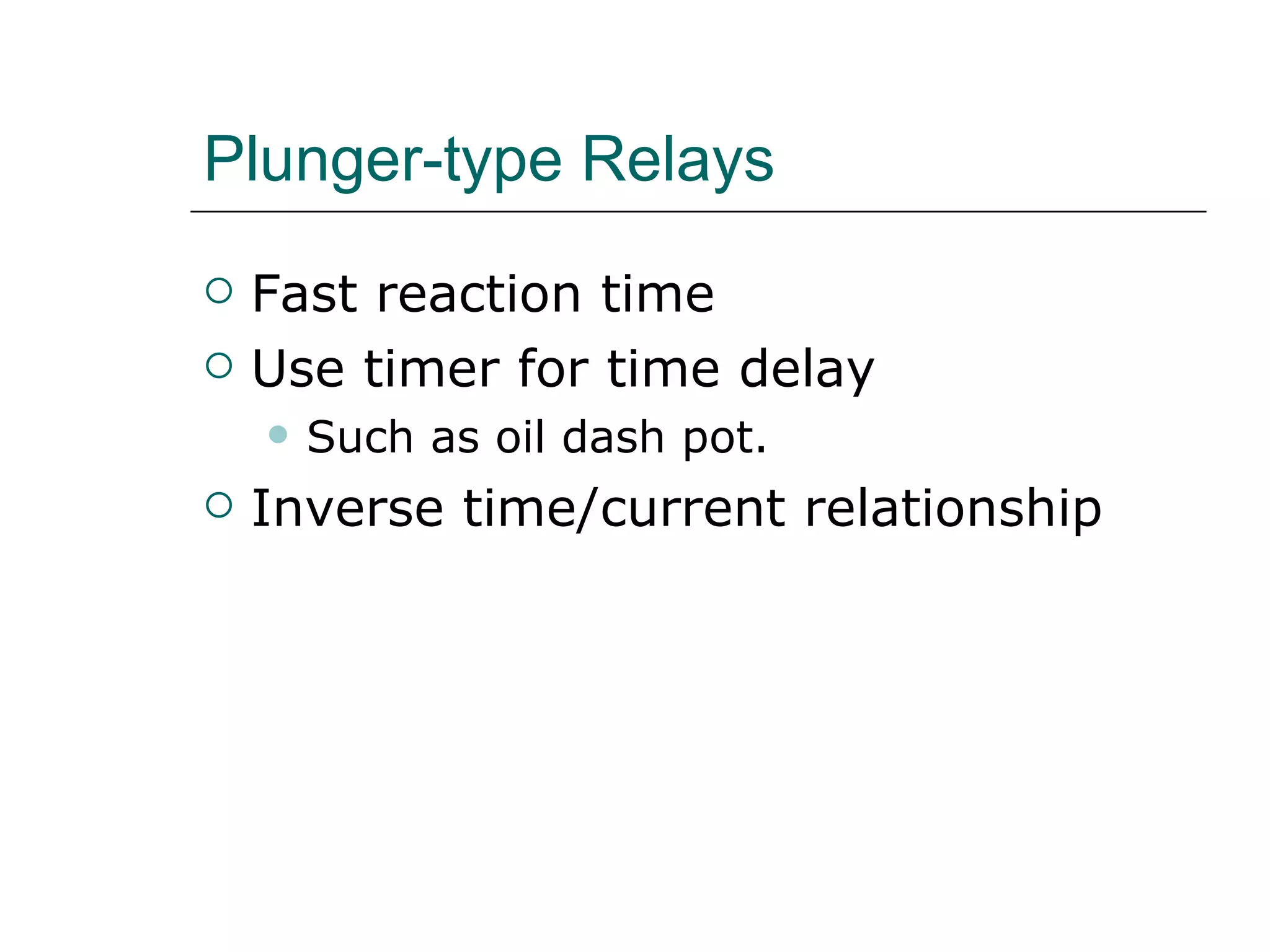
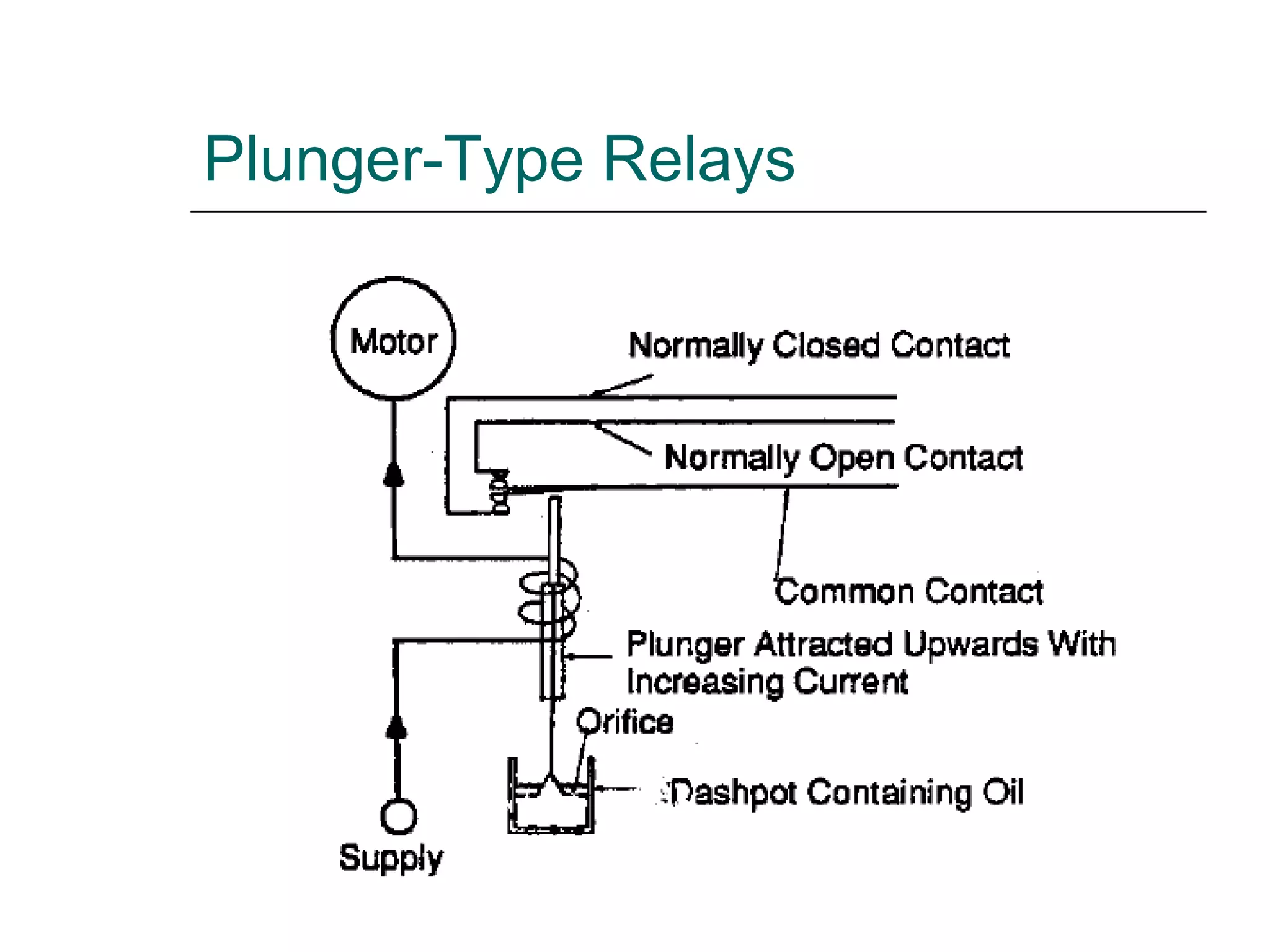
Plunger-type Relays Fast reaction time Use timer for time delay Such as oil dash pot. Inverse time/current relationship
Plunger-Type Relays
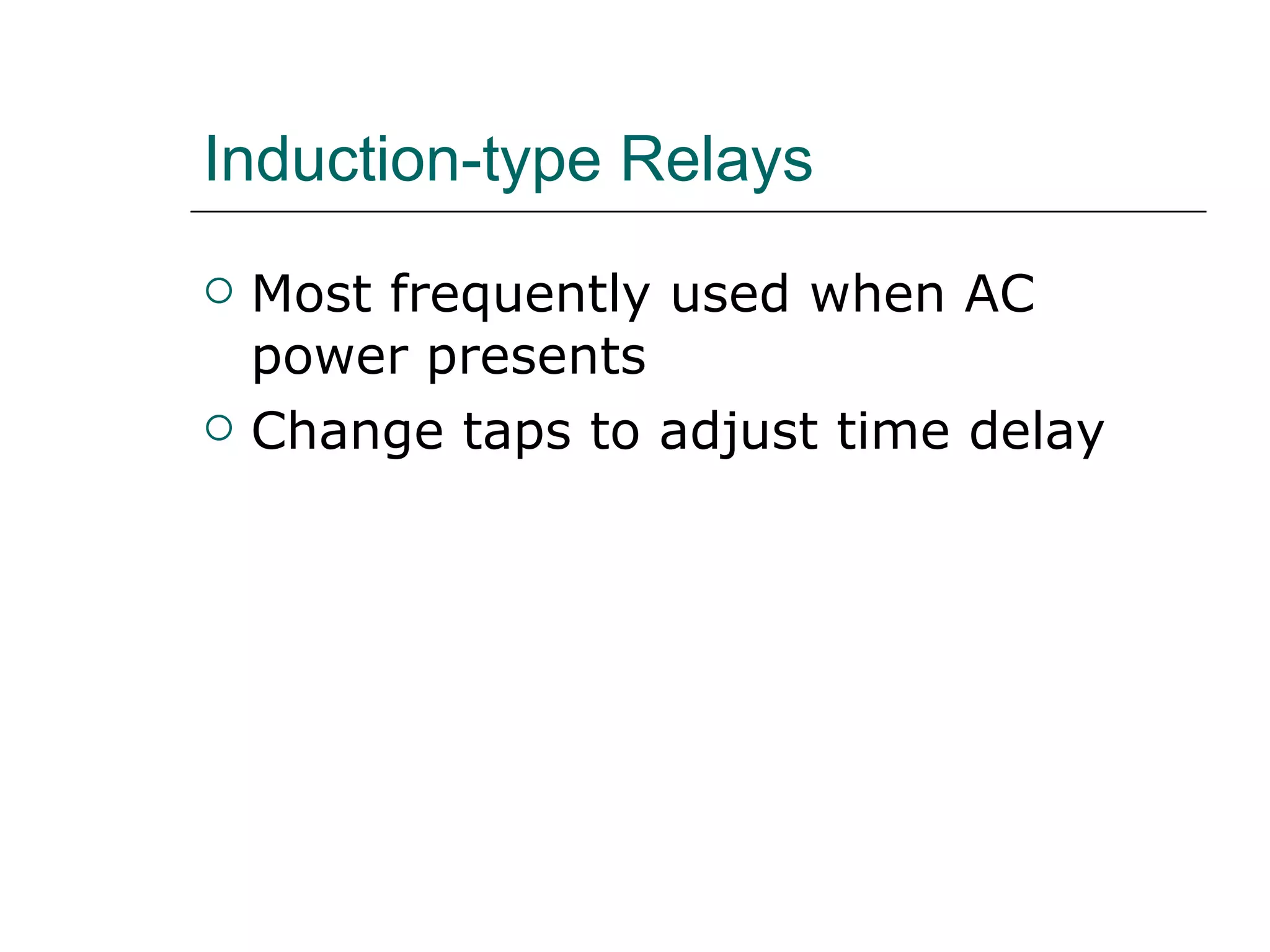
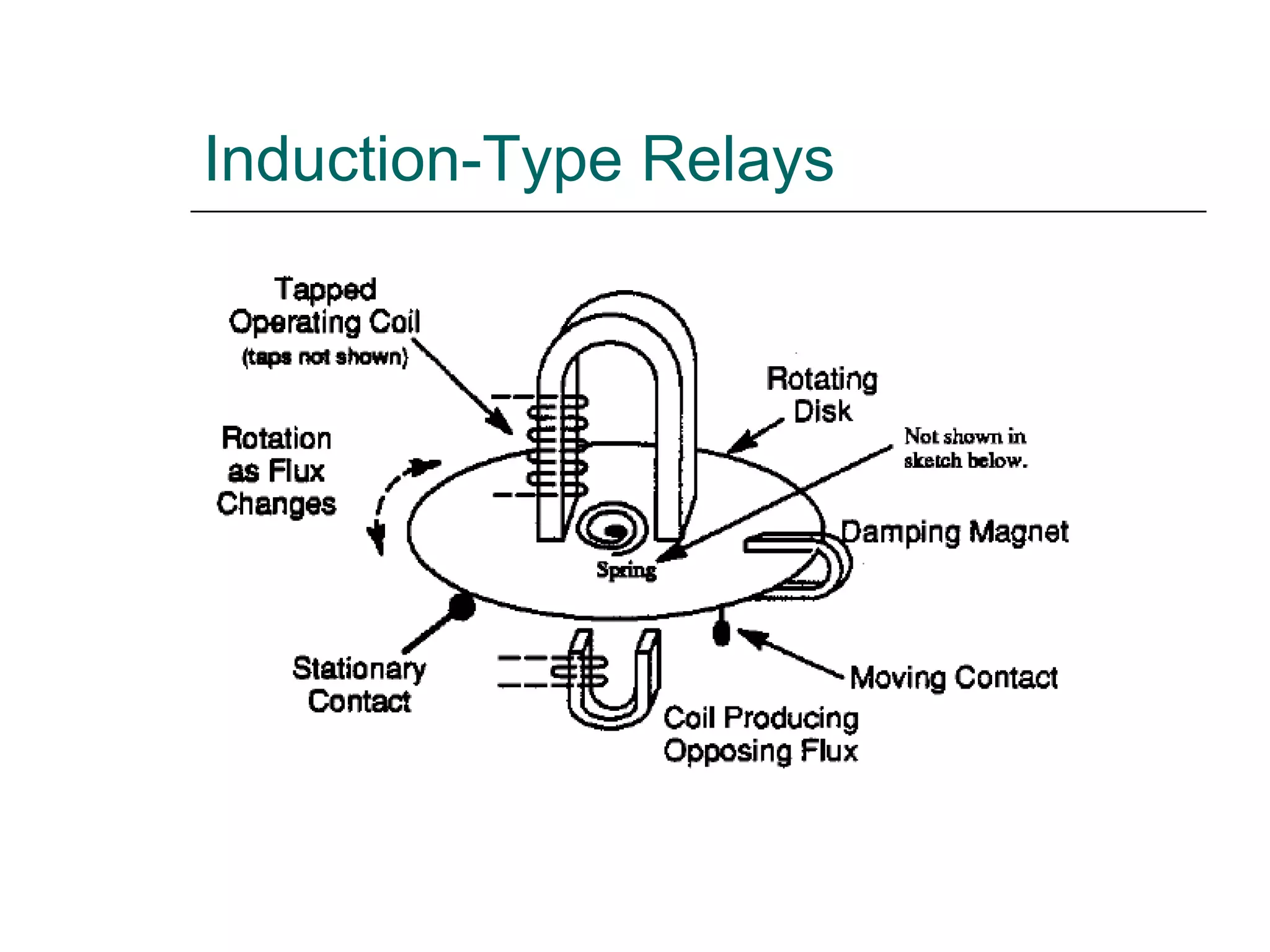
Induction-type Relays Most frequently used when AC power presents Change taps to adjust time delay
Induction-Type Relays
Motor Protection Stalling Some Definitions… Motor Stalling: It happens when motor circuits are energized, but motor rotor is not rotating. It is also called locked rotor.  Effects: this will result in excessive currents flow given the same load. This will cause thermal damage to the motor winding and insulation.
Motor Protection Stalling Similar types of relays that are used for motor timed overload protection could be used for motor stalling protection.
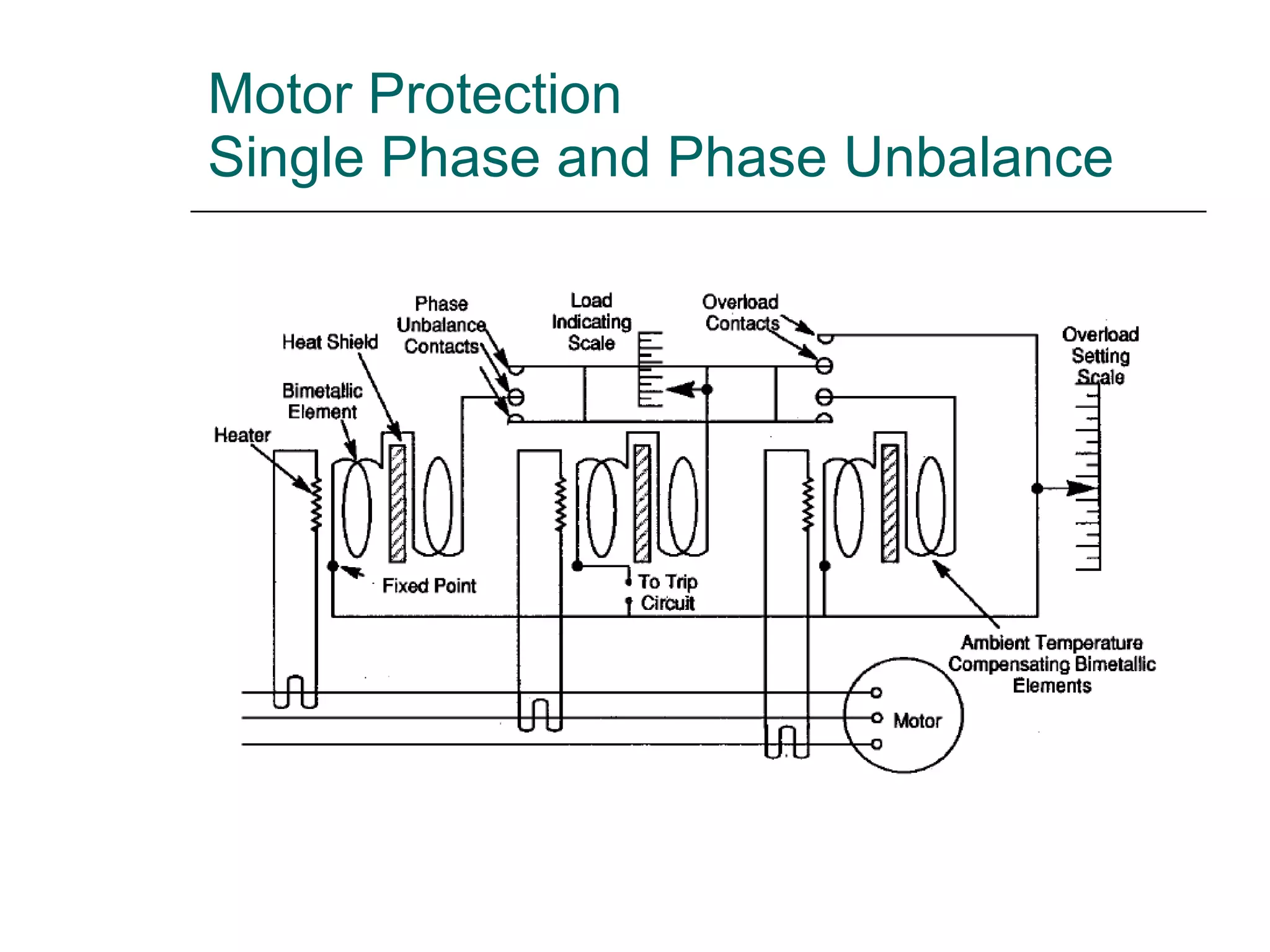
Motor Protection Single Phase and Phase Unbalance Some definitions… Single Phase: three-phase motors are subject to loss of one of the three phases from the power distribution system.
Motor Protection Single Phase and Phase Unbalance Some definitions… Phase Unbalance:  In a balanced system the three line-neutral voltages are equal in magnitude and are 120 degrees out of phase with each other. Otherwise, the system is unbalanced.
Motor Protection Single Phase and Phase Unbalance These conditions will cause  Motor winding overheating  Excessive vibrations Cause motor  insulation/winding/bearing damage
Motor Protection Single Phase and Phase Unbalance
Motor Protection Other Instantaneous Overcurrent Differential Relays Undervoltage Electromagnetic Relays Ground Fault Differential Relays
Transformer Protection Gas and Temperature Monitoring Differential and Ground Fault Protection
Transformer Protection Gas Monitoring Relays: These relays will sense any amount of gas inside the transformer. A tiny little amount of gas will cause transformer explosion. Temperature Monitoring Relays: These relays are used to monitor the winding temperature of the transformer and prevent overheating.
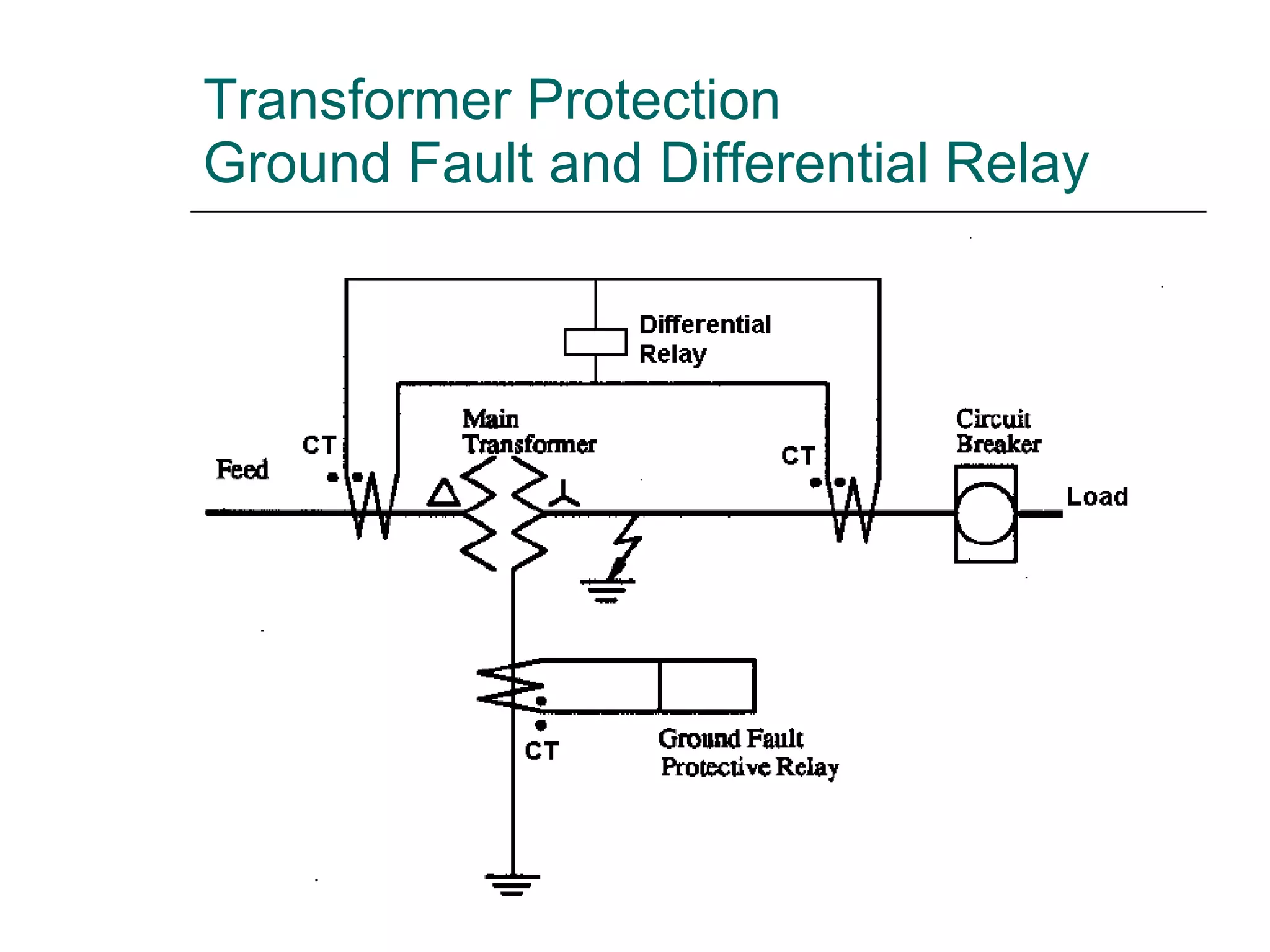
Transformer Protection Ground Fault For a wye connection, ground fault can be detected from the grounded neutral wire.
Transformer Protection Ground Fault and Differential Relay
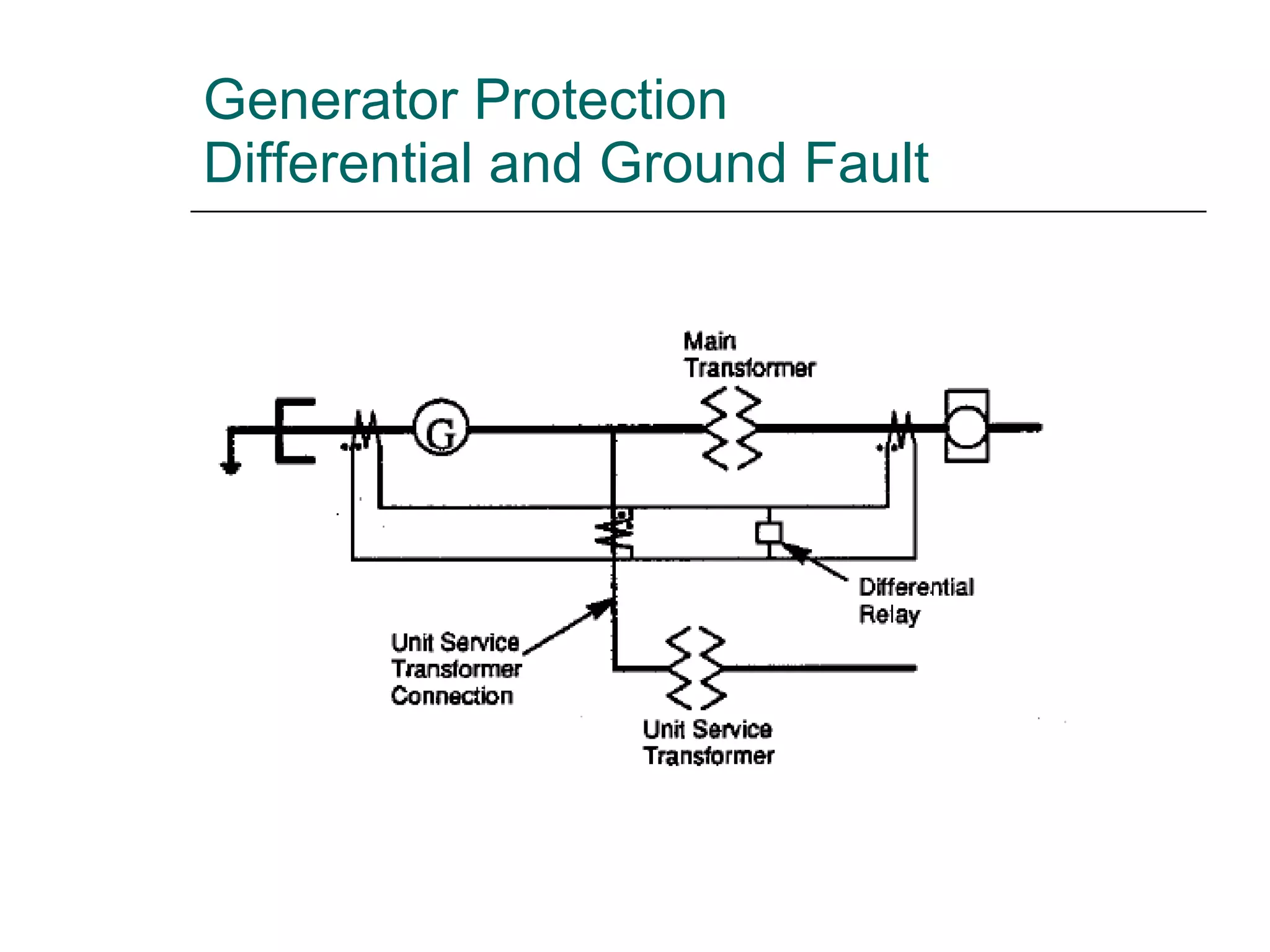
Generator Protection Differential and Ground Fault Protection Phase Unbalance
Generator Protection Differential and Ground Fault
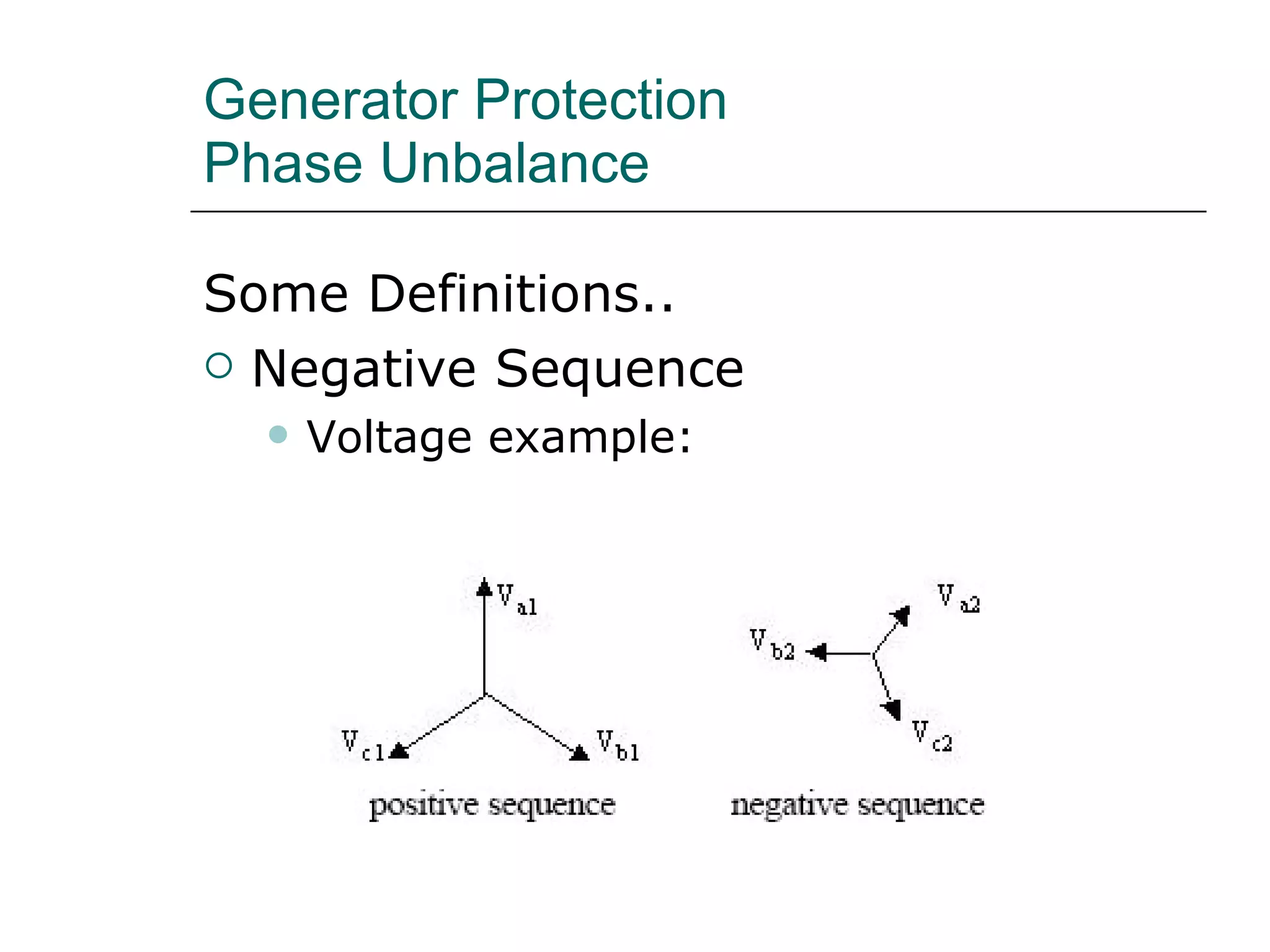
Generator Protection Phase Unbalance Some Definitions.. Negative Sequence Voltage example:
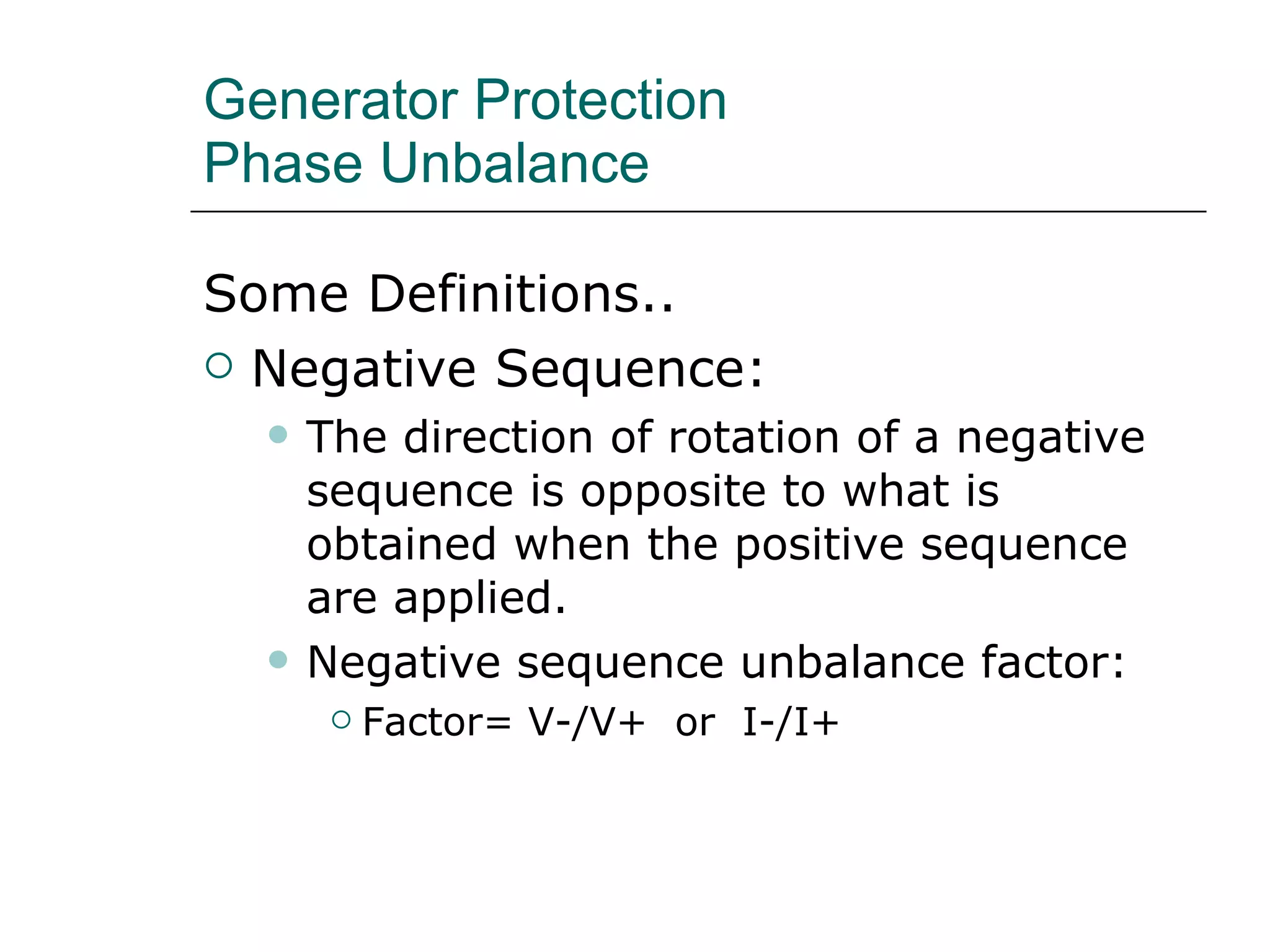
Generator Protection Phase Unbalance Some Definitions.. Negative Sequence: The direction of rotation of a negative sequence is opposite to what is obtained when the positive sequence are applied. Negative sequence unbalance factor: Factor= V-/V+  or  I-/I+
Generator Protection Phase Unbalance Negative Sequence Relay will constantly measure and compare the magnitude and direction of the current.
Conclusion Relays control output circuits of a much higher power. Safety is increased Protective relays are essential for keeping faults in the system isolated and keep equipment from being damaged.
Reference: IEEE Red Book Ontario Power Generation Training Course (Electrical Equipment) www.howstuffworks.com
 

protection and relay scheme

  • 1.
    Protection and RelaySchemes Chris Fraser Amanda Chen Wang Group#4 October 5, 2005
  • 2.
    Agenda Introduction ofProtective Relays Electrical System Protection with Protective Relays Conclusion
  • 3.
    What are Relays?Relays are electrical switches that open or close another circuit under certain conditions.
  • 4.
    Relay Purpose Isolatecontrolling circuit from controlled circuit. Control high voltage system with low voltage. Control high current system with low current. Logic Functions
  • 5.
    Relay Types ElectromagneticRelays (EMRs) EMRs consist of an input coil that's wound to accept a particular voltage signal, plus a set of one or more contacts that rely on an armature (or lever) activated by the energized coil to open or close an electrical circuit. Solid-state Relays (SSRs) SSRs use semiconductor output instead of mechanical contacts to switch the circuit. The output device is optically-coupled to an LED light source inside the relay. The relay is turned on by energizing this LED, usually with low-voltage DC power. Microprocessor Based Relays Use microprocessor for switching mechanism. Commonly used in power system monitoring and protection.
  • 6.
  • 7.
  • 8.
    Advantages/Disadvantages Electromagnetic Relays(EMRs) Simplicity Not expensive Mechanical Wear Solid-state Relays (SSRs) No Mechanical movements Faster than EMR No sparking between contacts Microprocessor-based Relay Much higher precision and more reliable and durable. Improve the reliability and power quality of electrical power systems before, during and after faults occur. Capable of both digital and analog I/O. Higher cost
  • 9.
    Why A SystemNeeds Protection? There is no ‘fault free’ system. It is neither practical nor economical to build a ‘fault free’ system. Electrical system shall tolerate certain degree of faults. Usually faults are caused by breakdown of insulation due to various reasons: system aging, lighting, etc.
  • 10.
    Electrical Faults majorityare phase-to-ground faults phase-to-phase phase-phase-phase double-phase-to-ground
  • 11.
    Advantages for UsingProtective Relays Detect system failures when they occur and isolate the faulted section from the remaining of the system. Mitigating the effects of failures after they occur. Minimize risk of fire, danger to personal and other high voltage systems.
  • 12.
    Protective Devices ComparisonRelays Circuit Breakers Fuses Acquisition Detection Activation Actuation
  • 13.
    Protective Devices ComparisonCircuit Breakers V.S. Relays Relays are like human brain; circuit breakers are like human muscle. Relays ‘make decisions’ based on settings. Relays send signals to circuit breakers. Based the sending signals circuit breakers will open/close.
  • 14.
    Protective Devices ComparisonFuses V.S. Relays Relays have different settings and can be set based on protection requirements. Relays can be reset. Fuses only have one specific characteristic for a individual type. Fuses cannot be reset but replaced if they blow.
  • 15.
    Protection and RelaySchemes Motor Protection Transformer Protection Generator Protection
  • 16.
    Motor Protection TimedOverload Locked Rotor Single Phase and Phase Unbalance Other
  • 17.
    Motor Protection Timed Overload Solution: Thermal overload relays Plunger-type relays Induction-type relays
  • 18.
    Motor Protection TimedOverload Protection Timed Overload Definition: Continuously operate motor above its rated value will cause thermal damage to the motor.
  • 19.
    Thermal Overload RelaysUse bimetallic strips to open/close relay contacts when temperature exceeds/drops to certain level. Require certain reaction time Inverse time/current relationship
  • 20.
  • 21.
    Plunger-type Relays Fastreaction time Use timer for time delay Such as oil dash pot. Inverse time/current relationship
  • 22.
  • 23.
    Induction-type Relays Mostfrequently used when AC power presents Change taps to adjust time delay
  • 24.
  • 25.
    Motor Protection StallingSome Definitions… Motor Stalling: It happens when motor circuits are energized, but motor rotor is not rotating. It is also called locked rotor. Effects: this will result in excessive currents flow given the same load. This will cause thermal damage to the motor winding and insulation.
  • 26.
    Motor Protection StallingSimilar types of relays that are used for motor timed overload protection could be used for motor stalling protection.
  • 27.
    Motor Protection SinglePhase and Phase Unbalance Some definitions… Single Phase: three-phase motors are subject to loss of one of the three phases from the power distribution system.
  • 28.
    Motor Protection SinglePhase and Phase Unbalance Some definitions… Phase Unbalance: In a balanced system the three line-neutral voltages are equal in magnitude and are 120 degrees out of phase with each other. Otherwise, the system is unbalanced.
  • 29.
    Motor Protection SinglePhase and Phase Unbalance These conditions will cause Motor winding overheating Excessive vibrations Cause motor insulation/winding/bearing damage
  • 30.
    Motor Protection SinglePhase and Phase Unbalance These conditions will cause Motor winding overheating Excessive vibrations Cause motor insulation/winding/bearing damage
  • 31.
    Motor Protection SinglePhase and Phase Unbalance
  • 32.
    Motor Protection OtherInstantaneous Overcurrent Differential Relays Undervoltage Electromagnetic Relays Ground Fault Differential Relays
  • 33.
    Transformer Protection Gasand Temperature Monitoring Differential and Ground Fault Protection
  • 34.
    Transformer Protection GasMonitoring Relays: These relays will sense any amount of gas inside the transformer. A tiny little amount of gas will cause transformer explosion. Temperature Monitoring Relays: These relays are used to monitor the winding temperature of the transformer and prevent overheating.
  • 35.
    Transformer Protection GroundFault For a wye connection, ground fault can be detected from the grounded neutral wire.
  • 36.
    Transformer Protection GroundFault and Differential Relay
  • 37.
    Generator Protection Differentialand Ground Fault Protection Phase Unbalance
  • 38.
  • 39.
    Generator Protection PhaseUnbalance Some Definitions.. Negative Sequence Voltage example:
  • 40.
    Generator Protection PhaseUnbalance Some Definitions.. Negative Sequence: The direction of rotation of a negative sequence is opposite to what is obtained when the positive sequence are applied. Negative sequence unbalance factor: Factor= V-/V+ or I-/I+
  • 41.
    Generator Protection PhaseUnbalance Negative Sequence Relay will constantly measure and compare the magnitude and direction of the current.
  • 42.
    Conclusion Relays controloutput circuits of a much higher power. Safety is increased Protective relays are essential for keeping faults in the system isolated and keep equipment from being damaged.
  • 43.
    Reference: IEEE RedBook Ontario Power Generation Training Course (Electrical Equipment) www.howstuffworks.com
  • 44.