Protective relaying
Protective relaying
• Used to give an alarm or cause prompt removal of any element of
power system from the service when that element behaves
abnomally
• Abmonal behaviour of an element might cause damage or
interference with effective operation of the rest of the system
• The protective relaying minimises the damage to the equipment and
interruption to the service when electrical failure occurs
Protective relaying
• Relays are compact and self contained devices
• When abnormal conditions exists,the relay contacts get closed
• This in turn closes the trip circuit of a circuit breaker
• The circuit breaker are the ones that disconnects the faulty element
and are called upon by the relays
Protective relaying
• The protection process therefore involves the following
Occurrence of fault
Operation of relay
Opening of a circuit breaker
Removal of faulty element
• The entire process is automatic and fast
Protective relaying
• Protective relay scheme includes:
Current and voltage transformers
Ptotective relays
Time delay relays
Auxiliary relays
Secondary circuits
Trip circuirts
• Protective relaying is the team work of all these components
Functions of protective relays
• Removal of component which is behaving abnormally by
closing the rip circuit of circuit breaker or to sound an
alarm
• To disconnect the abnormally operating part so as to
avoid the damage or interference within the effective
operation of the rest of system
• To prevent the subsequent faults by disconnecting the
abnormally operating part
Functions of protective relays
• To disconnect the faulty part as quickly as possible so as to
minimise the damage to the faulty part itself
• To restrict the spreading of the effect of fault causing least
interference to the rest of the healthy system. Thus by
disconnecting the faulty part, the fault effects get
localised
• To improve the system performance, system reliability,
system stability and service continuity
protective Zones
• In a protective relay scheme,circuit breakers are placed
at the appropriate points such that any element of the
entire power system can be disconnected for repairing
work and under abnormal conditions
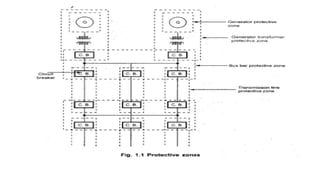
• A protective zone is the separate zone which is
established around each system element
• A fault occurring in any protective zone will cause the
tripping of relays which causes opening of all the circuit
breakers located within that zone
protective Zones
• The various components which are provided with the
protective zones are generators, transformers, transmission
lines ,busbars, cables etc
• No part of the system is left unprotected
• The figure below shows various protective zones
• The boundaries of protective zones are decided by the
locations of the current transformers
protective Zones
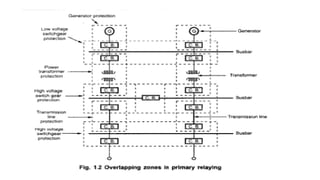
• In practice,protective zones are overlapped. Overlapping
ensures complete safety of each and every element of
the system
• There is no chance of existence of a dead spot in a
system,(unprotected zone)
• Failure within region of zones overlapping, more circuit
breakers get tripped than minimum necessary to
disconnect the faulty element
• Absence of overlaps means dead spot may exist, hence
circuit breakers lying within the zone may not trip even
though the fault occurs
protective Zones
• This may cause damage to the healthy system
• The overlapping of protective zones are relatively small and
probability of failures in the overlapped regions is very low
• Hence,the tripping of too many circuit breakers will also be infrequent
Primary and backup protection
• Protection provided by the relaying equipment can be
categorised into primary protection and backup
protection
• Primary protection is the first line of defence and is
responsible to protect all the power system elements from
all the types of faults
• backup protection comes into play only when the primary
protection fails
Primary and backup protection
• Backup protection is provided as the main protection can
fail due to many reasons
Circuit breaker failure
Protective relay failure
Tripping circuit failure
Loss of supply to the relay
Primary and backup protection
• When primary protection is not operational for
maintenance purpose,the backup protection acts as a
main protection
• The arrangement of backup protective scheme should be
such that the failure in main protection should not cause
the failure in the backup protection as well
• This is satisfied if backup relaying and primary relaying do
not have anything common
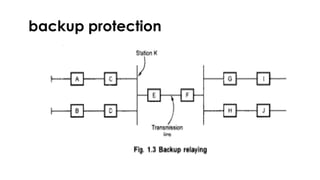
• Generally backup protection is located at different
stations from the primary protection
backup protection
backup protection
• Backup relay must operate with sufficient time delay so that the
primary relaying is given a chance to operate
• When fault occurs,both relays starts relaying operation but primary is
expected to trip first and backup will then reset without having had
time to complete the relaying operation
Methods of backup protection
• Relay backup
• Breaker backup
• Remote backup
• Centrally-coordinated
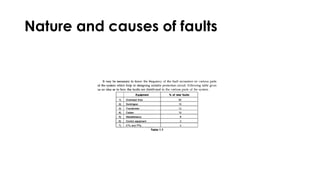
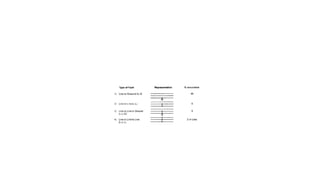
Nature and causes of faults
Electrical Power system Protective relaying

Electrical Power system Protective relaying

  • 1.
  • 2.
    Protective relaying • Usedto give an alarm or cause prompt removal of any element of power system from the service when that element behaves abnomally • Abmonal behaviour of an element might cause damage or interference with effective operation of the rest of the system • The protective relaying minimises the damage to the equipment and interruption to the service when electrical failure occurs
  • 3.
    Protective relaying • Relaysare compact and self contained devices • When abnormal conditions exists,the relay contacts get closed • This in turn closes the trip circuit of a circuit breaker • The circuit breaker are the ones that disconnects the faulty element and are called upon by the relays
  • 4.
    Protective relaying • Theprotection process therefore involves the following Occurrence of fault Operation of relay Opening of a circuit breaker Removal of faulty element • The entire process is automatic and fast
  • 5.
    Protective relaying • Protectiverelay scheme includes: Current and voltage transformers Ptotective relays Time delay relays Auxiliary relays Secondary circuits Trip circuirts • Protective relaying is the team work of all these components
  • 6.
    Functions of protectiverelays • Removal of component which is behaving abnormally by closing the rip circuit of circuit breaker or to sound an alarm • To disconnect the abnormally operating part so as to avoid the damage or interference within the effective operation of the rest of system • To prevent the subsequent faults by disconnecting the abnormally operating part
  • 7.
    Functions of protectiverelays • To disconnect the faulty part as quickly as possible so as to minimise the damage to the faulty part itself • To restrict the spreading of the effect of fault causing least interference to the rest of the healthy system. Thus by disconnecting the faulty part, the fault effects get localised • To improve the system performance, system reliability, system stability and service continuity
  • 8.
    protective Zones • Ina protective relay scheme,circuit breakers are placed at the appropriate points such that any element of the entire power system can be disconnected for repairing work and under abnormal conditions • A protective zone is the separate zone which is established around each system element • A fault occurring in any protective zone will cause the tripping of relays which causes opening of all the circuit breakers located within that zone
  • 9.
    protective Zones • Thevarious components which are provided with the protective zones are generators, transformers, transmission lines ,busbars, cables etc • No part of the system is left unprotected • The figure below shows various protective zones • The boundaries of protective zones are decided by the locations of the current transformers
  • 11.
    protective Zones • Inpractice,protective zones are overlapped. Overlapping ensures complete safety of each and every element of the system • There is no chance of existence of a dead spot in a system,(unprotected zone) • Failure within region of zones overlapping, more circuit breakers get tripped than minimum necessary to disconnect the faulty element • Absence of overlaps means dead spot may exist, hence circuit breakers lying within the zone may not trip even though the fault occurs
  • 12.
    protective Zones • Thismay cause damage to the healthy system • The overlapping of protective zones are relatively small and probability of failures in the overlapped regions is very low • Hence,the tripping of too many circuit breakers will also be infrequent
  • 14.
    Primary and backupprotection • Protection provided by the relaying equipment can be categorised into primary protection and backup protection • Primary protection is the first line of defence and is responsible to protect all the power system elements from all the types of faults • backup protection comes into play only when the primary protection fails
  • 15.
    Primary and backupprotection • Backup protection is provided as the main protection can fail due to many reasons Circuit breaker failure Protective relay failure Tripping circuit failure Loss of supply to the relay
  • 16.
    Primary and backupprotection • When primary protection is not operational for maintenance purpose,the backup protection acts as a main protection • The arrangement of backup protective scheme should be such that the failure in main protection should not cause the failure in the backup protection as well • This is satisfied if backup relaying and primary relaying do not have anything common • Generally backup protection is located at different stations from the primary protection
  • 17.
  • 18.
    backup protection • Backuprelay must operate with sufficient time delay so that the primary relaying is given a chance to operate • When fault occurs,both relays starts relaying operation but primary is expected to trip first and backup will then reset without having had time to complete the relaying operation

  • 19.
    Methods of backupprotection • Relay backup • Breaker backup • Remote backup • Centrally-coordinated
  • 20.