NCL INDUSTRIES LTD,
CEMENT DIVISION
PRESENTED BY:
2
PROTECTIVE RELAYS
Relay:
Relay is a device which detects the fault and initiates the operation
of circuit breaker to isolate the defective part of system from
healthy part of the system.
3
PROTECTIVE RELAYS
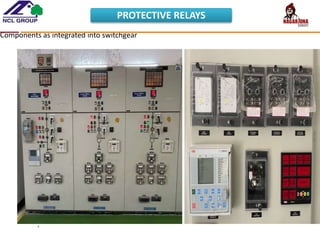
Components as integrated into switchgear
4
PROTECTIVE RELAYS
5
PROTECTIVE RELAYS
 A protective relay is a smart device that receive inputs compares
them to set points, and provide them to output. Inputs can be current,
voltage, resistance or temperature. Outputs can include visual
feedback in the form of indicator lights.
 Distinguish normal and abnormal conditions.
 Detects the abnormal conditions in the electrical circuits by
constantly measuring the electrical quantities which are different
under normal and abnormal conditions.
 Electrical quantities which may change under fault conditions
 Voltage
 Current
 Frequency
 Phase angle
6
PROTECTIVE RELAYS
7
PROTECTIVE RELAYS
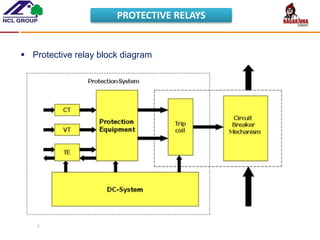
 Protective relay block diagram
8
PROTECTIVE RELAYS
INPUT: A relay needs information from the system to make decision.
SETTING : The user program setting that allow relay to make decision.
PROCESS: Once inputs are connected and settings are programmed,
the relay compares there and make decision.
OUTPUT: The relay will operate a switch to indicate that the input has
surpassed a setting.Or the relay can provide notification through visual
feedback such as a meter or LED.
9
PROTECTIVE RELAYS
Actuating quantities of the relay can be one or more of the following
parameters of voltage/Current derived from CT/PT.
 Magnitude
 Rate of change
 Direction
 Phase angle
 Frequency
 Wave shape
 Duration
 Ratio
Faults signal their presence, type and location to the protective relays
through the changes in one or more of the above quantities.Relay
operates to close trip circuit of the C.B
Open the C.B and disconnect the faulty section, entire process is
automatic.
10
PROTECTIVE RELAYS
Relay circuit connections can be devided into three parts
1) Primary winding of the current transformer (CT), connected in series
with the line to be protected .
2) Secondary winding of the CT and the relay operating coil.
3) Tripping circuit consists of
 A source of supply
 Trip coil of the CB
 Relay stationary contacts
 Protective relaying is a teamwork of these components.
11
PROTECTIVE RELAYS
OPERATION:
 F is the fault (short circuit) point on the transmission line,
 Line current increases to an enormous value ,
 Heavy current flows through the coil, causing the relay to operate by
closing its contact.
 Closes the trip circuit of the CB, making the CB open and isolating
the faulty section from the rest of the system.
 Ensures the safety of the circuit equipment from the damage and
normal working of the healthy portion of the system.
12
PROTECTIVE RELAYS
Desirable qualities of protective relays
 Selectivity
 Speed
 Sensitivity
 Reliability
 Stability
 Adequacy
13
PROTECTIVE RELAYS
 Selectivity
This feature aims at maintaining the continuity of supply system by
disconnecting the minimum section of the network necessary to isolate
the fault. The property of selective tripping is also known as
“discrimination”. This is the reason for which the entire system is divided
into several protective zones so that minimum protion of network is
isolated with accuracy. Two examples of utilization of this feature in a
relaying scheme are as followsa) Time graded systemsb) Unit systems
14
PROTECTIVE RELAYS
 Selectivity
Some Aspects of Relay Selectivity Discrimination (location of fault, type
of fault) by different methods (Examples):
 Time
 Current Magnitude
 Distance (V/I)
 Time + Current Magnitude
 Time + Distance
 Time + Direction of Current
 Use of Communication
 Use of other quantities:-ive sequence, harmonics
15
PROTECTIVE RELAYS
 Speed
 Minimum operating time to clear a fault in order to avoid damage to
equipment.
a) TheRelayTime:Thisisthetimebetweentheinstantofoccurrenceofthefa
ulttothe instant at which the relay contacts open.
b) TheBreakerTime:Thisisthetimebetweentheinstantofclosingofrelayco
ntactsto the instant of final arc extinction inside the medium and
removal of the fault.
Should disconnect the faulty system as fast as possible
Minimise damage.Electrical apparatus may be damaged if they carry
fault currents for a long time.
Voltage is reduced,may cause shutdown consumers,motors and the
generators on the system may become unstable.
Decrease the possibility of one type of fault into the other more severe
type.
Suppose short circuit on busbar with 60kA rms
Fault duration 0.07 sec: No damage .
Fault duration 7sec: Completely destroyed.
16
PROTECTIVE RELAYS
 Stability:
Ability of the relay system to operate with low value of actuating quantity
The sensitivity of a relay refers to the smallest value of the actuating
quantityat which the relay operates detecting any abnormal condition. In
case of an overcurrent relay, mathematically this can be defined as the
ratio between the short circuit fault current (Is) and the relay operating
current (Io). The value of Io , should not be too small or large so that the
relay is either too sensitive or slow in responding.
17
PROTECTIVE RELAYS
 Dependability/Reliability :
 Must Operate When Required
 Proper system design
 Backup
 To operate when main system fails
 To cover any parts that may fall in-between protectedzones (fall in
the cracks)
 Reliability of hardware. Testing and in-service proven history (How
you can get that in a fast changing world?)
 Reliability of software (software testing and checking)
 High quality protection system design Appropriate settings
 Security: against incorrect relay/device operation (must NOT operate
unnecessarily).
 Unit Protection System: able to detect and response to faults within
the Protection Zone.
 Non-unit Protection System: depends on correlated and coordinated
responses to establish selectivity (i.e. Time-Overcurrent)
18
PROTECTIVE RELAYS
 Adequacy:
It is economically unviable to have a 100% protection of the entire
system in concern. Therefore, the cost of the designed protection
system varies with the criticality and importance of the protected zone.
The protection system for more critical portionsis generally costly, as all
the features of a good protection system is maximized here. But a small
motor can be protected by a simple thermally operated relay, which is
simple and cheap. Therefore, the cost of the protection system should
be adequate in its cost.
19
PROTECTIVE RELAYS
Types of Relays
Types of protection relays are mainly based on their characteristic,
logic, on actuating parameter and operation mechanism.
Based on operation mechanism protection relay can be categorized as
electromagnetic relay, static relay and mechanical relay. Actually, a
relay is nothing but a combination of one or more open or closed
contacts. These all or some specific contacts the relay change their state
when actuating parameters are applied to the relay. That means open
contacts become closed and closed contacts become open. In an
electromagnetic relay, these closing and opening of relay contacts are
done by the electromagnetic action of a solenoid.
In the mechanical relay, these closing and opening of relay contacts are
done by mechanical displacement of different gear level system.
In static relay it is mainly done by semiconductor switches like
thyristor. In digital relay on and off state can be referred as 1 and 0
state.
20
PROTECTIVE RELAYS
Types of Relays
In static relay it is mainly done by semiconductor switches like
thyristor. In digital relay on and off state can be referred as 1 and 0
state.
Based on Characteristic the protection relay can be categorized as:
Definite time relays
Inverse time relays with definite minimum time(IDMT)
Instantaneous relays.
IDMT with inst.
Stepped characteristic.
Programmed switches.
Voltage restraint over current relay.
21
PROTECTIVE RELAYS
Types of Relays
Based on of logic the protection relay can be categorized as-
Differential.
Unbalance.
Neutral displacement.
Directional.
Restricted earth fault.
Over fluxing.
Distance schemes.
Bus bar protection.
Reverse power relays.
Loss of excitation.
Negative phase sequence relays etc.
22
PROTECTIVE RELAYS
Types of Relays
Based on actuating parameter the protection relay can be categorized
as-
Current relays.
Voltage relays.
Frequency relays.
Power relays etc.
Based on application the protection relay can be categorized as-
Primary relay.
Backup relay.
Primary relay or primary protection relay is the first line of power
system protection whereas backup relay is operated only when primary
relay fails to be operated during a fault. Hence backup relay is slower in
action than primary relay.
23
PROTECTIVE RELAYS
Any relay may fail to be operated due to any of the following reasons,
The protective relay itself is defective.
DC Trip voltage supply to the relay is unavailable.
Trip lead from relay panel to the circuit breaker is disconnected.
The trip coil in the circuit breaker is disconnected or defective.
Current or voltage signals from Current Transformers (CTs) or Potential
Transformers (PTs) respectively is unavailable.
24
PROTECTIVE RELAYS
Any relay may fail to be operated due to any of the following reasons,
The protective relay itself is defective.
DC Trip voltage supply to the relay is unavailable.
Trip lead from relay panel to the circuit breaker is disconnected.
The trip coil in the circuit breaker is disconnected or defective.
Current or voltage signals from Current Transformers (CTs) or Potential
Transformers (PTs) respectively is unavailable.
25
PROTECTIVE RELAYS
26
PROTECTIVE RELAYS
27
CEMENT MILL-4 HT PANEL
RATING:
VOLTAGE:

PPT.pptx

  • 1.
    NCL INDUSTRIES LTD, CEMENTDIVISION PRESENTED BY:
  • 2.
    2 PROTECTIVE RELAYS Relay: Relay isa device which detects the fault and initiates the operation of circuit breaker to isolate the defective part of system from healthy part of the system.
  • 3.
  • 4.
    Components as integratedinto switchgear 4 PROTECTIVE RELAYS
  • 5.
    5 PROTECTIVE RELAYS  Aprotective relay is a smart device that receive inputs compares them to set points, and provide them to output. Inputs can be current, voltage, resistance or temperature. Outputs can include visual feedback in the form of indicator lights.  Distinguish normal and abnormal conditions.  Detects the abnormal conditions in the electrical circuits by constantly measuring the electrical quantities which are different under normal and abnormal conditions.  Electrical quantities which may change under fault conditions  Voltage  Current  Frequency  Phase angle
  • 6.
  • 7.
  • 8.
    8 PROTECTIVE RELAYS INPUT: Arelay needs information from the system to make decision. SETTING : The user program setting that allow relay to make decision. PROCESS: Once inputs are connected and settings are programmed, the relay compares there and make decision. OUTPUT: The relay will operate a switch to indicate that the input has surpassed a setting.Or the relay can provide notification through visual feedback such as a meter or LED.
  • 9.
    9 PROTECTIVE RELAYS Actuating quantitiesof the relay can be one or more of the following parameters of voltage/Current derived from CT/PT.  Magnitude  Rate of change  Direction  Phase angle  Frequency  Wave shape  Duration  Ratio Faults signal their presence, type and location to the protective relays through the changes in one or more of the above quantities.Relay operates to close trip circuit of the C.B Open the C.B and disconnect the faulty section, entire process is automatic.
  • 10.
    10 PROTECTIVE RELAYS Relay circuitconnections can be devided into three parts 1) Primary winding of the current transformer (CT), connected in series with the line to be protected . 2) Secondary winding of the CT and the relay operating coil. 3) Tripping circuit consists of  A source of supply  Trip coil of the CB  Relay stationary contacts  Protective relaying is a teamwork of these components.
  • 11.
    11 PROTECTIVE RELAYS OPERATION:  Fis the fault (short circuit) point on the transmission line,  Line current increases to an enormous value ,  Heavy current flows through the coil, causing the relay to operate by closing its contact.  Closes the trip circuit of the CB, making the CB open and isolating the faulty section from the rest of the system.  Ensures the safety of the circuit equipment from the damage and normal working of the healthy portion of the system.
  • 12.
    12 PROTECTIVE RELAYS Desirable qualitiesof protective relays  Selectivity  Speed  Sensitivity  Reliability  Stability  Adequacy
  • 13.
    13 PROTECTIVE RELAYS  Selectivity Thisfeature aims at maintaining the continuity of supply system by disconnecting the minimum section of the network necessary to isolate the fault. The property of selective tripping is also known as “discrimination”. This is the reason for which the entire system is divided into several protective zones so that minimum protion of network is isolated with accuracy. Two examples of utilization of this feature in a relaying scheme are as followsa) Time graded systemsb) Unit systems
  • 14.
    14 PROTECTIVE RELAYS  Selectivity SomeAspects of Relay Selectivity Discrimination (location of fault, type of fault) by different methods (Examples):  Time  Current Magnitude  Distance (V/I)  Time + Current Magnitude  Time + Distance  Time + Direction of Current  Use of Communication  Use of other quantities:-ive sequence, harmonics
  • 15.
    15 PROTECTIVE RELAYS  Speed Minimum operating time to clear a fault in order to avoid damage to equipment. a) TheRelayTime:Thisisthetimebetweentheinstantofoccurrenceofthefa ulttothe instant at which the relay contacts open. b) TheBreakerTime:Thisisthetimebetweentheinstantofclosingofrelayco ntactsto the instant of final arc extinction inside the medium and removal of the fault. Should disconnect the faulty system as fast as possible Minimise damage.Electrical apparatus may be damaged if they carry fault currents for a long time. Voltage is reduced,may cause shutdown consumers,motors and the generators on the system may become unstable. Decrease the possibility of one type of fault into the other more severe type. Suppose short circuit on busbar with 60kA rms Fault duration 0.07 sec: No damage . Fault duration 7sec: Completely destroyed.
  • 16.
    16 PROTECTIVE RELAYS  Stability: Abilityof the relay system to operate with low value of actuating quantity The sensitivity of a relay refers to the smallest value of the actuating quantityat which the relay operates detecting any abnormal condition. In case of an overcurrent relay, mathematically this can be defined as the ratio between the short circuit fault current (Is) and the relay operating current (Io). The value of Io , should not be too small or large so that the relay is either too sensitive or slow in responding.
  • 17.
    17 PROTECTIVE RELAYS  Dependability/Reliability:  Must Operate When Required  Proper system design  Backup  To operate when main system fails  To cover any parts that may fall in-between protectedzones (fall in the cracks)  Reliability of hardware. Testing and in-service proven history (How you can get that in a fast changing world?)  Reliability of software (software testing and checking)  High quality protection system design Appropriate settings  Security: against incorrect relay/device operation (must NOT operate unnecessarily).  Unit Protection System: able to detect and response to faults within the Protection Zone.  Non-unit Protection System: depends on correlated and coordinated responses to establish selectivity (i.e. Time-Overcurrent)
  • 18.
    18 PROTECTIVE RELAYS  Adequacy: Itis economically unviable to have a 100% protection of the entire system in concern. Therefore, the cost of the designed protection system varies with the criticality and importance of the protected zone. The protection system for more critical portionsis generally costly, as all the features of a good protection system is maximized here. But a small motor can be protected by a simple thermally operated relay, which is simple and cheap. Therefore, the cost of the protection system should be adequate in its cost.
  • 19.
    19 PROTECTIVE RELAYS Types ofRelays Types of protection relays are mainly based on their characteristic, logic, on actuating parameter and operation mechanism. Based on operation mechanism protection relay can be categorized as electromagnetic relay, static relay and mechanical relay. Actually, a relay is nothing but a combination of one or more open or closed contacts. These all or some specific contacts the relay change their state when actuating parameters are applied to the relay. That means open contacts become closed and closed contacts become open. In an electromagnetic relay, these closing and opening of relay contacts are done by the electromagnetic action of a solenoid. In the mechanical relay, these closing and opening of relay contacts are done by mechanical displacement of different gear level system. In static relay it is mainly done by semiconductor switches like thyristor. In digital relay on and off state can be referred as 1 and 0 state.
  • 20.
    20 PROTECTIVE RELAYS Types ofRelays In static relay it is mainly done by semiconductor switches like thyristor. In digital relay on and off state can be referred as 1 and 0 state. Based on Characteristic the protection relay can be categorized as: Definite time relays Inverse time relays with definite minimum time(IDMT) Instantaneous relays. IDMT with inst. Stepped characteristic. Programmed switches. Voltage restraint over current relay.
  • 21.
    21 PROTECTIVE RELAYS Types ofRelays Based on of logic the protection relay can be categorized as- Differential. Unbalance. Neutral displacement. Directional. Restricted earth fault. Over fluxing. Distance schemes. Bus bar protection. Reverse power relays. Loss of excitation. Negative phase sequence relays etc.
  • 22.
    22 PROTECTIVE RELAYS Types ofRelays Based on actuating parameter the protection relay can be categorized as- Current relays. Voltage relays. Frequency relays. Power relays etc. Based on application the protection relay can be categorized as- Primary relay. Backup relay. Primary relay or primary protection relay is the first line of power system protection whereas backup relay is operated only when primary relay fails to be operated during a fault. Hence backup relay is slower in action than primary relay.
  • 23.
    23 PROTECTIVE RELAYS Any relaymay fail to be operated due to any of the following reasons, The protective relay itself is defective. DC Trip voltage supply to the relay is unavailable. Trip lead from relay panel to the circuit breaker is disconnected. The trip coil in the circuit breaker is disconnected or defective. Current or voltage signals from Current Transformers (CTs) or Potential Transformers (PTs) respectively is unavailable.
  • 24.
    24 PROTECTIVE RELAYS Any relaymay fail to be operated due to any of the following reasons, The protective relay itself is defective. DC Trip voltage supply to the relay is unavailable. Trip lead from relay panel to the circuit breaker is disconnected. The trip coil in the circuit breaker is disconnected or defective. Current or voltage signals from Current Transformers (CTs) or Potential Transformers (PTs) respectively is unavailable.
  • 25.
  • 26.
  • 27.
    27 CEMENT MILL-4 HTPANEL RATING: VOLTAGE: