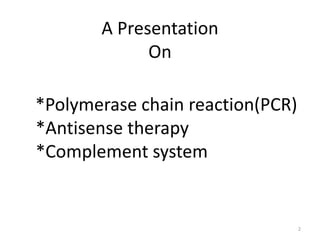
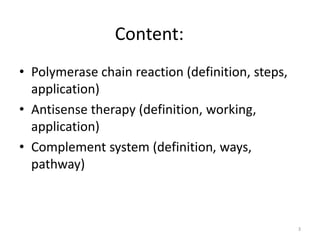
This presentation summarizes three topics: polymerase chain reaction (PCR), antisense therapy, and the complement system. PCR is an in vitro technique used to amplify a specific DNA sequence and was invented by Kary Mullis in 1983. It involves DNA denaturation, annealing of primers, and extension of the DNA sequence. Applications include genome mapping, disease diagnosis, and forensics. Antisense therapy inhibits gene expression by using single-stranded oligonucleotides to block transcription. It is used to treat various cancers and infections. The complement system consists of serum proteins that help activate the innate immune response. It can be activated via the classical or alternative pathway and acts through mechanisms like opsonization, inflammation, and
![Polymerase chain reaction
PCR, polymerase chain reaction, is an in-vitro
technique for amplification of a region of DNA
whose sequence is known or which lies
between two regions of known sequence[1].
It was invented in 1983 by Dr. Kary Mullis, for
which he received the Nobel Prize in
Chemistry in 1993 [2].
4](https://image.slidesharecdn.com/pcr-160325140941/85/Pcr-ppt-4-320.jpg)
![Basic component of PCR
Target DNA - contains the sequence to be amplified.
Pair of Primers - oligonucleotides that define the sequence
to be amplified.
dNTPs - deoxynucleotidetriphosphates: DNA building blocks.
Thermostable DNA Polymerase - enzyme that catalyzes the
reaction
Mg++ ions - cofactor of the enzyme
Buffer solution – maintains pH and ionic strength of the
reaction solution suitable for the activity of the enzyme [3].
5](https://image.slidesharecdn.com/pcr-160325140941/85/Pcr-ppt-5-320.jpg)
![Steps involve in PCR
6
1.DNA denaturation
2.DNA Annealing
3.Extension [3]](https://image.slidesharecdn.com/pcr-160325140941/85/Pcr-ppt-6-320.jpg)
![Application of PCR
Genome mapping and gene function
determination
Biodiversity studies ( e.g. evolution studies)
Diagnostics ( prenatal testing of genetic
diseases, early detection of cancer, viral
infections...)
Detection of drug resistance genes
Forensic (DNA fingerprinting) [2]
7](https://image.slidesharecdn.com/pcr-160325140941/85/Pcr-ppt-7-320.jpg)
![Antisense therapy
Antisense therapy refers to the inhibition of
translation by using a single stranded
nucleotide (antisense oligonucleotide) [2]
It inhibits both transcription and translation
by blocking transcription factor responsible for
the specific gene expression [2]
8](https://image.slidesharecdn.com/pcr-160325140941/85/Pcr-ppt-8-320.jpg)
![Working
9[4]](https://image.slidesharecdn.com/pcr-160325140941/85/Pcr-ppt-9-320.jpg)
![Application :
Antisense therapy use to treat-
Myeloid leukemia
Brain tumor
Malignant glioma
Prostate cancer
Viral and parasitic infection
Inflammatory diseases [2]
10](https://image.slidesharecdn.com/pcr-160325140941/85/Pcr-ppt-10-320.jpg)
![Complement system
• A complex consisting of at least 20 serum
proteins, which, once activated, acts like a
part of the innate immune defense.
• The complement components are present in
serum in inactive form.
• Complement proteins are synthesized mainly
in the liver, but tissue macrophages and
fibroblasts can synthesize some complement
proteins as well [2].
11](https://image.slidesharecdn.com/pcr-160325140941/85/Pcr-ppt-11-320.jpg)
![Ways of complement reaction
• Complement fixation
• Opsonization
• Inflammatory reaction
• Clearance of antigen-antibody complex [2].
12](https://image.slidesharecdn.com/pcr-160325140941/85/Pcr-ppt-12-320.jpg)
![Pathway of complement system
• The complement pathway can be activated by either
of two different pathways.
– Classical pathway (specific immune system)
– alternative (non-specific immune system) [2].
13](https://image.slidesharecdn.com/pcr-160325140941/85/Pcr-ppt-13-320.jpg)
![The Classical Pathway
14
The classical pathway is considered to be
part of the specific immune response because
it relies on antibodies to initiate it.
C1 becomes activated when it binds to the
ends of antibodies.
Once C1 is activated, it activates 2 other
complement proteins, C2 and C4 by cutting
them in half
C2 is cleaved into C2a and C2b
C4 is cleaved into C4a and C4b
Both C2b and C4b bind together on the
surface of the bacteria
C2a and C4a diffuse away [1].](https://image.slidesharecdn.com/pcr-160325140941/85/Pcr-ppt-14-320.jpg)
![The alternative pathway
• The alternative pathway is part of the non-
specific defense because it does not need
antibodies to initiate the pathway.
• The alternative pathway is slower than the
Classical pathway [2].
15](https://image.slidesharecdn.com/pcr-160325140941/85/Pcr-ppt-15-320.jpg)
![The Alternative
complement pathway
16[1]](https://image.slidesharecdn.com/pcr-160325140941/85/Pcr-ppt-16-320.jpg)

![References:
[1].Fundamentals of Biochemistry ( Voet, Voet,
Pratt)
[2].Biochemistry (U. Satyanarayana, U.
Chakrapani)
[3].Molecular Cell Biology ( Lodish, Darnell..)
[4]. Molecular & Cell Biology of Cancer (Knowles
and Selby)
18](https://image.slidesharecdn.com/pcr-160325140941/85/Pcr-ppt-18-320.jpg)