Presented by-
Anshika
BSc Hons
1
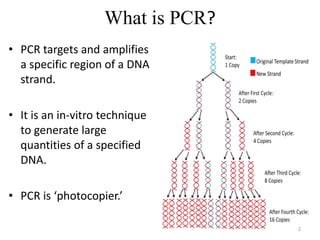
What is PCR?
• PCR targets and amplifies
a specific region of a DNA
strand.
• It is an in-vitro technique
to generate large
quantities of a specified
DNA.
• PCR is ‘photocopier.’
2
HISTORY
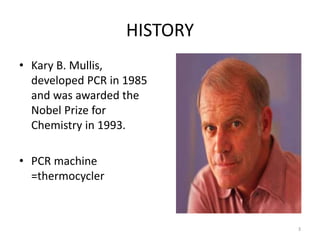
• Kary B. Mullis,
developed PCR in 1985
and was awarded the
Nobel Prize for
Chemistry in 1993.
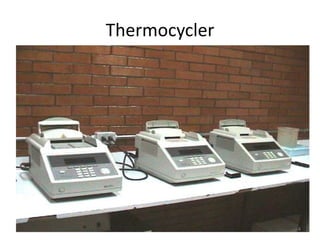
• PCR machine
=thermocycler
3
Thermocycler
4
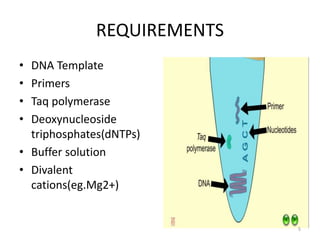
REQUIREMENTS
• DNA Template
• Primers
• Taq polymerase
• Deoxynucleoside
triphosphates(dNTPs)
• Buffer solution
• Divalent
cations(eg.Mg2+)
5
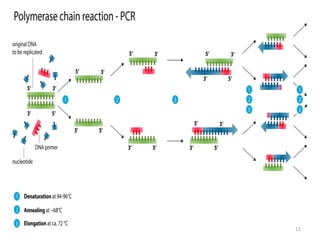
STEP INVOLVED:
6
7
8
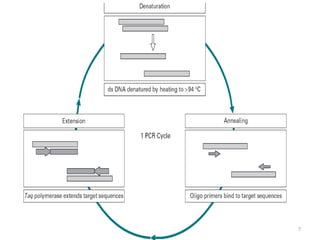
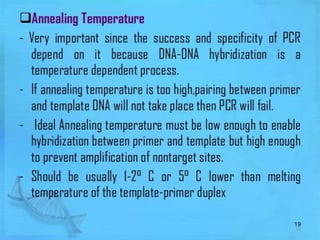
ANNEALING:
• The annealing step allows the hybridisation of
the two oligonucleotide primers, which are
present in excess, to bind to their
complementary sites that flank the target
DNA.
• The annealed oligonucleotides act as primers
for DNA synthesis, since they provide a free 3’
hydroxyl group for DNA polymerase.
• TEMPERATURE :45-60°C
9
10
11
Taq DNA polymerase
• The availability of a thermostable DNA
polymerase enzyme isolated from the
thermophilic bacterium Thermus aquaticus
found in hot springs provided the means to
automate the reaction.
 Taq DNA polymerase has a temperature
optimum of 72°C and survives prolonged
exposure to temperatures as high as 96°C and
so is still active after each of the denaturation
steps.
12
13
14
15
Types of PCR
16
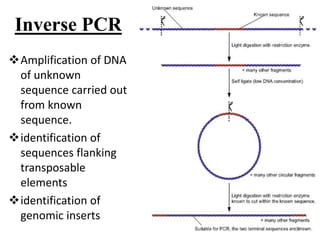
Inverse PCR
Amplification of DNA
of unknown
sequence carried out
from known
sequence.
identification of
sequences flanking
transposable
elements
identification of
genomic inserts
17
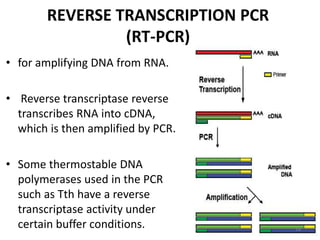
REVERSE TRANSCRIPTION PCR
(RT-PCR)
• for amplifying DNA from RNA.
• Reverse transcriptase reverse
transcribes RNA into cDNA,
which is then amplified by PCR.
• Some thermostable DNA
polymerases used in the PCR
such as Tth have a reverse
transcriptase activity under
certain buffer conditions. 18
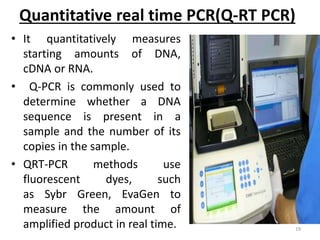
Quantitative real time PCR(Q-RT PCR)
• It quantitatively measures
starting amounts of DNA,
cDNA or RNA.
• Q-PCR is commonly used to
determine whether a DNA
sequence is present in a
sample and the number of its
copies in the sample.
• QRT-PCR methods use
fluorescent dyes, such
as Sybr Green, EvaGen to
measure the amount of
amplified product in real time. 19
20
21
THANK YOU 22

PCR-SlideShare

  • 1.
  • 2.
    What is PCR? •PCR targets and amplifies a specific region of a DNA strand. • It is an in-vitro technique to generate large quantities of a specified DNA. • PCR is ‘photocopier.’ 2
  • 3.
    HISTORY • Kary B.Mullis, developed PCR in 1985 and was awarded the Nobel Prize for Chemistry in 1993. • PCR machine =thermocycler 3
  • 4.
  • 5.
    REQUIREMENTS • DNA Template •Primers • Taq polymerase • Deoxynucleoside triphosphates(dNTPs) • Buffer solution • Divalent cations(eg.Mg2+) 5
  • 6.
  • 7.
  • 8.
  • 9.
    ANNEALING: • The annealingstep allows the hybridisation of the two oligonucleotide primers, which are present in excess, to bind to their complementary sites that flank the target DNA. • The annealed oligonucleotides act as primers for DNA synthesis, since they provide a free 3’ hydroxyl group for DNA polymerase. • TEMPERATURE :45-60°C 9
  • 10.
  • 11.
  • 12.
    Taq DNA polymerase •The availability of a thermostable DNA polymerase enzyme isolated from the thermophilic bacterium Thermus aquaticus found in hot springs provided the means to automate the reaction.  Taq DNA polymerase has a temperature optimum of 72°C and survives prolonged exposure to temperatures as high as 96°C and so is still active after each of the denaturation steps. 12
  • 13.
  • 14.
  • 15.
  • 16.
  • 17.
    Inverse PCR Amplification ofDNA of unknown sequence carried out from known sequence. identification of sequences flanking transposable elements identification of genomic inserts 17
  • 18.
    REVERSE TRANSCRIPTION PCR (RT-PCR) •for amplifying DNA from RNA. • Reverse transcriptase reverse transcribes RNA into cDNA, which is then amplified by PCR. • Some thermostable DNA polymerases used in the PCR such as Tth have a reverse transcriptase activity under certain buffer conditions. 18
  • 19.
    Quantitative real timePCR(Q-RT PCR) • It quantitatively measures starting amounts of DNA, cDNA or RNA. • Q-PCR is commonly used to determine whether a DNA sequence is present in a sample and the number of its copies in the sample. • QRT-PCR methods use fluorescent dyes, such as Sybr Green, EvaGen to measure the amount of amplified product in real time. 19
  • 20.
  • 21.
  • 22.