This document discusses different types of computers categorized by flexibility, efficiency, and working principle. There are general purpose computers designed to solve many problems and special purpose computers designed for restricted tasks. Supercomputers are the fastest and process huge data, while mainframes support many users simultaneously processing large volumes of data ideal for organizations. Microcomputers like PCs are for individual use. Digital computers process data as numbers while analogue computers process continuous data directly. Hybrid computers have features of both analogue and digital types.
Dr B TSampath Kumar
Professor
Department of Library and Information Science
Tumkur University, Tumakuru, INDIA
www.sampathkumar.info
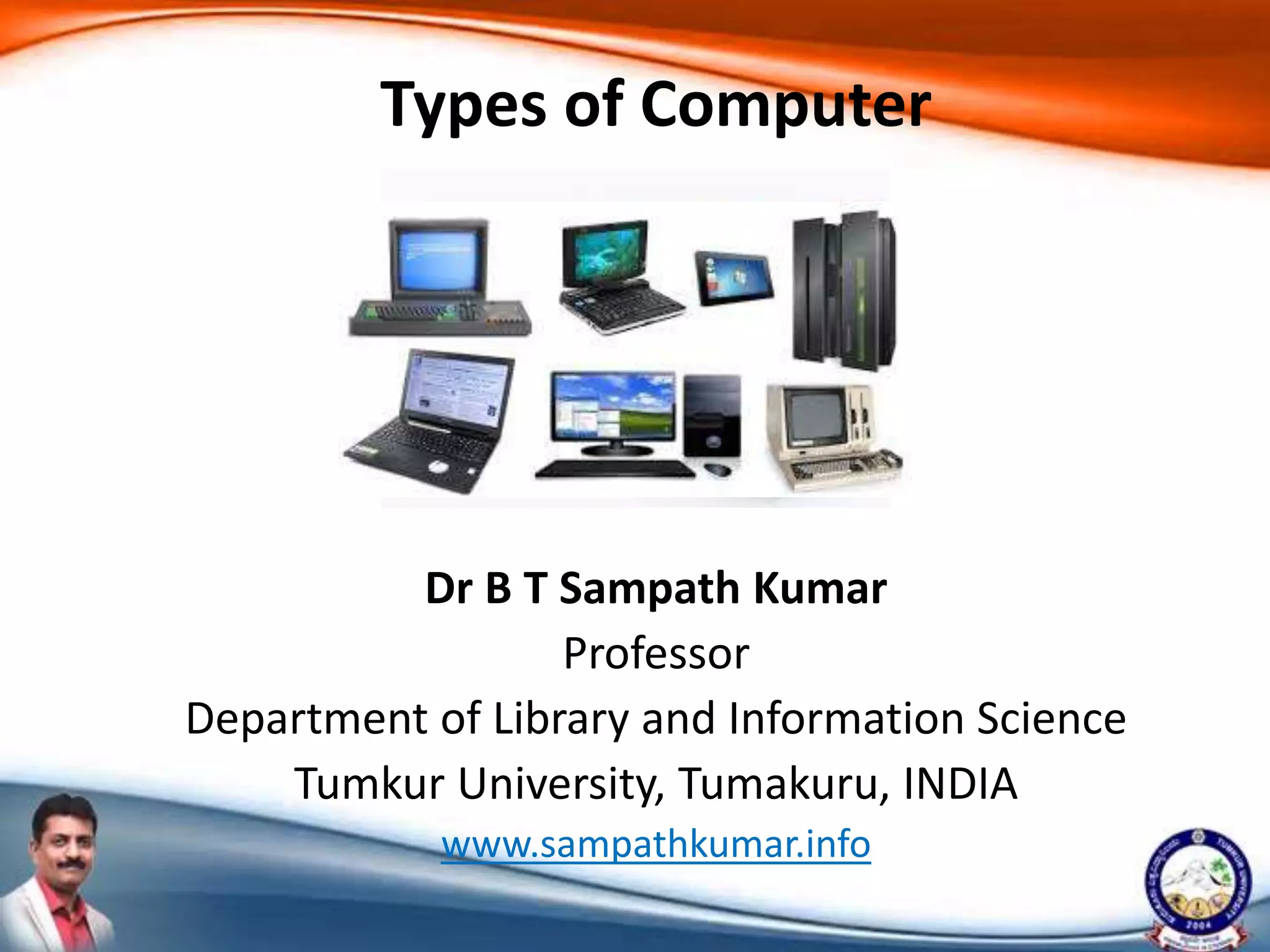
Types of Computer
2.
Types of computer
Computercan be categorized:
– Based on flexibility
– Based on efficiency
– Based on working principle
3.
Flexibility of operation
GeneralPurpose Computer
• General-purpose computers are designed to
solve a wide variety of problems.
• Computers used in Banks, libraries, hotels,
railways, educational institutes etc.,
4.
Cont..
Special Purpose Computers
•A special purpose computer is one that is
designed to solve a restricted class of
problems.
• Computers used in R&D organizations,
Satellite launching and Aircraft.
5.
Based on efficiency
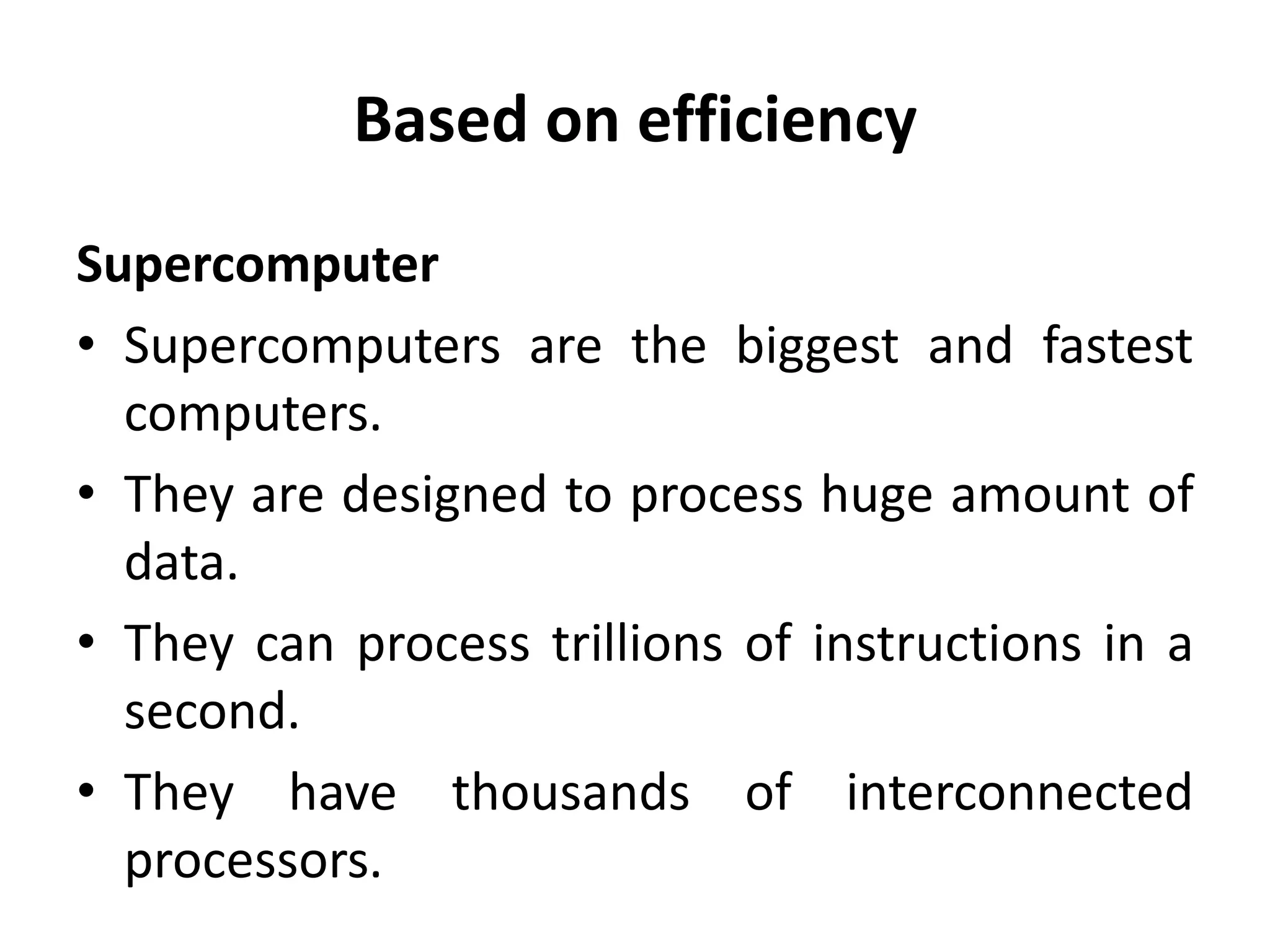
Supercomputer
•Supercomputers are the biggest and fastest
computers.
• They are designed to process huge amount of
data.
• They can process trillions of instructions in a
second.
• They have thousands of interconnected
processors.
6.
Cont..
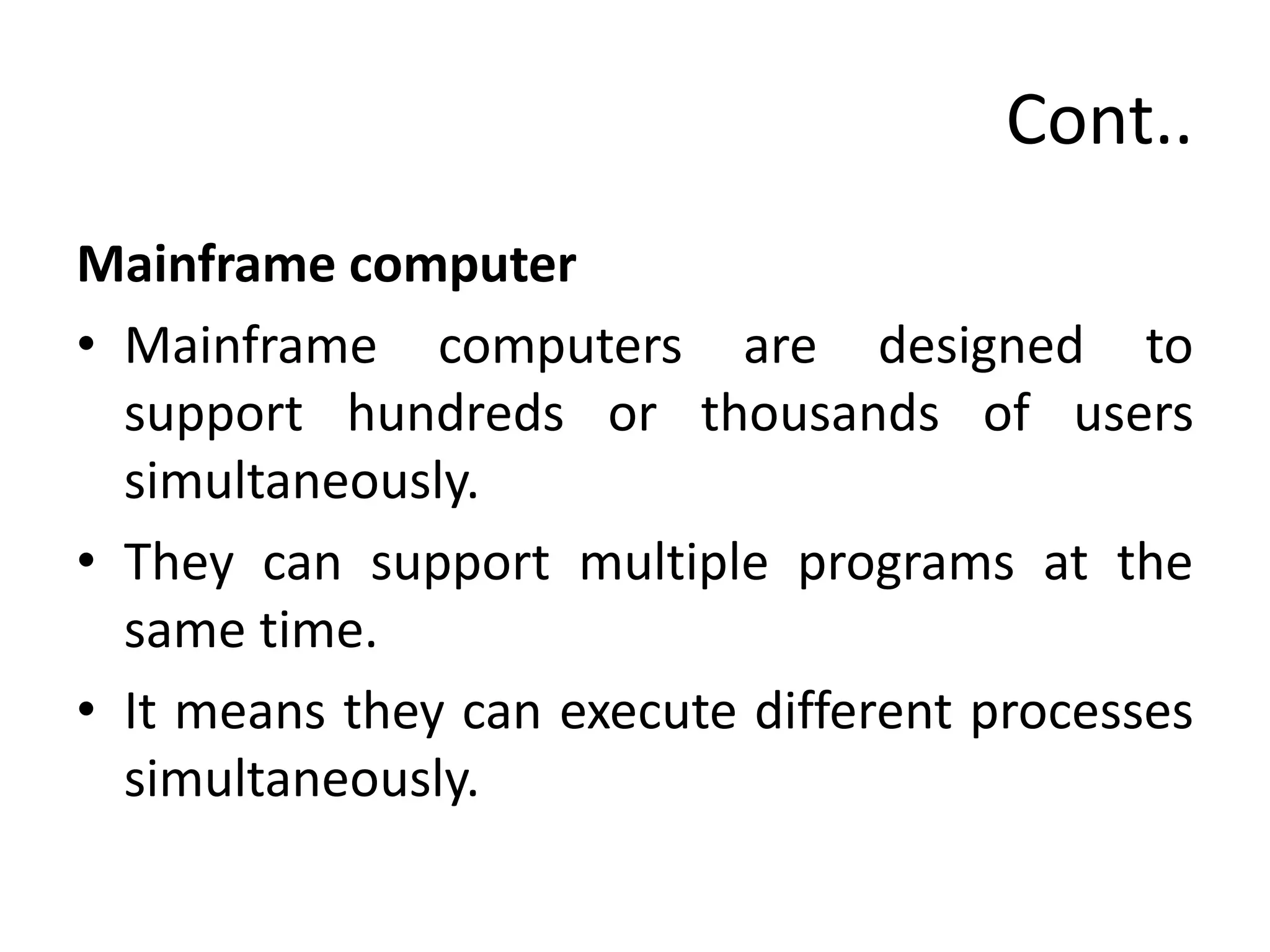
Mainframe computer
• Mainframecomputers are designed to
support hundreds or thousands of users
simultaneously.
• They can support multiple programs at the
same time.
• It means they can execute different processes
simultaneously.
7.
Cont..
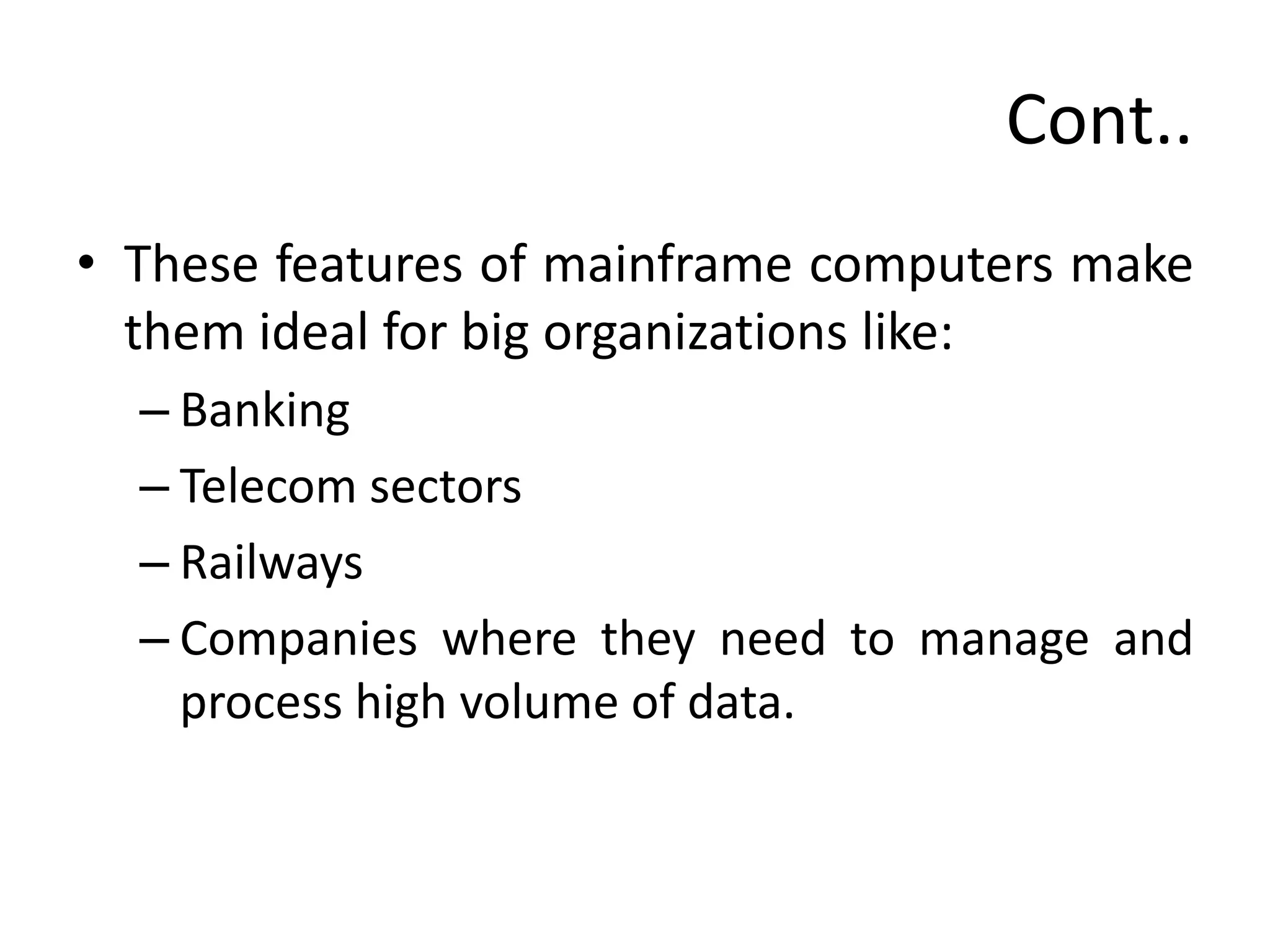
• These featuresof mainframe computers make
them ideal for big organizations like:
– Banking
– Telecom sectors
– Railways
– Companies where they need to manage and
process high volume of data.
8.
Cont..
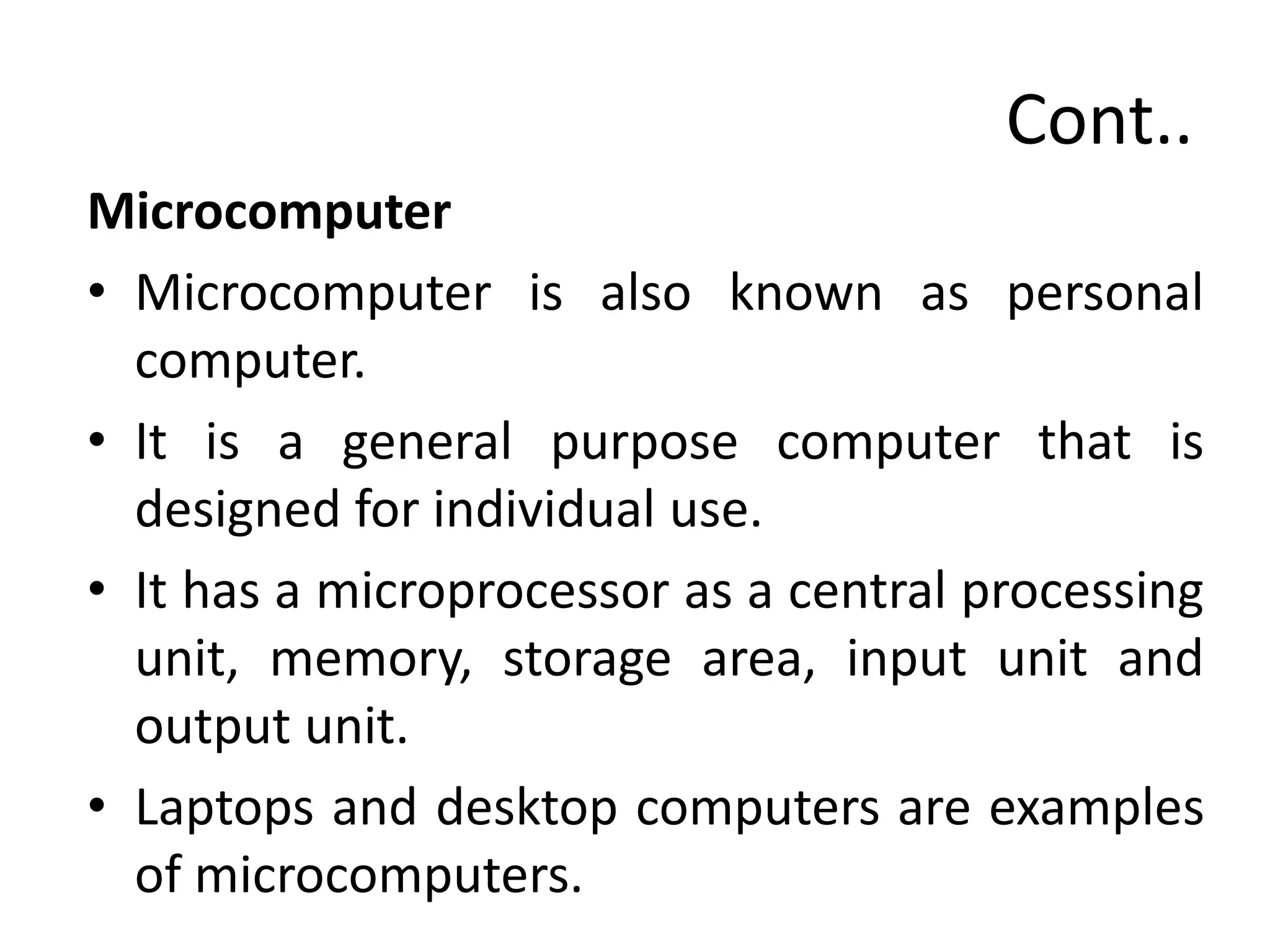
Microcomputer
• Microcomputer isalso known as personal
computer.
• It is a general purpose computer that is
designed for individual use.
• It has a microprocessor as a central processing
unit, memory, storage area, input unit and
output unit.
• Laptops and desktop computers are examples
of microcomputers.
9.
Cont..
Laptop
• These computersare portable computers and
they are easy to carry.
• As the size reduced, the term also changed to
laptop.
• The name was probably given because they
are used by keeping it on the laps while users
are on move
10.
Cont..
Notebook Computers
• Anotebook is an extremely lightweight
personal computer.
• Notebook computer typically weigh less than
six pounds
• It is small enough to fit easily in a briefcase.
11.
Based on workingprinciple
Analogue Computer
• Analogue computers are designed to process
the analogue data.
• Analogue data is continuous data that changes
continuously and cannot have discrete values
such as speed, temperature, pressure and
current
• Analogue computers directly accept the data
from the measuring device without first
converting it into numbers and codes.
12.
Cont..
Digital Computer
• Digitalcomputer is designed to perform
calculations and logical operations at high
speed.
• It accepts the raw data as digits or numbers
and processes it with programs stored in its
memory to produce output.
• All modern computers like laptops and
desktops that we use at home or office are
digital computers.
13.
Cont..
Hybrid Computer
• Hybridcomputer has features of both
analogue and digital computer.
• It is very fast like analogue computers and has
memory and accuracy like digital computers.
• It can process both continuous and discrete
data.
• So it is widely used in specialized applications
where both analogue and digital data is
processed.


![Types of computers[6999]](https://cdn.slidesharecdn.com/ss_thumbnails/typesofcomputers6999-201007141446-thumbnail.jpg?width=640&height=640&fit=bounds)


