Dr B T Sampath Kumar
Professor
Department of Library and Information Science
Tumkur University, Tumakuru, INDIA
www.sampathkumar.info
Network Protocols
Network protocol
• In telecommunication, a communication
protocol is a system of rules.
• It is a set of rules that governs the
communications between computers on a
network.
Types of protocol
The different types of network protocols are:
• HTTP/HTTPS
• FTP
• SMTP
• Ethernet
• TCP/IP
Hypertext Transfer Protocol (HTTP)
• HTTP is used for transmitting and displaying
information in the form of web pages on
browsers.
• This protocol defines how messages are
formatted and transmitted, and what actions
Web servers and browsers should take in
response to various commands.
Hypertext Transfer Protocol Secure
(HTTPS)
• The problem with the regular HTTP protocol is
that the information that flows from server to
browser is not encrypted, which means it can
be easily stolen.
• HTTPS is used for secure communication over
a computer network, and is widely used on the
Internet.
• In HTTPS, the communication protocol is
encrypted using Transport Layer Security (TLS).
File Transfer Protocol (FTP)
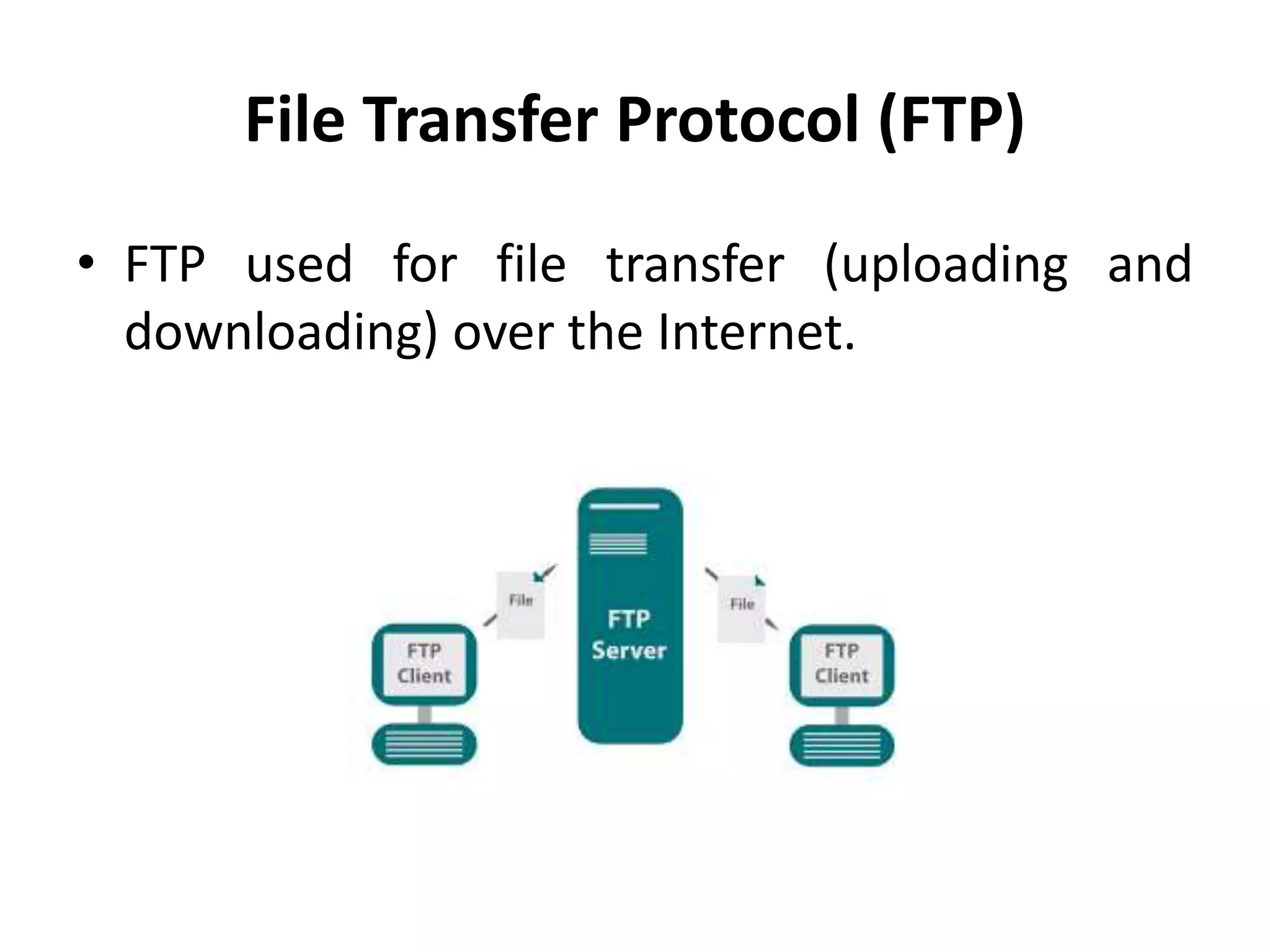
• FTP used for file transfer (uploading and
downloading) over the Internet.
Simple Mail Transfer Protocol (SMTP)
• Simple Mail Transfer Protocol is used in email.
• Ethernet is used for data transmission over a
LAN.
TCP/IP
• Transmission Control Protocol/IP, used for the
reliable transmission of data over a network.
• It is the basic communication language or
protocol of the Internet.
• It can also be used as a communication
protocol in a private network (either an
intranet or an extranet).

Network protocols

  • 1.
    Dr B TSampath Kumar Professor Department of Library and Information Science Tumkur University, Tumakuru, INDIA www.sampathkumar.info Network Protocols
  • 2.
    Network protocol • Intelecommunication, a communication protocol is a system of rules. • It is a set of rules that governs the communications between computers on a network.
  • 3.
    Types of protocol Thedifferent types of network protocols are: • HTTP/HTTPS • FTP • SMTP • Ethernet • TCP/IP
  • 4.
    Hypertext Transfer Protocol(HTTP) • HTTP is used for transmitting and displaying information in the form of web pages on browsers. • This protocol defines how messages are formatted and transmitted, and what actions Web servers and browsers should take in response to various commands.
  • 5.
    Hypertext Transfer ProtocolSecure (HTTPS) • The problem with the regular HTTP protocol is that the information that flows from server to browser is not encrypted, which means it can be easily stolen. • HTTPS is used for secure communication over a computer network, and is widely used on the Internet. • In HTTPS, the communication protocol is encrypted using Transport Layer Security (TLS).
  • 6.
    File Transfer Protocol(FTP) • FTP used for file transfer (uploading and downloading) over the Internet.
  • 7.
    Simple Mail TransferProtocol (SMTP) • Simple Mail Transfer Protocol is used in email. • Ethernet is used for data transmission over a LAN.
  • 8.
    TCP/IP • Transmission ControlProtocol/IP, used for the reliable transmission of data over a network. • It is the basic communication language or protocol of the Internet. • It can also be used as a communication protocol in a private network (either an intranet or an extranet).