Classification of computer
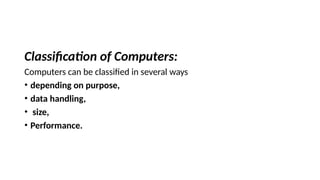
Classification of Computers:
Computers can be classified in several ways
• depending on purpose,
• data handling,
• size,
• Performance.
Based on Purpose Computers:
are divided into two major categories:
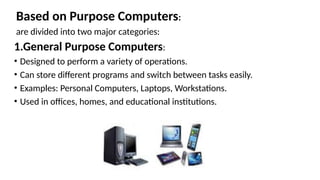
1.General Purpose Computers:
• Designed to perform a variety of operations.
• Can store different programs and switch between tasks easily.
• Examples: Personal Computers, Laptops, Workstations.
• Used in offices, homes, and educational institutions.
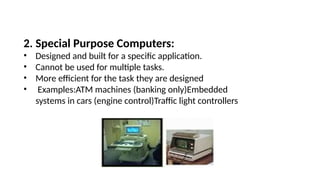
2. Special Purpose Computers:
• Designed and built for a specific application.
• Cannot be used for multiple tasks.
• More efficient for the task they are designed
• Examples:ATM machines (banking only)Embedded
systems in cars (engine control)Traffic light controllers
Based on Data Handling:
The way computers process and handle data
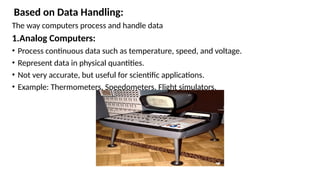
1.Analog Computers:
• Process continuous data such as temperature, speed, and voltage.
• Represent data in physical quantities.
• Not very accurate, but useful for scientific applications.
• Example: Thermometers, Speedometers, Flight simulators.
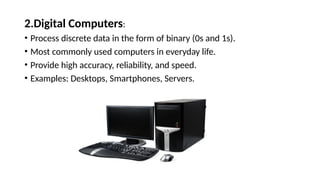
2.Digital Computers:
• Process discrete data in the form of binary (0s and 1s).
• Most commonly used computers in everyday life.
• Provide high accuracy, reliability, and speed.
• Examples: Desktops, Smartphones, Servers.
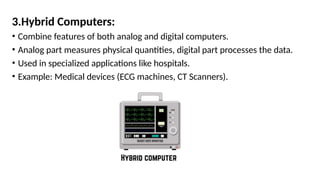
3.Hybrid Computers:
• Combine features of both analog and digital computers.
• Analog part measures physical quantities, digital part processes the data.
• Used in specialized applications like hospitals.
• Example: Medical devices (ECG machines, CT Scanners).
Based on Size and Performance Computers:
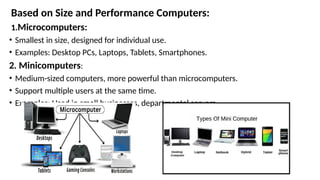
1.Microcomputers:
• Smallest in size, designed for individual use.
• Examples: Desktop PCs, Laptops, Tablets, Smartphones.
2. Minicomputers:
• Medium-sized computers, more powerful than microcomputers.
• Support multiple users at the same time.
• Examples: Used in small businesses, departmental servers.
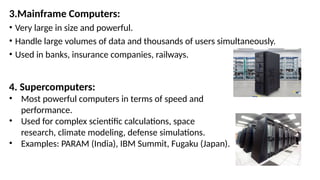
3.Mainframe Computers:
• Very large in size and powerful.
• Handle large volumes of data and thousands of users simultaneously.
• Used in banks, insurance companies, railways.
4. Supercomputers:
• Most powerful computers in terms of speed and
performance.
• Used for complex scientific calculations, space
research, climate modeling, defense simulations.
• Examples: PARAM (India), IBM Summit, Fugaku (Japan).
Classification of computer science and engineering

  • 1.
  • 2.
    Classification of Computers: Computerscan be classified in several ways • depending on purpose, • data handling, • size, • Performance.
  • 3.
    Based on PurposeComputers: are divided into two major categories: 1.General Purpose Computers: • Designed to perform a variety of operations. • Can store different programs and switch between tasks easily. • Examples: Personal Computers, Laptops, Workstations. • Used in offices, homes, and educational institutions.
  • 4.
    2. Special PurposeComputers: • Designed and built for a specific application. • Cannot be used for multiple tasks. • More efficient for the task they are designed • Examples:ATM machines (banking only)Embedded systems in cars (engine control)Traffic light controllers
  • 5.
    Based on DataHandling: The way computers process and handle data 1.Analog Computers: • Process continuous data such as temperature, speed, and voltage. • Represent data in physical quantities. • Not very accurate, but useful for scientific applications. • Example: Thermometers, Speedometers, Flight simulators.
  • 6.
    2.Digital Computers: • Processdiscrete data in the form of binary (0s and 1s). • Most commonly used computers in everyday life. • Provide high accuracy, reliability, and speed. • Examples: Desktops, Smartphones, Servers.
  • 7.
    3.Hybrid Computers: • Combinefeatures of both analog and digital computers. • Analog part measures physical quantities, digital part processes the data. • Used in specialized applications like hospitals. • Example: Medical devices (ECG machines, CT Scanners).
  • 8.
    Based on Sizeand Performance Computers: 1.Microcomputers: • Smallest in size, designed for individual use. • Examples: Desktop PCs, Laptops, Tablets, Smartphones. 2. Minicomputers: • Medium-sized computers, more powerful than microcomputers. • Support multiple users at the same time. • Examples: Used in small businesses, departmental servers.
  • 9.
    3.Mainframe Computers: • Verylarge in size and powerful. • Handle large volumes of data and thousands of users simultaneously. • Used in banks, insurance companies, railways. 4. Supercomputers: • Most powerful computers in terms of speed and performance. • Used for complex scientific calculations, space research, climate modeling, defense simulations. • Examples: PARAM (India), IBM Summit, Fugaku (Japan).