By
Muhammad Ikram
History of computer
Basic Information of computer
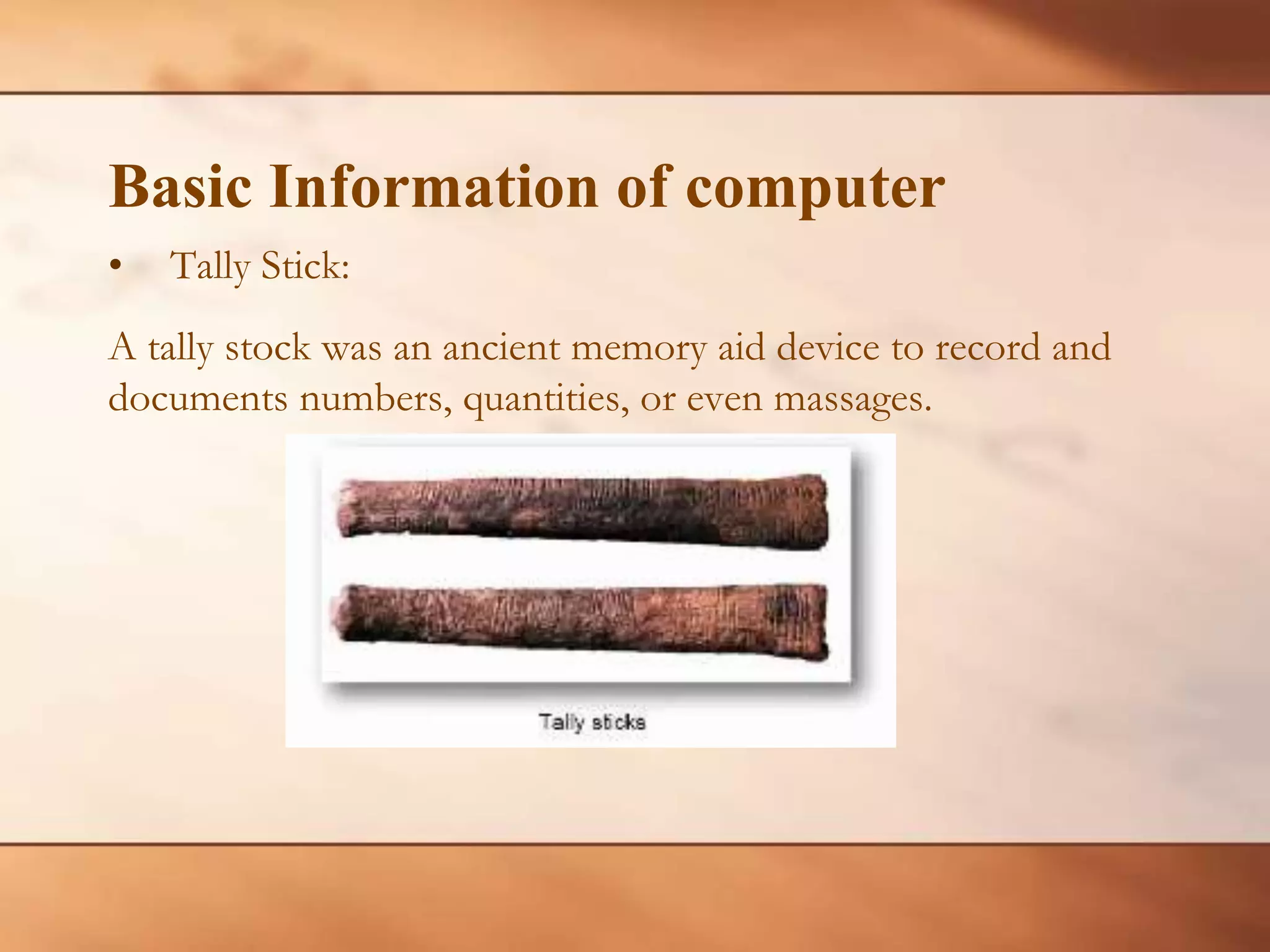
• Tally Stick:
A tally stock was an ancient memory aid device to record and
documents numbers, quantities, or even massages.
Abacus:
• An abacus is a mechanical device which is used to
calculation & numeric data.
• The was invented in(city) Babylonia
• It used to perform basic arithmetic operations.
• It was 1st calculation device in all world.
Old Image Of Abacus
New Image Of Abacus
Napier’s Bones:
• Invented by john Napier in 1614.
• Allow the operator to multiply, divide and calculate square and cube roots
by moving the rods around and placing them in specially constructed
boards.
Difference Engine & Analytical Engine
• It an automatic, mechanical calculator designed by Charles Babbage in
1822.
• It is 1st mechanical computer.
• In 1822 he had a working model to show off
• It was completely running with steamed.
• This computer will be completely controlled due to the program & will
be used.
• In 1833 he lost interest in it.
Analytical Engine:
• The Analytical Engine was a proposed mechanical general-purpose
computer designed by English mathematician and computer pioneer
Charles Babbage. It was first described in 1837 as the successor to
Babbage's difference engine, a design for a mechanical computer.
First Computer Programmer:
• In 1840, Augusta Ada Byron Suggests
to Babbage that he use the binary system.
• She write programs for the Analytical
• Engine. So she is known for first programmer.
• Daughter of Poet Lord Byron.
Computer Generations:
• There are five generations of computer.
• Let's discuss how the modern computer involved the generation after
generation.
• The computers that was developed the from 1942 to 1955 were called the
First generation of computer.
• The first generation computer used vacuum tube.
• Consist of Glass bulb and wire. The wire is used to carry data in the form
of electronic signal.
• The first Generation computers were large sizes.
• This vacuum used vacuum tube for computer calculation.
• Vacuum tube was very expensive due to the requirement of expertise
and skill. It was hot and burned.
• They had air-conditioned rooms to keep them. Because Vacuum tube
exhausted heat.
ENIAC UNIVAC-1
Second Generation of Computer:
• Transzers were used in the second generation.
• In 1947 Williom Shockley , Joan Bardrain & Williom Brittan invented
transzers.
• It requires less space. The size of 200 transistors was equal to a Vacuum
tube.
• It's cheaper than vacuum tube.
• Transzers works 40 times faster than a Vacuum Tube.
• It is not as hot as the Vacuum tube and does not break.
• It removes very little heat than the vacuum tube.
• Second Generation Computer has more complex calculations, logical
units, lower level and high level programming languages like, BASIC
,PASCAL COBOL & The assembly used to be used.
• There was also a system software with computer.
• Examples of second generation
Examples of Second Generation Computer include IBM 7094, IBM 1400 &
CDC 164 etc.
IBM 7094 IBM 1400
Image of Transzers
3rd Generation of Computer
• Integrated circuits (ICs) used for the computer's third generation.
• 1st ICs was invented & used in 1961.
• An IC is 1/4 square inches.
• A single-IC chip consists of thousands of transistors.
• In this way computer science became small-to-use, reliable and more
cheap and massively became popular in business magnetic core memory
used in these computers was used as internal storage
• Examples of 3rd generation
• Successful computers of this generation IBM system 360 , IBM 370
& UNIVAC 9000 Etc.
UNIVAC 9000 IBM system 360
Image of Integrated circuits
4th Generation of Computer
• The fourth generation used micro-processors for computers.
• Modern Micro Processors, usually there are less than a square inch and
millions of electronic circuits contain
• Today, many electrical appliances like wrist watches are used in cars and
vehicles.
• Micro processors have revolutionized the world of computer.
• Due to the micro processor, the speed of the contractor's speed and the
internal storage capacity increased and it sizes smaller.
• Examples of 4th generation
Apple Macintosh & IBM PC etc.
Apple Macintosh IBM PC
Image of micro-processors
5th Generation of Computer
• Artificial intelligence used in the fifth generation of computer
• Artificial intelligence is currently in progress
• Artificial intelligence makes revolution in computers fields.
• Now a days with the help of artificial intelligence people are
preparing a lot of robots.
• Artificial intelligence has made the world more fast.
• Artificial intelligence is currently in progress.
• The target of fifth generation computer is such development which works
according to natural gender input. those who have the ability to
remember and work
• Examples of 5th generation
• Every kind of robots
Army Robots
Doctor Robots
Pilate Robots
Working Robots
Thanks 4 Watching

History of computer

  • 1.
  • 2.
    Basic Information ofcomputer • Tally Stick: A tally stock was an ancient memory aid device to record and documents numbers, quantities, or even massages.
  • 3.
    Abacus: • An abacusis a mechanical device which is used to calculation & numeric data. • The was invented in(city) Babylonia • It used to perform basic arithmetic operations. • It was 1st calculation device in all world.
  • 4.
  • 5.
  • 6.
    Napier’s Bones: • Inventedby john Napier in 1614. • Allow the operator to multiply, divide and calculate square and cube roots by moving the rods around and placing them in specially constructed boards.
  • 7.
    Difference Engine &Analytical Engine • It an automatic, mechanical calculator designed by Charles Babbage in 1822. • It is 1st mechanical computer. • In 1822 he had a working model to show off • It was completely running with steamed. • This computer will be completely controlled due to the program & will be used. • In 1833 he lost interest in it.
  • 9.
    Analytical Engine: • TheAnalytical Engine was a proposed mechanical general-purpose computer designed by English mathematician and computer pioneer Charles Babbage. It was first described in 1837 as the successor to Babbage's difference engine, a design for a mechanical computer.
  • 10.
    First Computer Programmer: •In 1840, Augusta Ada Byron Suggests to Babbage that he use the binary system. • She write programs for the Analytical • Engine. So she is known for first programmer. • Daughter of Poet Lord Byron.
  • 11.
    Computer Generations: • Thereare five generations of computer. • Let's discuss how the modern computer involved the generation after generation. • The computers that was developed the from 1942 to 1955 were called the First generation of computer. • The first generation computer used vacuum tube. • Consist of Glass bulb and wire. The wire is used to carry data in the form of electronic signal. • The first Generation computers were large sizes. • This vacuum used vacuum tube for computer calculation.
  • 12.
    • Vacuum tubewas very expensive due to the requirement of expertise and skill. It was hot and burned. • They had air-conditioned rooms to keep them. Because Vacuum tube exhausted heat.
  • 14.
  • 16.
    Second Generation ofComputer: • Transzers were used in the second generation. • In 1947 Williom Shockley , Joan Bardrain & Williom Brittan invented transzers. • It requires less space. The size of 200 transistors was equal to a Vacuum tube. • It's cheaper than vacuum tube. • Transzers works 40 times faster than a Vacuum Tube. • It is not as hot as the Vacuum tube and does not break. • It removes very little heat than the vacuum tube.
  • 17.
    • Second GenerationComputer has more complex calculations, logical units, lower level and high level programming languages like, BASIC ,PASCAL COBOL & The assembly used to be used. • There was also a system software with computer. • Examples of second generation Examples of Second Generation Computer include IBM 7094, IBM 1400 & CDC 164 etc.
  • 18.
  • 19.
  • 20.
    3rd Generation ofComputer • Integrated circuits (ICs) used for the computer's third generation. • 1st ICs was invented & used in 1961. • An IC is 1/4 square inches. • A single-IC chip consists of thousands of transistors. • In this way computer science became small-to-use, reliable and more cheap and massively became popular in business magnetic core memory used in these computers was used as internal storage • Examples of 3rd generation • Successful computers of this generation IBM system 360 , IBM 370 & UNIVAC 9000 Etc.
  • 21.
    UNIVAC 9000 IBMsystem 360
  • 22.
  • 23.
    4th Generation ofComputer • The fourth generation used micro-processors for computers. • Modern Micro Processors, usually there are less than a square inch and millions of electronic circuits contain • Today, many electrical appliances like wrist watches are used in cars and vehicles. • Micro processors have revolutionized the world of computer. • Due to the micro processor, the speed of the contractor's speed and the internal storage capacity increased and it sizes smaller. • Examples of 4th generation Apple Macintosh & IBM PC etc.
  • 24.
  • 25.
  • 26.
    5th Generation ofComputer • Artificial intelligence used in the fifth generation of computer • Artificial intelligence is currently in progress • Artificial intelligence makes revolution in computers fields. • Now a days with the help of artificial intelligence people are preparing a lot of robots. • Artificial intelligence has made the world more fast. • Artificial intelligence is currently in progress.
  • 27.
    • The targetof fifth generation computer is such development which works according to natural gender input. those who have the ability to remember and work • Examples of 5th generation • Every kind of robots
  • 28.
  • 29.
  • 30.
  • 31.
  • 32.