TYPES OF COMPUTER
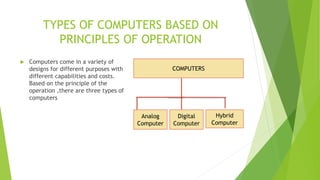
TYPES OF COMPUTERS BASED ON
PRINCIPLES OF OPERATION
 Computers come in a variety of
designs for different purposes with
different capabilities and costs.
Based on the principle of the
operation ,there are three types of
computers
COMPUTERS
Digital
Computer
Analog
Computer
Hybrid
Computer
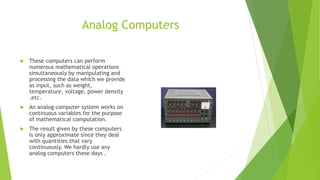
Analog Computers
 These computers can perform
numerous mathematical operations
simultaneously by manipulating and
processing the data which we provide
as input, such as weight,
temperature, voltage, power density
,etc.
 An analog computer system works on
continuous variables for the purpose
of mathematical computation.
 The result given by these computers
is only approximate since they deal
with quantities that vary
continuously. We hardly use any
analog computers these days .
Digital Computer
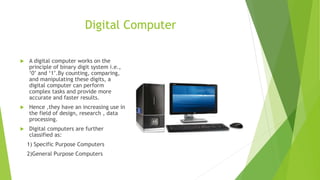
 A digital computer works on the
principle of binary digit system i.e.,
‘0’ and ‘1’.By counting, comparing,
and manipulating these digits, a
digital computer can perform
complex tasks and provide more
accurate and faster results.
 Hence ,they have an increasing use in
the field of design, research , data
processing.
 Digital computers are further
classified as:
1) Specific Purpose Computers
2)General Purpose Computers
Hybrid Computers
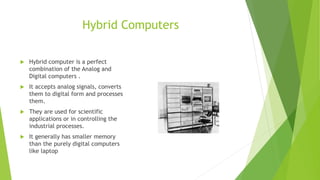
 Hybrid computer is a perfect
combination of the Analog and
Digital computers .
 It accepts analog signals, converts
them to digital form and processes
them.
 They are used for scientific
applications or in controlling the
industrial processes.
 It generally has smaller memory
than the purely digital computers
like laptop
Types Of Computer Based On
Configuration
 Apart from this general
categorization, computers can also
be differentiated on the basis of
their physical structures and their
use. Based on their capacity,
speed, and reliability, they can be
divided into the following
categories:
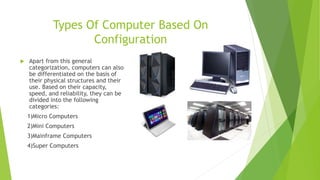
1)Micro Computers
2)Mini Computers
3)Mainframe Computers
4)Super Computers
Micro Computers
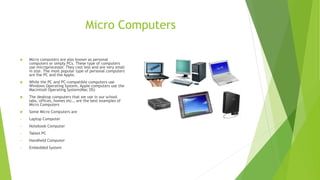
 Micro computers are also known as personal
computers or simply PCs. These type of computers
use microprocessor. They cost less and are very small
in size. The most popular type of personal computers
are the PC and the Apple.
 While the PC and PC-compatible computers use
Windows Operating System, Apple computers use the
Macintosh Operating System(Mac OS)
 The desktop computers that we use in our school
labs, offices, homes etc., are the best examples of
Micro Computers
 Some Micro Computers are
• Laptop Computer
• Notebook Computer
• Tablet PC
• Handheld Computer
• Embedded System
Laptop Computer
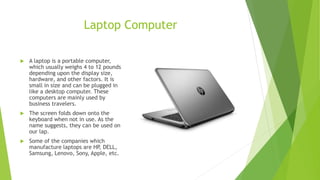
 A laptop is a portable computer,
which usually weighs 4 to 12 pounds
depending upon the display size,
hardware, and other factors. It is
small in size and can be plugged in
like a desktop computer. These
computers are mainly used by
business travelers.
 The screen folds down onto the
keyboard when not in use. As the
name suggests, they can be used on
our lap.
 Some of the companies which
manufacture laptops are HP, DELL,
Samsung, Lenovo, Sony, Apple, etc.
Notebook Computers
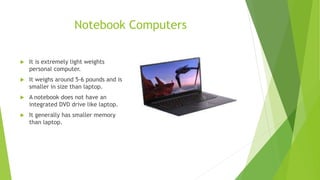
 It is extremely light weights
personal computer.
 It weighs around 5-6 pounds and is
smaller in size than laptop.
 A notebook does not have an
integrated DVD drive like laptop.
 It generally has smaller memory
than laptop.
Handheld Computer
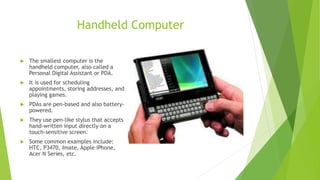
 The smallest computer is the
handheld computer, also called a
Personal Digital Assistant or PDA.
 It is used for scheduling
appointments, storing addresses, and
playing games.
 PDAs are pen-based and also battery-
powered.
 They use pen-like stylus that accepts
hand-written input directly on a
touch-sensitive screen.
 Some common examples include:
HTC, P3470, Imate, Apple iPhone,
Acer N Series, etc.
Embedded System
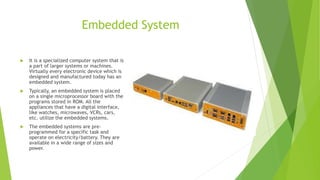
 It is a specialized computer system that is
a part of larger systems or machines.
Virtually every electronic device which is
designed and manufactured today has an
embedded system.
 Typically, an embedded system is placed
on a single microprocessor board with the
programs stored in ROM. All the
appliances that have a digital interface,
like watches, microwaves, VCRs, cars,
etc. utilize the embedded systems.
 The embedded systems are pre-
programmed for a specific task and
operate on electricity/battery. They are
available in a wide range of sizes and
power.
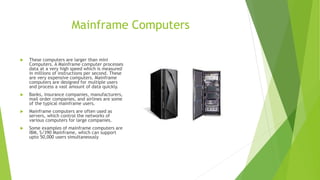
Mainframe Computers
 These computers are larger than mini
Computers. A Mainframe computer processes
data at a very high speed which is measured
in millions of instructions per second. These
are very expensive computers. Mainframe
computers are designed for multiple users
and process a vast amount of data quickly.
 Banks, insurance companies, manufacturers,
mail order companies, and airlines are some
of the typical mainframe users.
 Mainframe computers are often used as
servers, which control the networks of
various computers for large companies.
 Some examples of mainframe computers are
IBM, S/390 Mainframe, which can support
upto 50,000 users simultaneously
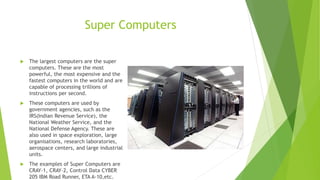
Super Computers
 The largest computers are the super
computers. These are the most
powerful, the most expensive and the
fastest computers in the world and are
capable of processing trillions of
instructions per second.
 These computers are used by
government agencies, such as the
IRS(Indian Revenue Service), the
National Weather Service, and the
National Defense Agency. These are
also used in space exploration, large
organisations, research laboratories,
aerospace centers, and large industrial
units.
 The examples of Super Computers are
CRAY-1, CRAY-2, Control Data CYBER
205 IBM Road Runner, ETA A-10,etc.
Made by-Kartik Chauhan
9D

Types of computer

  • 1.
  • 2.
    TYPES OF COMPUTERSBASED ON PRINCIPLES OF OPERATION  Computers come in a variety of designs for different purposes with different capabilities and costs. Based on the principle of the operation ,there are three types of computers COMPUTERS Digital Computer Analog Computer Hybrid Computer
  • 3.
    Analog Computers  Thesecomputers can perform numerous mathematical operations simultaneously by manipulating and processing the data which we provide as input, such as weight, temperature, voltage, power density ,etc.  An analog computer system works on continuous variables for the purpose of mathematical computation.  The result given by these computers is only approximate since they deal with quantities that vary continuously. We hardly use any analog computers these days .
  • 4.
    Digital Computer  Adigital computer works on the principle of binary digit system i.e., ‘0’ and ‘1’.By counting, comparing, and manipulating these digits, a digital computer can perform complex tasks and provide more accurate and faster results.  Hence ,they have an increasing use in the field of design, research , data processing.  Digital computers are further classified as: 1) Specific Purpose Computers 2)General Purpose Computers
  • 5.
    Hybrid Computers  Hybridcomputer is a perfect combination of the Analog and Digital computers .  It accepts analog signals, converts them to digital form and processes them.  They are used for scientific applications or in controlling the industrial processes.  It generally has smaller memory than the purely digital computers like laptop
  • 6.
    Types Of ComputerBased On Configuration  Apart from this general categorization, computers can also be differentiated on the basis of their physical structures and their use. Based on their capacity, speed, and reliability, they can be divided into the following categories: 1)Micro Computers 2)Mini Computers 3)Mainframe Computers 4)Super Computers
  • 7.
    Micro Computers  Microcomputers are also known as personal computers or simply PCs. These type of computers use microprocessor. They cost less and are very small in size. The most popular type of personal computers are the PC and the Apple.  While the PC and PC-compatible computers use Windows Operating System, Apple computers use the Macintosh Operating System(Mac OS)  The desktop computers that we use in our school labs, offices, homes etc., are the best examples of Micro Computers  Some Micro Computers are • Laptop Computer • Notebook Computer • Tablet PC • Handheld Computer • Embedded System
  • 8.
    Laptop Computer  Alaptop is a portable computer, which usually weighs 4 to 12 pounds depending upon the display size, hardware, and other factors. It is small in size and can be plugged in like a desktop computer. These computers are mainly used by business travelers.  The screen folds down onto the keyboard when not in use. As the name suggests, they can be used on our lap.  Some of the companies which manufacture laptops are HP, DELL, Samsung, Lenovo, Sony, Apple, etc.
  • 9.
    Notebook Computers  Itis extremely light weights personal computer.  It weighs around 5-6 pounds and is smaller in size than laptop.  A notebook does not have an integrated DVD drive like laptop.  It generally has smaller memory than laptop.
  • 10.
    Handheld Computer  Thesmallest computer is the handheld computer, also called a Personal Digital Assistant or PDA.  It is used for scheduling appointments, storing addresses, and playing games.  PDAs are pen-based and also battery- powered.  They use pen-like stylus that accepts hand-written input directly on a touch-sensitive screen.  Some common examples include: HTC, P3470, Imate, Apple iPhone, Acer N Series, etc.
  • 11.
    Embedded System  Itis a specialized computer system that is a part of larger systems or machines. Virtually every electronic device which is designed and manufactured today has an embedded system.  Typically, an embedded system is placed on a single microprocessor board with the programs stored in ROM. All the appliances that have a digital interface, like watches, microwaves, VCRs, cars, etc. utilize the embedded systems.  The embedded systems are pre- programmed for a specific task and operate on electricity/battery. They are available in a wide range of sizes and power.
  • 12.
    Mainframe Computers  Thesecomputers are larger than mini Computers. A Mainframe computer processes data at a very high speed which is measured in millions of instructions per second. These are very expensive computers. Mainframe computers are designed for multiple users and process a vast amount of data quickly.  Banks, insurance companies, manufacturers, mail order companies, and airlines are some of the typical mainframe users.  Mainframe computers are often used as servers, which control the networks of various computers for large companies.  Some examples of mainframe computers are IBM, S/390 Mainframe, which can support upto 50,000 users simultaneously
  • 13.
    Super Computers  Thelargest computers are the super computers. These are the most powerful, the most expensive and the fastest computers in the world and are capable of processing trillions of instructions per second.  These computers are used by government agencies, such as the IRS(Indian Revenue Service), the National Weather Service, and the National Defense Agency. These are also used in space exploration, large organisations, research laboratories, aerospace centers, and large industrial units.  The examples of Super Computers are CRAY-1, CRAY-2, Control Data CYBER 205 IBM Road Runner, ETA A-10,etc.
  • 14.