Dr B T Sampath Kumar
Professor
Department of Library and Information Science
Tumkur University, Tumakuru, INDIA
www.sampathkumar.info
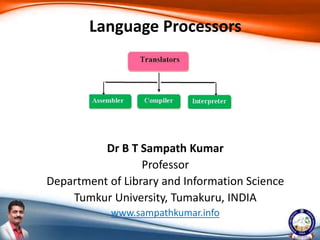
Language Processors
Language processors
• The language processor is a special translator
system used to turn a program written in a
Assembly/high-level language (source code)
into machine code (object program).
• There are three types of language processors:
– Assembler
– Interpreter
– Compiler
Programming language
• A programming language is a formal language,
which comprises a set of instructions that
produce various kinds of output.
• It is used in computer programming to
implement algorithms.
Types of programming languages
• There are two types of programming
languages, which can be categorized into the
following ways:
– Low level language
– High level language
Low level language
• This language is the most understandable
language used by computer to perform its
operations.
• It can be further categorized into:
– Machine Language
– Assembly language
Machine Language
• Machine language consists of strings of binary
numbers (i.e. 0s and 1s)
• It is the only one language, the processor
directly understands.
• Execution speed is very fast and primary
memory is efficiently used.
Cont..
Merits
• It is directly understood by the processor.
• The programs written in this language need
not to be translated.
• It doesn’t need larger memory.
Cont..
Demerits
• It is very difficult to program since all the
instructions are to be represented by 0s and
1s.
• Use of this language makes programming time
consuming.
• It is difficult to find error(s) and to debug.
• It can be used by experts only.
Assembly Language
• This language uses mnemonic codes (symbolic
operation code like ‘ADD’ for addition) in place
of 0s and 1s.
• The program is converted into machine code
by assembler. The resulting program is
referred to as an object code.
Cont..
Merits
• It makes programming easier than machine
language since it uses mnemonic codes for
programming:
– ADD for addition, SUB for subtraction, DIV for division, etc.
• It makes programming process faster.
• Error(s) can be identified much easily
compared to machine language.
• It is easier to debug than machine language.
Cont..
Demerits
• Programs written in this language are not
directly understandable by computer so
translators should be used.
• Being machine dependent language, programs
written in this language are very less or not
portable.
• Programmers must know its mnemonic codes
to perform any task.
Assembler
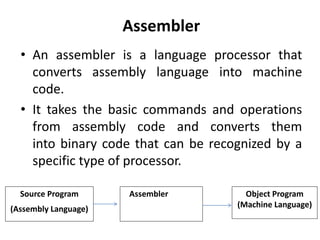
• An assembler is a language processor that
converts assembly language into machine
code.
• It takes the basic commands and operations
from assembly code and converts them
into binary code that can be recognized by a
specific type of processor.
Source Program
(Assembly Language)
Assembler Object Program
(Machine Language)
High level language
• Instructions of this language closely resembles
to human language or English like words.
• It uses mathematical notations to perform the
task.
• The high level language is easier to learn.
• It requires less time to write and is easier to
identify and remove the error(s).
Cont..
• The high level language is converted into
machine language by one of the two different
language translator programs:
– Interpreter or
– Compiler.
Cont..
Merits
• Because of their flexibility, procedural
languages are able to solve a variety of
problems.
• Programmer does not need to think in term of
computer architecture which makes them
focused on the problem.
• Programs written in this language are
portable.
Cont..
Demerits
• It is easier but needs higher processor and
larger memory.
• It needs to be translated using Compiler or
Interpreter therefore its execution time is
more.
Compiler
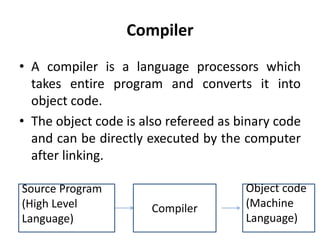
• A compiler is a language processors which
takes entire program and converts it into
object code.
• The object code is also refereed as binary code
and can be directly executed by the computer
after linking.
Source Program
(High Level
Language)
Compiler
Object code
(Machine
Language)
Interpreter
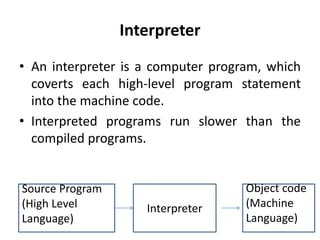
• An interpreter is a computer program, which
coverts each high-level program statement
into the machine code.
• Interpreted programs run slower than the
compiled programs.
Source Program
(High Level
Language)
Interpreter
Object code
(Machine
Language)

Language processors

  • 1.
    Dr B TSampath Kumar Professor Department of Library and Information Science Tumkur University, Tumakuru, INDIA www.sampathkumar.info Language Processors
  • 2.
    Language processors • Thelanguage processor is a special translator system used to turn a program written in a Assembly/high-level language (source code) into machine code (object program). • There are three types of language processors: – Assembler – Interpreter – Compiler
  • 3.
    Programming language • Aprogramming language is a formal language, which comprises a set of instructions that produce various kinds of output. • It is used in computer programming to implement algorithms.
  • 4.
    Types of programminglanguages • There are two types of programming languages, which can be categorized into the following ways: – Low level language – High level language
  • 5.
    Low level language •This language is the most understandable language used by computer to perform its operations. • It can be further categorized into: – Machine Language – Assembly language
  • 6.
    Machine Language • Machinelanguage consists of strings of binary numbers (i.e. 0s and 1s) • It is the only one language, the processor directly understands. • Execution speed is very fast and primary memory is efficiently used.
  • 7.
    Cont.. Merits • It isdirectly understood by the processor. • The programs written in this language need not to be translated. • It doesn’t need larger memory.
  • 8.
    Cont.. Demerits • It isvery difficult to program since all the instructions are to be represented by 0s and 1s. • Use of this language makes programming time consuming. • It is difficult to find error(s) and to debug. • It can be used by experts only.
  • 9.
    Assembly Language • Thislanguage uses mnemonic codes (symbolic operation code like ‘ADD’ for addition) in place of 0s and 1s. • The program is converted into machine code by assembler. The resulting program is referred to as an object code.
  • 10.
    Cont.. Merits • It makesprogramming easier than machine language since it uses mnemonic codes for programming: – ADD for addition, SUB for subtraction, DIV for division, etc. • It makes programming process faster. • Error(s) can be identified much easily compared to machine language. • It is easier to debug than machine language.
  • 11.
    Cont.. Demerits • Programs writtenin this language are not directly understandable by computer so translators should be used. • Being machine dependent language, programs written in this language are very less or not portable. • Programmers must know its mnemonic codes to perform any task.
  • 12.
    Assembler • An assembleris a language processor that converts assembly language into machine code. • It takes the basic commands and operations from assembly code and converts them into binary code that can be recognized by a specific type of processor. Source Program (Assembly Language) Assembler Object Program (Machine Language)
  • 13.
    High level language •Instructions of this language closely resembles to human language or English like words. • It uses mathematical notations to perform the task. • The high level language is easier to learn. • It requires less time to write and is easier to identify and remove the error(s).
  • 14.
    Cont.. • The highlevel language is converted into machine language by one of the two different language translator programs: – Interpreter or – Compiler.
  • 15.
    Cont.. Merits • Because oftheir flexibility, procedural languages are able to solve a variety of problems. • Programmer does not need to think in term of computer architecture which makes them focused on the problem. • Programs written in this language are portable.
  • 16.
    Cont.. Demerits • It iseasier but needs higher processor and larger memory. • It needs to be translated using Compiler or Interpreter therefore its execution time is more.
  • 17.
    Compiler • A compileris a language processors which takes entire program and converts it into object code. • The object code is also refereed as binary code and can be directly executed by the computer after linking. Source Program (High Level Language) Compiler Object code (Machine Language)
  • 18.
    Interpreter • An interpreteris a computer program, which coverts each high-level program statement into the machine code. • Interpreted programs run slower than the compiled programs. Source Program (High Level Language) Interpreter Object code (Machine Language)