It is a formal mechanism for displaying views
of a picture on an output device. A graphics
package allows the user to specify
a) Which part of the defined picture is to be
     displayed.
b) Where the part is to be placed on the
     display device.
Much like what we see in real life through a
small window or the view finder of a camera.
Objects are placed into the scene by modeling
   transformation to a master coordinate
   system, referred to as world coordinate
   system (WCS).
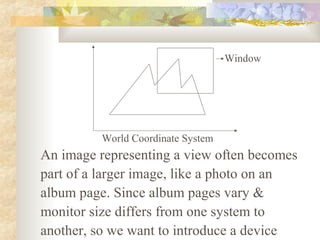
A WCS area selected for display is called
   window. The window defines what is to be
   viewed. Window is a rectangle finite
   region whose edges are parallel to the
   WCS.
Sometimes an additional coordinate system
called a viewing coordinate system is
introduced to show the effect of moving view.
Window


          World Coordinate System
An image representing a view often becomes
part of a larger image, like a photo on an
album page. Since album pages vary &
monitor size differs from one system to
another, so we want to introduce a device
independent tool to describe the display area,
called normalized device coordinate system
(NDCS) in which virtual display device’s area
is (1 x 1)square & lower left corner is at
    origin
(0,0) of the coordinate system.
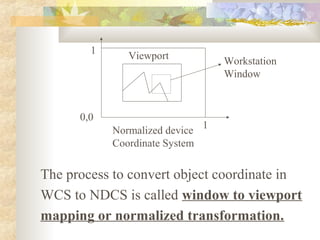
The area on a display device to which a
    window is mapped is called a viewport.
    The viewport defines where the view is to
    be displayed. The rectangle viewport with
    its edges parallel to the axes of the NDCS
1      Viewport           Workstation
                                  Window


      0,0
            Normalized device 1
            Coordinate System


The process to convert object coordinate in
WCS to NDCS is called window to viewport
mapping or normalized transformation.
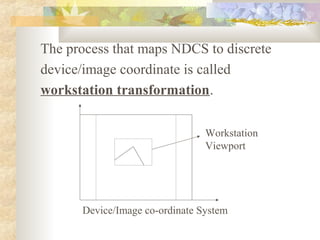
The process that maps NDCS to discrete
device/image coordinate is called
workstation transformation.

                                Workstation
                                Viewport


      Device/Image co-ordinate System
Which is a 2nd window to viewport mapping
with a workstation window in NDCS &
workstation viewport in device coordinate
system. These two coordinate mapping
Opn. refers to as viewing transformation.
Window to Viewport Transformation
Once object description have been transferred
  to the viewing reference frame, we choose
  the window extents in viewing coordinate
  & select the viewport limit in normalized
  coordinates. Object description are then
  transferred to normalized device coordinate
This can be done by using the transformation
  that maintain the same relative placement
  of object in normalized space as they had
  in viewing coordinates.
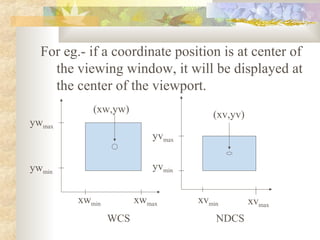
For eg.- if a coordinate position is at center of
    the viewing window, it will be displayed at
    the center of the viewport.
            (xw,yw)                  (xv,yv)
ywmax
                          yvmax


ywmin                     yvmin


         xwmin         xwmax      xvmin        xvmax
                 WCS                  NDCS
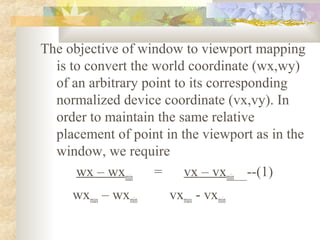
The objective of window to viewport mapping
  is to convert the world coordinate (wx,wy)
  of an arbitrary point to its corresponding
  normalized device coordinate (vx,vy). In
  order to maintain the same relative
  placement of point in the viewport as in the
  window, we require
      wx – wxmin    =     vx – vxmin --(1)
     wxmax – wxmin    vxmax - vxmin
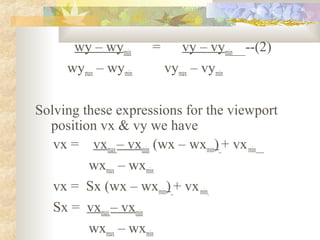
wy – wymin     =      vy – vymin --(2)
     wymax – wymin       vymax – vymin

Solving these expressions for the viewport
  position vx & vy we have
   vx = vxmax – vxmin (wx – wxmin) + vx min
         wxmax – wxmin
   vx = Sx (wx – wxmin) + vx min
   Sx = vxmax – vxmin
         wxmax – wxmin
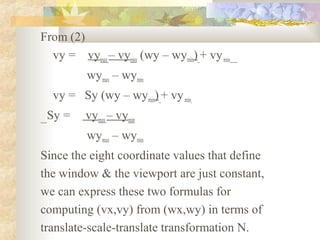
From (2)
  vy = vymax – vymin (wy – wymin) + vy min
          wymax – wymin
  vy = Sy (wy – wymin) + vy min
 Sy =     vymax – vymin
          wymax – wymin
Since the eight coordinate values that define
the window & the viewport are just constant,
we can express these two formulas for
computing (vx,vy) from (wx,wy) in terms of
translate-scale-translate transformation N.
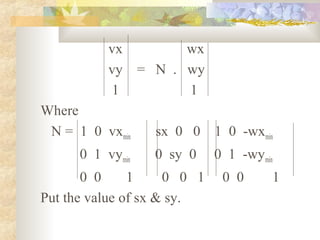
vx           wx
           vy     = N . wy
            1           1
Where
 N = 1 0 vxmin      sx 0 0   1 0 -wxmin
      0 1 vymin     0 sy 0   0 1 -wymin
       0 0     1     0 0 1    0 0     1
Put the value of sx & sy.
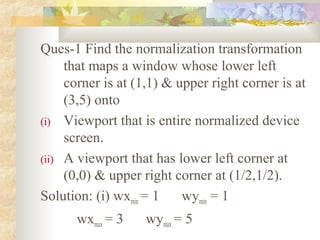
Ques-1 Find the normalization transformation
     that maps a window whose lower left
     corner is at (1,1) & upper right corner is at
     (3,5) onto
(i) Viewport that is entire normalized device
     screen.
(ii) A viewport that has lower left corner at
     (0,0) & upper right corner at (1/2,1/2).
Solution: (i) wxmin = 1    wymin = 1
      wxmax = 3    wymax = 5
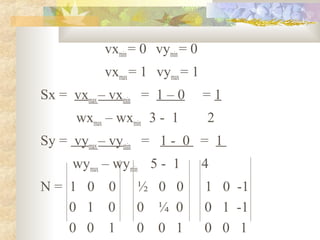
vxmin = 0 vymin = 0
           vxmax = 1 vymax = 1
Sx = vxmax – vxmin = 1 – 0       =1
      wxmax – wxmin 3 - 1        2
Sy = vymax – vymin = 1 - 0 = 1
     wymax – wymin 5 - 1         4
N= 1 0 0         ½ 0 0           1 0 -1
   0 1 0         0 ÂĽ 0           0 1 -1
   0 0 1         0 0 1           0 0 1
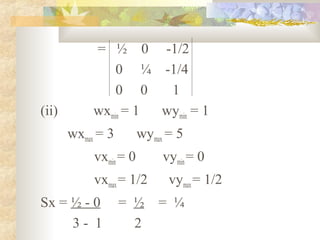
= ½ 0 -1/2
                0 ÂĽ -1/4
                0 0    1
(ii)        wxmin = 1 wymin = 1
       wxmax = 3        wymax = 5
            vxmin = 0        vymin = 0
            vxmax = 1/2       vymax = 1/2
Sx = ½ - 0         = ½      = ¼
     3- 1            2
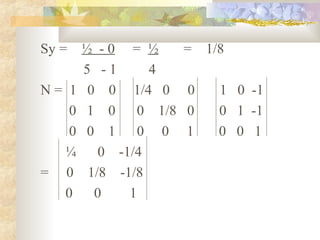
Sy =  ½ -0 = ½        =   1/8
      5 -1     4
N = 1 0 0 1/4 0       0     1 0 -1
    0 1 0     0 1/8   0     0 1 -1
    0 0 1     0 0     1     0 0 1
   ÂĽ    0 -1/4
= 0 1/8 -1/8
   0   0    1
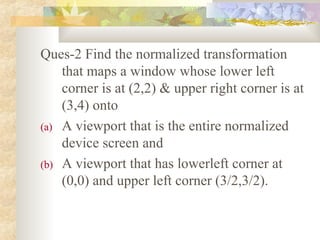
Ques-2 Find the normalized transformation
    that maps a window whose lower left
    corner is at (2,2) & upper right corner is at
    (3,4) onto
(a) A viewport that is the entire normalized
    device screen and
(b) A viewport that has lowerleft corner at
    (0,0) and upper left corner (3/2,3/2).

Two dimensional viewing

  • 1.
    It is aformal mechanism for displaying views of a picture on an output device. A graphics package allows the user to specify a) Which part of the defined picture is to be displayed. b) Where the part is to be placed on the display device. Much like what we see in real life through a small window or the view finder of a camera.
  • 2.
    Objects are placedinto the scene by modeling transformation to a master coordinate system, referred to as world coordinate system (WCS). A WCS area selected for display is called window. The window defines what is to be viewed. Window is a rectangle finite region whose edges are parallel to the WCS. Sometimes an additional coordinate system called a viewing coordinate system is introduced to show the effect of moving view.
  • 3.
    Window World Coordinate System An image representing a view often becomes part of a larger image, like a photo on an album page. Since album pages vary & monitor size differs from one system to another, so we want to introduce a device
  • 4.
    independent tool todescribe the display area, called normalized device coordinate system (NDCS) in which virtual display device’s area is (1 x 1)square & lower left corner is at origin (0,0) of the coordinate system. The area on a display device to which a window is mapped is called a viewport. The viewport defines where the view is to be displayed. The rectangle viewport with its edges parallel to the axes of the NDCS
  • 5.
    1 Viewport Workstation Window 0,0 Normalized device 1 Coordinate System The process to convert object coordinate in WCS to NDCS is called window to viewport mapping or normalized transformation.
  • 6.
    The process thatmaps NDCS to discrete device/image coordinate is called workstation transformation. Workstation Viewport Device/Image co-ordinate System
  • 7.
    Which is a2nd window to viewport mapping with a workstation window in NDCS & workstation viewport in device coordinate system. These two coordinate mapping Opn. refers to as viewing transformation.
  • 8.
    Window to ViewportTransformation Once object description have been transferred to the viewing reference frame, we choose the window extents in viewing coordinate & select the viewport limit in normalized coordinates. Object description are then transferred to normalized device coordinate This can be done by using the transformation that maintain the same relative placement of object in normalized space as they had in viewing coordinates.
  • 9.
    For eg.- ifa coordinate position is at center of the viewing window, it will be displayed at the center of the viewport. (xw,yw) (xv,yv) ywmax yvmax ywmin yvmin xwmin xwmax xvmin xvmax WCS NDCS
  • 10.
    The objective ofwindow to viewport mapping is to convert the world coordinate (wx,wy) of an arbitrary point to its corresponding normalized device coordinate (vx,vy). In order to maintain the same relative placement of point in the viewport as in the window, we require wx – wxmin = vx – vxmin --(1) wxmax – wxmin vxmax - vxmin
  • 11.
    wy – wymin = vy – vymin --(2) wymax – wymin vymax – vymin Solving these expressions for the viewport position vx & vy we have vx = vxmax – vxmin (wx – wxmin) + vx min wxmax – wxmin vx = Sx (wx – wxmin) + vx min Sx = vxmax – vxmin wxmax – wxmin
  • 12.
    From (2) vy = vymax – vymin (wy – wymin) + vy min wymax – wymin vy = Sy (wy – wymin) + vy min Sy = vymax – vymin wymax – wymin Since the eight coordinate values that define the window & the viewport are just constant, we can express these two formulas for computing (vx,vy) from (wx,wy) in terms of translate-scale-translate transformation N.
  • 13.
    vx wx vy = N . wy 1 1 Where N = 1 0 vxmin sx 0 0 1 0 -wxmin 0 1 vymin 0 sy 0 0 1 -wymin 0 0 1 0 0 1 0 0 1 Put the value of sx & sy.
  • 14.
    Ques-1 Find thenormalization transformation that maps a window whose lower left corner is at (1,1) & upper right corner is at (3,5) onto (i) Viewport that is entire normalized device screen. (ii) A viewport that has lower left corner at (0,0) & upper right corner at (1/2,1/2). Solution: (i) wxmin = 1 wymin = 1 wxmax = 3 wymax = 5
  • 15.
    vxmin = 0vymin = 0 vxmax = 1 vymax = 1 Sx = vxmax – vxmin = 1 – 0 =1 wxmax – wxmin 3 - 1 2 Sy = vymax – vymin = 1 - 0 = 1 wymax – wymin 5 - 1 4 N= 1 0 0 ½ 0 0 1 0 -1 0 1 0 0 ¼ 0 0 1 -1 0 0 1 0 0 1 0 0 1
  • 16.
    = ½ 0-1/2 0 ¼ -1/4 0 0 1 (ii) wxmin = 1 wymin = 1 wxmax = 3 wymax = 5 vxmin = 0 vymin = 0 vxmax = 1/2 vymax = 1/2 Sx = ½ - 0 = ½ = ¼ 3- 1 2
  • 17.
    Sy = ½ -0 = ½ = 1/8 5 -1 4 N = 1 0 0 1/4 0 0 1 0 -1 0 1 0 0 1/8 0 0 1 -1 0 0 1 0 0 1 0 0 1 ¼ 0 -1/4 = 0 1/8 -1/8 0 0 1
  • 18.
    Ques-2 Find thenormalized transformation that maps a window whose lower left corner is at (2,2) & upper right corner is at (3,4) onto (a) A viewport that is the entire normalized device screen and (b) A viewport that has lowerleft corner at (0,0) and upper left corner (3/2,3/2).