1
1 of 45 Tunnelling Grad Class (2015) Dr. Erik Eberhardt
EOSC 547:
Tunnelling &
Underground Design
Topic 7:
Brittle Fracture &
Stress-Controlled Failure
2 of 45 Tunnelling Grad Class (2015) Dr. Erik Eberhardt
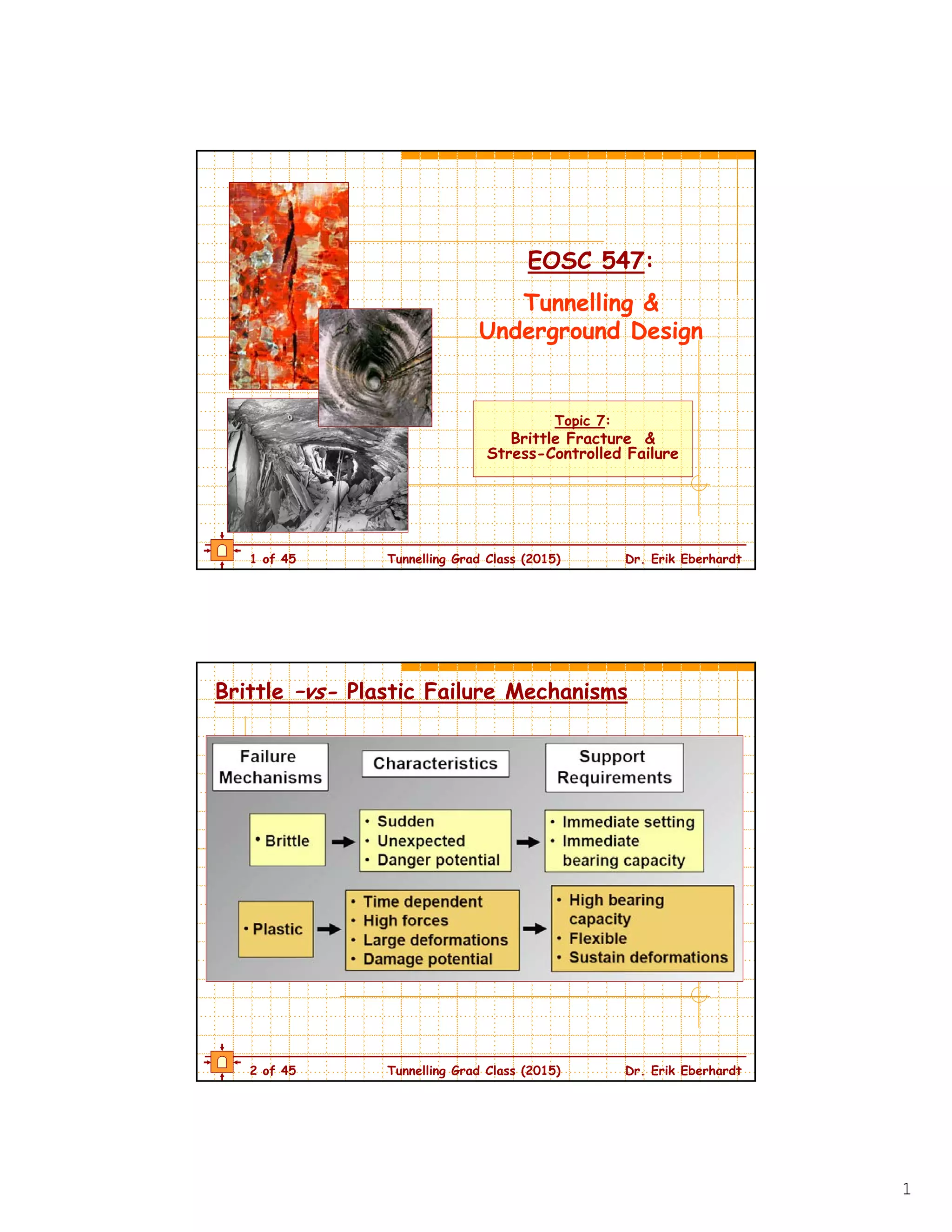
Brittle –vs- Plastic Failure Mechanisms
2
3 of 45 Tunnelling Grad Class (2015) Dr. Erik Eberhardt
Spalling and Rockburst in Tunnelling
Kaiser et al. (2000)
4 of 45 Tunnelling Grad Class (2015) Dr. Erik Eberhardt
Orientation of 1 & Induced Stresses
1
destressing
stress
concentration
1
destressing
stress
concentration
Potential Ground Control Issues:
Destressing = wedge failures
Concentration = spalling
Stresses can be visualized as flowing around the excavation periphery in the
direction of the major principle stress (1). Where they diverge, relaxation
occurs; where they converge, stress increases occur.
3
5 of 45 Tunnelling Grad Class (2015) Dr. Erik Eberhardt
Stress Driven Spalling
6 of 45 Tunnelling Grad Class (2015) Dr. Erik Eberhardt
Stress Driven Spalling in Tunnelling - Issues
Falling slabs of rock a hazard
to workers.
Problem for TBM as gripper pads cannot
be seated on the side wall.
4
7 of 45 Tunnelling Grad Class (2015) Dr. Erik Eberhardt
Stress Driven Spalling and Popping
8 of 45 Tunnelling Grad Class (2015) Dr. Erik Eberhardt
Rockbursting
5
9 of 45 Tunnelling Grad Class (2015) Dr. Erik Eberhardt
Rockbursting – Strainbursts
Rockburst: A sudden and violent failure of rock where rock
fragments are ejected into the excavation. Energy is released as
seismic energy radiated in the form of strain waves.
Strainburst: A self-initiated rockburst that develops due to a disequilibrium
between high stresses and rock strength (i.e. dynamic unstable fracturing).
Usually occurs after blasting, as
face is unable to adjust to the
immediately stress increase
Immediate unloading of confinement
from a triaxial to uniaxial stress
condition, stored energy released as
seismic energy
Commonly occurs when drifting
through contact between a brittle
and relative soft rock (i.e. highly
dependent on local mine rock
stiffness)
10 of 45 Tunnelling Grad Class (2015) Dr. Erik Eberhardt
Rockbursting – Slip Bursts
Slip burst: Slip bursts are characterized as a stick-slip shear movement
on a discontinuity. These bursts are less likely to be triggered by a
particular blast, and more likely to occur afterwards. Slip occurs when
the ratio of shear to normal (effective) stress along the fault plane
reaches a critical value (its shear strength).
Slip bursts at the Lucky Friday Mine.
Similar to mechanics of an earthquake
Fault slip typically intersects the mine
openings
In most cases, mining activity causes
slip by removing normal stress,
although some local intensification of
shear stress may also occur
Changes in stress along a fault are
often linked to mine activities by
time-dependent deformation
processes. These time-dependent
processes can act over long periods of
time, regardless of continued mining
Whyatt et al. (1997)
6
11 of 45 Tunnelling Grad Class (2015) Dr. Erik Eberhardt
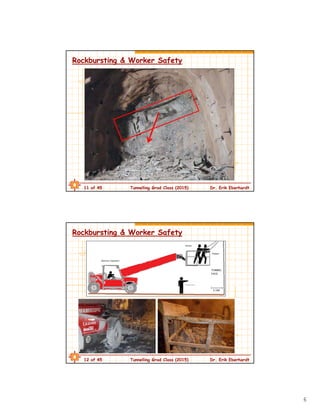
Rockbursting & Worker Safety
12 of 45 Tunnelling Grad Class (2015) Dr. Erik Eberhardt
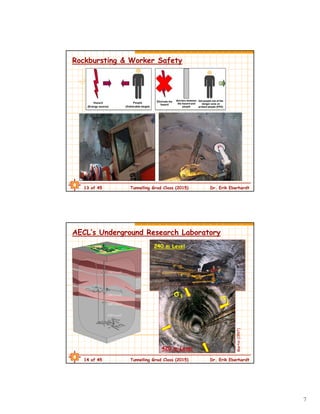
Rockbursting & Worker Safety
7
13 of 45 Tunnelling Grad Class (2015) Dr. Erik Eberhardt
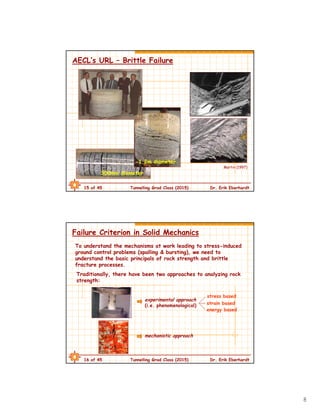
Rockbursting & Worker Safety
14 of 45 Tunnelling Grad Class (2015) Dr. Erik Eberhardt
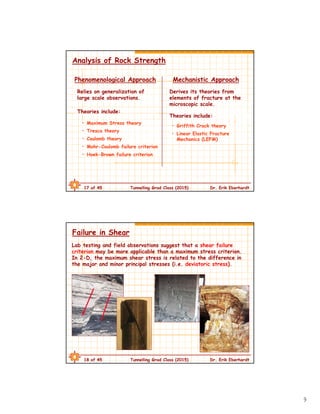
AECL’s Underground Research Laboratory
240 m Level
3 1
420 m Level
Martin(1997)
8
15 of 45 Tunnelling Grad Class (2015) Dr. Erik Eberhardt
AECL’s URL – Brittle Failure
300mm diameter
1.2m diameter
Martin (1997)
16 of 45 Tunnelling Grad Class (2015) Dr. Erik Eberhardt
Failure Criterion in Solid Mechanics
To understand the mechanisms at work leading to stress-induced
ground control problems (spalling & bursting), we need to
understand the basic principals of rock strength and brittle
fracture processes.
Traditionally, there have been two approaches to analyzing rock
strength:
experimental approach
(i.e. phenomenological)
stress based
energy based
strain based
mechanistic approach
9
17 of 45 Tunnelling Grad Class (2015) Dr. Erik Eberhardt
Analysis of Rock Strength
Phenomenological Approach
Relies on generalization of
large scale observations.
Mechanistic Approach
Derives its theories from
elements of fracture at the
microscopic scale.
• Maximum Stress theory
• Tresca theory
• Coulomb theory
• Mohr-Coulomb failure criterion
• Hoek-Brown failure criterion
Theories include:
Theories include:
• Griffith Crack theory
• Linear Elastic Fracture
Mechanics (LEFM)
18 of 45 Tunnelling Grad Class (2015) Dr. Erik Eberhardt
Failure in Shear
Lab testing and field observations suggest that a shear failure
criterion may be more applicable than a maximum stress criterion.
In 2-D, the maximum shear stress is related to the difference in
the major and minor principal stresses (i.e. deviatoric stress).
10
19 of 45 Tunnelling Grad Class (2015) Dr. Erik Eberhardt
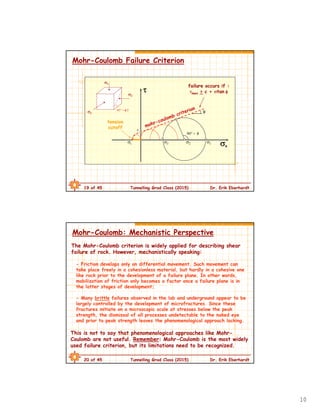
Mohr-Coulomb Failure Criterion
1
2
3
45° + /2
n

failure occurs if :
max > c + tan 
90° + 
c
123t

tension
cutoff
20 of 45 Tunnelling Grad Class (2015) Dr. Erik Eberhardt
Mohr-Coulomb: Mechanistic Perspective
The Mohr-Coulomb criterion is widely applied for describing shear
failure of rock. However, mechanistically speaking:
- Friction develops only on differential movement. Such movement can
take place freely in a cohesionless material, but hardly in a cohesive one
like rock prior to the development of a failure plane. In other words,
mobilization of friction only becomes a factor once a failure plane is in
the latter stages of development;
- Many brittle failures observed in the lab and underground appear to be
largely controlled by the development of microfractures. Since these
fractures initiate on a microscopic scale at stresses below the peak
strength, the dismissal of all processes undetectable to the naked eye
and prior to peak strength leaves the phenomenological approach lacking.
This is not to say that phenomenological approaches like Mohr-
Coulomb are not useful. Remember: Mohr-Coulomb is the most widely
used failure criterion, but its limitations need to be recognized.
11
21 of 45 Tunnelling Grad Class (2015) Dr. Erik Eberhardt
Analysis of Brittle Rock Strength
Phenomenological Approach
Relies on generalization of
large scale observations.
Mechanistic Approach
Derives its theories from
elements of fracture at the
microscopic scale.
• Maximum Stress theory
• Tresca theory
• Coulomb theory
• Mohr-Coulomb failure criterion
• Hoek-Brown failure criterion
Theories include:
Theories include:
• Griffith Crack theory
• Linear Elastic Fracture
Mechanics (LEFM)
22 of 45 Tunnelling Grad Class (2015) Dr. Erik Eberhardt
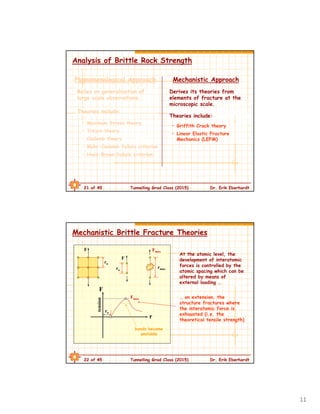
Mechanistic Brittle Fracture Theories
F
ro
r
Fmax … on extension, the
structure fractures where
the interatomic force is
exhausted (i.e. the
theoretical tensile strength)
F
F
ro
rmax
Fmax
At the atomic level, the
development of interatomic
forces is controlled by the
atomic spacing which can be
altered by means of
external loading …
bonds become
unstable
tension
ro
12
23 of 45 Tunnelling Grad Class (2015) Dr. Erik Eberhardt
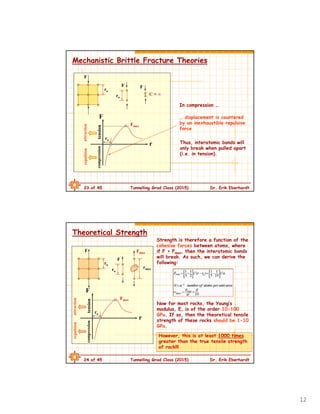
Mechanistic Brittle Fracture Theories
F
ro
tension
r
… displacement is countered
by an inexhaustible repulsive
force
F
ro
C ≈ ∞
F
compression
Fmax
attractionrepulsion
ro
F
In compression …
Thus, interatomic bonds will
only break when pulled apart
(i.e. in tension).
24 of 45 Tunnelling Grad Class (2015) Dr. Erik Eberhardt
Theoretical Strength
F
F
rmax
F
ro
Fmax
Strength is therefore a function of the
cohesive forces between atoms, where
if F > Fmax, then the interatomic bonds
will break. As such, we can derive the
following:
Now for most rocks, the Young’s
modulus, E, is of the order 10-100
GPa. If so, then the theoretical tensile
strength of these rocks should be 1-10
GPa.
ro
tension
r
compression
Fmax
attractionrepulsion
ro
However, this is at least 1000 times
greater than the true tensile strength
of rock!!!
13
25 of 45 Tunnelling Grad Class (2015) Dr. Erik Eberhardt
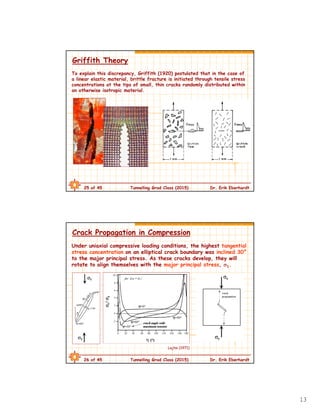
Griffith Theory
To explain this discrepancy, Griffith (1920) postulated that in the case of
a linear elastic material, brittle fracture is initiated through tensile stress
concentrations at the tips of small, thin cracks randomly distributed within
an otherwise isotropic material.
26 of 45 Tunnelling Grad Class (2015) Dr. Erik Eberhardt
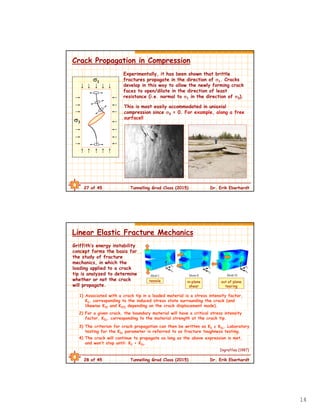
Crack Propagation in Compression
Under uniaxial compressive loading conditions, the highest tangential
stress concentration on an elliptical crack boundary was inclined 30°
to the major principal stress. As these cracks develop, they will
rotate to align themselves with the major principal stress, 1.
Lajtai (1971)
14
27 of 45 Tunnelling Grad Class (2015) Dr. Erik Eberhardt
Crack Propagation in Compression
Experimentally, it has been shown that brittle
fractures propagate in the direction of 1. Cracks
develop in this way to allow the newly forming crack
faces to open/dilate in the direction of least
resistance (i.e. normal to 1 in the direction of 3).
This is most easily accommodated in uniaxial
compression since 3 = 0. For example, along a free
surface!!
1
3
28 of 45 Tunnelling Grad Class (2015) Dr. Erik Eberhardt
Linear Elastic Fracture Mechanics
1) Associated with a crack tip in a loaded material is a stress intensity factor,
KI, corresponding to the induced stress state surrounding the crack (and
likewise KII and KIII depending on the crack displacement mode).
Griffith’s energy instability
concept forms the basis for
the study of fracture
mechanics, in which the
loading applied to a crack
tip is analyzed to determine
whether or not the crack
will propagate.
4) The crack will continue to propagate as long as the above expression is met,
and won’t stop until: KI < KIc.
2) For a given crack, the boundary material will have a critical stress intensity
factor, KIc, corresponding to the material strength at the crack tip.
3) The criterion for crack propagation can then be written as KI ≥ KIc. Laboratory
testing for the KIc parameter is referred to as fracture toughness testing.
Ingraffea (1987)
tensile in-plane
shear
out of plane
tearing
15
29 of 45 Tunnelling Grad Class (2015) Dr. Erik Eberhardt
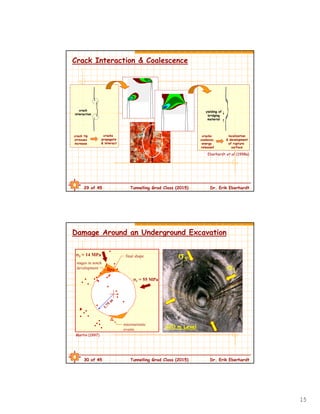
Crack Interaction & Coalescence
crack
interaction
crack tip
stresses
increase
cracks
propagate
& interact
Eberhardt et al. (1998a)
cracks
coalesce;
energy
released
yielding of
bridging
material
localization
& development
of rupture
surface
30 of 45 Tunnelling Grad Class (2015) Dr. Erik Eberhardt
Damage Around an Underground Excavation
1 = 55 MPa
3 = 14 MPa final shape
stages in notch
development
microseismic
events
3
1
420 m Level
Martin (1997)
16
31 of 45 Tunnelling Grad Class (2015) Dr. Erik Eberhardt
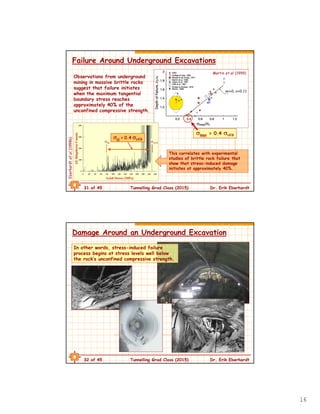
Failure Around Underground Excavations
max = 0.4 UCS
Martin et al. (1999)
Observations from underground
mining in massive brittle rocks
suggest that failure initiates
when the maximum tangential
boundary stress reaches
approximately 40% of the
unconfined compressive strength.
ci = 0.4 UCS
Eberhardtetal.(1998b)
This correlates with experimental
studies of brittle rock failure that
show that stress-induced damage
initiates at approximately 40%.
32 of 45 Tunnelling Grad Class (2015) Dr. Erik Eberhardt
Damage Around an Underground Excavation
In other words, stress-induced failure
process begins at stress levels well below
the rock’s unconfined compressive strength.
17
33 of 45 Tunnelling Grad Class (2015) Dr. Erik Eberhardt
Example: Tunnel Spalling & Depth of Failure
Problem: A 14-m diameter, 100-m deep tunnel is to
be excavated in a weak but massive
sedimentary rock unit with an average
compressive strength of 25 MPa. The
tunnel will be excavated by a tunnel boring
machine. In-situ stress tests revealed that
the major principal stress is horizontal and
three times higher than the vertical stress.
This has raised concerns of potential ground
control problems related to stress-induced
fracturing and slabbing of the rock.
As such, the designers need
to estimate the potential
depth of stress-induced
slabbing in order to select
the proper rock support
measures.
34 of 45 Tunnelling Grad Class (2015) Dr. Erik Eberhardt
Example: Tunnel Spalling & Depth of Failure
Assuming a vertical
stress of 2.5 MPa
(calculated from the
overburden), and
adopting a horizontal
to vertical stress ratio
of 3, a maximum
tangential stress of 20
MPa in the tunnel roof
is calculated.
8.0
25
20max
 MPa
c

Using Martin et al.
(1999)’s empirical
relationship
5.1
a
Df
mmDf 1285.1 
This means that,
potentially, the
slabbing may extend
4 m into the roof.
maDf 4
18
35 of 45 Tunnelling Grad Class (2015) Dr. Erik Eberhardt
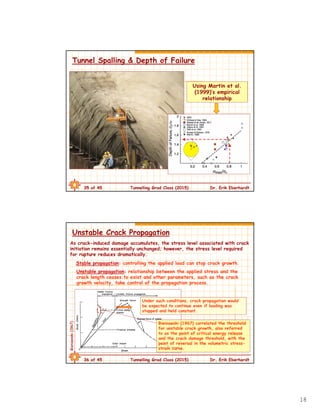
Tunnel Spalling & Depth of Failure
Using Martin et al.
(1999)’s empirical
relationship
36 of 45 Tunnelling Grad Class (2015) Dr. Erik Eberhardt
Unstable Crack Propagation
Stable propagation: controlling the applied load can stop crack growth.
Unstable propagation: relationship between the applied stress and the
crack length ceases to exist and other parameters, such as the crack
growth velocity, take control of the propagation process.
Under such conditions, crack propagation would
be expected to continue even if loading was
stopped and held constant.
As crack-induced damage accumulates, the stress level associated with crack
initiation remains essentially unchanged; however, the stress level required
for rupture reduces dramatically.
Bieniawski(1967)
Bieniawski (1967) correlated the threshold
for unstable crack growth, also referred
to as the point of critical energy release
and the crack damage threshold, with the
point of reversal in the volumetric stress-
strain curve.
19
37 of 45 Tunnelling Grad Class (2015) Dr. Erik Eberhardt
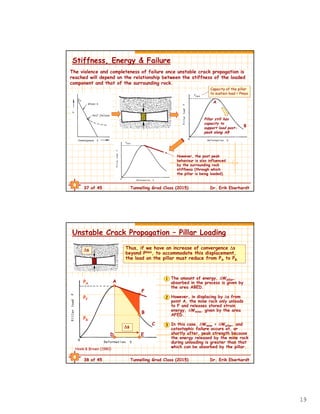
Stiffness, Energy & Failure
Capacity of the pillar
to sustain load = Pmax
A
B
Pillar still has
capacity to
support load post-
peak along AB
However, the post peak
behaviour is also influenced
by the surrounding rock
stiffness (through which
the pillar is being loaded).
The violence and completeness of failure once unstable crack propagation is
reached will depend on the relationship between the stiffness of the loaded
component and that of the surrounding rock.
38 of 45 Tunnelling Grad Class (2015) Dr. Erik Eberhardt
Hoek & Brown (1980)
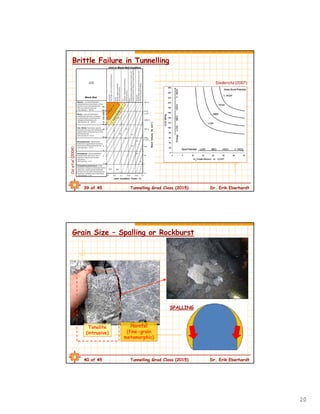
Unstable Crack Propagation – Pillar Loading
Thus, if we have an increase of convergence s
beyond Pmax, to accommodate this displacement,
the load on the pillar must reduce from PA to PB.
s
D E
F
PF
C
s
A
PB
B
PA
The amount of energy, Wpillar,
absorbed in the process is given by
the area ABED.
1
However, in displacing by s from
point A, the mine rock only unloads
to F and releases stored strain
energy, Wmine, given by the area
AFED.
2
In this case, Wmine > Wpillar, and
catastophic failure occurs at, or
shortly after, peak strength because
the energy released by the mine rock
during unloading is greater than that
which can be absorbed by the pillar.
3
20
39 of 45 Tunnelling Grad Class (2015) Dr. Erik Eberhardt
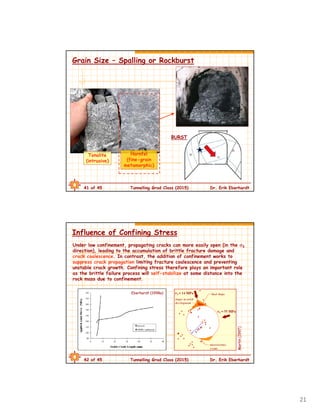
Brittle Failure in Tunnelling
Caietal.(2004)
Diederichs (2007)
40 of 45 Tunnelling Grad Class (2015) Dr. Erik Eberhardt
Grain Size – Spalling or Rockburst
Tonalite
(intrusive)
Hornfel
(fine-grain
metamorphic)
SPALLING
21
41 of 45 Tunnelling Grad Class (2015) Dr. Erik Eberhardt
Grain Size – Spalling or Rockburst
Tonalite
(intrusive)
Hornfel
(fine-grain
metamorphic)
BURST
42 of 45 Tunnelling Grad Class (2015) Dr. Erik Eberhardt
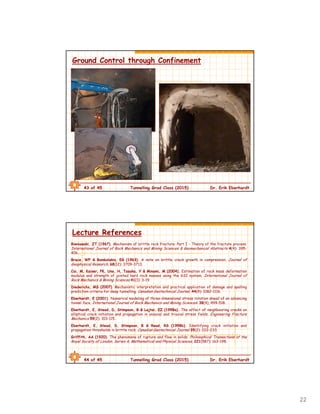
Influence of Confining Stress
Eberhardt (1998a)
Under low confinement, propagating cracks can more easily open (in the 3
direction), leading to the accumulation of brittle fracture damage and
crack coalescence. In contrast, the addition of confinement works to
suppress crack propagation limiting fracture coalescence and preventing
unstable crack growth. Confining stress therefore plays an important role
as the brittle failure process will self-stabilize at some distance into the
rock mass due to confinement.
Martin(1997)
22
43 of 45 Tunnelling Grad Class (2015) Dr. Erik Eberhardt
Ground Control through Confinement
44 of 45 Tunnelling Grad Class (2015) Dr. Erik Eberhardt
Lecture References
Bieniawski, ZT (1967). Mechanism of brittle rock fracture: Part I - Theory of the fracture process.
International Journal of Rock Mechanics and Mining Sciences & Geomechanical Abstracts 4(4): 395-
406.
Brace, WF & Bombolakis, EG (1963). A note on brittle crack growth in compression. Journal of
Geophysical Research, 68(12): 3709-3713.
Cai, M, Kaiser, PK, Uno, H, Tasaka, Y & Minami, M (2004). Estimation of rock mass deformation
modulus and strength of jointed hard rock masses using the GSI system. International Journal of
Rock Mechanics & Mining Sciences 41(1): 3-19.
Diederichs, MS (2007). Mechanistic interpretation and practical application of damage and spalling
prediction criteria for deep tunnelling. Canadian Geotechnical Journal, 44(9): 1082-1116.
Eberhardt, E (2001). Numerical modeling of three-dimensional stress rotation ahead of an advancing
tunnel face. International Journal of Rock Mechanics and Mining Sciences: 38(4), 499-518.
Eberhardt, E, Stead, D, Stimpson, B & Lajtai, EZ (1998a). The effect of neighbouring cracks on
elliptical crack initiation and propagation in uniaxial and triaxial stress fields. Engineering Fracture
Mechanics 59(2): 103-115.
Eberhardt, E, Stead, D, Stimpson, B & Read, RS (1998b). Identifying crack initiation and
propagation thresholds in brittle rock. Canadian Geotechnical Journal 35(2): 222-233.
Griffith, AA (1920). The phenomena of rupture and flow in solids. Philosophical Transactions of the
Royal Society of London, Series A, Mathematical and Physical Sciences, 221(587): 163-198.
23
45 of 45 Tunnelling Grad Class (2015) Dr. Erik Eberhardt
Lecture References
Griffith, AA (1924). The theory of rupture. In Proceedings of the First International Congress for
Applied Mechanics, Delft, pp. 55-63.
Harrison, JP & Hudson, JA (2000). Engineering Rock Mechanics – Part 2: Illustrative Worked
Examples. Elsevier Science: Oxford.
Hoek, E & Brown, ET (1980). Underground Excavations in Rock. Institution of Mining and
Metallurgy: London.
Ingraffea, AR (1987). Theory of crack initiation and propagation in rock. In Fracture Mechanics of
Rock. Academic Press Inc. Ltd.: London, pp. 71-110.
Lajtai, EZ (1971). A theoretical and experimental evaluation of the Griffith theory of brittle
fracture. Tectonophysics, 11: 129-156.
Kaiser, PK, Diederichs, MS, Martin, D, Sharpe, J & Steiner, W (2000). Underground works in
hard rock tunnelling and mining. In GeoEng2000, Melbourne. Technomic Publishing Company:
Lancaster, pp. 841-926.
Martin, CD (1997). The effect of cohesion loss and stress path on brittle rock strength. Canadian
Geotechnical Journal, 34(5): 698-725.
Martin, CD, Kaiser, PK & McCreath, DR (1999). Hoek-Brown parameters for predicting the depth
of brittle failure around tunnels. Canadian Geotechnical Journal 36(1): 136-151.
Whyatt, JK, Blake, W & Williams, TJ (1997). Classification of large seismic events at the Lucky
Friday Mine. Transactions of the Institution of Mining and Metallurgy, Section A: Mining Industry,
106: A148–A162.

Tunnelling & underground design (Topic7-brittle failure)

  • 1.
    1 1 of 45Tunnelling Grad Class (2015) Dr. Erik Eberhardt EOSC 547: Tunnelling & Underground Design Topic 7: Brittle Fracture & Stress-Controlled Failure 2 of 45 Tunnelling Grad Class (2015) Dr. Erik Eberhardt Brittle –vs- Plastic Failure Mechanisms
  • 2.
    2 3 of 45Tunnelling Grad Class (2015) Dr. Erik Eberhardt Spalling and Rockburst in Tunnelling Kaiser et al. (2000) 4 of 45 Tunnelling Grad Class (2015) Dr. Erik Eberhardt Orientation of 1 & Induced Stresses 1 destressing stress concentration 1 destressing stress concentration Potential Ground Control Issues: Destressing = wedge failures Concentration = spalling Stresses can be visualized as flowing around the excavation periphery in the direction of the major principle stress (1). Where they diverge, relaxation occurs; where they converge, stress increases occur.
  • 3.
    3 5 of 45Tunnelling Grad Class (2015) Dr. Erik Eberhardt Stress Driven Spalling 6 of 45 Tunnelling Grad Class (2015) Dr. Erik Eberhardt Stress Driven Spalling in Tunnelling - Issues Falling slabs of rock a hazard to workers. Problem for TBM as gripper pads cannot be seated on the side wall.
  • 4.
    4 7 of 45Tunnelling Grad Class (2015) Dr. Erik Eberhardt Stress Driven Spalling and Popping 8 of 45 Tunnelling Grad Class (2015) Dr. Erik Eberhardt Rockbursting
  • 5.
    5 9 of 45Tunnelling Grad Class (2015) Dr. Erik Eberhardt Rockbursting – Strainbursts Rockburst: A sudden and violent failure of rock where rock fragments are ejected into the excavation. Energy is released as seismic energy radiated in the form of strain waves. Strainburst: A self-initiated rockburst that develops due to a disequilibrium between high stresses and rock strength (i.e. dynamic unstable fracturing). Usually occurs after blasting, as face is unable to adjust to the immediately stress increase Immediate unloading of confinement from a triaxial to uniaxial stress condition, stored energy released as seismic energy Commonly occurs when drifting through contact between a brittle and relative soft rock (i.e. highly dependent on local mine rock stiffness) 10 of 45 Tunnelling Grad Class (2015) Dr. Erik Eberhardt Rockbursting – Slip Bursts Slip burst: Slip bursts are characterized as a stick-slip shear movement on a discontinuity. These bursts are less likely to be triggered by a particular blast, and more likely to occur afterwards. Slip occurs when the ratio of shear to normal (effective) stress along the fault plane reaches a critical value (its shear strength). Slip bursts at the Lucky Friday Mine. Similar to mechanics of an earthquake Fault slip typically intersects the mine openings In most cases, mining activity causes slip by removing normal stress, although some local intensification of shear stress may also occur Changes in stress along a fault are often linked to mine activities by time-dependent deformation processes. These time-dependent processes can act over long periods of time, regardless of continued mining Whyatt et al. (1997)
  • 6.
    6 11 of 45Tunnelling Grad Class (2015) Dr. Erik Eberhardt Rockbursting & Worker Safety 12 of 45 Tunnelling Grad Class (2015) Dr. Erik Eberhardt Rockbursting & Worker Safety
  • 7.
    7 13 of 45Tunnelling Grad Class (2015) Dr. Erik Eberhardt Rockbursting & Worker Safety 14 of 45 Tunnelling Grad Class (2015) Dr. Erik Eberhardt AECL’s Underground Research Laboratory 240 m Level 3 1 420 m Level Martin(1997)
  • 8.
    8 15 of 45Tunnelling Grad Class (2015) Dr. Erik Eberhardt AECL’s URL – Brittle Failure 300mm diameter 1.2m diameter Martin (1997) 16 of 45 Tunnelling Grad Class (2015) Dr. Erik Eberhardt Failure Criterion in Solid Mechanics To understand the mechanisms at work leading to stress-induced ground control problems (spalling & bursting), we need to understand the basic principals of rock strength and brittle fracture processes. Traditionally, there have been two approaches to analyzing rock strength: experimental approach (i.e. phenomenological) stress based energy based strain based mechanistic approach
  • 9.
    9 17 of 45Tunnelling Grad Class (2015) Dr. Erik Eberhardt Analysis of Rock Strength Phenomenological Approach Relies on generalization of large scale observations. Mechanistic Approach Derives its theories from elements of fracture at the microscopic scale. • Maximum Stress theory • Tresca theory • Coulomb theory • Mohr-Coulomb failure criterion • Hoek-Brown failure criterion Theories include: Theories include: • Griffith Crack theory • Linear Elastic Fracture Mechanics (LEFM) 18 of 45 Tunnelling Grad Class (2015) Dr. Erik Eberhardt Failure in Shear Lab testing and field observations suggest that a shear failure criterion may be more applicable than a maximum stress criterion. In 2-D, the maximum shear stress is related to the difference in the major and minor principal stresses (i.e. deviatoric stress).
  • 10.
    10 19 of 45Tunnelling Grad Class (2015) Dr. Erik Eberhardt Mohr-Coulomb Failure Criterion 1 2 3 45° + /2 n  failure occurs if : max > c + tan  90° +  c 123t  tension cutoff 20 of 45 Tunnelling Grad Class (2015) Dr. Erik Eberhardt Mohr-Coulomb: Mechanistic Perspective The Mohr-Coulomb criterion is widely applied for describing shear failure of rock. However, mechanistically speaking: - Friction develops only on differential movement. Such movement can take place freely in a cohesionless material, but hardly in a cohesive one like rock prior to the development of a failure plane. In other words, mobilization of friction only becomes a factor once a failure plane is in the latter stages of development; - Many brittle failures observed in the lab and underground appear to be largely controlled by the development of microfractures. Since these fractures initiate on a microscopic scale at stresses below the peak strength, the dismissal of all processes undetectable to the naked eye and prior to peak strength leaves the phenomenological approach lacking. This is not to say that phenomenological approaches like Mohr- Coulomb are not useful. Remember: Mohr-Coulomb is the most widely used failure criterion, but its limitations need to be recognized.
  • 11.
    11 21 of 45Tunnelling Grad Class (2015) Dr. Erik Eberhardt Analysis of Brittle Rock Strength Phenomenological Approach Relies on generalization of large scale observations. Mechanistic Approach Derives its theories from elements of fracture at the microscopic scale. • Maximum Stress theory • Tresca theory • Coulomb theory • Mohr-Coulomb failure criterion • Hoek-Brown failure criterion Theories include: Theories include: • Griffith Crack theory • Linear Elastic Fracture Mechanics (LEFM) 22 of 45 Tunnelling Grad Class (2015) Dr. Erik Eberhardt Mechanistic Brittle Fracture Theories F ro r Fmax … on extension, the structure fractures where the interatomic force is exhausted (i.e. the theoretical tensile strength) F F ro rmax Fmax At the atomic level, the development of interatomic forces is controlled by the atomic spacing which can be altered by means of external loading … bonds become unstable tension ro
  • 12.
    12 23 of 45Tunnelling Grad Class (2015) Dr. Erik Eberhardt Mechanistic Brittle Fracture Theories F ro tension r … displacement is countered by an inexhaustible repulsive force F ro C ≈ ∞ F compression Fmax attractionrepulsion ro F In compression … Thus, interatomic bonds will only break when pulled apart (i.e. in tension). 24 of 45 Tunnelling Grad Class (2015) Dr. Erik Eberhardt Theoretical Strength F F rmax F ro Fmax Strength is therefore a function of the cohesive forces between atoms, where if F > Fmax, then the interatomic bonds will break. As such, we can derive the following: Now for most rocks, the Young’s modulus, E, is of the order 10-100 GPa. If so, then the theoretical tensile strength of these rocks should be 1-10 GPa. ro tension r compression Fmax attractionrepulsion ro However, this is at least 1000 times greater than the true tensile strength of rock!!!
  • 13.
    13 25 of 45Tunnelling Grad Class (2015) Dr. Erik Eberhardt Griffith Theory To explain this discrepancy, Griffith (1920) postulated that in the case of a linear elastic material, brittle fracture is initiated through tensile stress concentrations at the tips of small, thin cracks randomly distributed within an otherwise isotropic material. 26 of 45 Tunnelling Grad Class (2015) Dr. Erik Eberhardt Crack Propagation in Compression Under uniaxial compressive loading conditions, the highest tangential stress concentration on an elliptical crack boundary was inclined 30° to the major principal stress. As these cracks develop, they will rotate to align themselves with the major principal stress, 1. Lajtai (1971)
  • 14.
    14 27 of 45Tunnelling Grad Class (2015) Dr. Erik Eberhardt Crack Propagation in Compression Experimentally, it has been shown that brittle fractures propagate in the direction of 1. Cracks develop in this way to allow the newly forming crack faces to open/dilate in the direction of least resistance (i.e. normal to 1 in the direction of 3). This is most easily accommodated in uniaxial compression since 3 = 0. For example, along a free surface!! 1 3 28 of 45 Tunnelling Grad Class (2015) Dr. Erik Eberhardt Linear Elastic Fracture Mechanics 1) Associated with a crack tip in a loaded material is a stress intensity factor, KI, corresponding to the induced stress state surrounding the crack (and likewise KII and KIII depending on the crack displacement mode). Griffith’s energy instability concept forms the basis for the study of fracture mechanics, in which the loading applied to a crack tip is analyzed to determine whether or not the crack will propagate. 4) The crack will continue to propagate as long as the above expression is met, and won’t stop until: KI < KIc. 2) For a given crack, the boundary material will have a critical stress intensity factor, KIc, corresponding to the material strength at the crack tip. 3) The criterion for crack propagation can then be written as KI ≥ KIc. Laboratory testing for the KIc parameter is referred to as fracture toughness testing. Ingraffea (1987) tensile in-plane shear out of plane tearing
  • 15.
    15 29 of 45Tunnelling Grad Class (2015) Dr. Erik Eberhardt Crack Interaction & Coalescence crack interaction crack tip stresses increase cracks propagate & interact Eberhardt et al. (1998a) cracks coalesce; energy released yielding of bridging material localization & development of rupture surface 30 of 45 Tunnelling Grad Class (2015) Dr. Erik Eberhardt Damage Around an Underground Excavation 1 = 55 MPa 3 = 14 MPa final shape stages in notch development microseismic events 3 1 420 m Level Martin (1997)
  • 16.
    16 31 of 45Tunnelling Grad Class (2015) Dr. Erik Eberhardt Failure Around Underground Excavations max = 0.4 UCS Martin et al. (1999) Observations from underground mining in massive brittle rocks suggest that failure initiates when the maximum tangential boundary stress reaches approximately 40% of the unconfined compressive strength. ci = 0.4 UCS Eberhardtetal.(1998b) This correlates with experimental studies of brittle rock failure that show that stress-induced damage initiates at approximately 40%. 32 of 45 Tunnelling Grad Class (2015) Dr. Erik Eberhardt Damage Around an Underground Excavation In other words, stress-induced failure process begins at stress levels well below the rock’s unconfined compressive strength.
  • 17.
    17 33 of 45Tunnelling Grad Class (2015) Dr. Erik Eberhardt Example: Tunnel Spalling & Depth of Failure Problem: A 14-m diameter, 100-m deep tunnel is to be excavated in a weak but massive sedimentary rock unit with an average compressive strength of 25 MPa. The tunnel will be excavated by a tunnel boring machine. In-situ stress tests revealed that the major principal stress is horizontal and three times higher than the vertical stress. This has raised concerns of potential ground control problems related to stress-induced fracturing and slabbing of the rock. As such, the designers need to estimate the potential depth of stress-induced slabbing in order to select the proper rock support measures. 34 of 45 Tunnelling Grad Class (2015) Dr. Erik Eberhardt Example: Tunnel Spalling & Depth of Failure Assuming a vertical stress of 2.5 MPa (calculated from the overburden), and adopting a horizontal to vertical stress ratio of 3, a maximum tangential stress of 20 MPa in the tunnel roof is calculated. 8.0 25 20max  MPa c  Using Martin et al. (1999)’s empirical relationship 5.1 a Df mmDf 1285.1  This means that, potentially, the slabbing may extend 4 m into the roof. maDf 4
  • 18.
    18 35 of 45Tunnelling Grad Class (2015) Dr. Erik Eberhardt Tunnel Spalling & Depth of Failure Using Martin et al. (1999)’s empirical relationship 36 of 45 Tunnelling Grad Class (2015) Dr. Erik Eberhardt Unstable Crack Propagation Stable propagation: controlling the applied load can stop crack growth. Unstable propagation: relationship between the applied stress and the crack length ceases to exist and other parameters, such as the crack growth velocity, take control of the propagation process. Under such conditions, crack propagation would be expected to continue even if loading was stopped and held constant. As crack-induced damage accumulates, the stress level associated with crack initiation remains essentially unchanged; however, the stress level required for rupture reduces dramatically. Bieniawski(1967) Bieniawski (1967) correlated the threshold for unstable crack growth, also referred to as the point of critical energy release and the crack damage threshold, with the point of reversal in the volumetric stress- strain curve.
  • 19.
    19 37 of 45Tunnelling Grad Class (2015) Dr. Erik Eberhardt Stiffness, Energy & Failure Capacity of the pillar to sustain load = Pmax A B Pillar still has capacity to support load post- peak along AB However, the post peak behaviour is also influenced by the surrounding rock stiffness (through which the pillar is being loaded). The violence and completeness of failure once unstable crack propagation is reached will depend on the relationship between the stiffness of the loaded component and that of the surrounding rock. 38 of 45 Tunnelling Grad Class (2015) Dr. Erik Eberhardt Hoek & Brown (1980) Unstable Crack Propagation – Pillar Loading Thus, if we have an increase of convergence s beyond Pmax, to accommodate this displacement, the load on the pillar must reduce from PA to PB. s D E F PF C s A PB B PA The amount of energy, Wpillar, absorbed in the process is given by the area ABED. 1 However, in displacing by s from point A, the mine rock only unloads to F and releases stored strain energy, Wmine, given by the area AFED. 2 In this case, Wmine > Wpillar, and catastophic failure occurs at, or shortly after, peak strength because the energy released by the mine rock during unloading is greater than that which can be absorbed by the pillar. 3
  • 20.
    20 39 of 45Tunnelling Grad Class (2015) Dr. Erik Eberhardt Brittle Failure in Tunnelling Caietal.(2004) Diederichs (2007) 40 of 45 Tunnelling Grad Class (2015) Dr. Erik Eberhardt Grain Size – Spalling or Rockburst Tonalite (intrusive) Hornfel (fine-grain metamorphic) SPALLING
  • 21.
    21 41 of 45Tunnelling Grad Class (2015) Dr. Erik Eberhardt Grain Size – Spalling or Rockburst Tonalite (intrusive) Hornfel (fine-grain metamorphic) BURST 42 of 45 Tunnelling Grad Class (2015) Dr. Erik Eberhardt Influence of Confining Stress Eberhardt (1998a) Under low confinement, propagating cracks can more easily open (in the 3 direction), leading to the accumulation of brittle fracture damage and crack coalescence. In contrast, the addition of confinement works to suppress crack propagation limiting fracture coalescence and preventing unstable crack growth. Confining stress therefore plays an important role as the brittle failure process will self-stabilize at some distance into the rock mass due to confinement. Martin(1997)
  • 22.
    22 43 of 45Tunnelling Grad Class (2015) Dr. Erik Eberhardt Ground Control through Confinement 44 of 45 Tunnelling Grad Class (2015) Dr. Erik Eberhardt Lecture References Bieniawski, ZT (1967). Mechanism of brittle rock fracture: Part I - Theory of the fracture process. International Journal of Rock Mechanics and Mining Sciences & Geomechanical Abstracts 4(4): 395- 406. Brace, WF & Bombolakis, EG (1963). A note on brittle crack growth in compression. Journal of Geophysical Research, 68(12): 3709-3713. Cai, M, Kaiser, PK, Uno, H, Tasaka, Y & Minami, M (2004). Estimation of rock mass deformation modulus and strength of jointed hard rock masses using the GSI system. International Journal of Rock Mechanics & Mining Sciences 41(1): 3-19. Diederichs, MS (2007). Mechanistic interpretation and practical application of damage and spalling prediction criteria for deep tunnelling. Canadian Geotechnical Journal, 44(9): 1082-1116. Eberhardt, E (2001). Numerical modeling of three-dimensional stress rotation ahead of an advancing tunnel face. International Journal of Rock Mechanics and Mining Sciences: 38(4), 499-518. Eberhardt, E, Stead, D, Stimpson, B & Lajtai, EZ (1998a). The effect of neighbouring cracks on elliptical crack initiation and propagation in uniaxial and triaxial stress fields. Engineering Fracture Mechanics 59(2): 103-115. Eberhardt, E, Stead, D, Stimpson, B & Read, RS (1998b). Identifying crack initiation and propagation thresholds in brittle rock. Canadian Geotechnical Journal 35(2): 222-233. Griffith, AA (1920). The phenomena of rupture and flow in solids. Philosophical Transactions of the Royal Society of London, Series A, Mathematical and Physical Sciences, 221(587): 163-198.
  • 23.
    23 45 of 45Tunnelling Grad Class (2015) Dr. Erik Eberhardt Lecture References Griffith, AA (1924). The theory of rupture. In Proceedings of the First International Congress for Applied Mechanics, Delft, pp. 55-63. Harrison, JP & Hudson, JA (2000). Engineering Rock Mechanics – Part 2: Illustrative Worked Examples. Elsevier Science: Oxford. Hoek, E & Brown, ET (1980). Underground Excavations in Rock. Institution of Mining and Metallurgy: London. Ingraffea, AR (1987). Theory of crack initiation and propagation in rock. In Fracture Mechanics of Rock. Academic Press Inc. Ltd.: London, pp. 71-110. Lajtai, EZ (1971). A theoretical and experimental evaluation of the Griffith theory of brittle fracture. Tectonophysics, 11: 129-156. Kaiser, PK, Diederichs, MS, Martin, D, Sharpe, J & Steiner, W (2000). Underground works in hard rock tunnelling and mining. In GeoEng2000, Melbourne. Technomic Publishing Company: Lancaster, pp. 841-926. Martin, CD (1997). The effect of cohesion loss and stress path on brittle rock strength. Canadian Geotechnical Journal, 34(5): 698-725. Martin, CD, Kaiser, PK & McCreath, DR (1999). Hoek-Brown parameters for predicting the depth of brittle failure around tunnels. Canadian Geotechnical Journal 36(1): 136-151. Whyatt, JK, Blake, W & Williams, TJ (1997). Classification of large seismic events at the Lucky Friday Mine. Transactions of the Institution of Mining and Metallurgy, Section A: Mining Industry, 106: A148–A162.