1
1 of 46 Tunnelling Grad Class (2015) Erik Eberhardt
EOSC547:
Tunnelling &
Underground Design
Topic 1:
Introduction –
Tunnelling Past &
Present
2 of 46 Tunnelling Grad Class (2015) Erik Eberhardt
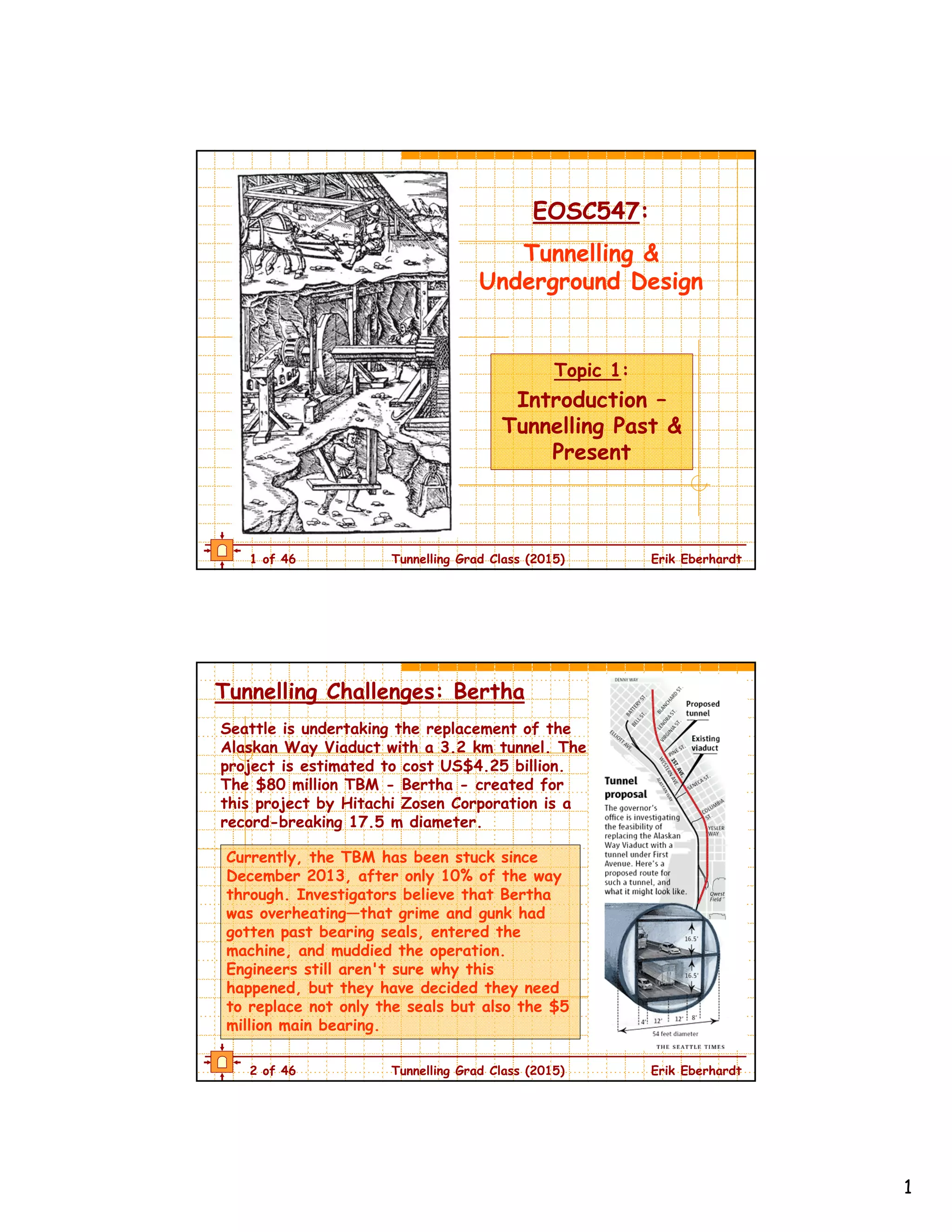
Tunnelling Challenges: Bertha
Seattle is undertaking the replacement of the
Alaskan Way Viaduct with a 3.2 km tunnel. The
project is estimated to cost US$4.25 billion.
The $80 million TBM - Bertha - created for
this project by Hitachi Zosen Corporation is a
record-breaking 17.5 m diameter.
Currently, the TBM has been stuck since
December 2013, after only 10% of the way
through. Investigators believe that Bertha
was overheating—that grime and gunk had
gotten past bearing seals, entered the
machine, and muddied the operation.
Engineers still aren't sure why this
happened, but they have decided they need
to replace not only the seals but also the $5
million main bearing.
2
3 of 46 Tunnelling Grad Class (2015) Erik Eberhardt
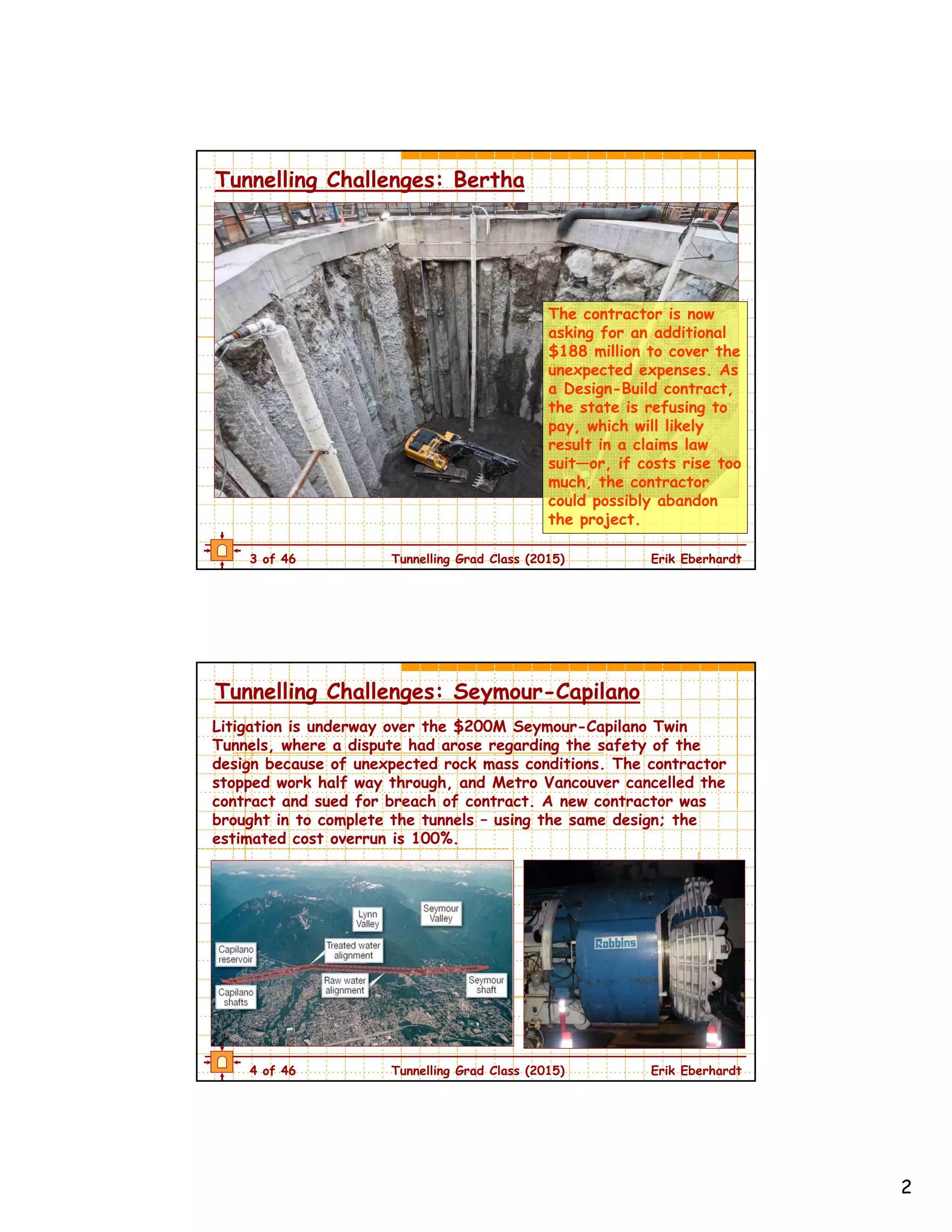
Tunnelling Challenges: Bertha
The contractor is now
asking for an additional
$188 million to cover the
unexpected expenses. As
a Design-Build contract,
the state is refusing to
pay, which will likely
result in a claims law
suit—or, if costs rise too
much, the contractor
could possibly abandon
the project.
4 of 46 Tunnelling Grad Class (2015) Erik Eberhardt
Tunnelling Challenges: Seymour-Capilano
Litigation is underway over the $200M Seymour-Capilano Twin
Tunnels, where a dispute had arose regarding the safety of the
design because of unexpected rock mass conditions. The contractor
stopped work half way through, and Metro Vancouver cancelled the
contract and sued for breach of contract. A new contractor was
brought in to complete the tunnels – using the same design; the
estimated cost overrun is 100%.
3
5 of 46 Tunnelling Grad Class (2015) Erik Eberhardt
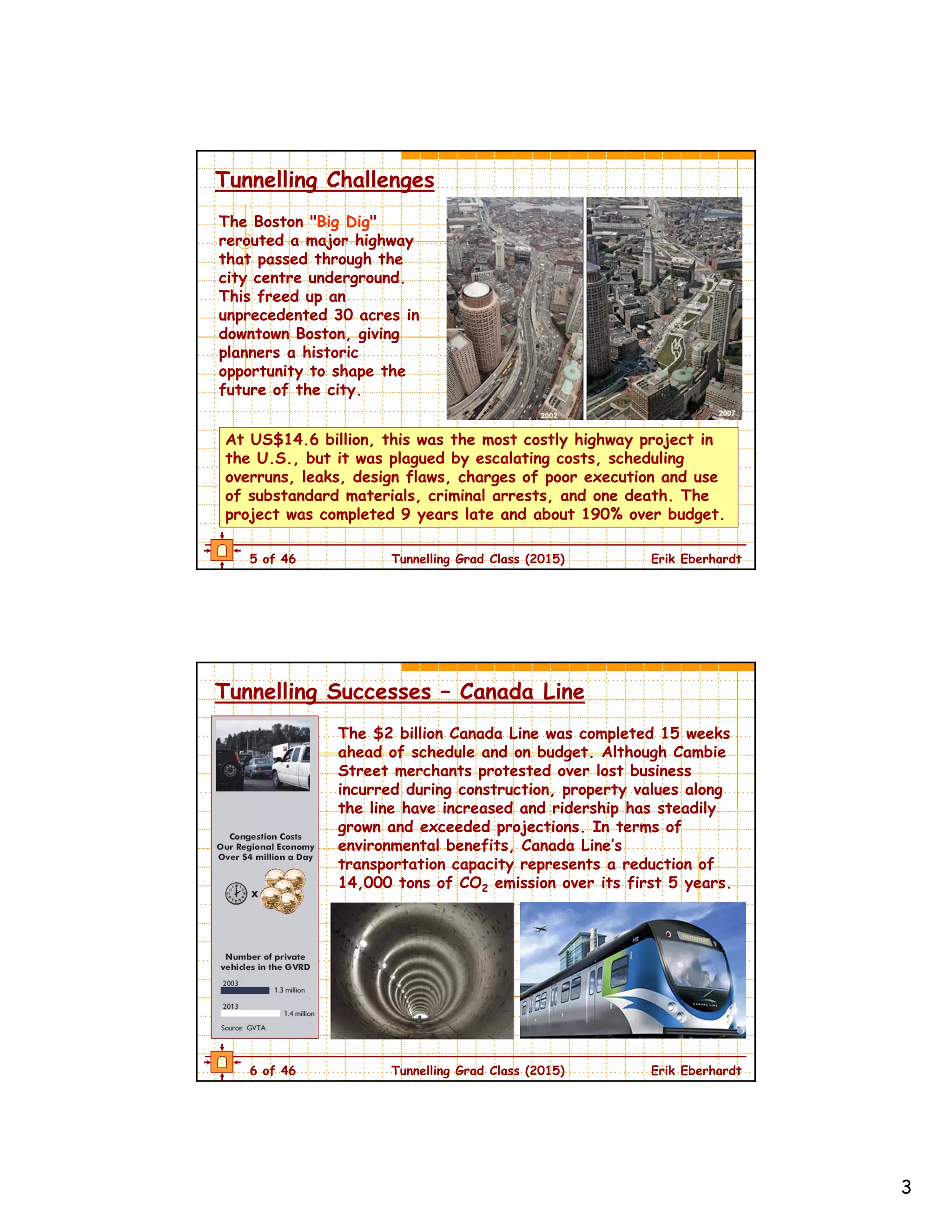
Tunnelling Challenges
The Boston "Big Dig"
rerouted a major highway
that passed through the
city centre underground.
This freed up an
unprecedented 30 acres in
downtown Boston, giving
planners a historic
opportunity to shape the
future of the city.
At US$14.6 billion, this was the most costly highway project in
the U.S., but it was plagued by escalating costs, scheduling
overruns, leaks, design flaws, charges of poor execution and use
of substandard materials, criminal arrests, and one death. The
project was completed 9 years late and about 190% over budget.
6 of 46 Tunnelling Grad Class (2015) Erik Eberhardt
Tunnelling Successes – Canada Line
The $2 billion Canada Line was completed 15 weeks
ahead of schedule and on budget. Although Cambie
Street merchants protested over lost business
incurred during construction, property values along
the line have increased and ridership has steadily
grown and exceeded projections. In terms of
environmental benefits, Canada Line’s
transportation capacity represents a reduction of
14,000 tons of CO2 emission over its first 5 years.
4
7 of 46 Tunnelling Grad Class (2015) Erik Eberhardt
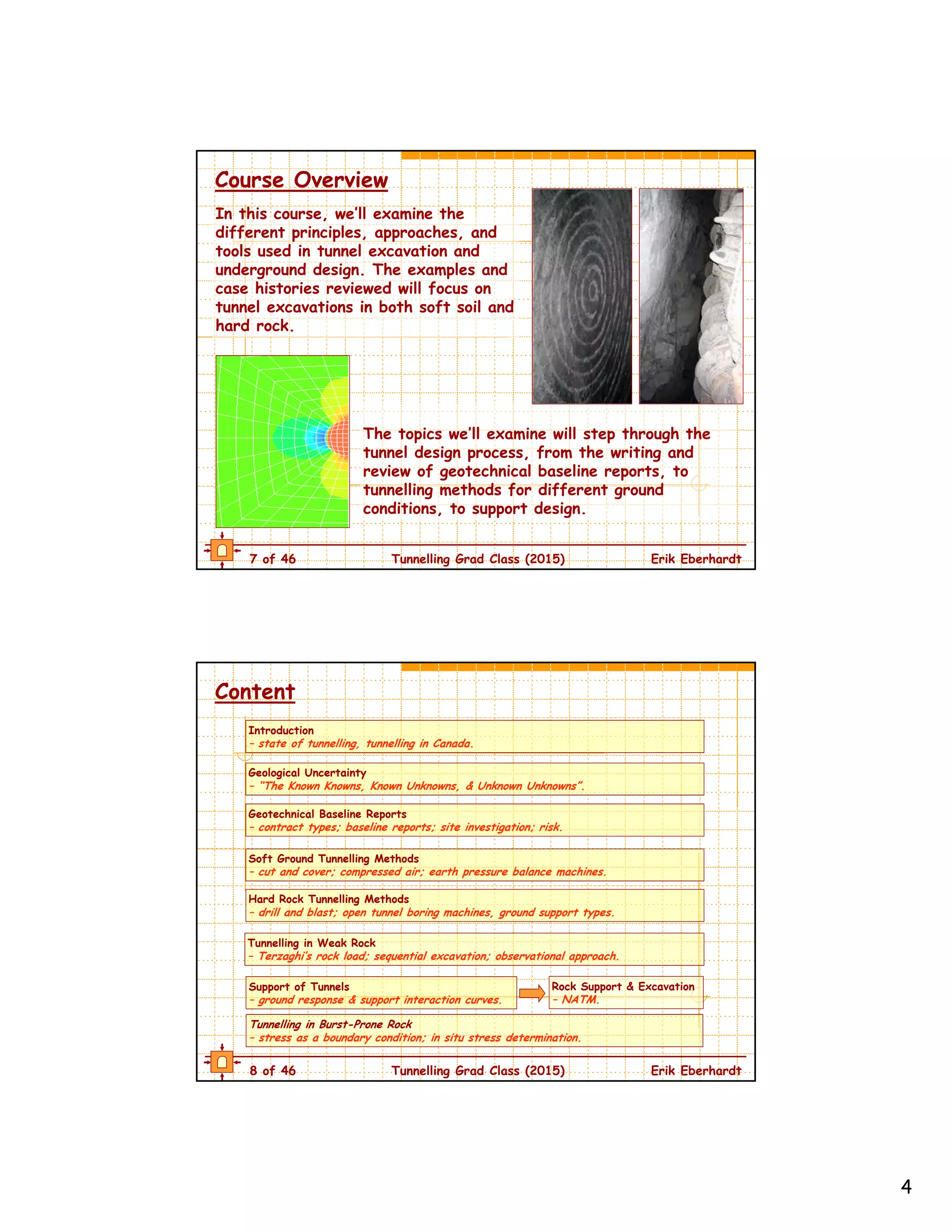
Course Overview
The topics we’ll examine will step through the
tunnel design process, from the writing and
review of geotechnical baseline reports, to
tunnelling methods for different ground
conditions, to support design.
In this course, we’ll examine the
different principles, approaches, and
tools used in tunnel excavation and
underground design. The examples and
case histories reviewed will focus on
tunnel excavations in both soft soil and
hard rock.
8 of 46 Tunnelling Grad Class (2015) Erik Eberhardt
Content
Tunnelling in Weak Rock
– Terzaghi’s rock load; sequential excavation; observational approach.
Tunnelling in Burst-Prone Rock
– stress as a boundary condition; in situ stress determination.
Soft Ground Tunnelling Methods
– cut and cover; compressed air; earth pressure balance machines.
Support of Tunnels
– ground response & support interaction curves.
Rock Support & Excavation
– NATM.
Introduction
– state of tunnelling, tunnelling in Canada.
Geotechnical Baseline Reports
– contract types; baseline reports; site investigation; risk.
Geological Uncertainty
– “The Known Knowns, Known Unknowns, & Unknown Unknowns”.
Hard Rock Tunnelling Methods
– drill and blast; open tunnel boring machines, ground support types.
5
9 of 46 Tunnelling Grad Class (2015) Erik Eberhardt
General Information
Lectures: Monday, 11:00 to 13:00 (ESB 5108)
Grades: tunnel design assignment
Part 1 – Baseline Report 15%
Part 2 – Squeezing Ground 25%
Part 3 – Spalling & Bursting 25%
student prepared lecture 25%
peer review participation 10%
Contact Info – 251 EOS South
Phone: (604) 827-5573
E-mail: erik@eos.ubc.ca
10 of 46 Tunnelling Grad Class (2015) Erik Eberhardt
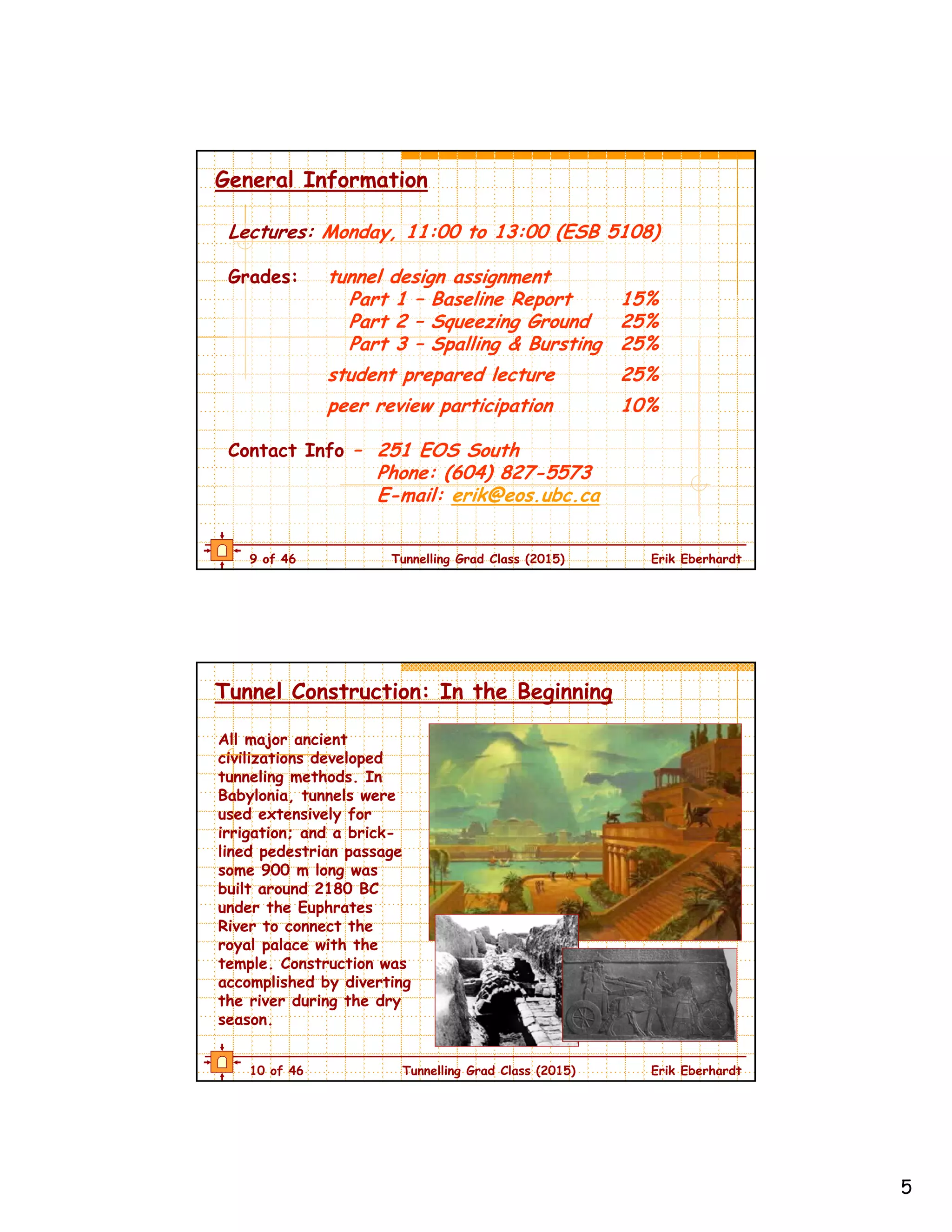
All major ancient
civilizations developed
tunneling methods. In
Babylonia, tunnels were
used extensively for
irrigation; and a brick-
lined pedestrian passage
some 900 m long was
built around 2180 BC
under the Euphrates
River to connect the
royal palace with the
temple. Construction was
accomplished by diverting
the river during the dry
season.
Tunnel Construction: In the Beginning
6
11 of 46 Tunnelling Grad Class (2015) Erik Eberhardt
Tunnel Construction: In the Beginning
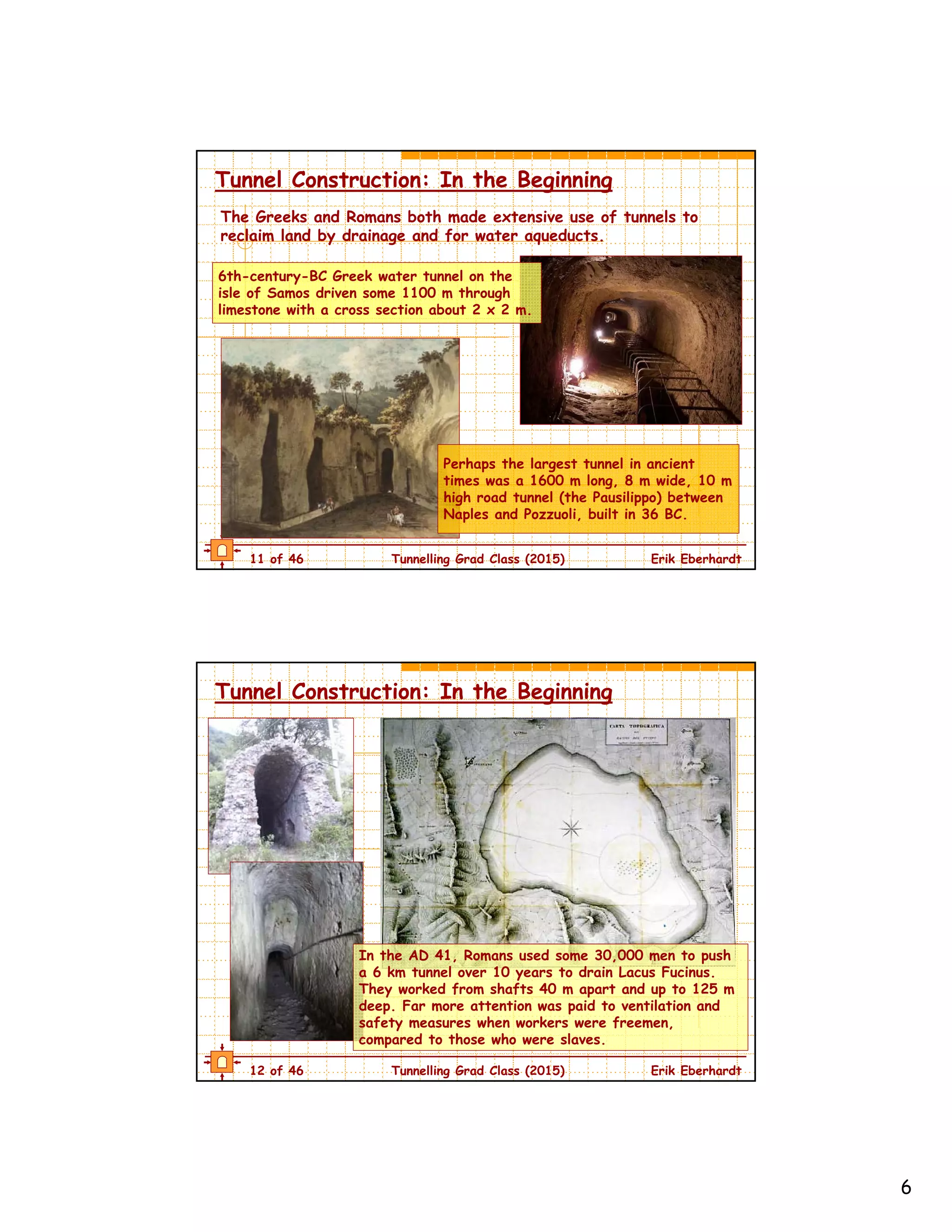
Perhaps the largest tunnel in ancient
times was a 1600 m long, 8 m wide, 10 m
high road tunnel (the Pausilippo) between
Naples and Pozzuoli, built in 36 BC.
The Greeks and Romans both made extensive use of tunnels to
reclaim land by drainage and for water aqueducts.
6th-century-BC Greek water tunnel on the
isle of Samos driven some 1100 m through
limestone with a cross section about 2 x 2 m.
12 of 46 Tunnelling Grad Class (2015) Erik Eberhardt
Tunnel Construction: In the Beginning
In the AD 41, Romans used some 30,000 men to push
a 6 km tunnel over 10 years to drain Lacus Fucinus.
They worked from shafts 40 m apart and up to 125 m
deep. Far more attention was paid to ventilation and
safety measures when workers were freemen,
compared to those who were slaves.
7
13 of 46 Tunnelling Grad Class (2015) Erik Eberhardt
Tunnel Construction: In the Beginning
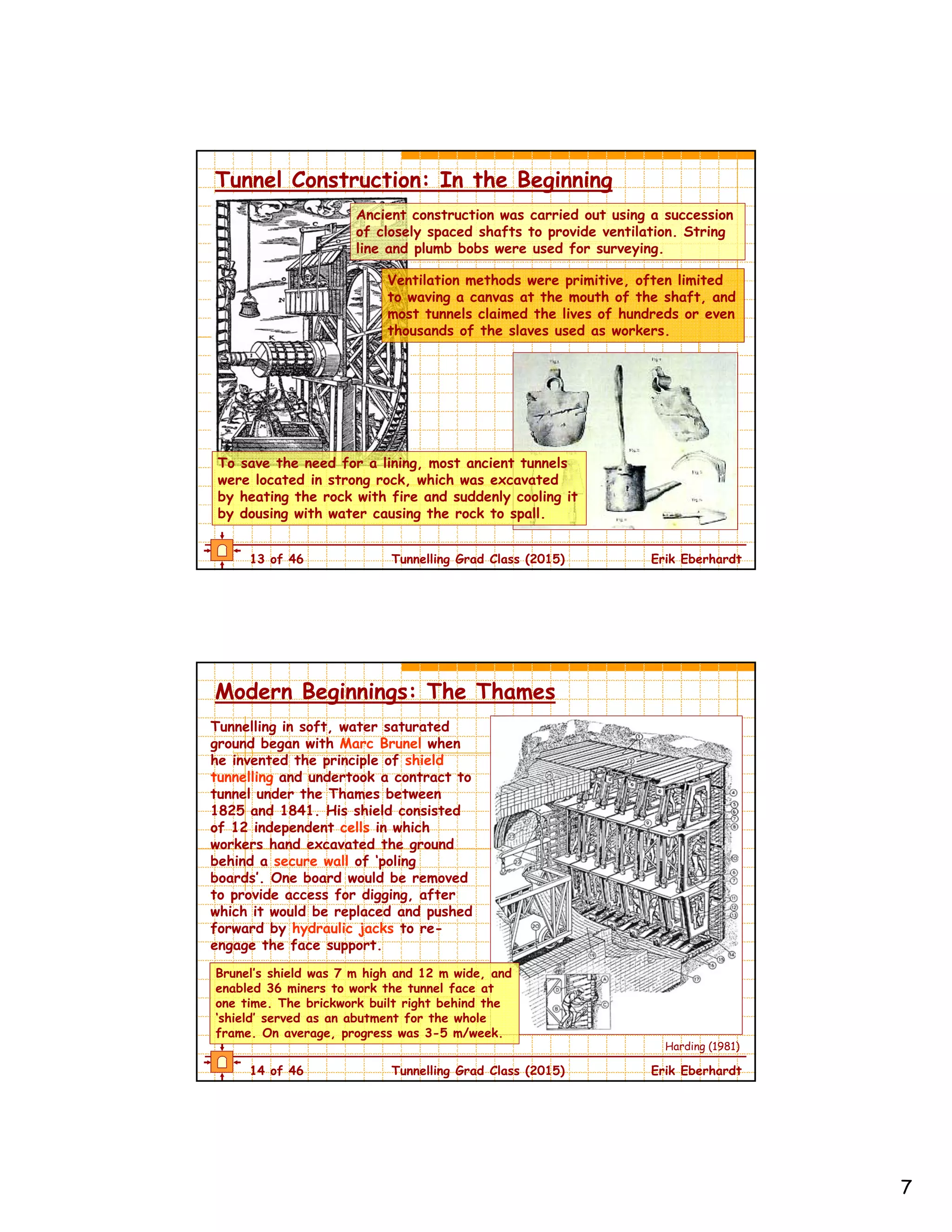
Ancient construction was carried out using a succession
of closely spaced shafts to provide ventilation. String
line and plumb bobs were used for surveying.
Ventilation methods were primitive, often limited
to waving a canvas at the mouth of the shaft, and
most tunnels claimed the lives of hundreds or even
thousands of the slaves used as workers.
To save the need for a lining, most ancient tunnels
were located in strong rock, which was excavated
by heating the rock with fire and suddenly cooling it
by dousing with water causing the rock to spall.
14 of 46 Tunnelling Grad Class (2015) Erik Eberhardt
Modern Beginnings: The Thames
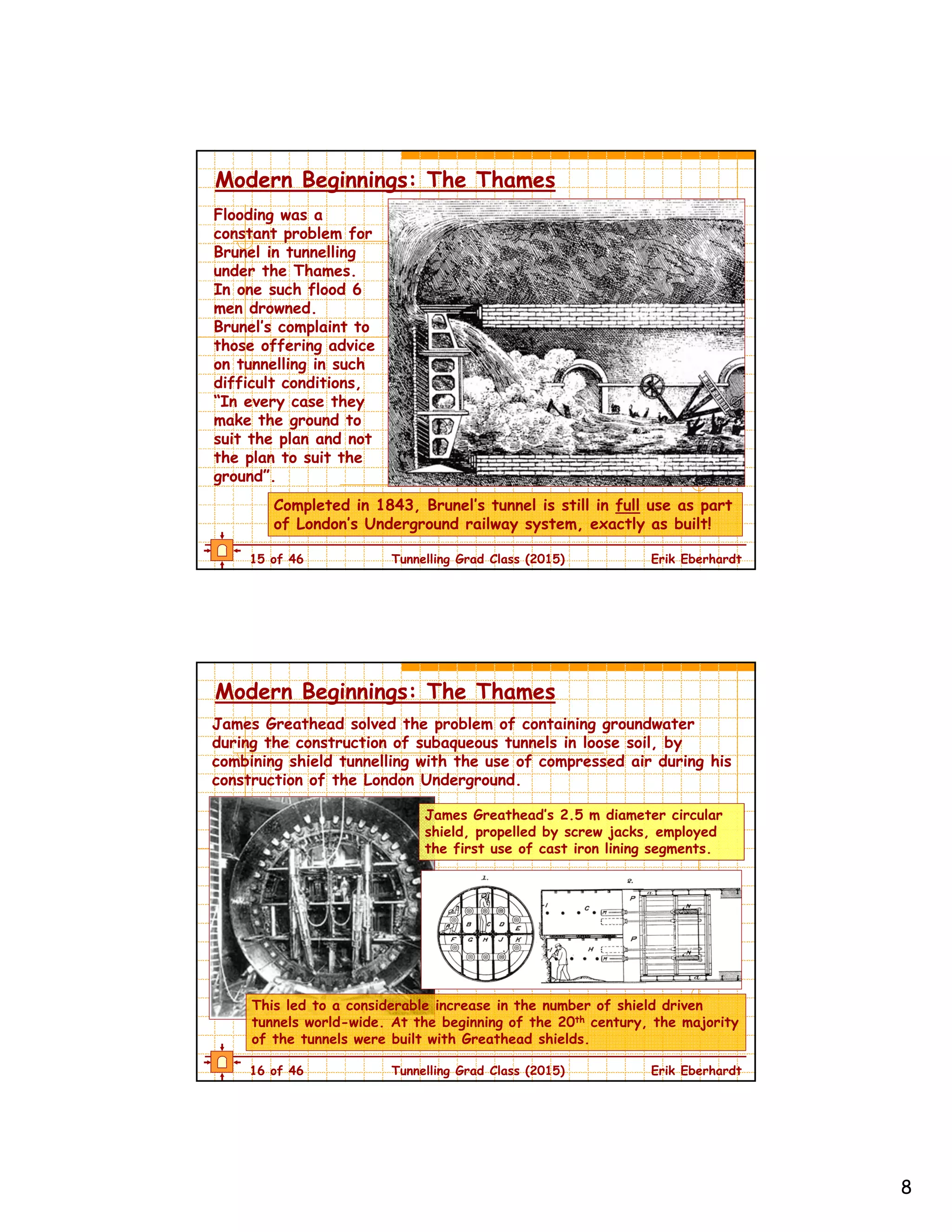
Tunnelling in soft, water saturated
ground began with Marc Brunel when
he invented the principle of shield
tunnelling and undertook a contract to
tunnel under the Thames between
1825 and 1841. His shield consisted
of 12 independent cells in which
workers hand excavated the ground
behind a secure wall of ‘poling
boards’. One board would be removed
to provide access for digging, after
which it would be replaced and pushed
forward by hydraulic jacks to re-
engage the face support.
Brunel’s shield was 7 m high and 12 m wide, and
enabled 36 miners to work the tunnel face at
one time. The brickwork built right behind the
‘shield’ served as an abutment for the whole
frame. On average, progress was 3-5 m/week.
Harding (1981)
8
15 of 46 Tunnelling Grad Class (2015) Erik Eberhardt
Modern Beginnings: The Thames
Flooding was a
constant problem for
Brunel in tunnelling
under the Thames.
In one such flood 6
men drowned.
Brunel’s complaint to
those offering advice
on tunnelling in such
difficult conditions,
“In every case they
make the ground to
suit the plan and not
the plan to suit the
ground”.
Completed in 1843, Brunel’s tunnel is still in full use as part
of London’s Underground railway system, exactly as built!
16 of 46 Tunnelling Grad Class (2015) Erik Eberhardt
Modern Beginnings: The Thames
James Greathead solved the problem of containing groundwater
during the construction of subaqueous tunnels in loose soil, by
combining shield tunnelling with the use of compressed air during his
construction of the London Underground.
This led to a considerable increase in the number of shield driven
tunnels world-wide. At the beginning of the 20th century, the majority
of the tunnels were built with Greathead shields.
James Greathead’s 2.5 m diameter circular
shield, propelled by screw jacks, employed
the first use of cast iron lining segments.
9
17 of 46 Tunnelling Grad Class (2015) Erik Eberhardt
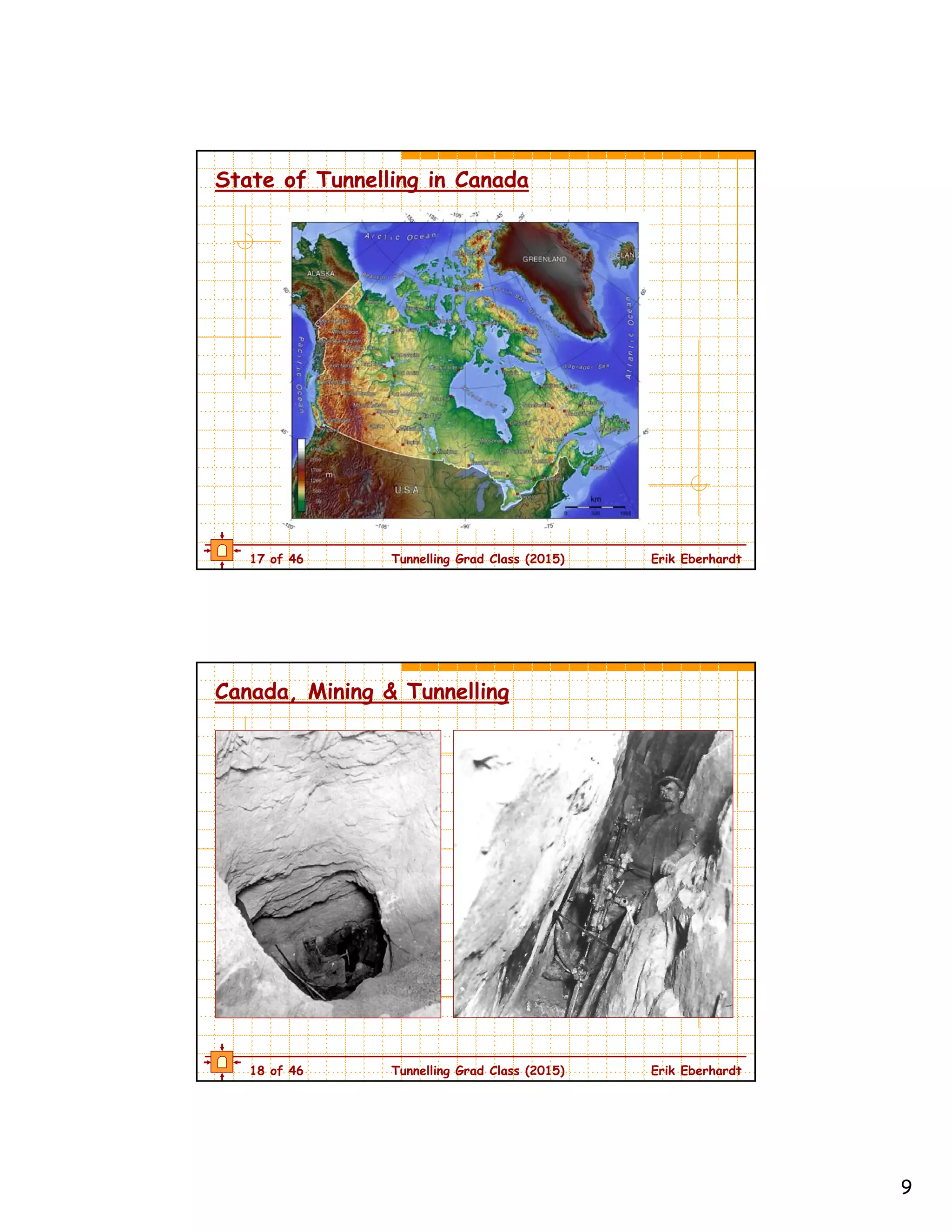
State of Tunnelling in Canada
18 of 46 Tunnelling Grad Class (2015) Erik Eberhardt
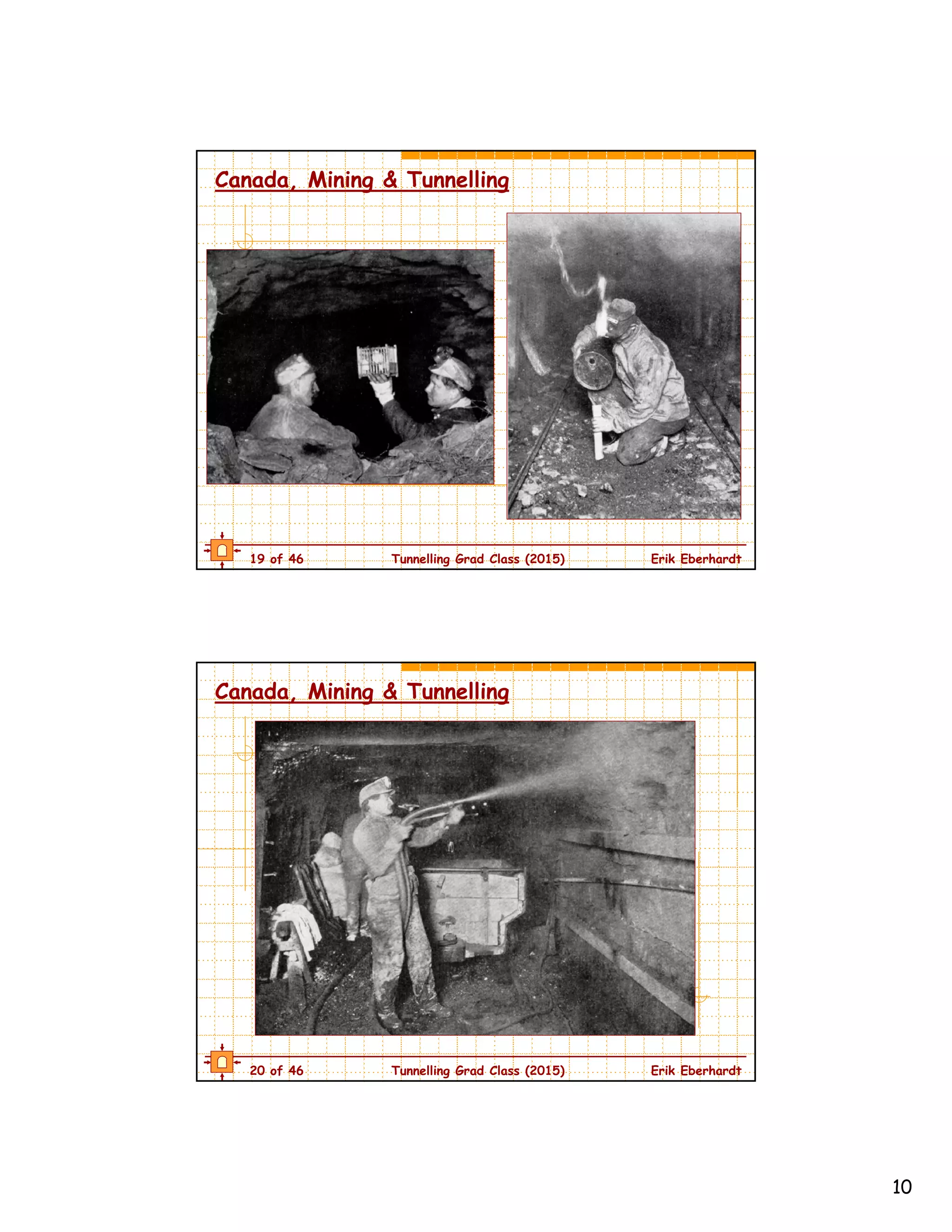
Canada, Mining & Tunnelling
10
19 of 46 Tunnelling Grad Class (2015) Erik Eberhardt
Canada, Mining & Tunnelling
20 of 46 Tunnelling Grad Class (2015) Erik Eberhardt
Canada, Mining & Tunnelling
11
21 of 46 Tunnelling Grad Class (2015) Erik Eberhardt
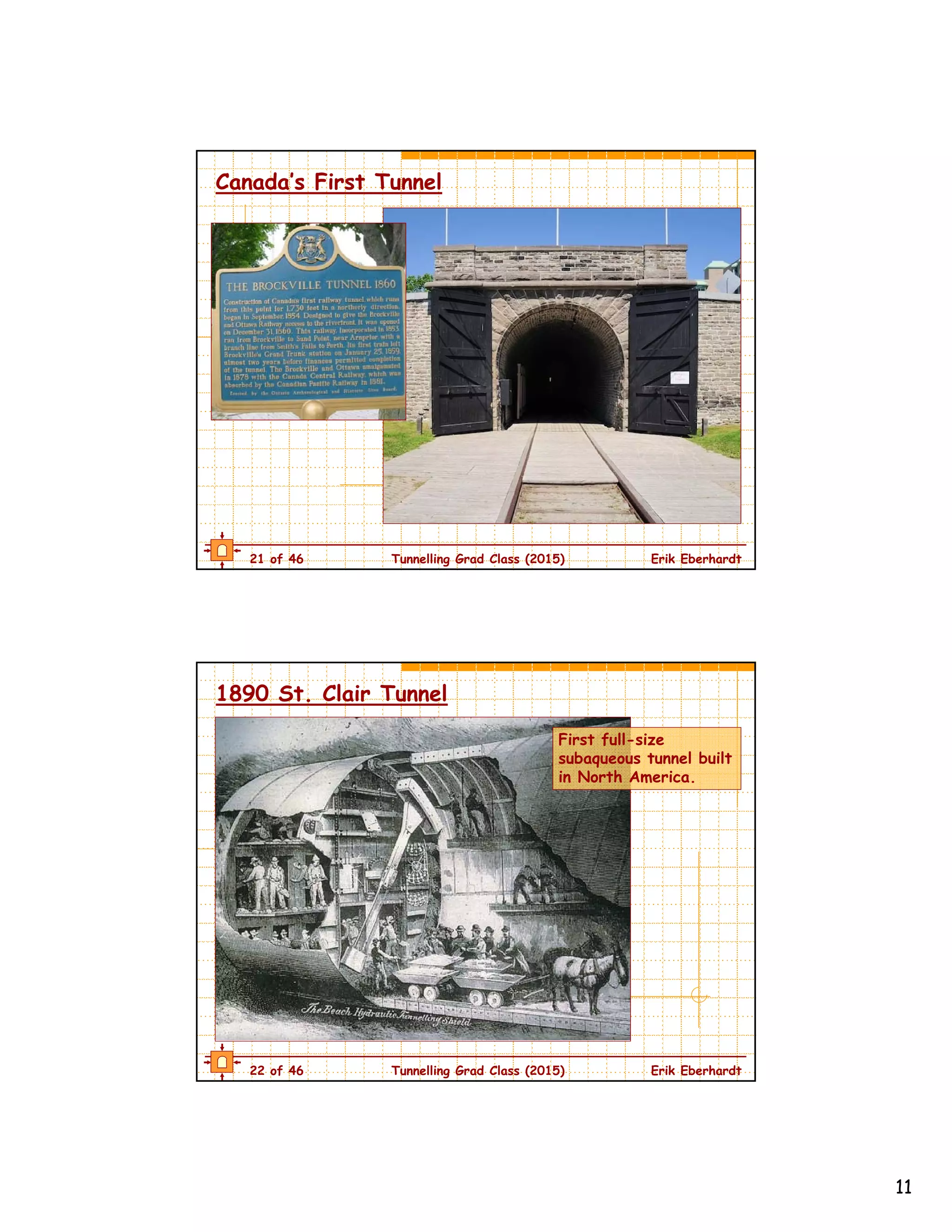
Canada’s First Tunnel
22 of 46 Tunnelling Grad Class (2015) Erik Eberhardt
1890 St. Clair Tunnel
First full-size
subaqueous tunnel built
in North America.
12
23 of 46 Tunnelling Grad Class (2015) Erik Eberhardt
1909 Spiral Tunnel
24 of 46 Tunnelling Grad Class (2015) Erik Eberhardt
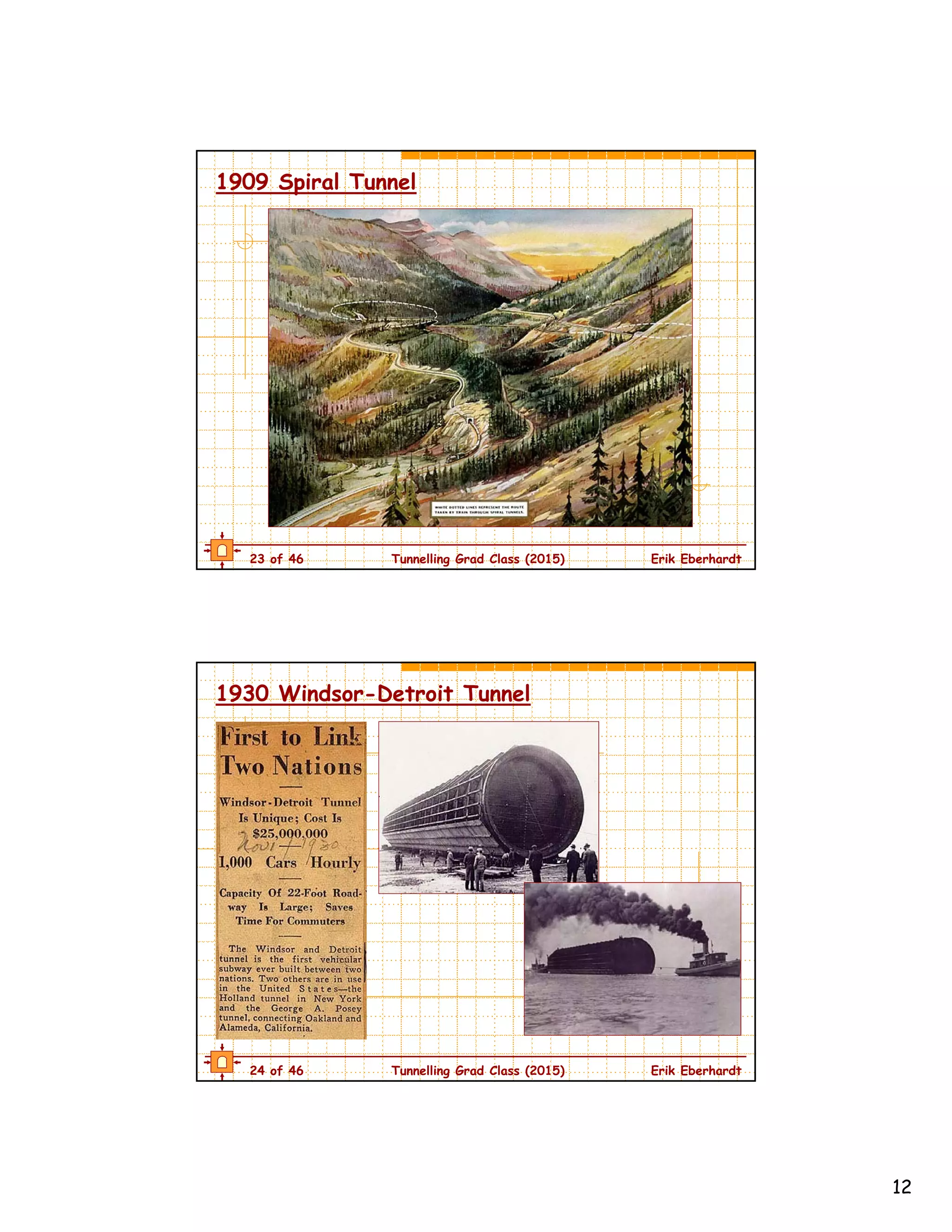
1930 Windsor-Detroit Tunnel
13
25 of 46 Tunnelling Grad Class (2015) Erik Eberhardt
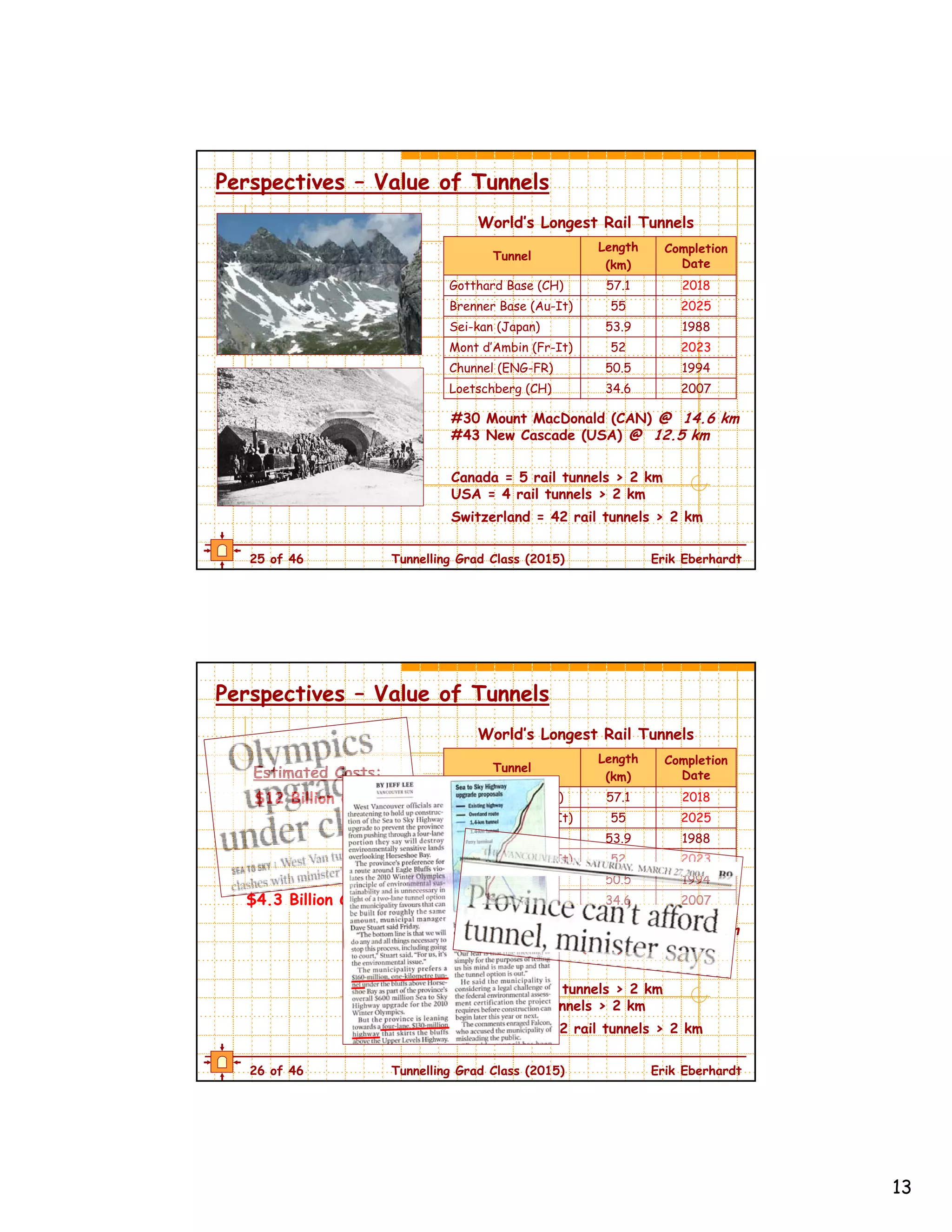
Tunnel
Length
(km)
Completion
Date
Gotthard Base (CH) 57.1 2018
Brenner Base (Au-It) 55 2025
Sei-kan (Japan) 53.9 1988
Mont d’Ambin (Fr-It) 52 2023
Chunnel (ENG-FR) 50.5 1994
Loetschberg (CH) 34.6 2007
World’s Longest Rail Tunnels
#30 Mount MacDonald (CAN) @ 14.6 km
#43 New Cascade (USA) @ 12.5 km
Canada = 5 rail tunnels > 2 km
USA = 4 rail tunnels > 2 km
Switzerland = 42 rail tunnels > 2 km
Perspectives – Value of Tunnels
26 of 46 Tunnelling Grad Class (2015) Erik Eberhardt
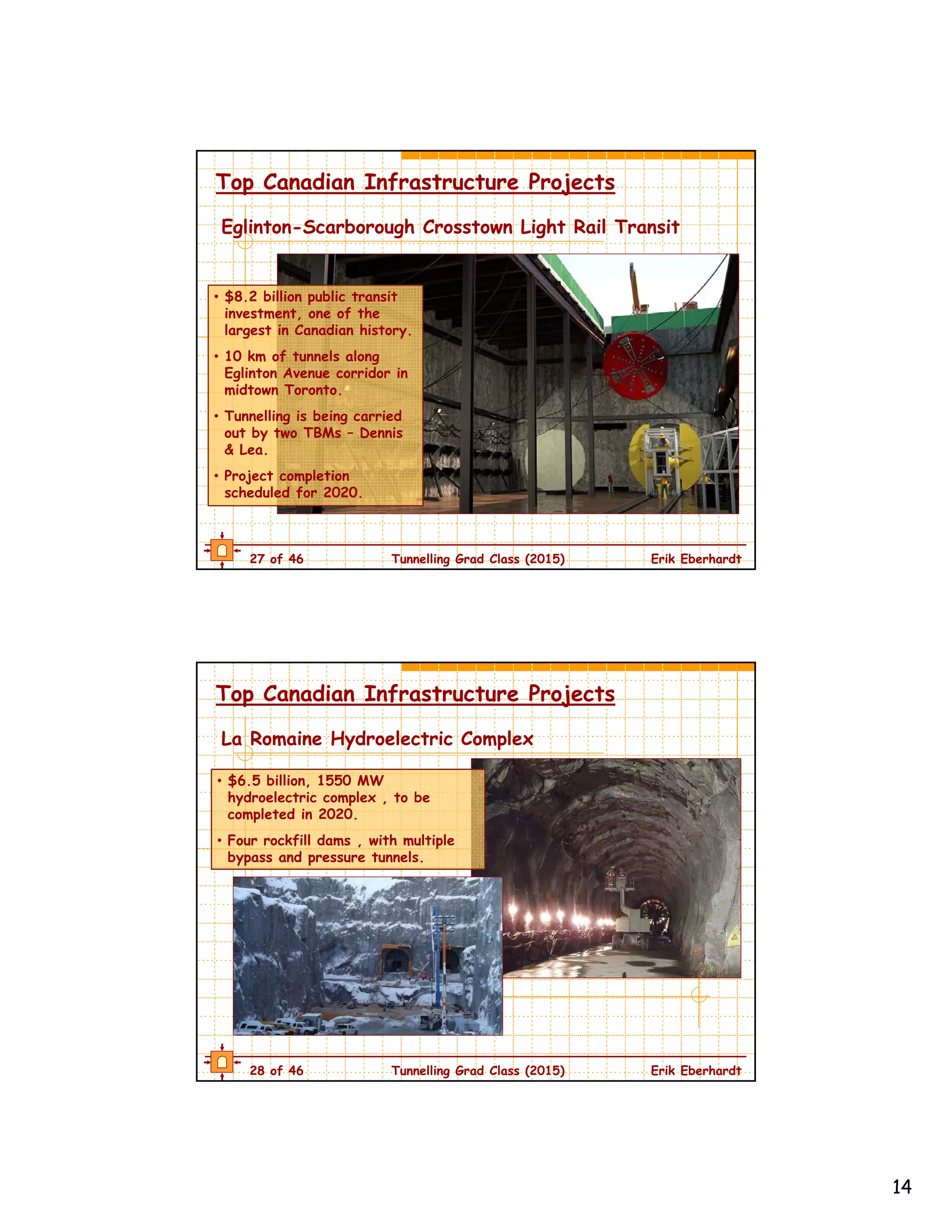
Tunnel
Length
(km)
Completion
Date
Gotthard Base (CH) 57.1 2018
Brenner Base (Au-It) 55 2025
Sei-kan (Japan) 53.9 1988
Mont d’Ambin (Fr-It) 52 2023
Chunnel (ENG-FR) 50.5 1994
Loetschberg (CH) 34.6 2007
World’s Longest Rail Tunnels
#30 Mount MacDonald (CAN) @ 14.6 km
#43 New Cascade (USA) @ 12.5 km
Canada = 5 rail tunnels > 2 km
USA = 4 rail tunnels > 2 km
Switzerland = 42 rail tunnels > 2 km
Perspectives – Value of Tunnels
Estimated Costs:
$12 Billion CDN
$4.3 Billion CDN
14
27 of 46 Tunnelling Grad Class (2015) Erik Eberhardt
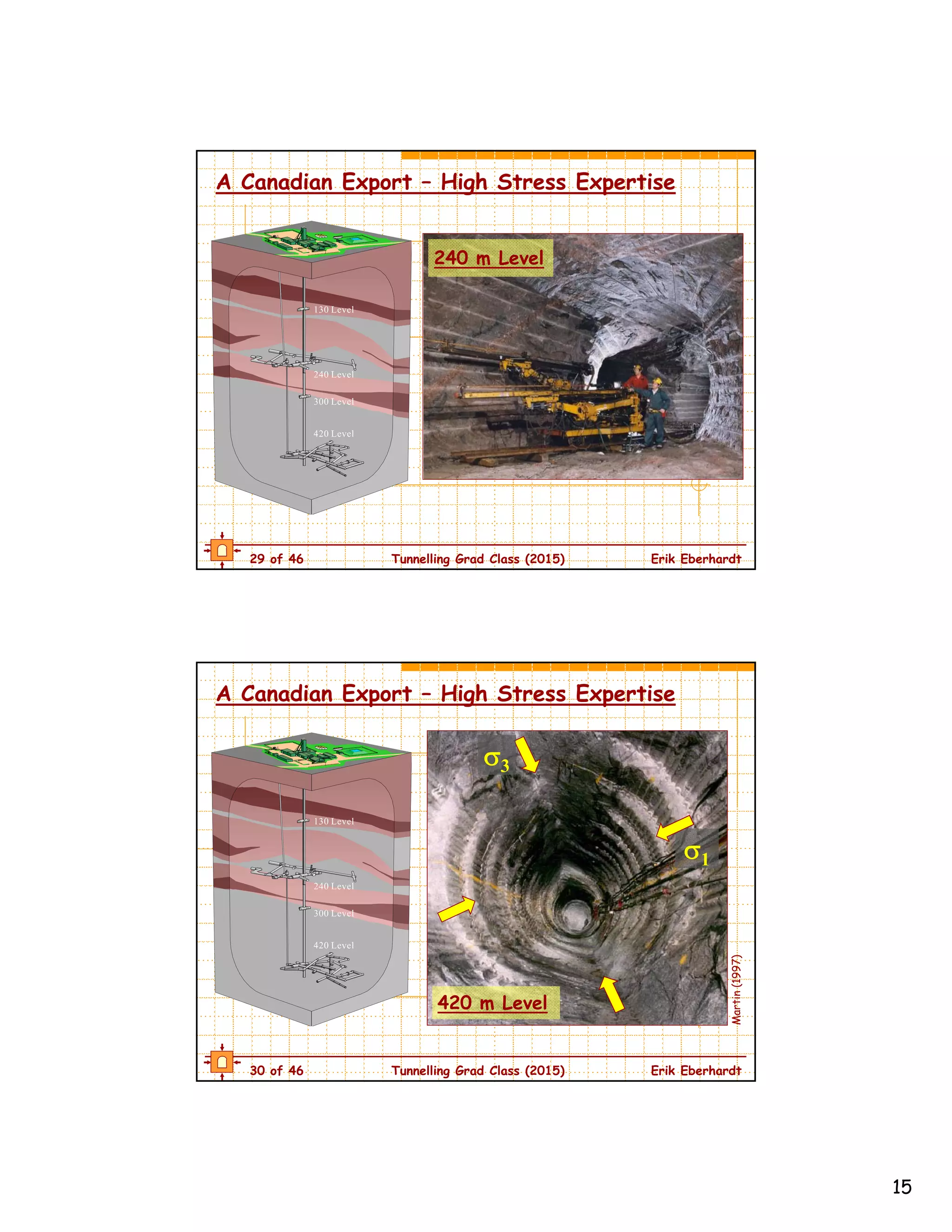
Eglinton-Scarborough Crosstown Light Rail Transit
• $8.2 billion public transit
investment, one of the
largest in Canadian history.
• 10 km of tunnels along
Eglinton Avenue corridor in
midtown Toronto.
• Tunnelling is being carried
out by two TBMs – Dennis
& Lea.
• Project completion
scheduled for 2020.
Top Canadian Infrastructure Projects
28 of 46 Tunnelling Grad Class (2015) Erik Eberhardt
La Romaine Hydroelectric Complex
• $6.5 billion, 1550 MW
hydroelectric complex , to be
completed in 2020.
• Four rockfill dams , with multiple
bypass and pressure tunnels.
Top Canadian Infrastructure Projects
15
29 of 46 Tunnelling Grad Class (2015) Erik Eberhardt
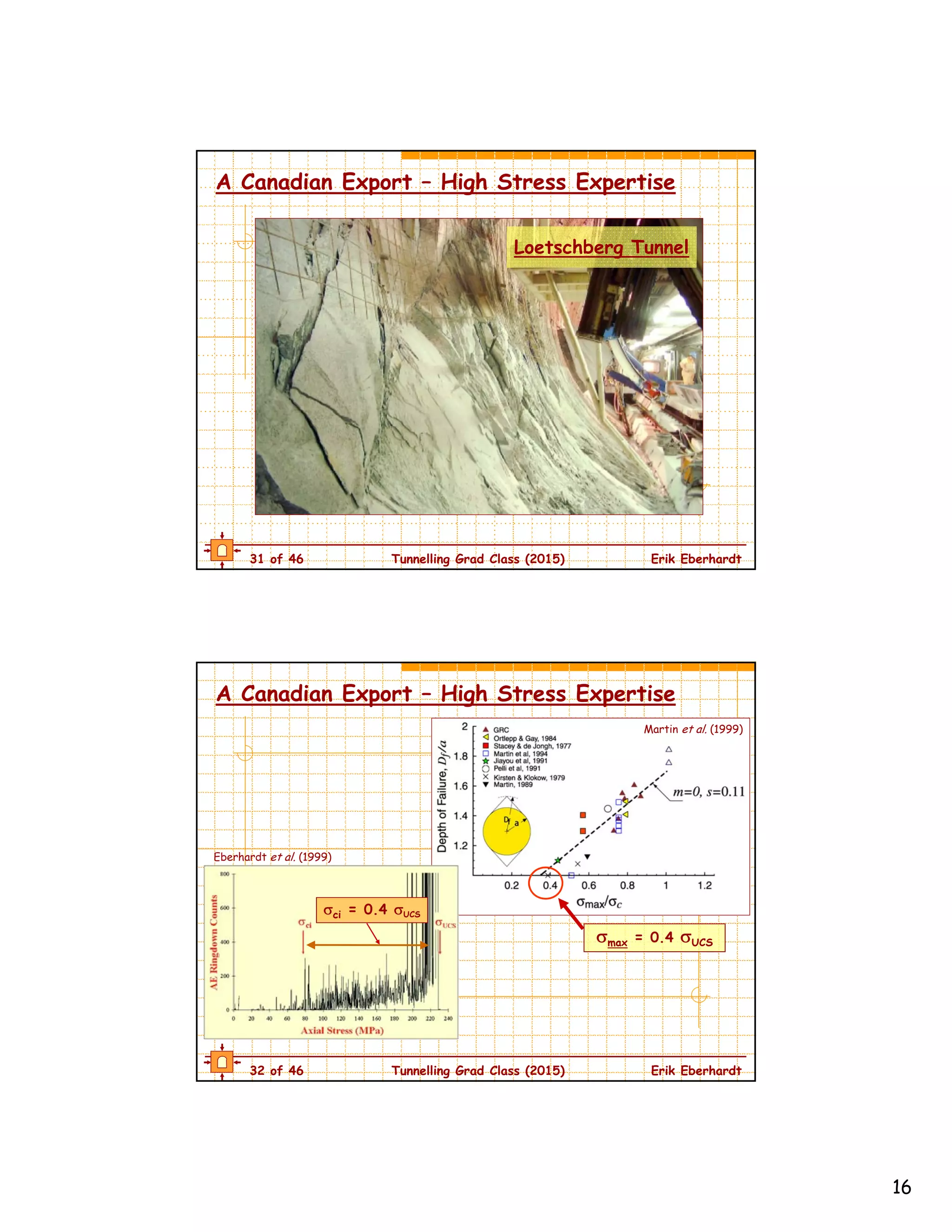
240 m Level
A Canadian Export – High Stress Expertise
30 of 46 Tunnelling Grad Class (2015) Erik Eberhardt
3
1
420 m Level
Martin(1997)
A Canadian Export – High Stress Expertise
16
31 of 46 Tunnelling Grad Class (2015) Erik Eberhardt
Loetschberg Tunnel
A Canadian Export – High Stress Expertise
32 of 46 Tunnelling Grad Class (2015) Erik Eberhardt
max = 0.4 UCS
Martin et al. (1999)
ci = 0.4 UCS
Eberhardt et al. (1999)
A Canadian Export – High Stress Expertise
17
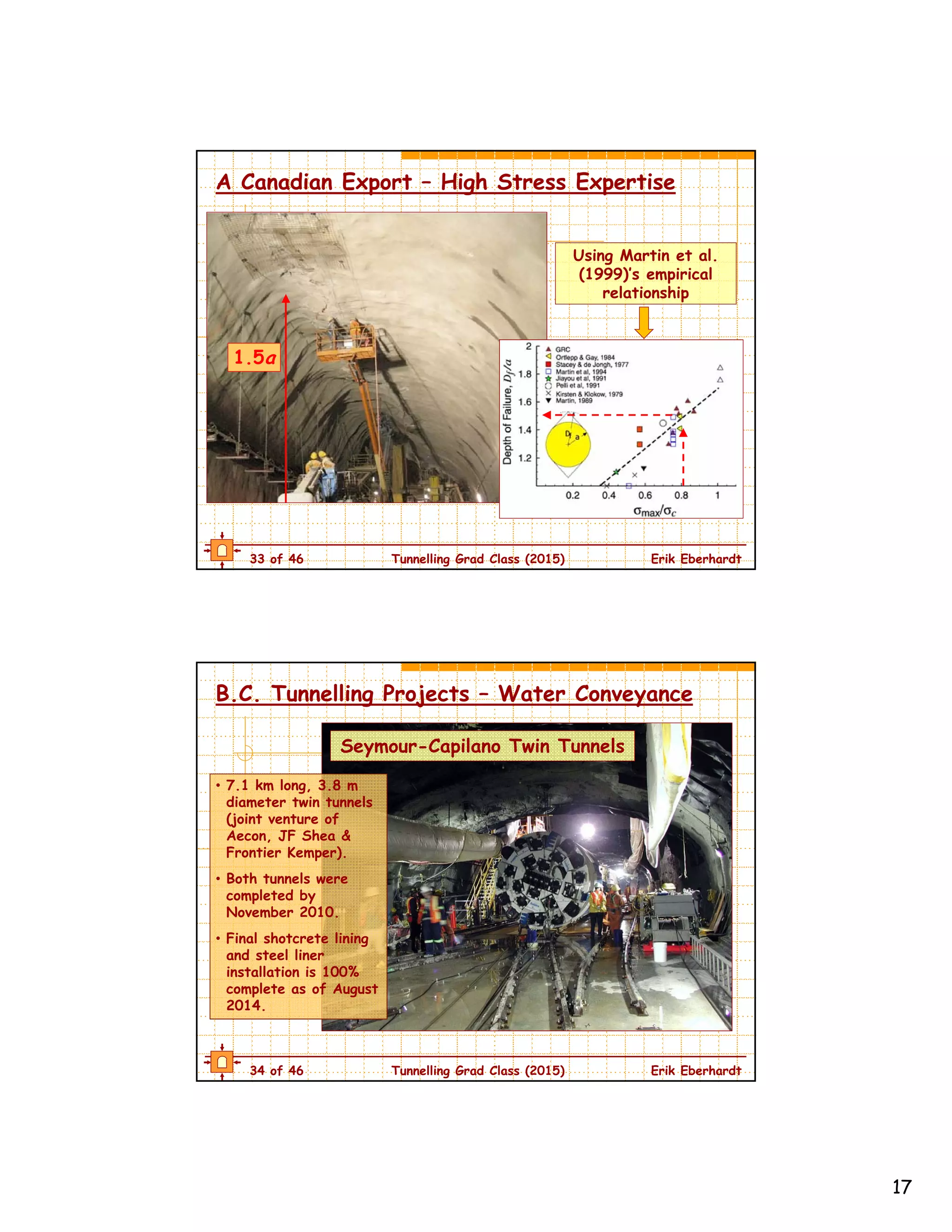
33 of 46 Tunnelling Grad Class (2015) Erik Eberhardt
A Canadian Export – High Stress Expertise
Using Martin et al.
(1999)’s empirical
relationship
1.5a
34 of 46 Tunnelling Grad Class (2015) Erik Eberhardt
• 7.1 km long, 3.8 m
diameter twin tunnels
(joint venture of
Aecon, JF Shea &
Frontier Kemper).
• Both tunnels were
completed by
November 2010.
• Final shotcrete lining
and steel liner
installation is 100%
complete as of August
2014.
Seymour-Capilano Twin Tunnels
B.C. Tunnelling Projects – Water Conveyance
18
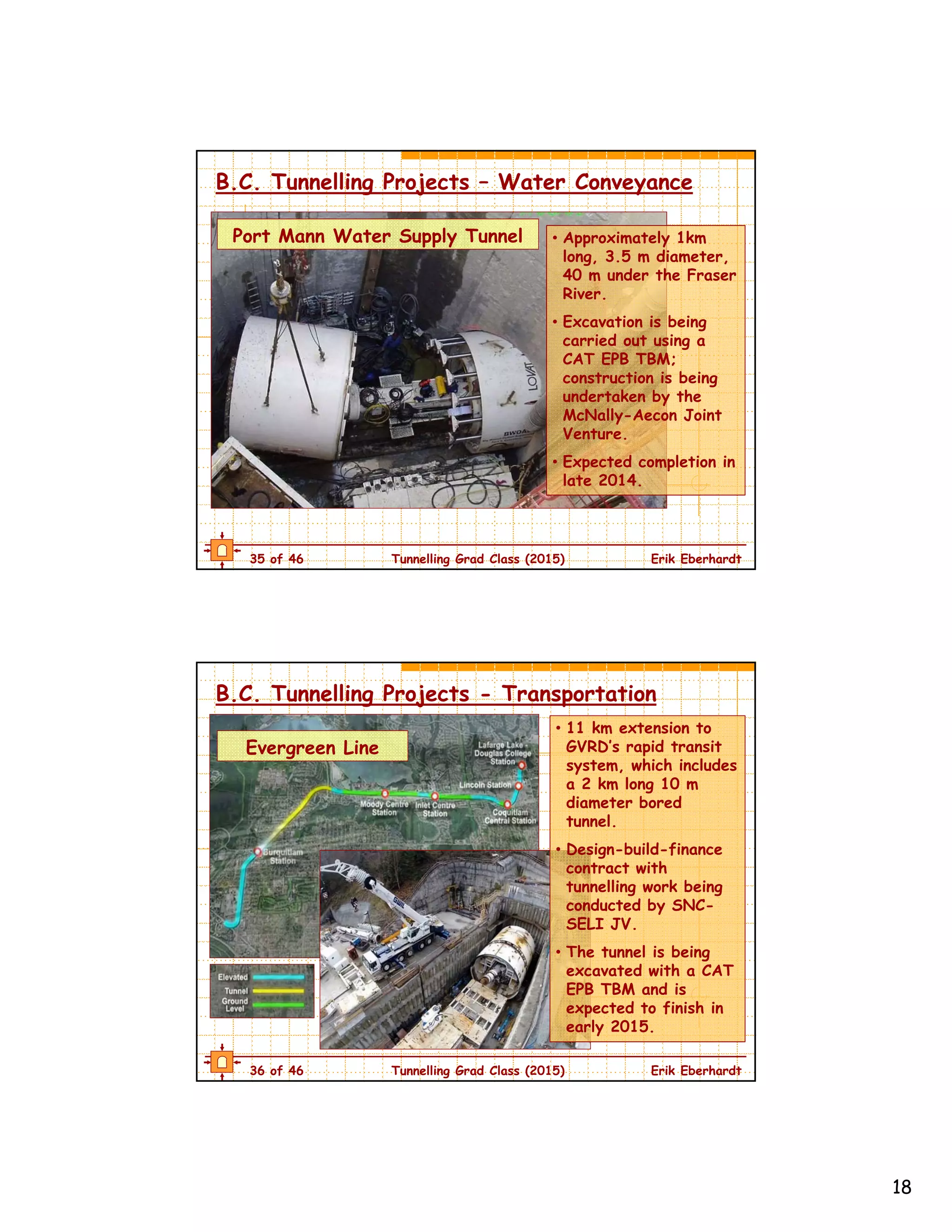
35 of 46 Tunnelling Grad Class (2015) Erik Eberhardt
Port Mann Water Supply Tunnel • Approximately 1km
long, 3.5 m diameter,
40 m under the Fraser
River.
• Excavation is being
carried out using a
CAT EPB TBM;
construction is being
undertaken by the
McNally-Aecon Joint
Venture.
• Expected completion in
late 2014.
B.C. Tunnelling Projects – Water Conveyance
36 of 46 Tunnelling Grad Class (2015) Erik Eberhardt
Evergreen Line
B.C. Tunnelling Projects - Transportation
• 11 km extension to
GVRD’s rapid transit
system, which includes
a 2 km long 10 m
diameter bored
tunnel.
• Design-build-finance
contract with
tunnelling work being
conducted by SNC-
SELI JV.
• The tunnel is being
excavated with a CAT
EPB TBM and is
expected to finish in
early 2015.
19
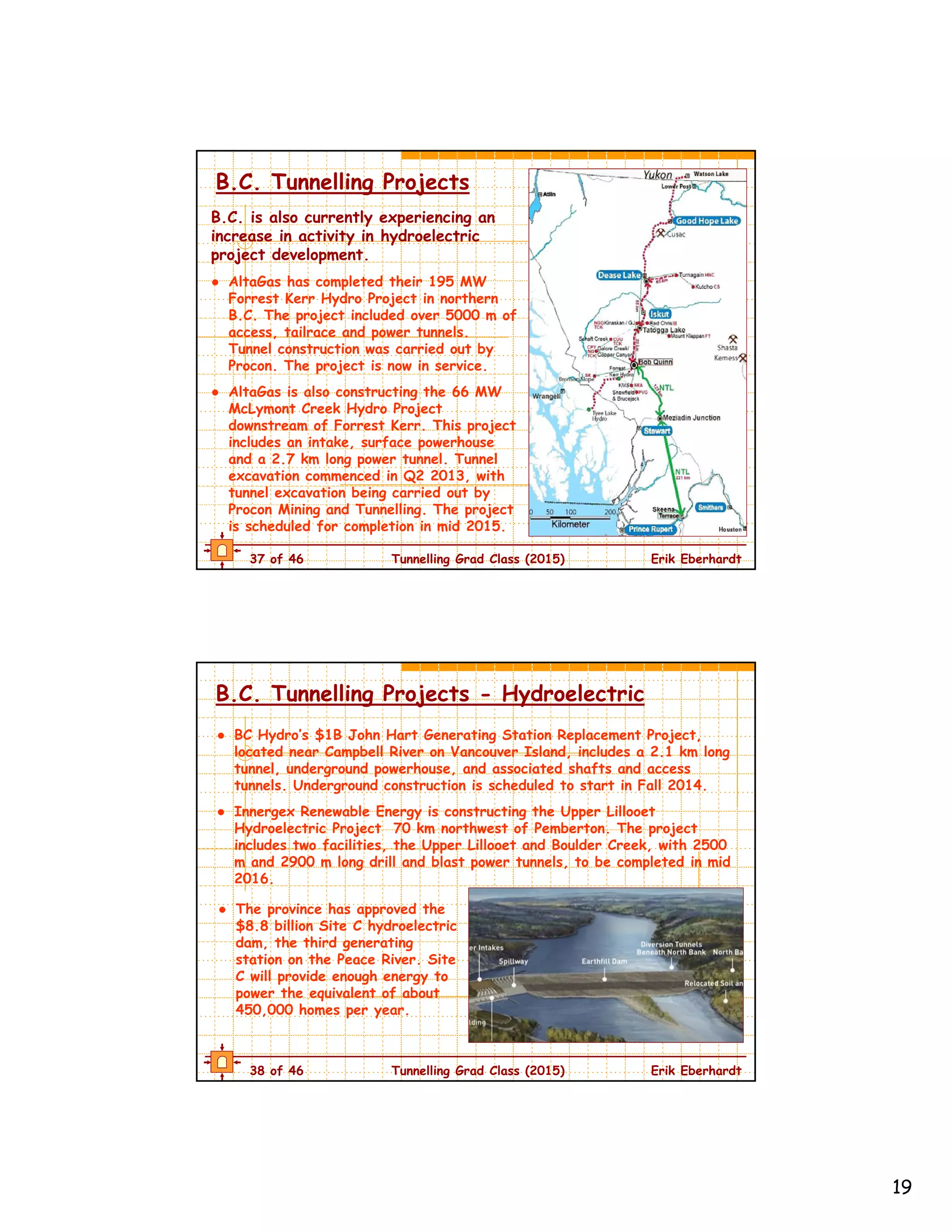
37 of 46 Tunnelling Grad Class (2015) Erik Eberhardt
B.C. Tunnelling Projects
B.C. is also currently experiencing an
increase in activity in hydroelectric
project development.
● AltaGas has completed their 195 MW
Forrest Kerr Hydro Project in northern
B.C. The project included over 5000 m of
access, tailrace and power tunnels.
Tunnel construction was carried out by
Procon. The project is now in service.
● AltaGas is also constructing the 66 MW
McLymont Creek Hydro Project
downstream of Forrest Kerr. This project
includes an intake, surface powerhouse
and a 2.7 km long power tunnel. Tunnel
excavation commenced in Q2 2013, with
tunnel excavation being carried out by
Procon Mining and Tunnelling. The project
is scheduled for completion in mid 2015.
38 of 46 Tunnelling Grad Class (2015) Erik Eberhardt
B.C. Tunnelling Projects - Hydroelectric
● BC Hydro’s $1B John Hart Generating Station Replacement Project,
located near Campbell River on Vancouver Island, includes a 2.1 km long
tunnel, underground powerhouse, and associated shafts and access
tunnels. Underground construction is scheduled to start in Fall 2014.
● Innergex Renewable Energy is constructing the Upper Lillooet
Hydroelectric Project 70 km northwest of Pemberton. The project
includes two facilities, the Upper Lillooet and Boulder Creek, with 2500
m and 2900 m long drill and blast power tunnels, to be completed in mid
2016.
● The province has approved the
$8.8 billion Site C hydroelectric
dam, the third generating
station on the Peace River. Site
C will provide enough energy to
power the equivalent of about
450,000 homes per year.
20
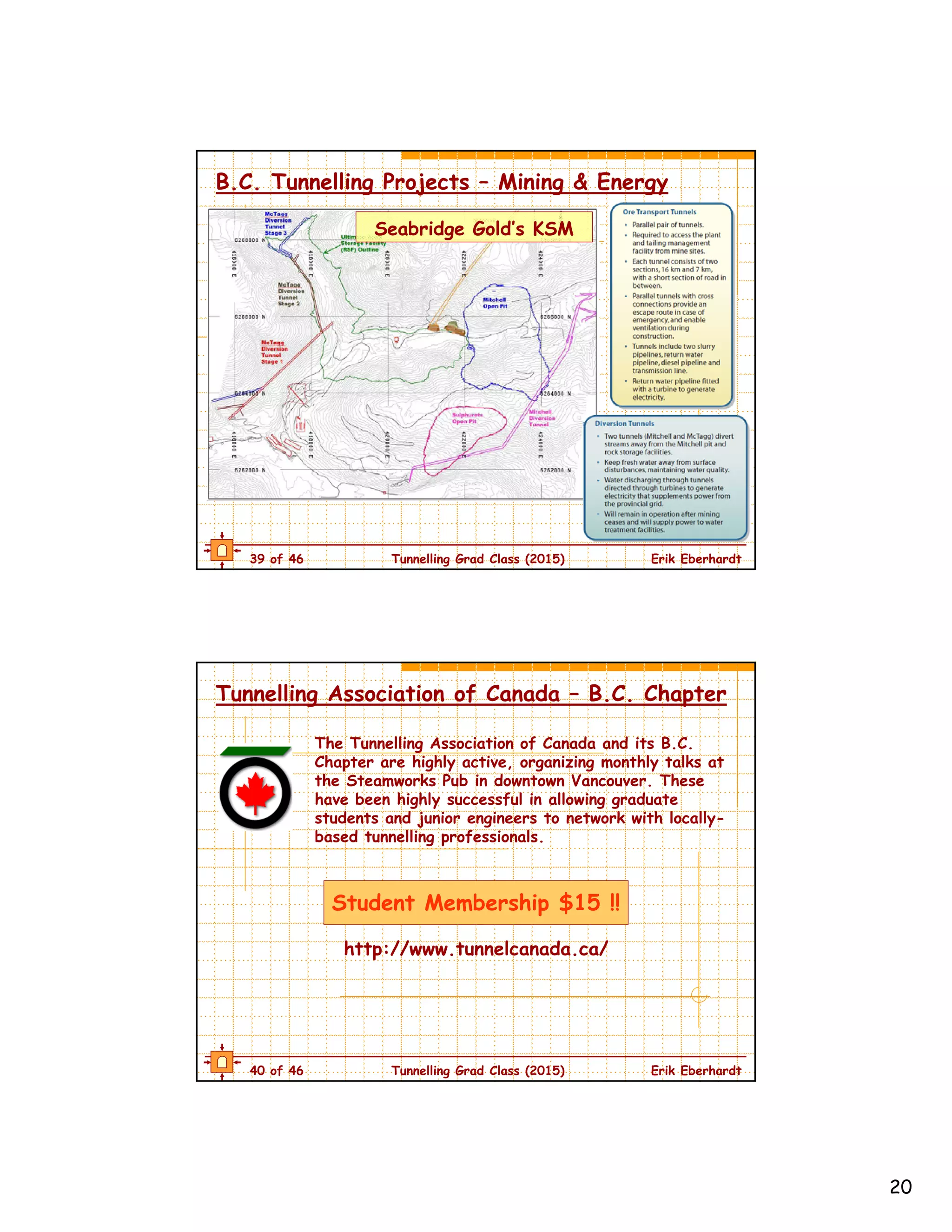
39 of 46 Tunnelling Grad Class (2015) Erik Eberhardt
B.C. Tunnelling Projects – Mining & Energy
Seabridge Gold’s KSM
40 of 46 Tunnelling Grad Class (2015) Erik Eberhardt
Tunnelling Association of Canada – B.C. Chapter
The Tunnelling Association of Canada and its B.C.
Chapter are highly active, organizing monthly talks at
the Steamworks Pub in downtown Vancouver. These
have been highly successful in allowing graduate
students and junior engineers to network with locally-
based tunnelling professionals.
Student Membership $15 !!
http://www.tunnelcanada.ca/
21
41 of 46 Tunnelling Grad Class (2015) Erik Eberhardt
Future Perspectives
• The level of tunnelling expertise within Canada is
extensive, honed through the large number of tunnels
that have been completed in a variety of challenging
geological settings, in major cities and remote locations.
• Our collective experiences with EPB in glacial deposits
and hard rock tunnelling in high stresses are only two
examples where Canada has positioned itself as an
international leader.
• The tunnelling industry is active in B.C., with a number
of transportation, water and sewer, hydroelectric, mining
and pipeline projects planned, ongoing and completed in
Greater Vancouver and other regions of the province.

Tunnelling & underground design (Topic1-introduction to the tunnelling industry)

  • 1.
    1 1 of 46Tunnelling Grad Class (2015) Erik Eberhardt EOSC547: Tunnelling & Underground Design Topic 1: Introduction – Tunnelling Past & Present 2 of 46 Tunnelling Grad Class (2015) Erik Eberhardt Tunnelling Challenges: Bertha Seattle is undertaking the replacement of the Alaskan Way Viaduct with a 3.2 km tunnel. The project is estimated to cost US$4.25 billion. The $80 million TBM - Bertha - created for this project by Hitachi Zosen Corporation is a record-breaking 17.5 m diameter. Currently, the TBM has been stuck since December 2013, after only 10% of the way through. Investigators believe that Bertha was overheating—that grime and gunk had gotten past bearing seals, entered the machine, and muddied the operation. Engineers still aren't sure why this happened, but they have decided they need to replace not only the seals but also the $5 million main bearing.
  • 2.
    2 3 of 46Tunnelling Grad Class (2015) Erik Eberhardt Tunnelling Challenges: Bertha The contractor is now asking for an additional $188 million to cover the unexpected expenses. As a Design-Build contract, the state is refusing to pay, which will likely result in a claims law suit—or, if costs rise too much, the contractor could possibly abandon the project. 4 of 46 Tunnelling Grad Class (2015) Erik Eberhardt Tunnelling Challenges: Seymour-Capilano Litigation is underway over the $200M Seymour-Capilano Twin Tunnels, where a dispute had arose regarding the safety of the design because of unexpected rock mass conditions. The contractor stopped work half way through, and Metro Vancouver cancelled the contract and sued for breach of contract. A new contractor was brought in to complete the tunnels – using the same design; the estimated cost overrun is 100%.
  • 3.
    3 5 of 46Tunnelling Grad Class (2015) Erik Eberhardt Tunnelling Challenges The Boston "Big Dig" rerouted a major highway that passed through the city centre underground. This freed up an unprecedented 30 acres in downtown Boston, giving planners a historic opportunity to shape the future of the city. At US$14.6 billion, this was the most costly highway project in the U.S., but it was plagued by escalating costs, scheduling overruns, leaks, design flaws, charges of poor execution and use of substandard materials, criminal arrests, and one death. The project was completed 9 years late and about 190% over budget. 6 of 46 Tunnelling Grad Class (2015) Erik Eberhardt Tunnelling Successes – Canada Line The $2 billion Canada Line was completed 15 weeks ahead of schedule and on budget. Although Cambie Street merchants protested over lost business incurred during construction, property values along the line have increased and ridership has steadily grown and exceeded projections. In terms of environmental benefits, Canada Line’s transportation capacity represents a reduction of 14,000 tons of CO2 emission over its first 5 years.
  • 4.
    4 7 of 46Tunnelling Grad Class (2015) Erik Eberhardt Course Overview The topics we’ll examine will step through the tunnel design process, from the writing and review of geotechnical baseline reports, to tunnelling methods for different ground conditions, to support design. In this course, we’ll examine the different principles, approaches, and tools used in tunnel excavation and underground design. The examples and case histories reviewed will focus on tunnel excavations in both soft soil and hard rock. 8 of 46 Tunnelling Grad Class (2015) Erik Eberhardt Content Tunnelling in Weak Rock – Terzaghi’s rock load; sequential excavation; observational approach. Tunnelling in Burst-Prone Rock – stress as a boundary condition; in situ stress determination. Soft Ground Tunnelling Methods – cut and cover; compressed air; earth pressure balance machines. Support of Tunnels – ground response & support interaction curves. Rock Support & Excavation – NATM. Introduction – state of tunnelling, tunnelling in Canada. Geotechnical Baseline Reports – contract types; baseline reports; site investigation; risk. Geological Uncertainty – “The Known Knowns, Known Unknowns, & Unknown Unknowns”. Hard Rock Tunnelling Methods – drill and blast; open tunnel boring machines, ground support types.
  • 5.
    5 9 of 46Tunnelling Grad Class (2015) Erik Eberhardt General Information Lectures: Monday, 11:00 to 13:00 (ESB 5108) Grades: tunnel design assignment Part 1 – Baseline Report 15% Part 2 – Squeezing Ground 25% Part 3 – Spalling & Bursting 25% student prepared lecture 25% peer review participation 10% Contact Info – 251 EOS South Phone: (604) 827-5573 E-mail: erik@eos.ubc.ca 10 of 46 Tunnelling Grad Class (2015) Erik Eberhardt All major ancient civilizations developed tunneling methods. In Babylonia, tunnels were used extensively for irrigation; and a brick- lined pedestrian passage some 900 m long was built around 2180 BC under the Euphrates River to connect the royal palace with the temple. Construction was accomplished by diverting the river during the dry season. Tunnel Construction: In the Beginning
  • 6.
    6 11 of 46Tunnelling Grad Class (2015) Erik Eberhardt Tunnel Construction: In the Beginning Perhaps the largest tunnel in ancient times was a 1600 m long, 8 m wide, 10 m high road tunnel (the Pausilippo) between Naples and Pozzuoli, built in 36 BC. The Greeks and Romans both made extensive use of tunnels to reclaim land by drainage and for water aqueducts. 6th-century-BC Greek water tunnel on the isle of Samos driven some 1100 m through limestone with a cross section about 2 x 2 m. 12 of 46 Tunnelling Grad Class (2015) Erik Eberhardt Tunnel Construction: In the Beginning In the AD 41, Romans used some 30,000 men to push a 6 km tunnel over 10 years to drain Lacus Fucinus. They worked from shafts 40 m apart and up to 125 m deep. Far more attention was paid to ventilation and safety measures when workers were freemen, compared to those who were slaves.
  • 7.
    7 13 of 46Tunnelling Grad Class (2015) Erik Eberhardt Tunnel Construction: In the Beginning Ancient construction was carried out using a succession of closely spaced shafts to provide ventilation. String line and plumb bobs were used for surveying. Ventilation methods were primitive, often limited to waving a canvas at the mouth of the shaft, and most tunnels claimed the lives of hundreds or even thousands of the slaves used as workers. To save the need for a lining, most ancient tunnels were located in strong rock, which was excavated by heating the rock with fire and suddenly cooling it by dousing with water causing the rock to spall. 14 of 46 Tunnelling Grad Class (2015) Erik Eberhardt Modern Beginnings: The Thames Tunnelling in soft, water saturated ground began with Marc Brunel when he invented the principle of shield tunnelling and undertook a contract to tunnel under the Thames between 1825 and 1841. His shield consisted of 12 independent cells in which workers hand excavated the ground behind a secure wall of ‘poling boards’. One board would be removed to provide access for digging, after which it would be replaced and pushed forward by hydraulic jacks to re- engage the face support. Brunel’s shield was 7 m high and 12 m wide, and enabled 36 miners to work the tunnel face at one time. The brickwork built right behind the ‘shield’ served as an abutment for the whole frame. On average, progress was 3-5 m/week. Harding (1981)
  • 8.
    8 15 of 46Tunnelling Grad Class (2015) Erik Eberhardt Modern Beginnings: The Thames Flooding was a constant problem for Brunel in tunnelling under the Thames. In one such flood 6 men drowned. Brunel’s complaint to those offering advice on tunnelling in such difficult conditions, “In every case they make the ground to suit the plan and not the plan to suit the ground”. Completed in 1843, Brunel’s tunnel is still in full use as part of London’s Underground railway system, exactly as built! 16 of 46 Tunnelling Grad Class (2015) Erik Eberhardt Modern Beginnings: The Thames James Greathead solved the problem of containing groundwater during the construction of subaqueous tunnels in loose soil, by combining shield tunnelling with the use of compressed air during his construction of the London Underground. This led to a considerable increase in the number of shield driven tunnels world-wide. At the beginning of the 20th century, the majority of the tunnels were built with Greathead shields. James Greathead’s 2.5 m diameter circular shield, propelled by screw jacks, employed the first use of cast iron lining segments.
  • 9.
    9 17 of 46Tunnelling Grad Class (2015) Erik Eberhardt State of Tunnelling in Canada 18 of 46 Tunnelling Grad Class (2015) Erik Eberhardt Canada, Mining & Tunnelling
  • 10.
    10 19 of 46Tunnelling Grad Class (2015) Erik Eberhardt Canada, Mining & Tunnelling 20 of 46 Tunnelling Grad Class (2015) Erik Eberhardt Canada, Mining & Tunnelling
  • 11.
    11 21 of 46Tunnelling Grad Class (2015) Erik Eberhardt Canada’s First Tunnel 22 of 46 Tunnelling Grad Class (2015) Erik Eberhardt 1890 St. Clair Tunnel First full-size subaqueous tunnel built in North America.
  • 12.
    12 23 of 46Tunnelling Grad Class (2015) Erik Eberhardt 1909 Spiral Tunnel 24 of 46 Tunnelling Grad Class (2015) Erik Eberhardt 1930 Windsor-Detroit Tunnel
  • 13.
    13 25 of 46Tunnelling Grad Class (2015) Erik Eberhardt Tunnel Length (km) Completion Date Gotthard Base (CH) 57.1 2018 Brenner Base (Au-It) 55 2025 Sei-kan (Japan) 53.9 1988 Mont d’Ambin (Fr-It) 52 2023 Chunnel (ENG-FR) 50.5 1994 Loetschberg (CH) 34.6 2007 World’s Longest Rail Tunnels #30 Mount MacDonald (CAN) @ 14.6 km #43 New Cascade (USA) @ 12.5 km Canada = 5 rail tunnels > 2 km USA = 4 rail tunnels > 2 km Switzerland = 42 rail tunnels > 2 km Perspectives – Value of Tunnels 26 of 46 Tunnelling Grad Class (2015) Erik Eberhardt Tunnel Length (km) Completion Date Gotthard Base (CH) 57.1 2018 Brenner Base (Au-It) 55 2025 Sei-kan (Japan) 53.9 1988 Mont d’Ambin (Fr-It) 52 2023 Chunnel (ENG-FR) 50.5 1994 Loetschberg (CH) 34.6 2007 World’s Longest Rail Tunnels #30 Mount MacDonald (CAN) @ 14.6 km #43 New Cascade (USA) @ 12.5 km Canada = 5 rail tunnels > 2 km USA = 4 rail tunnels > 2 km Switzerland = 42 rail tunnels > 2 km Perspectives – Value of Tunnels Estimated Costs: $12 Billion CDN $4.3 Billion CDN
  • 14.
    14 27 of 46Tunnelling Grad Class (2015) Erik Eberhardt Eglinton-Scarborough Crosstown Light Rail Transit • $8.2 billion public transit investment, one of the largest in Canadian history. • 10 km of tunnels along Eglinton Avenue corridor in midtown Toronto. • Tunnelling is being carried out by two TBMs – Dennis & Lea. • Project completion scheduled for 2020. Top Canadian Infrastructure Projects 28 of 46 Tunnelling Grad Class (2015) Erik Eberhardt La Romaine Hydroelectric Complex • $6.5 billion, 1550 MW hydroelectric complex , to be completed in 2020. • Four rockfill dams , with multiple bypass and pressure tunnels. Top Canadian Infrastructure Projects
  • 15.
    15 29 of 46Tunnelling Grad Class (2015) Erik Eberhardt 240 m Level A Canadian Export – High Stress Expertise 30 of 46 Tunnelling Grad Class (2015) Erik Eberhardt 3 1 420 m Level Martin(1997) A Canadian Export – High Stress Expertise
  • 16.
    16 31 of 46Tunnelling Grad Class (2015) Erik Eberhardt Loetschberg Tunnel A Canadian Export – High Stress Expertise 32 of 46 Tunnelling Grad Class (2015) Erik Eberhardt max = 0.4 UCS Martin et al. (1999) ci = 0.4 UCS Eberhardt et al. (1999) A Canadian Export – High Stress Expertise
  • 17.
    17 33 of 46Tunnelling Grad Class (2015) Erik Eberhardt A Canadian Export – High Stress Expertise Using Martin et al. (1999)’s empirical relationship 1.5a 34 of 46 Tunnelling Grad Class (2015) Erik Eberhardt • 7.1 km long, 3.8 m diameter twin tunnels (joint venture of Aecon, JF Shea & Frontier Kemper). • Both tunnels were completed by November 2010. • Final shotcrete lining and steel liner installation is 100% complete as of August 2014. Seymour-Capilano Twin Tunnels B.C. Tunnelling Projects – Water Conveyance
  • 18.
    18 35 of 46Tunnelling Grad Class (2015) Erik Eberhardt Port Mann Water Supply Tunnel • Approximately 1km long, 3.5 m diameter, 40 m under the Fraser River. • Excavation is being carried out using a CAT EPB TBM; construction is being undertaken by the McNally-Aecon Joint Venture. • Expected completion in late 2014. B.C. Tunnelling Projects – Water Conveyance 36 of 46 Tunnelling Grad Class (2015) Erik Eberhardt Evergreen Line B.C. Tunnelling Projects - Transportation • 11 km extension to GVRD’s rapid transit system, which includes a 2 km long 10 m diameter bored tunnel. • Design-build-finance contract with tunnelling work being conducted by SNC- SELI JV. • The tunnel is being excavated with a CAT EPB TBM and is expected to finish in early 2015.
  • 19.
    19 37 of 46Tunnelling Grad Class (2015) Erik Eberhardt B.C. Tunnelling Projects B.C. is also currently experiencing an increase in activity in hydroelectric project development. ● AltaGas has completed their 195 MW Forrest Kerr Hydro Project in northern B.C. The project included over 5000 m of access, tailrace and power tunnels. Tunnel construction was carried out by Procon. The project is now in service. ● AltaGas is also constructing the 66 MW McLymont Creek Hydro Project downstream of Forrest Kerr. This project includes an intake, surface powerhouse and a 2.7 km long power tunnel. Tunnel excavation commenced in Q2 2013, with tunnel excavation being carried out by Procon Mining and Tunnelling. The project is scheduled for completion in mid 2015. 38 of 46 Tunnelling Grad Class (2015) Erik Eberhardt B.C. Tunnelling Projects - Hydroelectric ● BC Hydro’s $1B John Hart Generating Station Replacement Project, located near Campbell River on Vancouver Island, includes a 2.1 km long tunnel, underground powerhouse, and associated shafts and access tunnels. Underground construction is scheduled to start in Fall 2014. ● Innergex Renewable Energy is constructing the Upper Lillooet Hydroelectric Project 70 km northwest of Pemberton. The project includes two facilities, the Upper Lillooet and Boulder Creek, with 2500 m and 2900 m long drill and blast power tunnels, to be completed in mid 2016. ● The province has approved the $8.8 billion Site C hydroelectric dam, the third generating station on the Peace River. Site C will provide enough energy to power the equivalent of about 450,000 homes per year.
  • 20.
    20 39 of 46Tunnelling Grad Class (2015) Erik Eberhardt B.C. Tunnelling Projects – Mining & Energy Seabridge Gold’s KSM 40 of 46 Tunnelling Grad Class (2015) Erik Eberhardt Tunnelling Association of Canada – B.C. Chapter The Tunnelling Association of Canada and its B.C. Chapter are highly active, organizing monthly talks at the Steamworks Pub in downtown Vancouver. These have been highly successful in allowing graduate students and junior engineers to network with locally- based tunnelling professionals. Student Membership $15 !! http://www.tunnelcanada.ca/
  • 21.
    21 41 of 46Tunnelling Grad Class (2015) Erik Eberhardt Future Perspectives • The level of tunnelling expertise within Canada is extensive, honed through the large number of tunnels that have been completed in a variety of challenging geological settings, in major cities and remote locations. • Our collective experiences with EPB in glacial deposits and hard rock tunnelling in high stresses are only two examples where Canada has positioned itself as an international leader. • The tunnelling industry is active in B.C., with a number of transportation, water and sewer, hydroelectric, mining and pipeline projects planned, ongoing and completed in Greater Vancouver and other regions of the province.