1
1 of 43 Tunnelling Grad Class (2015) Dr. Erik Eberhardt
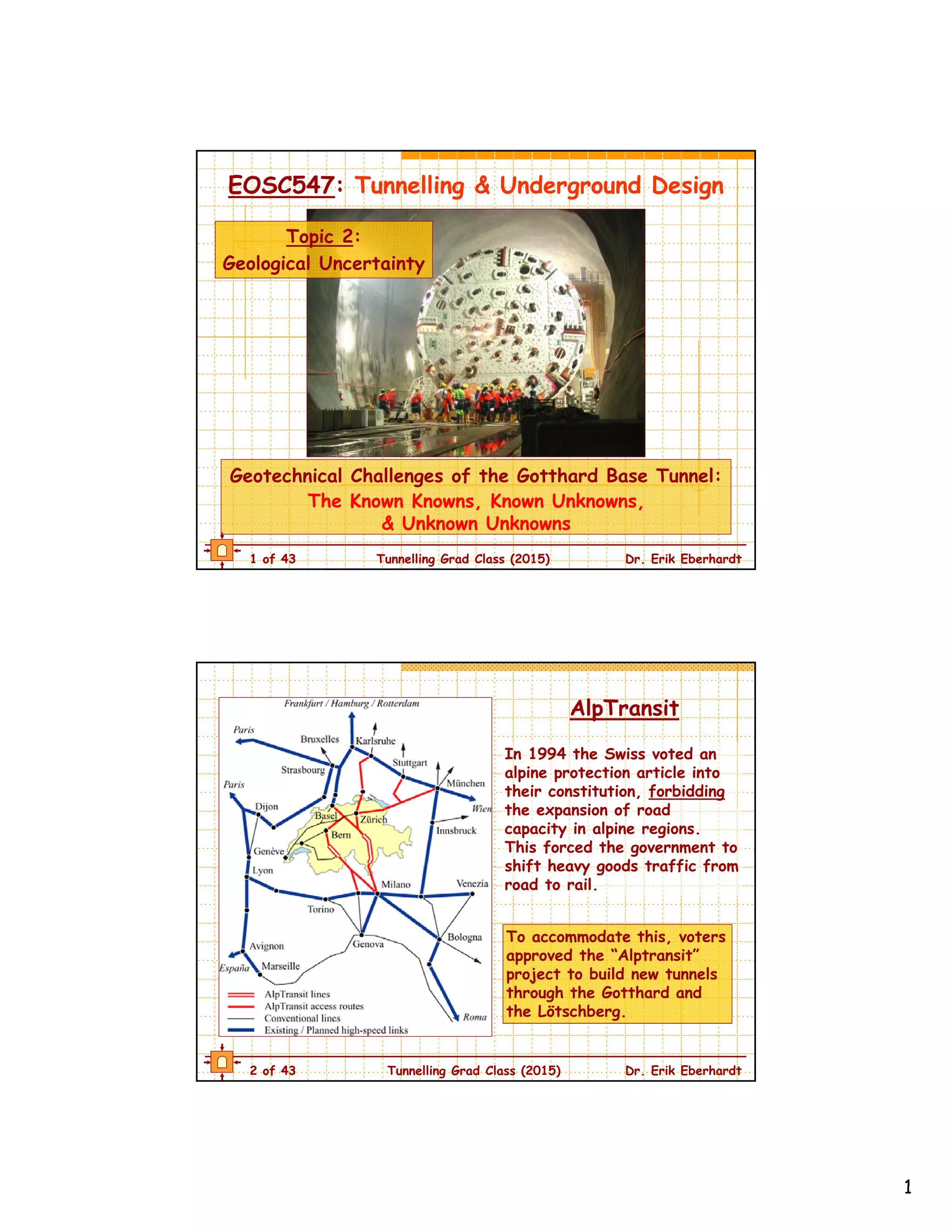
EOSC547: Tunnelling & Underground Design
Geotechnical Challenges of the Gotthard Base Tunnel:
Topic 2:
Geological Uncertainty
The Known Knowns, Known Unknowns,
& Unknown Unknowns
2 of 43 Tunnelling Grad Class (2015) Dr. Erik Eberhardt
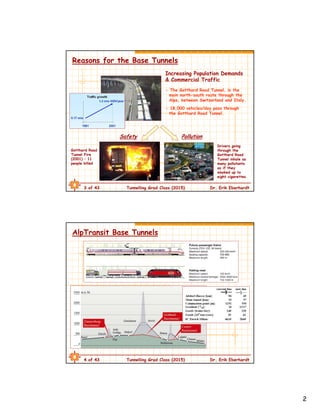
AlpTransit
In 1994 the Swiss voted an
alpine protection article into
their constitution, forbidding
the expansion of road
capacity in alpine regions.
This forced the government to
shift heavy goods traffic from
road to rail.
To accommodate this, voters
approved the “Alptransit”
project to build new tunnels
through the Gotthard and
the Lötschberg.
2
3 of 43 Tunnelling Grad Class (2015) Dr. Erik Eberhardt
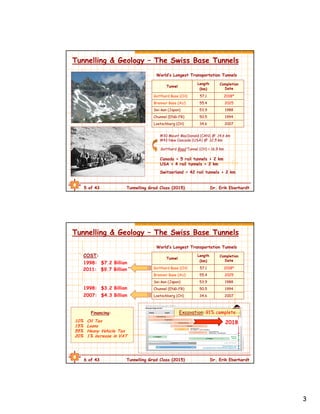
Reasons for the Base Tunnels
Increasing Population Demands
& Commercial Traffic
- The Gotthard Road Tunnel, is the
main north-south route through the
Alps, between Switzerland and Italy.
- 18,000 vehicles/day pass through
the Gotthard Road Tunnel.
Safety
Gotthard Road
Tunnel Fire
(2001) – 11
people killed
Pollution
Drivers going
through the
Gotthard Road
Tunnel inhale as
many pollutants
as if they
smoked up to
eight cigarettes.
4 of 43 Tunnelling Grad Class (2015) Dr. Erik Eberhardt
AlpTransit Base Tunnels
3
5 of 43 Tunnelling Grad Class (2015) Dr. Erik Eberhardt
Tunnelling & Geology – The Swiss Base Tunnels
#30 Mount MacDonald (CAN) @ 14.6 km
#43 New Cascade (USA) @ 12.5 km
Canada = 5 rail tunnels > 2 km
USA = 4 rail tunnels > 2 km
Switzerland = 42 rail tunnels > 2 km
Gotthard Road Tunnel (CH) = 16.9 km
Tunnel
Length
(km)
Completion
Date
Gotthard Base (CH) 57.1 2018*
Brenner Base (AU) 55.4 2025
Sei-kan (Japan) 53.9 1988
Chunnel (ENG-FR) 50.5 1994
Loetschberg (CH) 34.6 2007
World’s Longest Transportation Tunnels
6 of 43 Tunnelling Grad Class (2015) Dr. Erik Eberhardt
Tunnelling & Geology – The Swiss Base Tunnels
Tunnel
Length
(km)
Completion
Date
Gotthard Base (CH) 57.1 2018*
Brenner Base (AU) 55.4 2025
Sei-kan (Japan) 53.9 1988
Chunnel (ENG-FR) 50.5 1994
Loetschberg (CH) 34.6 2007
World’s Longest Transportation Tunnels
Financing:
10% Oil Tax
15% Loans
55% Heavy Vehicle Tax
20% 1% increase in VAT
Modernisierung der Bahn
Bauprogramm
2000 2005 2010 2015 2020 2025
7.5.2_Modern.Bahnen.Bauprogramm_98_0161_S
Gotthard
San Gottardo
2000 Lötschberg 2007
2000 Gotthard 2012
2000 1. Etappe 2005
2011 2.Etappe 2022
Infrastruktur
2002 2012
2006 Zimmerberg 2013
2006 Ceneri 2016
2011 2016
2007 2011
Neat
Bahn
2000
Lärmschutz
Ausbauten
St. Gallen – Arth-Goldau
Verbindung
Zürichsee – Gotthard
Anschluss an
europäisches Hochleistungsnetz
Rollmaterial
2018
COST:
1998: $7.2 Billion
2011: $9.7 Billion *
1998: $3.2 Billion
2007: $4.3 Billion
Excavation: 91% complete
4
7 of 43 Tunnelling Grad Class (2015) Dr. Erik Eberhardt
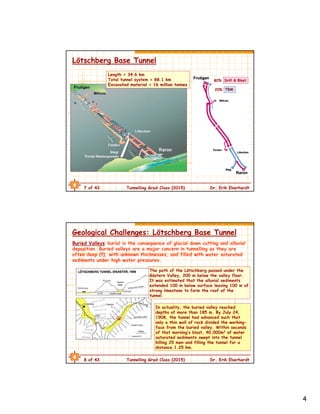
Lötschberg Base Tunnel
Drill & Blast
TBM
Length = 34.6 km
Total tunnel system = 88.1 km
Excavated material = 16 million tonnes
80%
20%
8 of 43 Tunnelling Grad Class (2015) Dr. Erik Eberhardt
The path of the Lötschberg passed under the
Gästern Valley, 200 m below the valley floor.
It was estimated that the alluvial sediments
extended 100 m below surface leaving 100 m of
strong limestone to form the roof of the
tunnel.
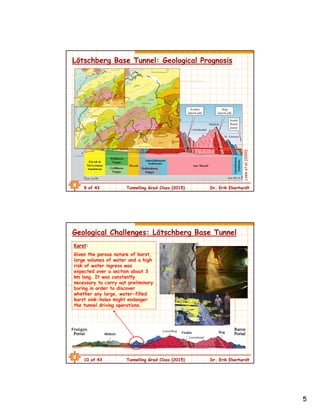
Geological Challenges: Lötschberg Base Tunnel
Buried Valleys: burial is the consequence of glacial down cutting and alluvial
deposition. Buried valleys are a major concern in tunnelling as they are
often deep (!!), with unknown thicknesses, and filled with water saturated
sediments under high water pressures.
In actuality, the buried valley reached
depths of more than 185 m. By July 24,
1908, the tunnel had advanced such that
only a thin wall of rock divided the working-
face from the buried valley. Within seconds
of that morning’s blast, 40,000m3 of water
saturated sediments swept into the tunnel
killing 25 men and filling the tunnel for a
distance 1.25 km.
5
9 of 43 Tunnelling Grad Class (2015) Dr. Erik Eberhardt
Loewetal.(2000)
Lötschberg Base Tunnel: Geological Prognosis
10 of 43 Tunnelling Grad Class (2015) Dr. Erik Eberhardt
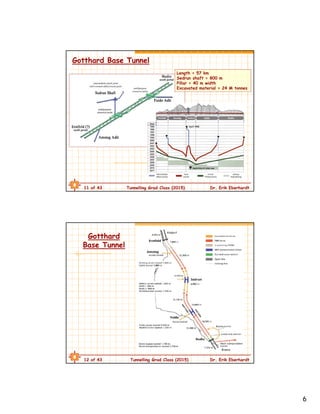
Geological Challenges: Lötschberg Base Tunnel
Karst:
Given the porous nature of karst,
large volumes of water and a high
risk of water ingress was
expected over a section about 3
km long. It was constantly
necessary to carry out preliminary
boring in order to discover
whether any large, water-filled
karst sink-holes might endanger
the tunnel driving operations.
1.5m
6
11 of 43 Tunnelling Grad Class (2015) Dr. Erik Eberhardt
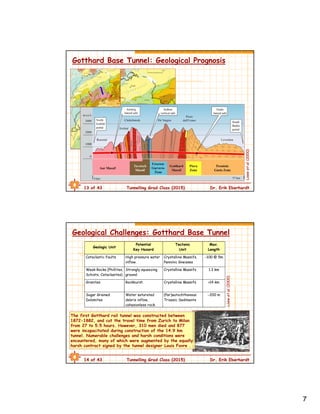
Gotthard Base Tunnel
Length = 57 km
Sedrun shaft = 800 m
Pillar = 40 m width
Excavated material = 24 M tonnes
12 of 43 Tunnelling Grad Class (2015) Dr. Erik Eberhardt
Gotthard
Base Tunnel
7
13 of 43 Tunnelling Grad Class (2015) Dr. Erik Eberhardt
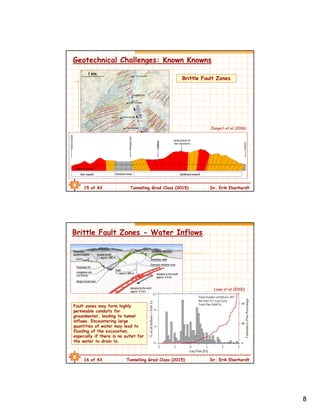
Gotthard Base Tunnel: Geological Prognosis
Loewetal.(2000)
14 of 43 Tunnelling Grad Class (2015) Dr. Erik Eberhardt
Geological Challenges: Gotthard Base Tunnel
Geologic Unit
Potential
Key Hazard
Tectonic
Unit
Max.
Length
Cataclastic Faults High pressure water
inflow.
Crystalline Massifs,
Penninic Gneisses
100 @ 5m
Weak Rocks (Phillites,
Schists, Cataclasites)
Strongly squeezing
ground.
Crystalline Massifs 1.3 km
Granites Rockburst. Crystalline Massifs >14 km
Sugar Grained
Dolomites
Water saturated
debris inflow,
cohesionless rock.
(Par)autochthonous
Triassic Sediments
200 m
Loewetal.(2000)
The first Gotthard rail tunnel was constructed between
1872-1882, and cut the travel time from Zurich to Milan
from 27 to 5.5 hours. However, 310 men died and 877
were incapacitated during construction of the 14.9 km
tunnel. Numerable challenges and harsh conditions were
encountered, many of which were augmented by the equally
harsh contract signed by the tunnel designer Louis Favre .
8
15 of 43 Tunnelling Grad Class (2015) Dr. Erik Eberhardt
Geotechnical Challenges: Known Knowns
Zangerl et al. (2006)
Brittle Fault Zones
16 of 43 Tunnelling Grad Class (2015) Dr. Erik Eberhardt
Brittle Fault Zones - Water Inflows
Loew et al. (2000)
Fault zones may form highly
permeable conduits for
groundwater, leading to tunnel
inflows. Encountering large
quantities of water may lead to
flooding of the excavation,
especially if there is no outlet for
the water to drain to.
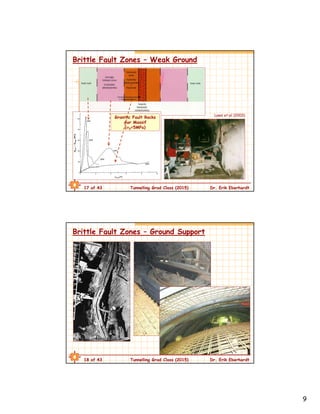
9
17 of 43 Tunnelling Grad Class (2015) Dr. Erik Eberhardt
Granitic Fault Rocks
Aar Massif
(3=5MPa)
Brittle Fault Zones – Weak Ground
Laws et al. (2003)
18 of 43 Tunnelling Grad Class (2015) Dr. Erik Eberhardt
Brittle Fault Zones – Ground Support
10
19 of 43 Tunnelling Grad Class (2015) Dr. Erik Eberhardt
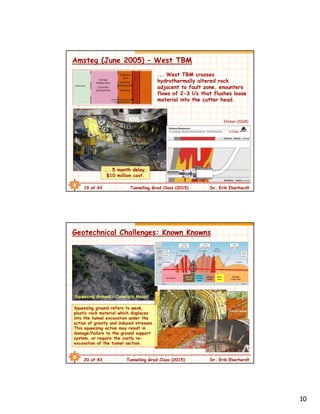
Amsteg (June 2005) – West TBM
... West TBM crosses
hydrothermally altered rock
adjacent to fault zone, enounters
flows of 2-3 l/s that flushes loose
material into the cutter head.
... 5 month delay,
$10 million cost.
Ehrbar (2008)
20 of 43 Tunnelling Grad Class (2015) Dr. Erik Eberhardt
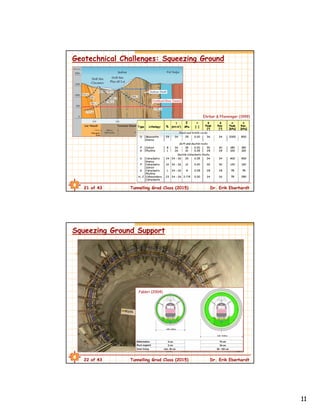
Geotechnical Challenges: Known Knowns
Squeezing Ground – Tavetsch Massif
Squeezing ground refers to weak,
plastic rock material which displaces
into the tunnel excavation under the
action of gravity and induced stresses.
This squeezing action may result in
damage/failure to the ground support
system, or require the costly re-
excavation of the tunnel section.
11
21 of 43 Tunnelling Grad Class (2015) Dr. Erik Eberhardt
Ehrbar & Pfenninger (1999)
Geotechnical Challenges: Squeezing Ground
22 of 43 Tunnelling Grad Class (2015) Dr. Erik Eberhardt
Fabbri (2004)
Squeezing Ground Support
12
23 of 43 Tunnelling Grad Class (2015) Dr. Erik Eberhardt
Geotechnical Challenges: Known Unknowns
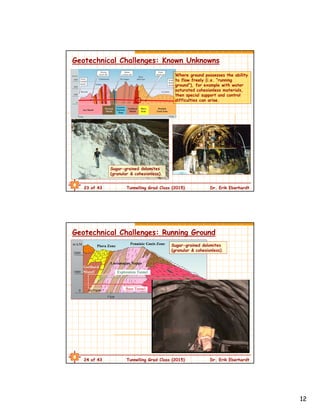
Where ground possesses the ability
to flow freely (i.e. “running
ground”), for example with water
saturated cohesionless materials,
then special support and control
difficulties can arise.
Sugar-grained dolomites
(granular & cohesionless).
24 of 43 Tunnelling Grad Class (2015) Dr. Erik Eberhardt
Geotechnical Challenges: Running Ground
Sugar-grained dolomites
(granular & cohesionless).
13
25 of 43 Tunnelling Grad Class (2015) Dr. Erik Eberhardt
Geotechnical Challenges: Running Ground
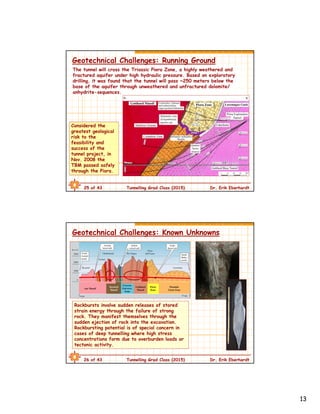
The tunnel will cross the Triassic Piora Zone, a highly weathered and
fractured aquifer under high hydraulic pressure. Based on exploratory
drilling, it was found that the tunnel will pass ~250 meters below the
base of the aquifer through unweathered and unfractured dolomite/
anhydrite-sequences.
Considered the
greatest geological
risk to the
feasibility and
success of the
tunnel project, in
Nov. 2008 the
TBM passed safely
through the Piora.
26 of 43 Tunnelling Grad Class (2015) Dr. Erik Eberhardt
Geotechnical Challenges: Known Unknowns
Rockbursts involve sudden releases of stored
strain energy through the failure of strong
rock. They manifest themselves through the
sudden ejection of rock into the excavation.
Rockbursting potential is of special concern in
cases of deep tunnelling where high stress
concentrations form due to overburden loads or
tectonic activity.
14
27 of 43 Tunnelling Grad Class (2015) Dr. Erik Eberhardt
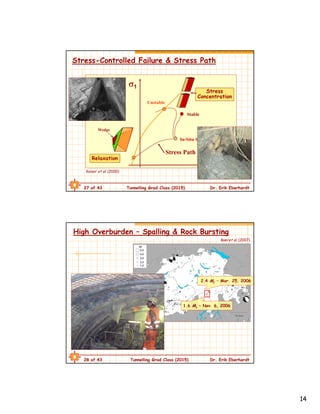
Stress-Controlled Failure & Stress Path
Unstable
Stable
Stress Path
Relaxation
In-Situ Stress
3
Stress
Concentration
1
Wedge
Kaiser et al. (2000)
28 of 43 Tunnelling Grad Class (2015) Dr. Erik Eberhardt
High Overburden – Spalling & Rock Bursting
2.4 ML – Mar. 25, 2006
1.6 ML – Nov. 6, 2006
Baeret al. (2007)
15
29 of 43 Tunnelling Grad Class (2015) Dr. Erik Eberhardt
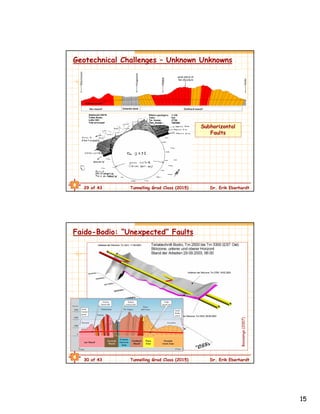
Geotechnical Challenges – Unknown Unknowns
Subhorizontal
Faults
30 of 43 Tunnelling Grad Class (2015) Dr. Erik Eberhardt
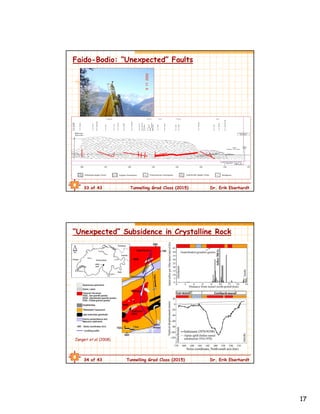
Faido-Bodio: “Unexpected” Faults
Bonzanigo(2007)
16
31 of 43 Tunnelling Grad Class (2015) Dr. Erik Eberhardt
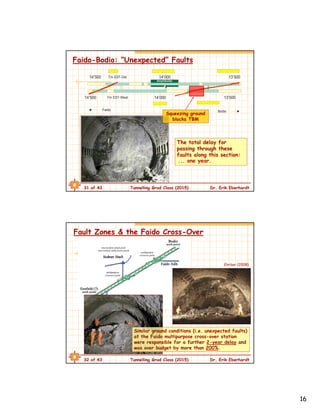
The total delay for
passing through these
faults along this section:
Faido-Bodio: “Unexpected” Faults
13’500
Amphibolite
13’50014’00014’500
14’00014’500
Tm EST-Ost
Tm EST-West
Faido Bodio
Squeezing ground
blocks TBM
... one year.
32 of 43 Tunnelling Grad Class (2015) Dr. Erik Eberhardt
Fault Zones & the Faido Cross-Over
Similar ground conditions (i.e. unexpected faults)
at the Faido multipurpose cross-over station
were responsible for a further 2-year delay and
was over budget by more than 200%.
Ehrbar (2008)
17
33 of 43 Tunnelling Grad Class (2015) Dr. Erik Eberhardt
Faido-Bodio: “Unexpected” Faults
34 of 43 Tunnelling Grad Class (2015) Dr. Erik Eberhardt
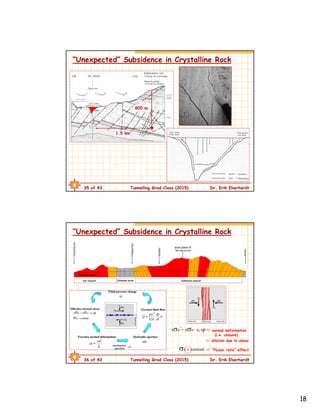
Zangerl et al. (2008)
“Unexpected” Subsidence in Crystalline Rock
18
35 of 43 Tunnelling Grad Class (2015) Dr. Erik Eberhardt
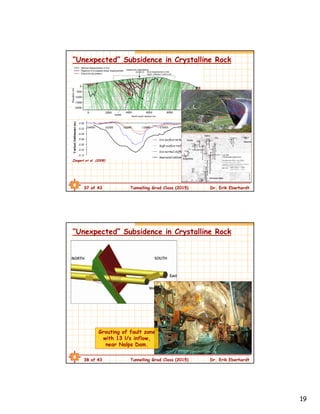
800 m
1.5 km
“Unexpected” Subsidence in Crystalline Rock
36 of 43 Tunnelling Grad Class (2015) Dr. Erik Eberhardt
n´= n - f p
n  constant
 normal deformation
(i.e. closure)
 dilation due to shear
 “Poison ratio” effect
“Unexpected” Subsidence in Crystalline Rock
19
37 of 43 Tunnelling Grad Class (2015) Dr. Erik Eberhardt
Zangerl et al. (2008)
“Unexpected” Subsidence in Crystalline Rock
38 of 43 Tunnelling Grad Class (2015) Dr. Erik Eberhardt
Grouting of fault zone
with 13 l/s inflow,
near Nalps Dam.
“Unexpected” Subsidence in Crystalline Rock
20
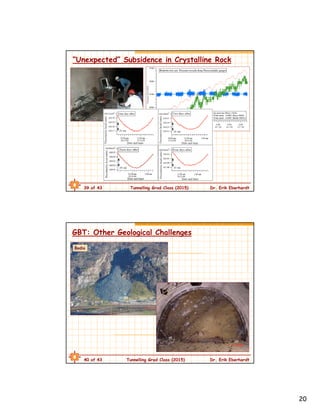
39 of 43 Tunnelling Grad Class (2015) Dr. Erik Eberhardt
“Unexpected” Subsidence in Crystalline Rock
40 of 43 Tunnelling Grad Class (2015) Dr. Erik Eberhardt
GBT: Other Geological Challenges
Bodio
21
41 of 43 Tunnelling Grad Class (2015) Dr. Erik Eberhardt
GBT: Other Geological Challenges
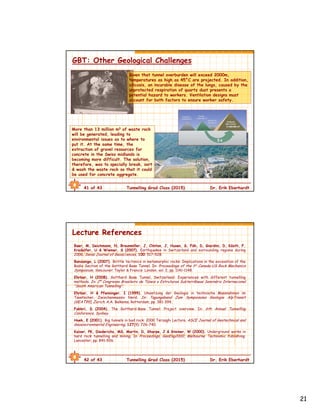
More than 13 million m3 of waste rock
will be generated, leading to
environmental issues as to where to
put it. At the same time, the
extraction of gravel resources for
concrete in the Swiss midlands is
becoming more difficult. The solution,
therefore, was to specially break, sort
& wash the waste rock so that it could
be used for concrete aggregate.
Given that tunnel overburden will exceed 2000m,
temperatures as high as 45°C are projected. In addition,
silicosis, an incurable disease of the lungs, caused by the
unprotected respiration of quartz dust presents a
potential hazard to workers. Ventilation designs must
account for both factors to ensure worker safety.
42 of 43 Tunnelling Grad Class (2015) Dr. Erik Eberhardt
Lecture References
Baer, M, Deichmann, N, Braunmiller, J, Clinton, J, Husen, S, Fäh, D, Giardini, D, Kästli, F,
Kradolfer, U & Wiemer, S (2007). Earthquakes in Switzerland and surrounding regions during
2006. Swiss Journal of Geosci.ences, 100: 517–528.
Bonzanigo, L (2007). Brittle tectonics in metamorphic rocks: Implications in the excavation of the
Bodio Section of the Gotthard Base Tunnel. In: Proceedings of the 1st Canada-US Rock Mechanics
Symposium, Vancouver. Taylor & Francis: London, vol. 2, pp. 1141-1148.
Ehrbar, H (2008). Gotthard Base Tunnel, Switzerland: Experiences with different tunnelling
methods. In: 2º Congresso Brasileiro de Túneis e Estruturas Subterrâneas Seminário Internacional
“South American Tunnelling”.
Ehrbar, H & Pfenninger, I (1999). Umsetzung der Geologie in technische Massnahmen im
Tavetscher, Zwischenmassiv Nord. In: Tagungsband Zum Sympoisums Geologie AlpTransit
(GEAT99), Zurich. A.A. Balkema, Rotterdam, pp. 381-394.
Fabbri, D (2004). The Gotthard-Base Tunnel: Project overview. In: 6th Annual Tunnelling
Conference, Sydney.
Hoek, E (2001). Big tunnels in bad rock: 2000 Terzaghi Lecture. ASCE Journal of Geotechnical and
Geoenvironmental Engineering, 127(9): 726-740.
Kaiser, PK, Diederichs, MS, Martin, D, Sharpe, J & Steiner, W (2000). Underground works in
hard rock tunnelling and mining. In Proceedings, GeoEng2000, Melbourne. Technomic Publishing:
Lancaster, pp. 841-926.
22
43 of 43 Tunnelling Grad Class (2015) Dr. Erik Eberhardt
Lecture References
Laws, S, Eberhardt, E, Loew, S & Descoeudres, F (2003). Geomechanical properties of shear
zones in the Eastern Aar Massif, Switzerland and their implication on tunnelling. Rock Mechanics
and Rock Engineering, 36(4): 271-303.
Loew, S, Ziegler, H-J & Keller, F (2000). AlpTransit: Engineering geology of the world’s longest
tunnel system. In: Proceedings, GeoEng 2000, Melbourne. Technomic Publishing, Lancaster, 927–937.
Zangerl, C, Eberhardt, E, Evans, KF & Loew, S (2008). Consolidation settlements above deep
tunnels in fractured crystalline rock: Part 2 – Numerical analysis of the Gotthard highway tunnel
case study. International Journal of Rock Mechanics and Mining Sciences, 45(8): 1211-1225.
Zangerl, C, Loew, S & Eberhardt, E (2006). Structure, geometry and formation of brittle
discontinuities in anisotropic crystalline rocks of the Central Gotthard Massif, Switzerland. Eclogae
Geologicae Helvetiae, 99(2): 271-290.

Tunnelling & underground design (Topic2-geological uncertainty)

  • 1.
    1 1 of 43Tunnelling Grad Class (2015) Dr. Erik Eberhardt EOSC547: Tunnelling & Underground Design Geotechnical Challenges of the Gotthard Base Tunnel: Topic 2: Geological Uncertainty The Known Knowns, Known Unknowns, & Unknown Unknowns 2 of 43 Tunnelling Grad Class (2015) Dr. Erik Eberhardt AlpTransit In 1994 the Swiss voted an alpine protection article into their constitution, forbidding the expansion of road capacity in alpine regions. This forced the government to shift heavy goods traffic from road to rail. To accommodate this, voters approved the “Alptransit” project to build new tunnels through the Gotthard and the Lötschberg.
  • 2.
    2 3 of 43Tunnelling Grad Class (2015) Dr. Erik Eberhardt Reasons for the Base Tunnels Increasing Population Demands & Commercial Traffic - The Gotthard Road Tunnel, is the main north-south route through the Alps, between Switzerland and Italy. - 18,000 vehicles/day pass through the Gotthard Road Tunnel. Safety Gotthard Road Tunnel Fire (2001) – 11 people killed Pollution Drivers going through the Gotthard Road Tunnel inhale as many pollutants as if they smoked up to eight cigarettes. 4 of 43 Tunnelling Grad Class (2015) Dr. Erik Eberhardt AlpTransit Base Tunnels
  • 3.
    3 5 of 43Tunnelling Grad Class (2015) Dr. Erik Eberhardt Tunnelling & Geology – The Swiss Base Tunnels #30 Mount MacDonald (CAN) @ 14.6 km #43 New Cascade (USA) @ 12.5 km Canada = 5 rail tunnels > 2 km USA = 4 rail tunnels > 2 km Switzerland = 42 rail tunnels > 2 km Gotthard Road Tunnel (CH) = 16.9 km Tunnel Length (km) Completion Date Gotthard Base (CH) 57.1 2018* Brenner Base (AU) 55.4 2025 Sei-kan (Japan) 53.9 1988 Chunnel (ENG-FR) 50.5 1994 Loetschberg (CH) 34.6 2007 World’s Longest Transportation Tunnels 6 of 43 Tunnelling Grad Class (2015) Dr. Erik Eberhardt Tunnelling & Geology – The Swiss Base Tunnels Tunnel Length (km) Completion Date Gotthard Base (CH) 57.1 2018* Brenner Base (AU) 55.4 2025 Sei-kan (Japan) 53.9 1988 Chunnel (ENG-FR) 50.5 1994 Loetschberg (CH) 34.6 2007 World’s Longest Transportation Tunnels Financing: 10% Oil Tax 15% Loans 55% Heavy Vehicle Tax 20% 1% increase in VAT Modernisierung der Bahn Bauprogramm 2000 2005 2010 2015 2020 2025 7.5.2_Modern.Bahnen.Bauprogramm_98_0161_S Gotthard San Gottardo 2000 Lötschberg 2007 2000 Gotthard 2012 2000 1. Etappe 2005 2011 2.Etappe 2022 Infrastruktur 2002 2012 2006 Zimmerberg 2013 2006 Ceneri 2016 2011 2016 2007 2011 Neat Bahn 2000 Lärmschutz Ausbauten St. Gallen – Arth-Goldau Verbindung Zürichsee – Gotthard Anschluss an europäisches Hochleistungsnetz Rollmaterial 2018 COST: 1998: $7.2 Billion 2011: $9.7 Billion * 1998: $3.2 Billion 2007: $4.3 Billion Excavation: 91% complete
  • 4.
    4 7 of 43Tunnelling Grad Class (2015) Dr. Erik Eberhardt Lötschberg Base Tunnel Drill & Blast TBM Length = 34.6 km Total tunnel system = 88.1 km Excavated material = 16 million tonnes 80% 20% 8 of 43 Tunnelling Grad Class (2015) Dr. Erik Eberhardt The path of the Lötschberg passed under the Gästern Valley, 200 m below the valley floor. It was estimated that the alluvial sediments extended 100 m below surface leaving 100 m of strong limestone to form the roof of the tunnel. Geological Challenges: Lötschberg Base Tunnel Buried Valleys: burial is the consequence of glacial down cutting and alluvial deposition. Buried valleys are a major concern in tunnelling as they are often deep (!!), with unknown thicknesses, and filled with water saturated sediments under high water pressures. In actuality, the buried valley reached depths of more than 185 m. By July 24, 1908, the tunnel had advanced such that only a thin wall of rock divided the working- face from the buried valley. Within seconds of that morning’s blast, 40,000m3 of water saturated sediments swept into the tunnel killing 25 men and filling the tunnel for a distance 1.25 km.
  • 5.
    5 9 of 43Tunnelling Grad Class (2015) Dr. Erik Eberhardt Loewetal.(2000) Lötschberg Base Tunnel: Geological Prognosis 10 of 43 Tunnelling Grad Class (2015) Dr. Erik Eberhardt Geological Challenges: Lötschberg Base Tunnel Karst: Given the porous nature of karst, large volumes of water and a high risk of water ingress was expected over a section about 3 km long. It was constantly necessary to carry out preliminary boring in order to discover whether any large, water-filled karst sink-holes might endanger the tunnel driving operations. 1.5m
  • 6.
    6 11 of 43Tunnelling Grad Class (2015) Dr. Erik Eberhardt Gotthard Base Tunnel Length = 57 km Sedrun shaft = 800 m Pillar = 40 m width Excavated material = 24 M tonnes 12 of 43 Tunnelling Grad Class (2015) Dr. Erik Eberhardt Gotthard Base Tunnel
  • 7.
    7 13 of 43Tunnelling Grad Class (2015) Dr. Erik Eberhardt Gotthard Base Tunnel: Geological Prognosis Loewetal.(2000) 14 of 43 Tunnelling Grad Class (2015) Dr. Erik Eberhardt Geological Challenges: Gotthard Base Tunnel Geologic Unit Potential Key Hazard Tectonic Unit Max. Length Cataclastic Faults High pressure water inflow. Crystalline Massifs, Penninic Gneisses 100 @ 5m Weak Rocks (Phillites, Schists, Cataclasites) Strongly squeezing ground. Crystalline Massifs 1.3 km Granites Rockburst. Crystalline Massifs >14 km Sugar Grained Dolomites Water saturated debris inflow, cohesionless rock. (Par)autochthonous Triassic Sediments 200 m Loewetal.(2000) The first Gotthard rail tunnel was constructed between 1872-1882, and cut the travel time from Zurich to Milan from 27 to 5.5 hours. However, 310 men died and 877 were incapacitated during construction of the 14.9 km tunnel. Numerable challenges and harsh conditions were encountered, many of which were augmented by the equally harsh contract signed by the tunnel designer Louis Favre .
  • 8.
    8 15 of 43Tunnelling Grad Class (2015) Dr. Erik Eberhardt Geotechnical Challenges: Known Knowns Zangerl et al. (2006) Brittle Fault Zones 16 of 43 Tunnelling Grad Class (2015) Dr. Erik Eberhardt Brittle Fault Zones - Water Inflows Loew et al. (2000) Fault zones may form highly permeable conduits for groundwater, leading to tunnel inflows. Encountering large quantities of water may lead to flooding of the excavation, especially if there is no outlet for the water to drain to.
  • 9.
    9 17 of 43Tunnelling Grad Class (2015) Dr. Erik Eberhardt Granitic Fault Rocks Aar Massif (3=5MPa) Brittle Fault Zones – Weak Ground Laws et al. (2003) 18 of 43 Tunnelling Grad Class (2015) Dr. Erik Eberhardt Brittle Fault Zones – Ground Support
  • 10.
    10 19 of 43Tunnelling Grad Class (2015) Dr. Erik Eberhardt Amsteg (June 2005) – West TBM ... West TBM crosses hydrothermally altered rock adjacent to fault zone, enounters flows of 2-3 l/s that flushes loose material into the cutter head. ... 5 month delay, $10 million cost. Ehrbar (2008) 20 of 43 Tunnelling Grad Class (2015) Dr. Erik Eberhardt Geotechnical Challenges: Known Knowns Squeezing Ground – Tavetsch Massif Squeezing ground refers to weak, plastic rock material which displaces into the tunnel excavation under the action of gravity and induced stresses. This squeezing action may result in damage/failure to the ground support system, or require the costly re- excavation of the tunnel section.
  • 11.
    11 21 of 43Tunnelling Grad Class (2015) Dr. Erik Eberhardt Ehrbar & Pfenninger (1999) Geotechnical Challenges: Squeezing Ground 22 of 43 Tunnelling Grad Class (2015) Dr. Erik Eberhardt Fabbri (2004) Squeezing Ground Support
  • 12.
    12 23 of 43Tunnelling Grad Class (2015) Dr. Erik Eberhardt Geotechnical Challenges: Known Unknowns Where ground possesses the ability to flow freely (i.e. “running ground”), for example with water saturated cohesionless materials, then special support and control difficulties can arise. Sugar-grained dolomites (granular & cohesionless). 24 of 43 Tunnelling Grad Class (2015) Dr. Erik Eberhardt Geotechnical Challenges: Running Ground Sugar-grained dolomites (granular & cohesionless).
  • 13.
    13 25 of 43Tunnelling Grad Class (2015) Dr. Erik Eberhardt Geotechnical Challenges: Running Ground The tunnel will cross the Triassic Piora Zone, a highly weathered and fractured aquifer under high hydraulic pressure. Based on exploratory drilling, it was found that the tunnel will pass ~250 meters below the base of the aquifer through unweathered and unfractured dolomite/ anhydrite-sequences. Considered the greatest geological risk to the feasibility and success of the tunnel project, in Nov. 2008 the TBM passed safely through the Piora. 26 of 43 Tunnelling Grad Class (2015) Dr. Erik Eberhardt Geotechnical Challenges: Known Unknowns Rockbursts involve sudden releases of stored strain energy through the failure of strong rock. They manifest themselves through the sudden ejection of rock into the excavation. Rockbursting potential is of special concern in cases of deep tunnelling where high stress concentrations form due to overburden loads or tectonic activity.
  • 14.
    14 27 of 43Tunnelling Grad Class (2015) Dr. Erik Eberhardt Stress-Controlled Failure & Stress Path Unstable Stable Stress Path Relaxation In-Situ Stress 3 Stress Concentration 1 Wedge Kaiser et al. (2000) 28 of 43 Tunnelling Grad Class (2015) Dr. Erik Eberhardt High Overburden – Spalling & Rock Bursting 2.4 ML – Mar. 25, 2006 1.6 ML – Nov. 6, 2006 Baeret al. (2007)
  • 15.
    15 29 of 43Tunnelling Grad Class (2015) Dr. Erik Eberhardt Geotechnical Challenges – Unknown Unknowns Subhorizontal Faults 30 of 43 Tunnelling Grad Class (2015) Dr. Erik Eberhardt Faido-Bodio: “Unexpected” Faults Bonzanigo(2007)
  • 16.
    16 31 of 43Tunnelling Grad Class (2015) Dr. Erik Eberhardt The total delay for passing through these faults along this section: Faido-Bodio: “Unexpected” Faults 13’500 Amphibolite 13’50014’00014’500 14’00014’500 Tm EST-Ost Tm EST-West Faido Bodio Squeezing ground blocks TBM ... one year. 32 of 43 Tunnelling Grad Class (2015) Dr. Erik Eberhardt Fault Zones & the Faido Cross-Over Similar ground conditions (i.e. unexpected faults) at the Faido multipurpose cross-over station were responsible for a further 2-year delay and was over budget by more than 200%. Ehrbar (2008)
  • 17.
    17 33 of 43Tunnelling Grad Class (2015) Dr. Erik Eberhardt Faido-Bodio: “Unexpected” Faults 34 of 43 Tunnelling Grad Class (2015) Dr. Erik Eberhardt Zangerl et al. (2008) “Unexpected” Subsidence in Crystalline Rock
  • 18.
    18 35 of 43Tunnelling Grad Class (2015) Dr. Erik Eberhardt 800 m 1.5 km “Unexpected” Subsidence in Crystalline Rock 36 of 43 Tunnelling Grad Class (2015) Dr. Erik Eberhardt n´= n - f p n  constant  normal deformation (i.e. closure)  dilation due to shear  “Poison ratio” effect “Unexpected” Subsidence in Crystalline Rock
  • 19.
    19 37 of 43Tunnelling Grad Class (2015) Dr. Erik Eberhardt Zangerl et al. (2008) “Unexpected” Subsidence in Crystalline Rock 38 of 43 Tunnelling Grad Class (2015) Dr. Erik Eberhardt Grouting of fault zone with 13 l/s inflow, near Nalps Dam. “Unexpected” Subsidence in Crystalline Rock
  • 20.
    20 39 of 43Tunnelling Grad Class (2015) Dr. Erik Eberhardt “Unexpected” Subsidence in Crystalline Rock 40 of 43 Tunnelling Grad Class (2015) Dr. Erik Eberhardt GBT: Other Geological Challenges Bodio
  • 21.
    21 41 of 43Tunnelling Grad Class (2015) Dr. Erik Eberhardt GBT: Other Geological Challenges More than 13 million m3 of waste rock will be generated, leading to environmental issues as to where to put it. At the same time, the extraction of gravel resources for concrete in the Swiss midlands is becoming more difficult. The solution, therefore, was to specially break, sort & wash the waste rock so that it could be used for concrete aggregate. Given that tunnel overburden will exceed 2000m, temperatures as high as 45°C are projected. In addition, silicosis, an incurable disease of the lungs, caused by the unprotected respiration of quartz dust presents a potential hazard to workers. Ventilation designs must account for both factors to ensure worker safety. 42 of 43 Tunnelling Grad Class (2015) Dr. Erik Eberhardt Lecture References Baer, M, Deichmann, N, Braunmiller, J, Clinton, J, Husen, S, Fäh, D, Giardini, D, Kästli, F, Kradolfer, U & Wiemer, S (2007). Earthquakes in Switzerland and surrounding regions during 2006. Swiss Journal of Geosci.ences, 100: 517–528. Bonzanigo, L (2007). Brittle tectonics in metamorphic rocks: Implications in the excavation of the Bodio Section of the Gotthard Base Tunnel. In: Proceedings of the 1st Canada-US Rock Mechanics Symposium, Vancouver. Taylor & Francis: London, vol. 2, pp. 1141-1148. Ehrbar, H (2008). Gotthard Base Tunnel, Switzerland: Experiences with different tunnelling methods. In: 2º Congresso Brasileiro de Túneis e Estruturas Subterrâneas Seminário Internacional “South American Tunnelling”. Ehrbar, H & Pfenninger, I (1999). Umsetzung der Geologie in technische Massnahmen im Tavetscher, Zwischenmassiv Nord. In: Tagungsband Zum Sympoisums Geologie AlpTransit (GEAT99), Zurich. A.A. Balkema, Rotterdam, pp. 381-394. Fabbri, D (2004). The Gotthard-Base Tunnel: Project overview. In: 6th Annual Tunnelling Conference, Sydney. Hoek, E (2001). Big tunnels in bad rock: 2000 Terzaghi Lecture. ASCE Journal of Geotechnical and Geoenvironmental Engineering, 127(9): 726-740. Kaiser, PK, Diederichs, MS, Martin, D, Sharpe, J & Steiner, W (2000). Underground works in hard rock tunnelling and mining. In Proceedings, GeoEng2000, Melbourne. Technomic Publishing: Lancaster, pp. 841-926.
  • 22.
    22 43 of 43Tunnelling Grad Class (2015) Dr. Erik Eberhardt Lecture References Laws, S, Eberhardt, E, Loew, S & Descoeudres, F (2003). Geomechanical properties of shear zones in the Eastern Aar Massif, Switzerland and their implication on tunnelling. Rock Mechanics and Rock Engineering, 36(4): 271-303. Loew, S, Ziegler, H-J & Keller, F (2000). AlpTransit: Engineering geology of the world’s longest tunnel system. In: Proceedings, GeoEng 2000, Melbourne. Technomic Publishing, Lancaster, 927–937. Zangerl, C, Eberhardt, E, Evans, KF & Loew, S (2008). Consolidation settlements above deep tunnels in fractured crystalline rock: Part 2 – Numerical analysis of the Gotthard highway tunnel case study. International Journal of Rock Mechanics and Mining Sciences, 45(8): 1211-1225. Zangerl, C, Loew, S & Eberhardt, E (2006). Structure, geometry and formation of brittle discontinuities in anisotropic crystalline rocks of the Central Gotthard Massif, Switzerland. Eclogae Geologicae Helvetiae, 99(2): 271-290.