1
1 of 30 Tunnelling Grad Class (2015) Dr. Erik Eberhardt
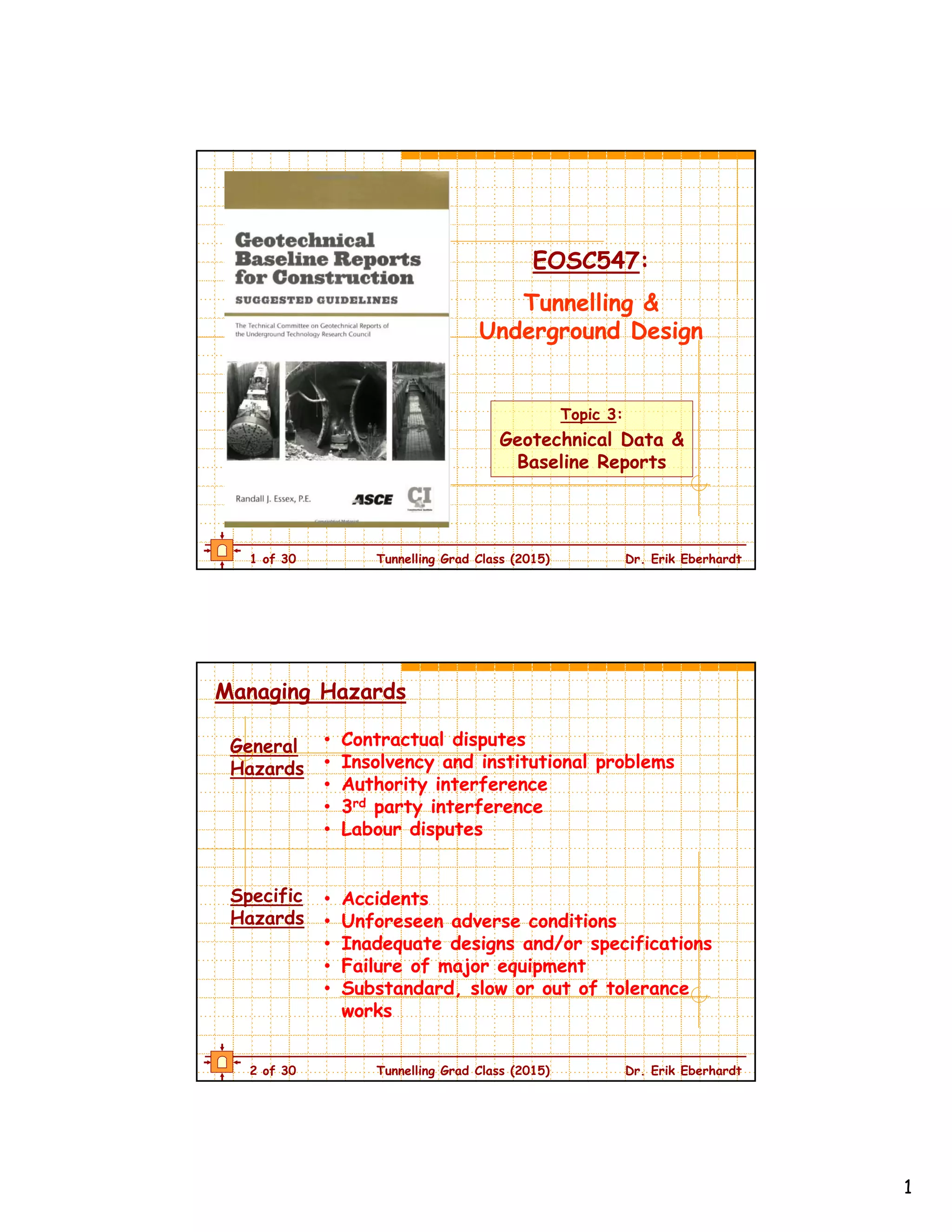
EOSC547:
Tunnelling &
Underground Design
Topic 3:
Geotechnical Data &
Baseline Reports
2 of 30 Tunnelling Grad Class (2015) Dr. Erik Eberhardt
Managing Hazards
• Contractual disputes
• Insolvency and institutional problems
• Authority interference
• 3rd party interference
• Labour disputes
General
Hazards
Specific
Hazards
• Accidents
• Unforeseen adverse conditions
• Inadequate designs and/or specifications
• Failure of major equipment
• Substandard, slow or out of tolerance
works
2
3 of 30 Tunnelling Grad Class (2015) Dr. Erik Eberhardt
Tunnelling Contracts – Risk Management
Contracts are the fundamental mechanism for Financial
Risk Management in every country in the world.
• Trend towards design + build contracts
• One-sided contract conditions
• High risk type construction methods
• Tight construction schedules
• Low financial budgets
• Fierce competition in construction industries
4 of 30 Tunnelling Grad Class (2015) Dr. Erik Eberhardt
Tunnelling Contracts – Risk Management
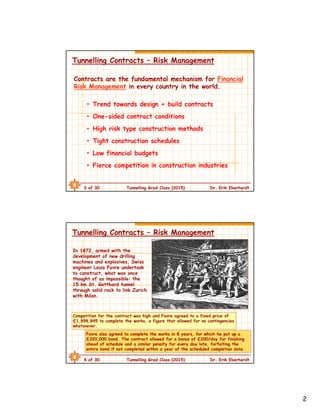
Competition for the contract was high and Favre agreed to a fixed price of
£1,898,845 to complete the works, a figure that allowed for no contingencies
whatsoever.
In 1872, armed with the
development of new drilling
machines and explosives, Swiss
engineer Louis Favre undertook
to construct, what was once
thought of as impossible: the
15 km St. Gotthard tunnel
through solid rock to link Zurich
with Milan.
Favre also agreed to complete the works in 8 years, for which he put up a
£320,000 bond. The contract allowed for a bonus of £200/day for finishing
ahead of schedule and a similar penalty for every day late, forfeiting the
entire bond if not completed within a year of the scheduled completion date.
3
5 of 30 Tunnelling Grad Class (2015) Dr. Erik Eberhardt
Tunnelling Contracts – Risk Management
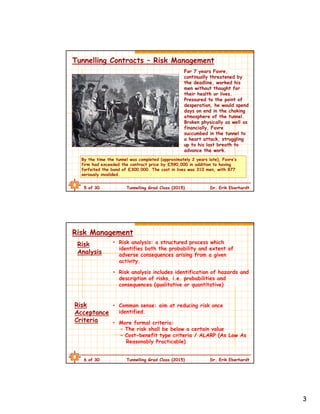
By the time the tunnel was completed (approximately 2 years late), Favre’s
firm had exceeded the contract price by £590,000 in addition to having
forfeited the bond of £300,000. The cost in lives was 310 men, with 877
seriously invalided.
For 7 years Favre,
continually threatened by
the deadline, worked his
men without thought for
their health or lives.
Pressured to the point of
desperation, he would spend
days on end in the choking
atmosphere of the tunnel.
Broken physically as well as
financially, Favre
succumbed in the tunnel to
a heart attack, struggling
up to his last breath to
advance the work.
6 of 30 Tunnelling Grad Class (2015) Dr. Erik Eberhardt
Risk Management
• Risk analysis: a structured process which
identifies both the probability and extent of
adverse consequences arising from a given
activity.
• Risk analysis includes identification of hazards and
description of risks, i.e. probabilities and
consequences (qualitative or quantitative)
Risk
Analysis
Risk
Acceptance
Criteria
• Common sense: aim at reducing risk once
identified.
• More formal criteria:
– The risk shall be below a certain value
– Cost-benefit type criteria / ALARP (As Low As
Reasonably Practicable)
4
7 of 30 Tunnelling Grad Class (2015) Dr. Erik Eberhardt
Risk Management
Planning/Contract/Schedule
Hazard Identification
Probability/
Frequency Analysis
Consequence
Analysis
Risk
Risk
Acceptance
Criteria
Risk
Reduction
Measures
Risk Evaluation
Acceptable
8 of 30 Tunnelling Grad Class (2015) Dr. Erik Eberhardt
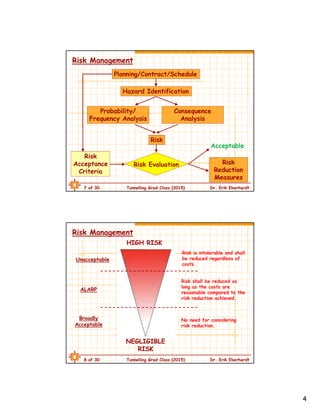
Risk Management
Risk is intolerable and shall
be reduced regardless of
costs.
Unacceptable
ALARP
Risk shall be reduced as
long as the costs are
reasonable compared to the
risk reduction achieved.
Broadly
Acceptable
No need for considering
risk reduction.
HIGH RISK
NEGLIGIBLE
RISK
5
9 of 30 Tunnelling Grad Class (2015) Dr. Erik Eberhardt
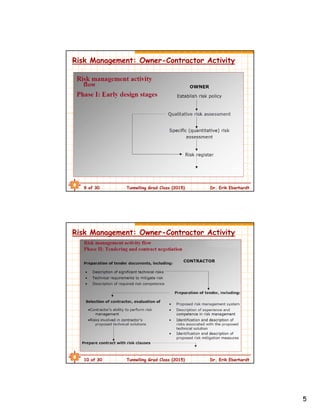
Risk Management: Owner-Contractor Activity
10 of 30 Tunnelling Grad Class (2015) Dr. Erik Eberhardt
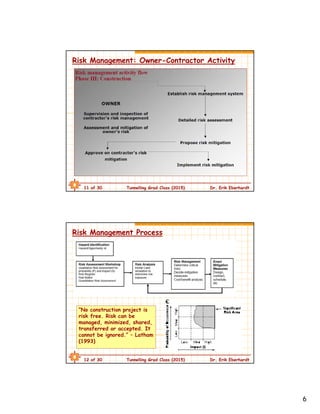
Risk Management: Owner-Contractor Activity
6
11 of 30 Tunnelling Grad Class (2015) Dr. Erik Eberhardt
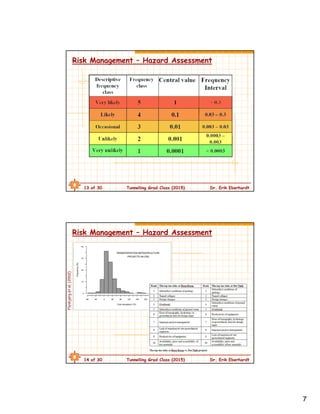
Risk Management: Owner-Contractor Activity
12 of 30 Tunnelling Grad Class (2015) Dr. Erik Eberhardt
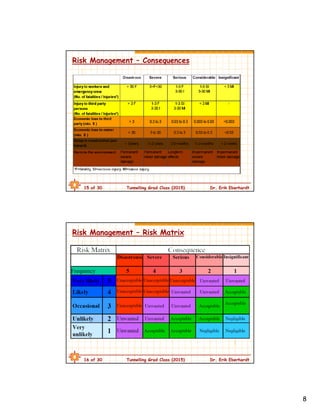
Risk Management Process
“No construction project is
risk free. Risk can be
managed, minimized, shared,
transferred or accepted. It
cannot be ignored.” – Latham
(1993)
7
13 of 30 Tunnelling Grad Class (2015) Dr. Erik Eberhardt
Risk Management – Hazard Assessment
14 of 30 Tunnelling Grad Class (2015) Dr. Erik Eberhardt
Risk Management – Hazard Assessment
Flyvbjergetal.(2002)
8
15 of 30 Tunnelling Grad Class (2015) Dr. Erik Eberhardt
Risk Management – Consequences
16 of 30 Tunnelling Grad Class (2015) Dr. Erik Eberhardt
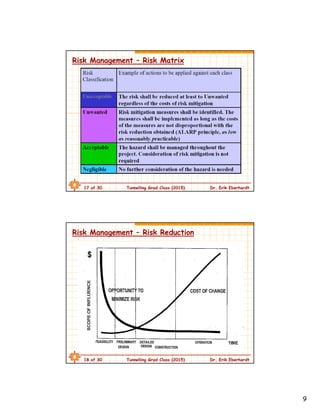
Risk Management – Risk Matrix
9
17 of 30 Tunnelling Grad Class (2015) Dr. Erik Eberhardt
Risk Management – Risk Matrix
18 of 30 Tunnelling Grad Class (2015) Dr. Erik Eberhardt
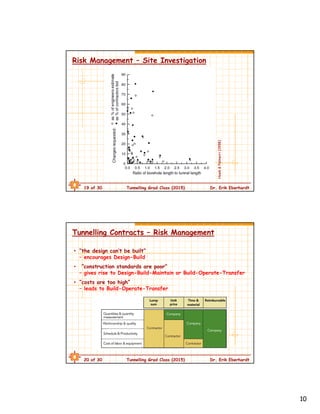
Risk Management – Risk Reduction
10
19 of 30 Tunnelling Grad Class (2015) Dr. Erik Eberhardt
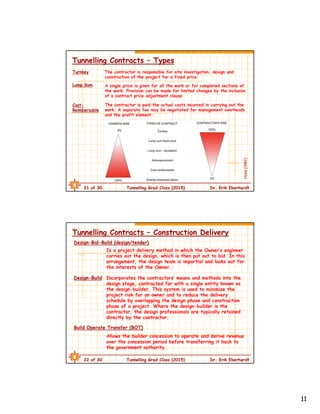
Risk Management – Site Investigation
Hoek&Palmeiri(1998)
20 of 30 Tunnelling Grad Class (2015) Dr. Erik Eberhardt
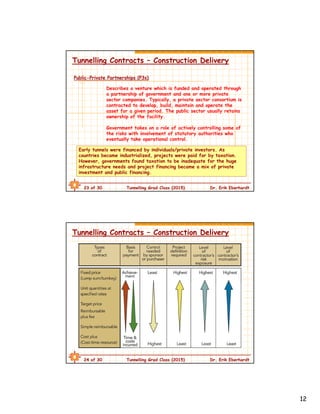
Tunnelling Contracts – Risk Management
• “the design can’t be built”
– encourages Design-Build
• “construction standards are poor”
– gives rise to Design-Build-Maintain or Build-Operate-Transfer
• “costs are too high”
– leads to Build-Operate-Transfer
11
21 of 30 Tunnelling Grad Class (2015) Dr. Erik Eberhardt
Tunnelling Contracts – Types
The contractor is responsible for site investigation, design and
construction of the project for a fixed price.
Turnkey
Lump Sum A single price is given for all the work or for completed sections of
the work. Provision can be made for limited changes by the inclusion
of a contract price adjustment clause.
Cost-
Reimbersable
The contractor is paid the actual costs incurred in carrying out the
work. A separate fee may be negotiated for management overheads
and the profit element.
Hoek(1982)
22 of 30 Tunnelling Grad Class (2015) Dr. Erik Eberhardt
Tunnelling Contracts – Construction Delivery
Incorporates the contractors’ means and methods into the
design stage, contracted for with a single entity known as
the design-builder. This system is used to minimize the
project risk for an owner and to reduce the delivery
schedule by overlapping the design phase and construction
phase of a project. Where the design-builder is the
contractor, the design professionals are typically retained
directly by the contractor.
Design-Build
Build Operate Transfer (BOT)
Allows the builder concession to operate and derive revenue
over the concession period before transferring it back to
the government authority.
Is a project delivery method in which the Owner’s engineer
carries out the design, which is then put out to bid. In this
arrangement, the design team is impartial and looks out for
the interests of the Owner.
Design-Bid-Build (design/tender)
12
23 of 30 Tunnelling Grad Class (2015) Dr. Erik Eberhardt
Tunnelling Contracts – Construction Delivery
Public-Private Partnerships (P3s)
Describes a venture which is funded and operated through
a partnership of government and one or more private
sector companies. Typically, a private sector consortium is
contracted to develop, build, maintain and operate the
asset for a given period. The public sector usually retains
ownership of the facility.
Government takes on a role of actively controlling some of
the risks with involvement of statutory authorities who
eventually take operational control.
Early tunnels were financed by individuals/private investors. As
countries became industrialized, projects were paid for by taxation.
However, governments found taxation to be inadequate for the huge
infrastructure needs and project financing became a mix of private
investment and public financing.
24 of 30 Tunnelling Grad Class (2015) Dr. Erik Eberhardt
Tunnelling Contracts – Construction Delivery
13
25 of 30 Tunnelling Grad Class (2015) Dr. Erik Eberhardt
Geotechnical Reporting
- compilation of all of the results of the site investigation process.
Geological Data Report
- generally restricted to factual information and does not include very much
interpretation.
- contractor is left to assess the factual information and draw conclusions on
the probable groundwater and rock mass behaviour; tasks that may be very
difficult to accommodate during the bidding process.
Geotechnical Baseline Report
- interpretative report in which all the factual data collected during the site
investigation stages are analysed in terms of potential groundwater and rock
mass behaviour and other issues that could cause problems during construction.
- interpretations form a behavioural baseline which can be used in setting
contractual limits.
- contractor cannot make claims for ground behaviour which falls at or above
the baseline while the owner has to accept responsibility for problems resulting
from rock mass behaviour which is worse than that predicted in the baseline
report.
Hoek (2012)
26 of 30 Tunnelling Grad Class (2015) Dr. Erik Eberhardt
Geotechnical Baseline Reports
- Aims to establish a contractual understanding of the subsurface site
conditions.
Geotechnical Baseline Reports (GBRs) are charged with portraying a realistic
interpretation of the subsurface conditions that are anticipated in the proposed
construction. They should include not only the mean conditions of ground behaviour
and groundwater conditions anticipated, but the report should also address the
range of variances that is expected.
- Risks associated with conditions consistent with or less adverse than the
baseline are allocated to the contractor and those significantly more adverse
than the baseline are accepted by the owner.
Thus, the purpose of the GBR is to establish a realistic, common basis for
evaluating any contractor claims for differing site conditions that develop during
construction. The GBR is the basis for equitable contractual risk sharing and risk
allocation between the project owner and their selected contractor.
14
27 of 30 Tunnelling Grad Class (2015) Dr. Erik Eberhardt
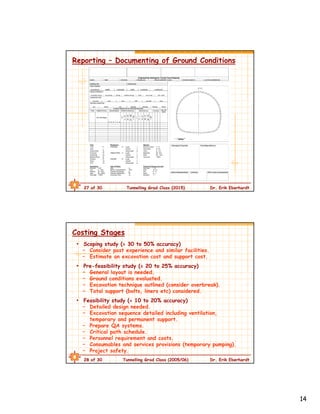
Reporting – Documenting of Ground Conditions
28 of 30 Tunnelling Grad Class (2005/06) Dr. Erik Eberhardt
• Scoping study (± 30 to 50% accuracy)
– Consider past experience and similar facilities.
– Estimate an excavation cost and support cost.
• Pre-feasibility study (± 20 to 25% accuracy)
– General layout is needed.
– Ground conditions evaluated.
– Excavation technique outlined (consider overbreak).
– Total support (bolts, liners etc) considered.
• Feasibility study (± 10 to 20% accuracy)
– Detailed design needed.
– Excavation sequence detailed including ventilation,
temporary and permanent support.
– Prepare QA systems.
– Critical path schedule.
– Personnel requirement and costs.
– Consumables and services provisions (temporary pumping).
– Project safety.
Costing Stages
15
29 of 30 Tunnelling Grad Class (2015) Dr. Erik Eberhardt
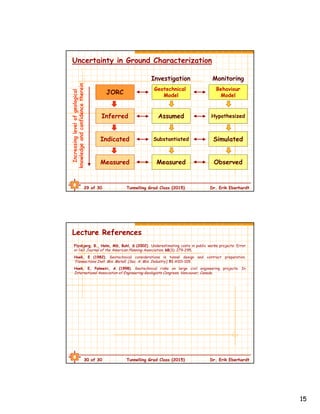
JORC
Inferred
Indicated
Measured
Increasinglevelofgeological
knowledgeandconfidencetherein
Uncertainty in Ground Characterization
Geotechnical
Model
Assumed
Substantiated
Measured
Investigation
Behaviour
Model
Hypothesized
Simulated
Observed
Monitoring
30 of 30 Tunnelling Grad Class (2015) Dr. Erik Eberhardt
Lecture References
Flyvbjerg, B., Holm, MS, Buhl, S (2002). Underestimating costs in public works projects: Error
or lie? Journal of the American Planning Association, 68(3): 279-295.
Hoek, E (1982). Geotechnical considerations in tunnel design and contract preparation.
Transactions Inst. Min. Metall. (Sec. A: Min. Industry), 91:A101-109.
Hoek, E, Palmeiri, A (1998). Geotechnical risks on large civil engineering projects. In
International Association of Engineering Geologists Congress, Vancouver, Canada.

Tunnelling & underground design (Topic3-geotechnical data baseline reports)

  • 1.
    1 1 of 30Tunnelling Grad Class (2015) Dr. Erik Eberhardt EOSC547: Tunnelling & Underground Design Topic 3: Geotechnical Data & Baseline Reports 2 of 30 Tunnelling Grad Class (2015) Dr. Erik Eberhardt Managing Hazards • Contractual disputes • Insolvency and institutional problems • Authority interference • 3rd party interference • Labour disputes General Hazards Specific Hazards • Accidents • Unforeseen adverse conditions • Inadequate designs and/or specifications • Failure of major equipment • Substandard, slow or out of tolerance works
  • 2.
    2 3 of 30Tunnelling Grad Class (2015) Dr. Erik Eberhardt Tunnelling Contracts – Risk Management Contracts are the fundamental mechanism for Financial Risk Management in every country in the world. • Trend towards design + build contracts • One-sided contract conditions • High risk type construction methods • Tight construction schedules • Low financial budgets • Fierce competition in construction industries 4 of 30 Tunnelling Grad Class (2015) Dr. Erik Eberhardt Tunnelling Contracts – Risk Management Competition for the contract was high and Favre agreed to a fixed price of £1,898,845 to complete the works, a figure that allowed for no contingencies whatsoever. In 1872, armed with the development of new drilling machines and explosives, Swiss engineer Louis Favre undertook to construct, what was once thought of as impossible: the 15 km St. Gotthard tunnel through solid rock to link Zurich with Milan. Favre also agreed to complete the works in 8 years, for which he put up a £320,000 bond. The contract allowed for a bonus of £200/day for finishing ahead of schedule and a similar penalty for every day late, forfeiting the entire bond if not completed within a year of the scheduled completion date.
  • 3.
    3 5 of 30Tunnelling Grad Class (2015) Dr. Erik Eberhardt Tunnelling Contracts – Risk Management By the time the tunnel was completed (approximately 2 years late), Favre’s firm had exceeded the contract price by £590,000 in addition to having forfeited the bond of £300,000. The cost in lives was 310 men, with 877 seriously invalided. For 7 years Favre, continually threatened by the deadline, worked his men without thought for their health or lives. Pressured to the point of desperation, he would spend days on end in the choking atmosphere of the tunnel. Broken physically as well as financially, Favre succumbed in the tunnel to a heart attack, struggling up to his last breath to advance the work. 6 of 30 Tunnelling Grad Class (2015) Dr. Erik Eberhardt Risk Management • Risk analysis: a structured process which identifies both the probability and extent of adverse consequences arising from a given activity. • Risk analysis includes identification of hazards and description of risks, i.e. probabilities and consequences (qualitative or quantitative) Risk Analysis Risk Acceptance Criteria • Common sense: aim at reducing risk once identified. • More formal criteria: – The risk shall be below a certain value – Cost-benefit type criteria / ALARP (As Low As Reasonably Practicable)
  • 4.
    4 7 of 30Tunnelling Grad Class (2015) Dr. Erik Eberhardt Risk Management Planning/Contract/Schedule Hazard Identification Probability/ Frequency Analysis Consequence Analysis Risk Risk Acceptance Criteria Risk Reduction Measures Risk Evaluation Acceptable 8 of 30 Tunnelling Grad Class (2015) Dr. Erik Eberhardt Risk Management Risk is intolerable and shall be reduced regardless of costs. Unacceptable ALARP Risk shall be reduced as long as the costs are reasonable compared to the risk reduction achieved. Broadly Acceptable No need for considering risk reduction. HIGH RISK NEGLIGIBLE RISK
  • 5.
    5 9 of 30Tunnelling Grad Class (2015) Dr. Erik Eberhardt Risk Management: Owner-Contractor Activity 10 of 30 Tunnelling Grad Class (2015) Dr. Erik Eberhardt Risk Management: Owner-Contractor Activity
  • 6.
    6 11 of 30Tunnelling Grad Class (2015) Dr. Erik Eberhardt Risk Management: Owner-Contractor Activity 12 of 30 Tunnelling Grad Class (2015) Dr. Erik Eberhardt Risk Management Process “No construction project is risk free. Risk can be managed, minimized, shared, transferred or accepted. It cannot be ignored.” – Latham (1993)
  • 7.
    7 13 of 30Tunnelling Grad Class (2015) Dr. Erik Eberhardt Risk Management – Hazard Assessment 14 of 30 Tunnelling Grad Class (2015) Dr. Erik Eberhardt Risk Management – Hazard Assessment Flyvbjergetal.(2002)
  • 8.
    8 15 of 30Tunnelling Grad Class (2015) Dr. Erik Eberhardt Risk Management – Consequences 16 of 30 Tunnelling Grad Class (2015) Dr. Erik Eberhardt Risk Management – Risk Matrix
  • 9.
    9 17 of 30Tunnelling Grad Class (2015) Dr. Erik Eberhardt Risk Management – Risk Matrix 18 of 30 Tunnelling Grad Class (2015) Dr. Erik Eberhardt Risk Management – Risk Reduction
  • 10.
    10 19 of 30Tunnelling Grad Class (2015) Dr. Erik Eberhardt Risk Management – Site Investigation Hoek&Palmeiri(1998) 20 of 30 Tunnelling Grad Class (2015) Dr. Erik Eberhardt Tunnelling Contracts – Risk Management • “the design can’t be built” – encourages Design-Build • “construction standards are poor” – gives rise to Design-Build-Maintain or Build-Operate-Transfer • “costs are too high” – leads to Build-Operate-Transfer
  • 11.
    11 21 of 30Tunnelling Grad Class (2015) Dr. Erik Eberhardt Tunnelling Contracts – Types The contractor is responsible for site investigation, design and construction of the project for a fixed price. Turnkey Lump Sum A single price is given for all the work or for completed sections of the work. Provision can be made for limited changes by the inclusion of a contract price adjustment clause. Cost- Reimbersable The contractor is paid the actual costs incurred in carrying out the work. A separate fee may be negotiated for management overheads and the profit element. Hoek(1982) 22 of 30 Tunnelling Grad Class (2015) Dr. Erik Eberhardt Tunnelling Contracts – Construction Delivery Incorporates the contractors’ means and methods into the design stage, contracted for with a single entity known as the design-builder. This system is used to minimize the project risk for an owner and to reduce the delivery schedule by overlapping the design phase and construction phase of a project. Where the design-builder is the contractor, the design professionals are typically retained directly by the contractor. Design-Build Build Operate Transfer (BOT) Allows the builder concession to operate and derive revenue over the concession period before transferring it back to the government authority. Is a project delivery method in which the Owner’s engineer carries out the design, which is then put out to bid. In this arrangement, the design team is impartial and looks out for the interests of the Owner. Design-Bid-Build (design/tender)
  • 12.
    12 23 of 30Tunnelling Grad Class (2015) Dr. Erik Eberhardt Tunnelling Contracts – Construction Delivery Public-Private Partnerships (P3s) Describes a venture which is funded and operated through a partnership of government and one or more private sector companies. Typically, a private sector consortium is contracted to develop, build, maintain and operate the asset for a given period. The public sector usually retains ownership of the facility. Government takes on a role of actively controlling some of the risks with involvement of statutory authorities who eventually take operational control. Early tunnels were financed by individuals/private investors. As countries became industrialized, projects were paid for by taxation. However, governments found taxation to be inadequate for the huge infrastructure needs and project financing became a mix of private investment and public financing. 24 of 30 Tunnelling Grad Class (2015) Dr. Erik Eberhardt Tunnelling Contracts – Construction Delivery
  • 13.
    13 25 of 30Tunnelling Grad Class (2015) Dr. Erik Eberhardt Geotechnical Reporting - compilation of all of the results of the site investigation process. Geological Data Report - generally restricted to factual information and does not include very much interpretation. - contractor is left to assess the factual information and draw conclusions on the probable groundwater and rock mass behaviour; tasks that may be very difficult to accommodate during the bidding process. Geotechnical Baseline Report - interpretative report in which all the factual data collected during the site investigation stages are analysed in terms of potential groundwater and rock mass behaviour and other issues that could cause problems during construction. - interpretations form a behavioural baseline which can be used in setting contractual limits. - contractor cannot make claims for ground behaviour which falls at or above the baseline while the owner has to accept responsibility for problems resulting from rock mass behaviour which is worse than that predicted in the baseline report. Hoek (2012) 26 of 30 Tunnelling Grad Class (2015) Dr. Erik Eberhardt Geotechnical Baseline Reports - Aims to establish a contractual understanding of the subsurface site conditions. Geotechnical Baseline Reports (GBRs) are charged with portraying a realistic interpretation of the subsurface conditions that are anticipated in the proposed construction. They should include not only the mean conditions of ground behaviour and groundwater conditions anticipated, but the report should also address the range of variances that is expected. - Risks associated with conditions consistent with or less adverse than the baseline are allocated to the contractor and those significantly more adverse than the baseline are accepted by the owner. Thus, the purpose of the GBR is to establish a realistic, common basis for evaluating any contractor claims for differing site conditions that develop during construction. The GBR is the basis for equitable contractual risk sharing and risk allocation between the project owner and their selected contractor.
  • 14.
    14 27 of 30Tunnelling Grad Class (2015) Dr. Erik Eberhardt Reporting – Documenting of Ground Conditions 28 of 30 Tunnelling Grad Class (2005/06) Dr. Erik Eberhardt • Scoping study (± 30 to 50% accuracy) – Consider past experience and similar facilities. – Estimate an excavation cost and support cost. • Pre-feasibility study (± 20 to 25% accuracy) – General layout is needed. – Ground conditions evaluated. – Excavation technique outlined (consider overbreak). – Total support (bolts, liners etc) considered. • Feasibility study (± 10 to 20% accuracy) – Detailed design needed. – Excavation sequence detailed including ventilation, temporary and permanent support. – Prepare QA systems. – Critical path schedule. – Personnel requirement and costs. – Consumables and services provisions (temporary pumping). – Project safety. Costing Stages
  • 15.
    15 29 of 30Tunnelling Grad Class (2015) Dr. Erik Eberhardt JORC Inferred Indicated Measured Increasinglevelofgeological knowledgeandconfidencetherein Uncertainty in Ground Characterization Geotechnical Model Assumed Substantiated Measured Investigation Behaviour Model Hypothesized Simulated Observed Monitoring 30 of 30 Tunnelling Grad Class (2015) Dr. Erik Eberhardt Lecture References Flyvbjerg, B., Holm, MS, Buhl, S (2002). Underestimating costs in public works projects: Error or lie? Journal of the American Planning Association, 68(3): 279-295. Hoek, E (1982). Geotechnical considerations in tunnel design and contract preparation. Transactions Inst. Min. Metall. (Sec. A: Min. Industry), 91:A101-109. Hoek, E, Palmeiri, A (1998). Geotechnical risks on large civil engineering projects. In International Association of Engineering Geologists Congress, Vancouver, Canada.