Thyroid storm
Thyrotoxic crisis
Hyperthyroidism
 is a condition in which the thyroid gland produces and secretes excessive
amounts of the free (not protein bound circulating in the blood[1]) thyroid
hormones -triiodothyronine (T3) and/or thyroxine (T4)
causes
 Graves’ disease
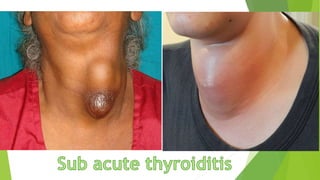
 Viral infection-------------------lead to sub acute thyroiditis
 Neoplasms –like functioning thyroid adenomas autonomously functioning toxic
nodules and toxic, multi nodular goiters (TMNGs)
 from taking too much thyroid medication. In these cases the thyroid gland
itself is not overactive, but there is still too much thyroid hormone in the
blood. Untreated, thyrotoxicosis can lead to serious medical complications
such as heart rhythm disturbances and Osteoporosis, caused from the long-
term effects of hormone overproduction.
 Another condition, called subclinical hyperthyroidism, may be diagnosed when
you have low levels of thyroid stimulating hormone (TSH) but normal levels of
thyroid hormone. Your doctor may treat asymptomatic (without symptoms)
subclinical hyperthyroidism to avoid future symptoms.
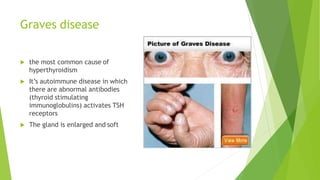
Graves disease
 the most common cause of
hyperthyroidism
 It’s autoimmune disease in which
there are abnormal antibodies
(thyroid stimulating
immunoglobulins) activates TSH
receptors
 The gland is enlarged and soft
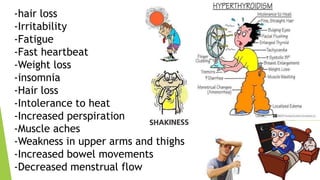
Signs and Symptoms of hyperthyroidism
-hair loss
-Irritability
-Fatigue
-Fast heartbeat
-Weight loss
-insomnia
-Hair loss
-Intolerance to heat
-Increased perspiration
-Muscle aches
-Weakness in upper arms and thighs
-Increased bowel movements
-Decreased menstrual flow
Thyrotoxic crisis
 Exaggerated or florid state of thyrotoxicosis"
 "Life threatening, sudden onset of thyroid hyperactivity"
 May represent end stage of a continuum :
– Thyroid hyperactivity to thyrotoxicosis to Thyrotoxic
crisis to thyroid storm
Relation () hyperthyroidism and
thyrotoxicosis
 Hyperthyroidism is a type of thyrotoxicosis in which accelerated thyroid
hormone biosynthesis and secretion by the thyroid gland produce
thyrotoxicosis. However, hyperthyroidism and thyrotoxicosis are not
synonymous This is because, although many patients have thyrotoxicosis
caused by hyperthyroidism, other patients may have thyrotoxicosis resulting
from inflammation of the thyroid gland, which causes the release of stored
thyroid hormone but not accelerated synthesis, or they may have
thyrotoxicosis, which is caused by ingestion of exogenous thyroid hormone.
 Differentiating between thyrotoxicosis caused by hyperthyroidism and
thyrotoxicosis not caused by hyperthyroidism is important, because disease
management and therapy differ for each form.
Thyroid Storm
Background Etiology
Most cases secondary to Graves' disease Some
due to toxic multinodular goiter Rare causes :
Acute thyroiditis
Malignancies (most do
not efficiently produce
thyroid hormones)
Very rare in children
Manifestation
 Patients may have a known history of thyrotoxicosis. In the
absence of previously diagnosed thyrotoxicosis, the history may
include symptoms such as irritability, agitation, emotional
liability, a voracious appetite with poor weight gain, excessive
sweating and heat intolerance, and poor school performance
caused by decreased attention span.
 General symptoms
 GIT
 Neurologic
 Cardiac
General symptoms
 Fever
 Profuse sweating
 Poor feeding and weight loss
 Respiratory distress
 Fatigue (more common in older adolescents)
GIT symptoms
 Nausea and vomiting
 Diarrhea
 Abdominal pain
 Jaundice
Neurological symptoms
 Anxiety (more common in
older adolescents)
 Altered behavior
 Seizures, coma
Cardiac symptoms
 Hypertension with wide pulse pressure
 Hypotension in later stages with shock
 Tachycardia disproportionate to fever
 Signs of high-output heart failure
 Cardiac arrhythmia (Supraventricular arrhythmias are
more common, [eg, atrial flutter and fibrillation], but
ventricular tachycardia may also occur.)
causes
 Thyroid storm is precipitated by the following factors in individuals with thyrotoxicosis:
 Sepsis
 Surgery
 Anesthesia induction
 Radioactive iodine (RAI) therapy
 Drugs (anticholinergic and adrenergic drugs such as pseudoephedrine; salicylates;
nonsteroidal anti-inflammatory drugs [NSAIDs]; chemotherapy and iodinated contrast
agents
 Excessive thyroid hormone (TH) ingestion
 Withdrawal of or noncompliance with antithyroid medications
 Diabetic ketoacidosis
 Direct trauma to the thyroid gland
 Vigorous palpation of an enlarged thyroid
 Toxemia of pregnancy and labor in older adolescents; molar pregnancy
Laboratory Studies
 Thyroid storm diagnosis is based on clinical features, not on laboratory test
findings. If the patient's clinical picture is consistent with thyroid storm, do not
delay treatment pending laboratory confirmation of thyrotoxicosis.
 Thyroid studies :Results of thyroid studies are usually consistent with
hyperthyroidism and are useful only if the patient has not been previously
diagnosed.
 CBC count: CBC count reveals mild leukocytosis, with a shift to the left.
 Liver function tests (LFTs): LFTs commonly reveal nonspecific abnormalities such
as elevated levels of alanine aminotransferase (ALT), aspartate aminotransferase
(AST),
 ABG and urinalysis: Measurement of blood gas and electrolyte levels and
urinalysis testing may be performed to assess and monitor short-term
management.
Imaging Studies
 The following imaging studies may be indicated:
 Chest radiography: Chest radiography may reveal cardiac enlargement due to congestive
heart failure……Radiography may also reveal pulmonary edema caused by heart failure
and/or evidence of pulmonary infection.
 CT scanning: Head CT scanning may be necessary to exclude other neurologic conditions if
diagnosis is uncertain after the initial stabilization of a patient who presents with altered
mental status.
 ECG is useful in monitoring for cardiac arrhythmias. Atrial fibrillation is the most common
cardiac arrhythmia associated with thyroid storm. Other arrhythmias such as atrial flutter
and, less commonly, ventricular tachycardia may also occur.
Treatment
Medical Care
 immediately provide supplemental oxygen, ventilatory support, and
intravenous fluids. Dextrose solutions are the preferred intravenous fluids to
cope with continuously high metabolic demand.
 Aggressively control hyperthermia
 antiadrenergic drugs (e.g., propranolol) to minimize sympathomimetic
symptoms.
 Administer antithyroid medications to block further synthesis of thyroid
hormones (THs).
 Administer iodine compounds (Lugol iodine or potassium iodide) orally or via a
nasogastric tube to block the release of THs (at least 1 h after starting
antithyroid drug therapy). If available, intravenous radiocontrast dyes such as
ipodate and iopanoate can be effective in this regard. These agents are
particularly effective at preventing peripheral conversion of T4 to T3.
Medical care
 Administer glucocorticoids (hydrocortisone ) 50mg i.v /6h to decrease
peripheral conversion of T4 to T3. This may also be useful in preventing
relative adrenal insufficiency due to hyperthyroidism.
 Treat the underlying condition, if any, that precipitated thyroid storm and
exclude comorbidities such as diabetic ketoacidosis and adrenal insufficiency.
Infection should be treated with antibiotics.
 Rarely, as a life-saving measure, plasma pheresis has been used to treat thyroid
storm in adults.
 Iodine preparations should be discontinued once the acute phase resolves and
the patient becomes afebrile with normalization of cardiac and neurological
status. Glucocorticoids should be weaned and stopped and the dose of
thioamides adjusted to maintain thyroid function in the normal range. Beta-
blockers may be discontinued once thyroid function normalizes.
Medical care
 High-dose propylthiouracil (PTU) is preferred because of its early
onset of action and capacity to inhibit peripheral conversion of T4 to
T3. The US Food and Drug Administration (FDA) had added a boxed
warning, the strongest warning issued by the FDA, to the prescribing
information for PTU.
 If the patient is given PTU during treatment of thyroid storm, this
should be switched to methimazole at the time of discharge unless
methimazole is contraindicated. If there is a contraindication for the
use of methimazole, alternative methods to treat hyperthyroidism
should be considered after discharge, such as radioactive iodine or
surgery
Surgical Care
 Patients with Graves disease who need urgent treatment of hyperthyroidism
but have absolute contraindications to thioamides may be managed acutely
with beta-blockers, iodine preparations, and glucocorticoids as described.
Subsequently, thyroidectomy may be performed after about 7 days of iodine
administration. Iodine reduces the vascularity of the gland and the risk for
thyroid storm.
Thyroidstorm ppt

Thyroidstorm ppt

  • 1.
  • 2.
    Hyperthyroidism  is acondition in which the thyroid gland produces and secretes excessive amounts of the free (not protein bound circulating in the blood[1]) thyroid hormones -triiodothyronine (T3) and/or thyroxine (T4)
  • 3.
    causes  Graves’ disease Viral infection-------------------lead to sub acute thyroiditis  Neoplasms –like functioning thyroid adenomas autonomously functioning toxic nodules and toxic, multi nodular goiters (TMNGs)  from taking too much thyroid medication. In these cases the thyroid gland itself is not overactive, but there is still too much thyroid hormone in the blood. Untreated, thyrotoxicosis can lead to serious medical complications such as heart rhythm disturbances and Osteoporosis, caused from the long- term effects of hormone overproduction.  Another condition, called subclinical hyperthyroidism, may be diagnosed when you have low levels of thyroid stimulating hormone (TSH) but normal levels of thyroid hormone. Your doctor may treat asymptomatic (without symptoms) subclinical hyperthyroidism to avoid future symptoms.
  • 4.
    Graves disease  themost common cause of hyperthyroidism  It’s autoimmune disease in which there are abnormal antibodies (thyroid stimulating immunoglobulins) activates TSH receptors  The gland is enlarged and soft
  • 6.
    Signs and Symptomsof hyperthyroidism
  • 7.
    -hair loss -Irritability -Fatigue -Fast heartbeat -Weightloss -insomnia -Hair loss -Intolerance to heat -Increased perspiration -Muscle aches -Weakness in upper arms and thighs -Increased bowel movements -Decreased menstrual flow
  • 8.
    Thyrotoxic crisis  Exaggeratedor florid state of thyrotoxicosis"  "Life threatening, sudden onset of thyroid hyperactivity"  May represent end stage of a continuum : – Thyroid hyperactivity to thyrotoxicosis to Thyrotoxic crisis to thyroid storm
  • 9.
    Relation () hyperthyroidismand thyrotoxicosis  Hyperthyroidism is a type of thyrotoxicosis in which accelerated thyroid hormone biosynthesis and secretion by the thyroid gland produce thyrotoxicosis. However, hyperthyroidism and thyrotoxicosis are not synonymous This is because, although many patients have thyrotoxicosis caused by hyperthyroidism, other patients may have thyrotoxicosis resulting from inflammation of the thyroid gland, which causes the release of stored thyroid hormone but not accelerated synthesis, or they may have thyrotoxicosis, which is caused by ingestion of exogenous thyroid hormone.  Differentiating between thyrotoxicosis caused by hyperthyroidism and thyrotoxicosis not caused by hyperthyroidism is important, because disease management and therapy differ for each form.
  • 10.
    Thyroid Storm Background Etiology Mostcases secondary to Graves' disease Some due to toxic multinodular goiter Rare causes : Acute thyroiditis Malignancies (most do not efficiently produce thyroid hormones) Very rare in children
  • 11.
    Manifestation  Patients mayhave a known history of thyrotoxicosis. In the absence of previously diagnosed thyrotoxicosis, the history may include symptoms such as irritability, agitation, emotional liability, a voracious appetite with poor weight gain, excessive sweating and heat intolerance, and poor school performance caused by decreased attention span.  General symptoms  GIT  Neurologic  Cardiac
  • 12.
    General symptoms  Fever Profuse sweating  Poor feeding and weight loss  Respiratory distress  Fatigue (more common in older adolescents)
  • 13.
    GIT symptoms  Nauseaand vomiting  Diarrhea  Abdominal pain  Jaundice Neurological symptoms  Anxiety (more common in older adolescents)  Altered behavior  Seizures, coma
  • 14.
    Cardiac symptoms  Hypertensionwith wide pulse pressure  Hypotension in later stages with shock  Tachycardia disproportionate to fever  Signs of high-output heart failure  Cardiac arrhythmia (Supraventricular arrhythmias are more common, [eg, atrial flutter and fibrillation], but ventricular tachycardia may also occur.)
  • 15.
    causes  Thyroid stormis precipitated by the following factors in individuals with thyrotoxicosis:  Sepsis  Surgery  Anesthesia induction  Radioactive iodine (RAI) therapy  Drugs (anticholinergic and adrenergic drugs such as pseudoephedrine; salicylates; nonsteroidal anti-inflammatory drugs [NSAIDs]; chemotherapy and iodinated contrast agents  Excessive thyroid hormone (TH) ingestion  Withdrawal of or noncompliance with antithyroid medications  Diabetic ketoacidosis  Direct trauma to the thyroid gland  Vigorous palpation of an enlarged thyroid  Toxemia of pregnancy and labor in older adolescents; molar pregnancy
  • 16.
    Laboratory Studies  Thyroidstorm diagnosis is based on clinical features, not on laboratory test findings. If the patient's clinical picture is consistent with thyroid storm, do not delay treatment pending laboratory confirmation of thyrotoxicosis.  Thyroid studies :Results of thyroid studies are usually consistent with hyperthyroidism and are useful only if the patient has not been previously diagnosed.  CBC count: CBC count reveals mild leukocytosis, with a shift to the left.  Liver function tests (LFTs): LFTs commonly reveal nonspecific abnormalities such as elevated levels of alanine aminotransferase (ALT), aspartate aminotransferase (AST),  ABG and urinalysis: Measurement of blood gas and electrolyte levels and urinalysis testing may be performed to assess and monitor short-term management.
  • 17.
    Imaging Studies  Thefollowing imaging studies may be indicated:  Chest radiography: Chest radiography may reveal cardiac enlargement due to congestive heart failure……Radiography may also reveal pulmonary edema caused by heart failure and/or evidence of pulmonary infection.  CT scanning: Head CT scanning may be necessary to exclude other neurologic conditions if diagnosis is uncertain after the initial stabilization of a patient who presents with altered mental status.  ECG is useful in monitoring for cardiac arrhythmias. Atrial fibrillation is the most common cardiac arrhythmia associated with thyroid storm. Other arrhythmias such as atrial flutter and, less commonly, ventricular tachycardia may also occur.
  • 18.
  • 19.
    Medical Care  immediatelyprovide supplemental oxygen, ventilatory support, and intravenous fluids. Dextrose solutions are the preferred intravenous fluids to cope with continuously high metabolic demand.  Aggressively control hyperthermia  antiadrenergic drugs (e.g., propranolol) to minimize sympathomimetic symptoms.  Administer antithyroid medications to block further synthesis of thyroid hormones (THs).  Administer iodine compounds (Lugol iodine or potassium iodide) orally or via a nasogastric tube to block the release of THs (at least 1 h after starting antithyroid drug therapy). If available, intravenous radiocontrast dyes such as ipodate and iopanoate can be effective in this regard. These agents are particularly effective at preventing peripheral conversion of T4 to T3.
  • 20.
    Medical care  Administerglucocorticoids (hydrocortisone ) 50mg i.v /6h to decrease peripheral conversion of T4 to T3. This may also be useful in preventing relative adrenal insufficiency due to hyperthyroidism.  Treat the underlying condition, if any, that precipitated thyroid storm and exclude comorbidities such as diabetic ketoacidosis and adrenal insufficiency. Infection should be treated with antibiotics.  Rarely, as a life-saving measure, plasma pheresis has been used to treat thyroid storm in adults.  Iodine preparations should be discontinued once the acute phase resolves and the patient becomes afebrile with normalization of cardiac and neurological status. Glucocorticoids should be weaned and stopped and the dose of thioamides adjusted to maintain thyroid function in the normal range. Beta- blockers may be discontinued once thyroid function normalizes.
  • 21.
    Medical care  High-dosepropylthiouracil (PTU) is preferred because of its early onset of action and capacity to inhibit peripheral conversion of T4 to T3. The US Food and Drug Administration (FDA) had added a boxed warning, the strongest warning issued by the FDA, to the prescribing information for PTU.  If the patient is given PTU during treatment of thyroid storm, this should be switched to methimazole at the time of discharge unless methimazole is contraindicated. If there is a contraindication for the use of methimazole, alternative methods to treat hyperthyroidism should be considered after discharge, such as radioactive iodine or surgery
  • 22.
    Surgical Care  Patientswith Graves disease who need urgent treatment of hyperthyroidism but have absolute contraindications to thioamides may be managed acutely with beta-blockers, iodine preparations, and glucocorticoids as described. Subsequently, thyroidectomy may be performed after about 7 days of iodine administration. Iodine reduces the vascularity of the gland and the risk for thyroid storm.