TUBERCULOSIS
“THE WHITE DEATH”
THIS SLIDE DECK COVERS THE FOLLOWING
TOPICS ABOUT TUBERCULOSIS
 Introduction
 Ancient History
 Incidence
 Types Of Tuberculosis
 Risk Factors Of Tuberculosis
 Clinical Manifestations
 Pathophysiology
Diagnostics evaluation
Complications
THIS SLIDE DECK COVERS THE FOLLOWING
TOPICS ABOUT TUBERCULOSIS
Preventive measures
DOTS
Pharmacological management
Anti-tubercular drugs
Other management strategies
Key activities of nurses
Nursing diagnosis
Conclusion
References
INTRODUCTION
 Tuberculosis (TB), also known colloquially as the “white death” or historically as
consumption, is an infectious disease usually caused by Mycobacterium
tuberculosis (MTB) bacteria.
 Tuberculosis generally affects the lungs, but it can also affect other parts of the
body.
 Most infections show no symptoms, in which case it is known as latent
tuberculosis.
 Around 10% of latent infections progress to active disease which, if left untreated,
kill about half of those affected.
MYCOBACTERIUM
TUBERCULOSIS
 It is also known as Koch's bacillus.
 First discovered in 1882 by Robert
Koch.
 M. tuberculosis has an unusual,
waxy coating on its cell surface
primarily due to the presence of
mycolic acid. This coating makes
the cells impervious to Gram
staining.
 M. tuberculosis can appear weakly
Gram-positive.
ANCIENT HISTORY
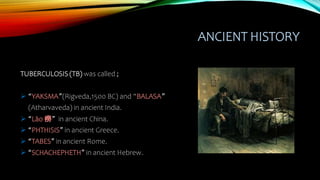
TUBERCULOSIS (TB) was called ;
 “YAKSMA”(Rigveda,1500 BC) and “BALASA”
(Atharvaveda) in ancient India.
 “Lào 癆” in ancient China.
 “PHTHISIS” in ancient Greece.
 “TABES” in ancient Rome.
 “SCHACHEPHETH” in ancient Hebrew.
INCIDENCE : WHO GLOBAL TB REPORT
2022
 India’s TB incidence for the year 2021 is 210/100,000 – compared to the baseline year of
2015(incidence was 256/100,000 of population in India).
 There has been an 18% decline which is 7% points better than the global average of 11%.
 These figures also place India at the 36th position in terms of incidence rates.
 21.4 lakh TB cases notified in India in 2021, 18% higher than 2020.
 Over 22 crore people screened for TB in 2021 across the country for early detection and
treatment of TB.
 Under the new initiative Pradhan Mantri TB Mukt Abhiyan, more than 40,000 Nikshay
Mitra supporting over 10.4 lakh TB patients all over the country.
Active Tuberculosis
(Symptomatic, Contagious, +ve
blood & skin test)
Latent Tuberculosis
(Asymptomatic, Non-contagious,
+ve blood & skin test)
Extrapulmonary
(Involves parts of the body
outside of the lungs)
Convert into active TB in 5-10 %
people with weakened immune
system
Pulmonary
(Involves lungs)
1. Skeletal TB (bone)
2. Milliary TB ( bone marrow, liver, spinal cord, brain, heart, etc.)
3. Gastrointestinal TB (GIT)
4. Genitourinary TB (genitals or urinary tract/kidney)
5. Liver TB (liver)
6. TB meningitis (meninges surrounding the brain & spinal cord )
7. TB peritonitis (peritoneum)
8. TB pericarditis (pericardium)
9. Cutaneous TB (skin)
RISK FACTORS OF TUBERCULOSIS
Other Risk Factors Of TB:
Close contact with infected individual.
Living in crowed areas.
Working in healthcare.
Limiting access to healthcare.
Not being vaccinated.
Homeless.
IV drug abuse.
Malnutrition.
Immunocompromised.
CLINICAL
MANIFESTATIONS
PATHOPHYSIOLOGY
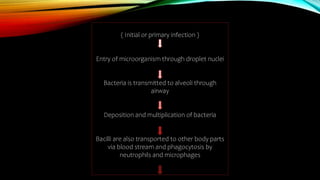
( Initial or primary infection )
Entry of microorganism through droplet nuclei
Bacteria is transmitted to alveoli through
airway
Deposition and multiplication of bacteria
Bacilli are also transported to other body parts
via blood stream and phagocytosis by
neutrophils and microphages
Mycobacterium
Pulmonary alveoli
Immune system has lodged in
Detects presence of pathogens and engulf the
bacteria
Mycobacterium bacteria inhibits the macrophages
to forms phagolysosome and remains protected
inside the microphages
Start replication inside macrophages
Primary infection occurs
Cell mediated immunity gets activated, surrounded
the cell to form granuloma(3weeks)
Leads to necrosis of tissues at infection site
Involve nearby lymph nodes(cone complex)
Calcification of cone complex (Latent TB)
DIAGNOSTICS
EVALUATION
 History Collection
 Physical Examination
 Sputum Culture Test
 Bacteriological Test
 Mantoux Test
 Chest X-Ray
(Radiography)
 QFT-Gold Test
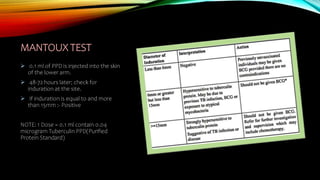
MANTOUX TEST
 0.1 ml of PPD is injected into the skin
of the lower arm.
 48-72 hours later; check for
induration at the site.
 If induration is equal to and more
than 15mm :- Positive
NOTE: 1 Dose = 0.1 ml contain 0.04
microgram Tuberculin PPD(Purified
Protein Standard)
CHEST X- RAY
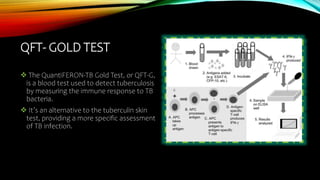
QFT- GOLD TEST
 The QuantiFERON-TB Gold Test, or QFT-G,
is a blood test used to detect tuberculosis
by measuring the immune response to TB
bacteria.
 It’s an alternative to the tuberculin skin
test, providing a more specific assessment
of TB infection.
COMPLICATIONS
 Meningitis
 Spinal Pain
 Joint Damage
 Damage to the Liver or Kidney
 Heart Disorder
 Pleural Effusion
 Serious reactions to Drug Therapy
(hepato-toxicity; hypersensitivity)
PREVENTIVE
MEASURES
Other Preventive Measures;
 Mask
 BCG Vaccine
 Regular medical follow up.
 Isolation of patient
 UV Germicidal irradiation
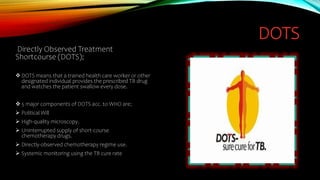
DOTS
Directly Observed Treatment
Shortcourse (DOTS);
 DOTS means that a trained health care worker or other
designated individual provides the prescribed TB drug
and watches the patient swallow every dose.
 5 major components of DOTS acc. to WHO are;
 Political Will
 High-quality microscopy.
 Uninterrupted supply of short-course
chemotherapy drugs.
 Directly-observed chemotherapy regime use.
 Systemic monitoring using the TB cure rate
PHARMACOLOGICAL
MANAGEMENT
TREATMENT OF TUBERCULOSIS
The duration of treatment is usually 6-8 months.
 There are two phases in the treatment of tuberculosis, depending upon the category of
treatment;
i. The Intensive Phase (IP) – 2-4 months
ii. The Continuation Phase (CP) – 4-5 months
 During IP, all doses are given under direct observation, three times a week on alternate days for 2-4
months.
 Thereafter, sputum is examined and if found negative, the CP is started.
 There are three categories of treatment regimens for
patients suffering from tuberculosis (pulmonary or
extrapulmonary).
 Drugs are supplied in a patient wise boxes (PWB) containing
the full course of treatment for one patient and packaged in
blister packs.
 The PWBs have a color code indicating the category of
treatment (red for Cat I, blue for Cat II, green or Cat III).
 In each PWB, there are 2 pouches, one for IP (marked A)
and one for CP (marked B).
CATEGORY I (CAT I) TREATMENT
REGIMEN
 New sputum –ve pulmonary TB
cases.
 New sputum –ve, pulmonary TB
cases, who are seriously ill.
 New cases of extra-pulmonary
TB, , who are seriously ill.
 All new TB cases with known HIV
+ve status.
Intensive Phase for two months
Continuation Phase for four
months
Prescribed for the following
types of patients;
Drug Regimen in CAT-I
Isoniazid(H) 300 mg
2 tablets
Rifampicin(R) 450 mg
1 capsule
Pyrazinamide(Z) 750 mg
2 tablets
Ethambutol(E) 600 mg
2 tablets
Isoniazid(H) 300 mg
2 tablets
Rifampicin(R) 450 mg
1 capsule
CATEGORY II (CAT-II) TREATMENT
REGIMEN
Intensive Phase for three months Continuation Phase for five months
Prescribed for the following
types of patients;
 Sputum +ve relapse cases.
 Sputum +ve failure cases.
 Sputum +ve treatment after
default cases.
 Others; extrapulmonary relapse
or failure.
Drug Regimen in CAT-II
Isoniazid(H) 300 mg
2 tablets
Rifampicin(R) 450 mg
1 capsule
Pyrazinamide(Z) 750 mg
2 tablets
Ethambutol(E) 600 mg
2 tablets
Isoniazid(H) 300 mg
2 tablets
Rifampicin(R) 450 mg
1 capsule
Ethambutol(E) 600 mg
2 tablets
CATEGORY III (CAT-III) TREATMENT
REGIMEN
Intensive Phase for two months
Continuation Phase for four
months
Prescribed for the following
types of patients;
 New sputum –ve pulmonary TB
cases, who are not seriously ill.
 New extra-pulmonary TB cases,
who are not seriously ill.
Drug Regimen in CAT-III
Isoniazid(H) 300 mg
2 tablets
Rifampicin(R) 450 mg
1 capsule
Ethambutol(E) 750 mg
2 tablets
Isoniazid(H) 300 mg
2 tablets
Rifampicin(R) 450 mg
1 capsule
ANTI-TUBERCULAR DRUGS
 Isoniazid(H)
 Rifampicin(R)
 Pyrazinamide(Z)
 Ethambutol(E)
 Streptomycin(S)
First
Line
Drugs
Thioacetazone
PASA
Ethionamide
Cycloserine
Kanamycin
Amikacin
Second
Line
Drugs
Ciprofloxacin
Ofloxacin
Clarithromycin
Azithromycin
Rifabutin
Newer
Drugs
OTHER MANAGEMENT STRATEGIES
Nutritional Therapy
Lifestyle Modification
Cough Hygiene
Regular Follow-up
Prevention of Complications
KEY ACTIVITIES OF NURSES
Patient Care
Health Education
Treatment Observation
Sputum Collection
Management/Coordination
Contact Tracing/Screening
Research
Teaching
NURSING DIAGNOSIS
Ineffective airway clearance related to copious tracheobronchial secretions.
Deficient knowledge about treatment regimen and preventive health
measures and related ineffective individual management of the therapeutic
regimen.
CONCLUSION
Tuberculosis remains a global health concern, affecting millions each year. Despite
advancements in diagnosis and treatment, challenges such as drug resistance and
social determinants continue to impede efforts for eradication. A comprehensive
approach, including improved healthcare infrastructure and global collaboration, is
crucial to effectively combat this infectious diseases.
REFERENCE
PRESS INFORATION BUREAU, Government Of India
https://pib.gov.in/PressReleasePage.aspx?PRID=1871626
WORLD HEALTH ORGANIZATION,
https://www.who.int/health-topics/tuberculosis
CENTERS FOR DISEASE CONTROL AND PREVENTION, United States of America
https://www.cdc.gov/tb/topics/basics/deault.htm

TUBERCULOSIS. .pptx

  • 1.
  • 2.
    THIS SLIDE DECKCOVERS THE FOLLOWING TOPICS ABOUT TUBERCULOSIS  Introduction  Ancient History  Incidence  Types Of Tuberculosis  Risk Factors Of Tuberculosis  Clinical Manifestations  Pathophysiology Diagnostics evaluation Complications
  • 3.
    THIS SLIDE DECKCOVERS THE FOLLOWING TOPICS ABOUT TUBERCULOSIS Preventive measures DOTS Pharmacological management Anti-tubercular drugs Other management strategies Key activities of nurses Nursing diagnosis Conclusion References
  • 4.
    INTRODUCTION  Tuberculosis (TB),also known colloquially as the “white death” or historically as consumption, is an infectious disease usually caused by Mycobacterium tuberculosis (MTB) bacteria.  Tuberculosis generally affects the lungs, but it can also affect other parts of the body.  Most infections show no symptoms, in which case it is known as latent tuberculosis.  Around 10% of latent infections progress to active disease which, if left untreated, kill about half of those affected.
  • 5.
    MYCOBACTERIUM TUBERCULOSIS  It isalso known as Koch's bacillus.  First discovered in 1882 by Robert Koch.  M. tuberculosis has an unusual, waxy coating on its cell surface primarily due to the presence of mycolic acid. This coating makes the cells impervious to Gram staining.  M. tuberculosis can appear weakly Gram-positive.
  • 6.
    ANCIENT HISTORY TUBERCULOSIS (TB)was called ;  “YAKSMA”(Rigveda,1500 BC) and “BALASA” (Atharvaveda) in ancient India.  “Lào 癆” in ancient China.  “PHTHISIS” in ancient Greece.  “TABES” in ancient Rome.  “SCHACHEPHETH” in ancient Hebrew.
  • 7.
    INCIDENCE : WHOGLOBAL TB REPORT 2022  India’s TB incidence for the year 2021 is 210/100,000 – compared to the baseline year of 2015(incidence was 256/100,000 of population in India).  There has been an 18% decline which is 7% points better than the global average of 11%.  These figures also place India at the 36th position in terms of incidence rates.  21.4 lakh TB cases notified in India in 2021, 18% higher than 2020.  Over 22 crore people screened for TB in 2021 across the country for early detection and treatment of TB.  Under the new initiative Pradhan Mantri TB Mukt Abhiyan, more than 40,000 Nikshay Mitra supporting over 10.4 lakh TB patients all over the country.
  • 8.
    Active Tuberculosis (Symptomatic, Contagious,+ve blood & skin test) Latent Tuberculosis (Asymptomatic, Non-contagious, +ve blood & skin test) Extrapulmonary (Involves parts of the body outside of the lungs) Convert into active TB in 5-10 % people with weakened immune system Pulmonary (Involves lungs) 1. Skeletal TB (bone) 2. Milliary TB ( bone marrow, liver, spinal cord, brain, heart, etc.) 3. Gastrointestinal TB (GIT) 4. Genitourinary TB (genitals or urinary tract/kidney) 5. Liver TB (liver) 6. TB meningitis (meninges surrounding the brain & spinal cord ) 7. TB peritonitis (peritoneum) 8. TB pericarditis (pericardium) 9. Cutaneous TB (skin)
  • 9.
    RISK FACTORS OFTUBERCULOSIS Other Risk Factors Of TB: Close contact with infected individual. Living in crowed areas. Working in healthcare. Limiting access to healthcare. Not being vaccinated. Homeless. IV drug abuse. Malnutrition. Immunocompromised.
  • 10.
  • 11.
  • 12.
    ( Initial orprimary infection ) Entry of microorganism through droplet nuclei Bacteria is transmitted to alveoli through airway Deposition and multiplication of bacteria Bacilli are also transported to other body parts via blood stream and phagocytosis by neutrophils and microphages
  • 13.
    Mycobacterium Pulmonary alveoli Immune systemhas lodged in Detects presence of pathogens and engulf the bacteria Mycobacterium bacteria inhibits the macrophages to forms phagolysosome and remains protected inside the microphages
  • 14.
    Start replication insidemacrophages Primary infection occurs Cell mediated immunity gets activated, surrounded the cell to form granuloma(3weeks) Leads to necrosis of tissues at infection site Involve nearby lymph nodes(cone complex) Calcification of cone complex (Latent TB)
  • 15.
    DIAGNOSTICS EVALUATION  History Collection Physical Examination  Sputum Culture Test  Bacteriological Test  Mantoux Test  Chest X-Ray (Radiography)  QFT-Gold Test
  • 16.
    MANTOUX TEST  0.1ml of PPD is injected into the skin of the lower arm.  48-72 hours later; check for induration at the site.  If induration is equal to and more than 15mm :- Positive NOTE: 1 Dose = 0.1 ml contain 0.04 microgram Tuberculin PPD(Purified Protein Standard)
  • 17.
  • 18.
    QFT- GOLD TEST The QuantiFERON-TB Gold Test, or QFT-G, is a blood test used to detect tuberculosis by measuring the immune response to TB bacteria.  It’s an alternative to the tuberculin skin test, providing a more specific assessment of TB infection.
  • 19.
    COMPLICATIONS  Meningitis  SpinalPain  Joint Damage  Damage to the Liver or Kidney  Heart Disorder  Pleural Effusion  Serious reactions to Drug Therapy (hepato-toxicity; hypersensitivity)
  • 20.
    PREVENTIVE MEASURES Other Preventive Measures; Mask  BCG Vaccine  Regular medical follow up.  Isolation of patient  UV Germicidal irradiation
  • 21.
    DOTS Directly Observed Treatment Shortcourse(DOTS);  DOTS means that a trained health care worker or other designated individual provides the prescribed TB drug and watches the patient swallow every dose.  5 major components of DOTS acc. to WHO are;  Political Will  High-quality microscopy.  Uninterrupted supply of short-course chemotherapy drugs.  Directly-observed chemotherapy regime use.  Systemic monitoring using the TB cure rate
  • 23.
  • 24.
    TREATMENT OF TUBERCULOSIS Theduration of treatment is usually 6-8 months.  There are two phases in the treatment of tuberculosis, depending upon the category of treatment; i. The Intensive Phase (IP) – 2-4 months ii. The Continuation Phase (CP) – 4-5 months  During IP, all doses are given under direct observation, three times a week on alternate days for 2-4 months.  Thereafter, sputum is examined and if found negative, the CP is started.
  • 25.
     There arethree categories of treatment regimens for patients suffering from tuberculosis (pulmonary or extrapulmonary).  Drugs are supplied in a patient wise boxes (PWB) containing the full course of treatment for one patient and packaged in blister packs.  The PWBs have a color code indicating the category of treatment (red for Cat I, blue for Cat II, green or Cat III).  In each PWB, there are 2 pouches, one for IP (marked A) and one for CP (marked B).
  • 26.
    CATEGORY I (CATI) TREATMENT REGIMEN  New sputum –ve pulmonary TB cases.  New sputum –ve, pulmonary TB cases, who are seriously ill.  New cases of extra-pulmonary TB, , who are seriously ill.  All new TB cases with known HIV +ve status. Intensive Phase for two months Continuation Phase for four months Prescribed for the following types of patients; Drug Regimen in CAT-I Isoniazid(H) 300 mg 2 tablets Rifampicin(R) 450 mg 1 capsule Pyrazinamide(Z) 750 mg 2 tablets Ethambutol(E) 600 mg 2 tablets Isoniazid(H) 300 mg 2 tablets Rifampicin(R) 450 mg 1 capsule
  • 27.
    CATEGORY II (CAT-II)TREATMENT REGIMEN Intensive Phase for three months Continuation Phase for five months Prescribed for the following types of patients;  Sputum +ve relapse cases.  Sputum +ve failure cases.  Sputum +ve treatment after default cases.  Others; extrapulmonary relapse or failure. Drug Regimen in CAT-II Isoniazid(H) 300 mg 2 tablets Rifampicin(R) 450 mg 1 capsule Pyrazinamide(Z) 750 mg 2 tablets Ethambutol(E) 600 mg 2 tablets Isoniazid(H) 300 mg 2 tablets Rifampicin(R) 450 mg 1 capsule Ethambutol(E) 600 mg 2 tablets
  • 28.
    CATEGORY III (CAT-III)TREATMENT REGIMEN Intensive Phase for two months Continuation Phase for four months Prescribed for the following types of patients;  New sputum –ve pulmonary TB cases, who are not seriously ill.  New extra-pulmonary TB cases, who are not seriously ill. Drug Regimen in CAT-III Isoniazid(H) 300 mg 2 tablets Rifampicin(R) 450 mg 1 capsule Ethambutol(E) 750 mg 2 tablets Isoniazid(H) 300 mg 2 tablets Rifampicin(R) 450 mg 1 capsule
  • 29.
  • 30.
     Isoniazid(H)  Rifampicin(R) Pyrazinamide(Z)  Ethambutol(E)  Streptomycin(S) First Line Drugs
  • 31.
  • 32.
  • 33.
    OTHER MANAGEMENT STRATEGIES NutritionalTherapy Lifestyle Modification Cough Hygiene Regular Follow-up Prevention of Complications
  • 34.
    KEY ACTIVITIES OFNURSES Patient Care Health Education Treatment Observation Sputum Collection Management/Coordination Contact Tracing/Screening Research Teaching
  • 35.
    NURSING DIAGNOSIS Ineffective airwayclearance related to copious tracheobronchial secretions. Deficient knowledge about treatment regimen and preventive health measures and related ineffective individual management of the therapeutic regimen.
  • 36.
    CONCLUSION Tuberculosis remains aglobal health concern, affecting millions each year. Despite advancements in diagnosis and treatment, challenges such as drug resistance and social determinants continue to impede efforts for eradication. A comprehensive approach, including improved healthcare infrastructure and global collaboration, is crucial to effectively combat this infectious diseases.
  • 37.
    REFERENCE PRESS INFORATION BUREAU,Government Of India https://pib.gov.in/PressReleasePage.aspx?PRID=1871626 WORLD HEALTH ORGANIZATION, https://www.who.int/health-topics/tuberculosis CENTERS FOR DISEASE CONTROL AND PREVENTION, United States of America https://www.cdc.gov/tb/topics/basics/deault.htm