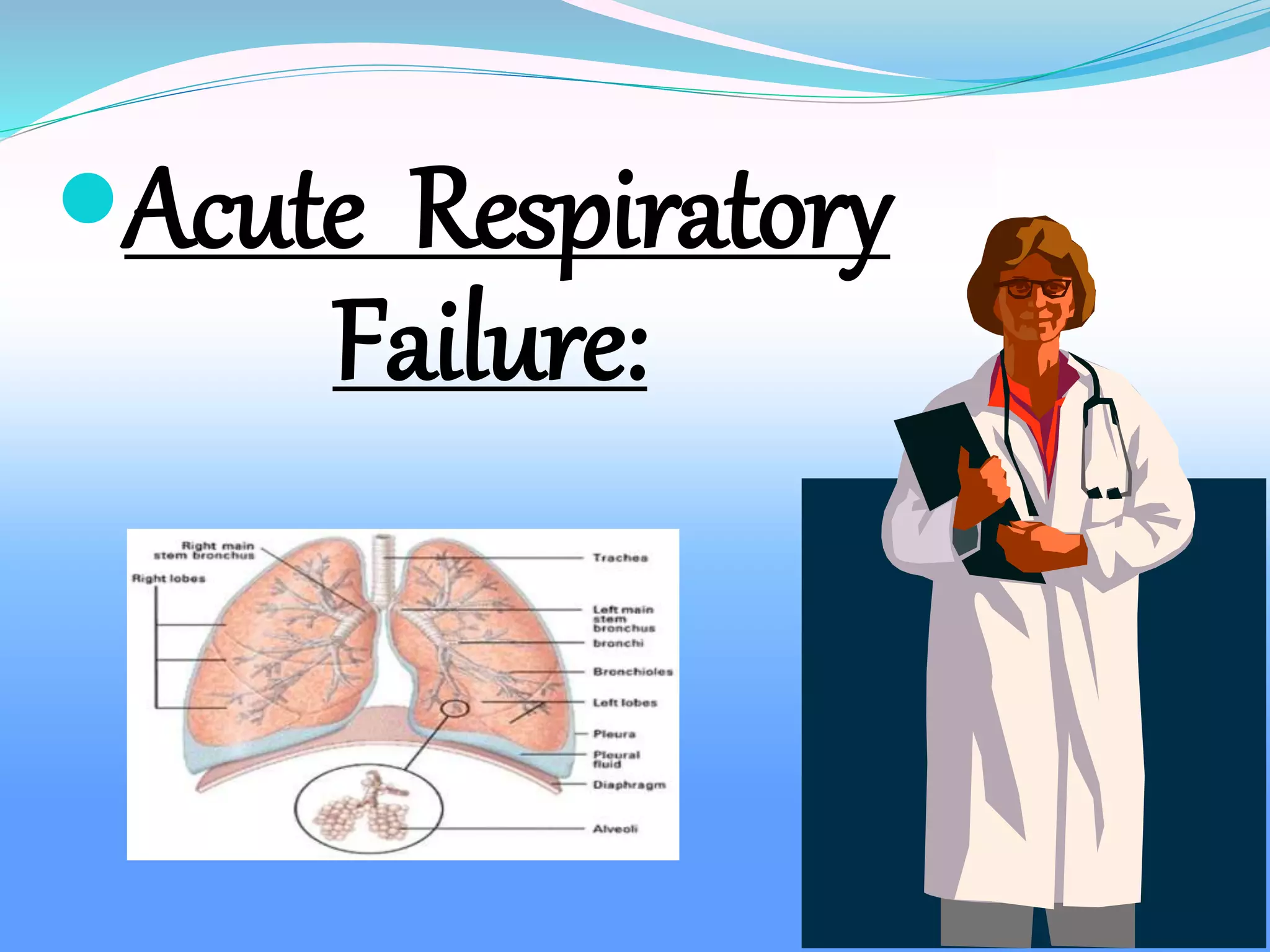
Acute Respiratory
Failure:
Introduction:
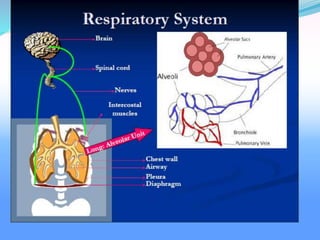
 The body relies primarily on the central nervous
system, the pulmonary system, the heart and the
vascular system to accomplish effective respiration.
Respiratory failure occurs when one or more of these
system or organ fails to maintain optimal functioning.
If the respiratory failure occurs so rapidly that the
compensatory mechanisms cannot accommodate or if
the compensatory mechanisms overwhelmed the
acute respiratory failure develops.
Definition:
 Respiratory failure is defined as a PaO2 value of less
than 60 mm Hg while breathing air or a PaCO2 of
more than 50 mm Hg.
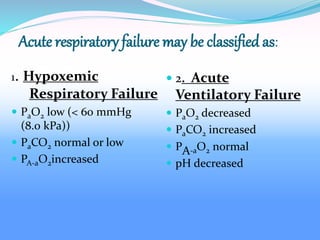
Acute respiratory failure may be classified as:
1. Hypoxemic
Respiratory Failure
 PaO2 low (< 60 mmHg
(8.0 kPa))
 PaCO2 normal or low
 PA-aO2increased
 2. Acute
Ventilatory Failure
 PaO2 decreased
 PaCO2 increased
 PA-aO2 normal
 pH decreased
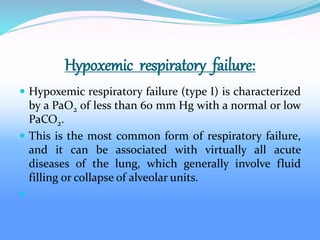
Hypoxemic respiratory failure:
 Hypoxemic respiratory failure (type I) is characterized
by a PaO2 of less than 60 mm Hg with a normal or low
PaCO2.
 This is the most common form of respiratory failure,
and it can be associated with virtually all acute
diseases of the lung, which generally involve fluid
filling or collapse of alveolar units.

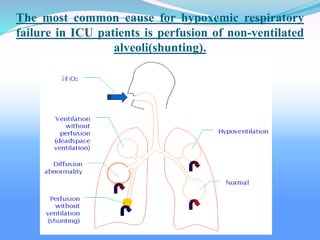
The most common cause for hypoxemic respiratory
failure in ICU patients is perfusion of non-ventilated
alveoli(shunting).
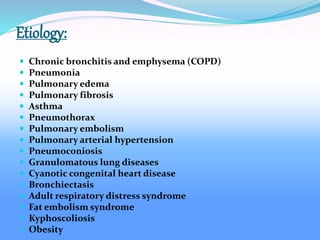
Etiology:
 Chronic bronchitis and emphysema (COPD)
 Pneumonia
 Pulmonary edema
 Pulmonary fibrosis
 Asthma
 Pneumothorax
 Pulmonary embolism
 Pulmonary arterial hypertension
 Pneumoconiosis
 Granulomatous lung diseases
 Cyanotic congenital heart disease
 Bronchiectasis
 Adult respiratory distress syndrome
 Fat embolism syndrome
 Kyphoscoliosis
 Obesity
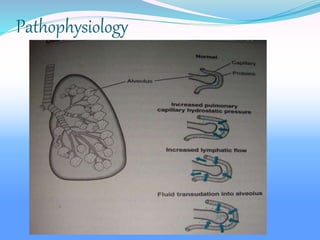
Pathophysiology
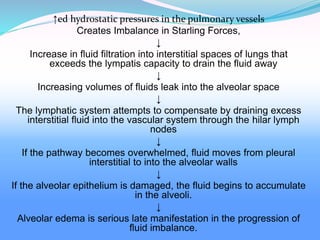
↑ed hydrostatic pressures in the pulmonary vessels
Creates Imbalance in Starling Forces,
↓
Increase in fluid filtration into interstitial spaces of lungs that
exceeds the lympatis capacity to drain the fluid away
↓
Increasing volumes of fluids leak into the alveolar space
↓
The lymphatic system attempts to compensate by draining excess
interstitial fluid into the vascular system through the hilar lymph
nodes
↓
If the pathway becomes overwhelmed, fluid moves from pleural
interstitial to into the alveolar walls
↓
If the alveolar epithelium is damaged, the fluid begins to accumulate
in the alveoli.
↓
Alveolar edema is serious late manifestation in the progression of
fluid imbalance.
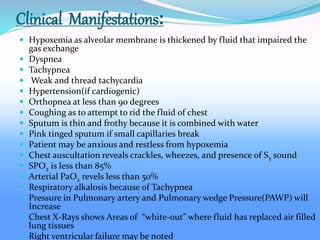
Clinical Manifestations:
 Hypoxemia as alveolar membrane is thickened by fluid that impaired the
gas exchange
 Dyspnea
 Tachypnea
 Weak and thread tachycardia
 Hypertension(if cardiogenic)
 Orthopnea at less than 90 degrees
 Coughing as to attempt to rid the fluid of chest
 Sputum is thin and frothy because it is combined with water
 Pink tinged sputum if small capillaries break
 Patient may be anxious and restless from hypoxemia
 Chest auscultation reveals crackles, wheezes, and presence of S3 sound
 SPO2 is less than 85%
 Arterial PaO2 revels less than 50%
 Respiratory alkalosis because of Tachypnea
 Pressure in Pulmonary artery and Pulmonary wedge Pressure(PAWP) will
Increase
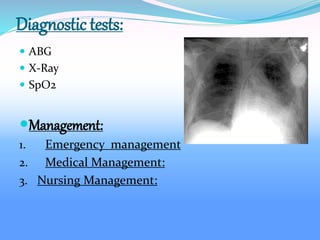
 Chest X-Rays shows Areas of “white-out” where fluid has replaced air filled
lung tissues
 Right ventricular failure may be noted
Diagnostic tests:
 ABG
 X-Ray
 SpO2
Management:
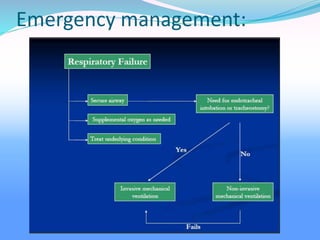
1. Emergency management
2. Medical Management:
3. Nursing Management:
Emergency management:
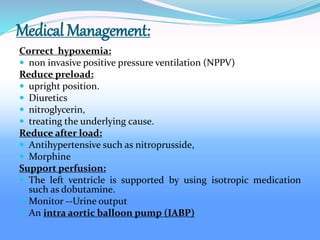
Medical Management:
Correct hypoxemia:
 non invasive positive pressure ventilation (NPPV)
Reduce preload:
 upright position.
 Diuretics
 nitroglycerin,
 treating the underlying cause.
Reduce after load:
 Antihypertensive such as nitroprusside,
 Morphine
Support perfusion:
 The left ventricle is supported by using isotropic medication
such as dobutamine.
 Monitor --Urine output
 An intra aortic balloon pump (IABP)
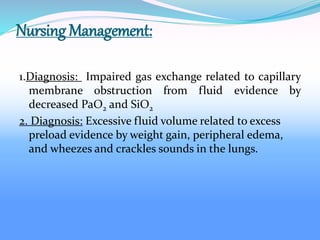
Nursing Management:
1.Diagnosis: Impaired gas exchange related to capillary
membrane obstruction from fluid evidence by
decreased PaO2 and SiO2
2. Diagnosis: Excessive fluid volume related to excess
preload evidence by weight gain, peripheral edema,
and wheezes and crackles sounds in the lungs.
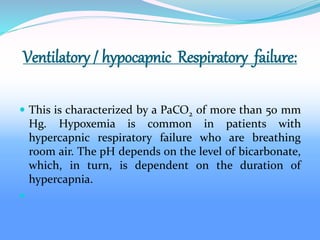
Ventilatory / hypocapnic Respiratory failure:
 This is characterized by a PaCO2 of more than 50 mm
Hg. Hypoxemia is common in patients with
hypercapnic respiratory failure who are breathing
room air. The pH depends on the level of bicarbonate,
which, in turn, is dependent on the duration of
hypercapnia.

Etiology:
 In acute Ventilatory failure, the respiratory load placed
on the lungs to exchange CO2 is impaired by;
1. Problem of resistance to moving air in and out of the
lung,
2. The ability of lung to expand and contact(elastic
recoil), and
3. Conditions that increase the productions of CO2 or
decrease the surface available for exchange of gases.
Pathophysiology:
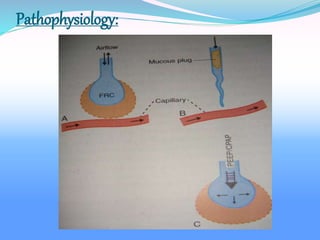
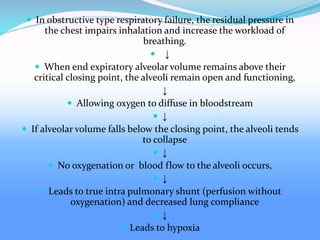
 In obstructive type respiratory failure, the residual pressure in
the chest impairs inhalation and increase the workload of
breathing.
 ↓
 When end expiratory alveolar volume remains above their
critical closing point, the alveoli remain open and functioning,
↓
 Allowing oxygen to diffuse in bloodstream
 ↓
 If alveolar volume falls below the closing point, the alveoli tends
to collapse
 ↓
 No oxygenation or blood flow to the alveoli occurs,
 ↓
 Leads to true intra pulmonary shunt (perfusion without
oxygenation) and decreased lung compliance
 ↓
 Leads to hypoxia
Clinical Manifestation:
 Altered respiratory rate and patterns
 Breaths are shallow due to spasm of the airway
 Client become confused, less conversant, and are
difficult to arouse
 Pulsus paradoxes
 Pulse oxymetry shows steadily decrease in SpO2
 ABG analysis shows falling PaO2 and rising PaCO2

Diagnostic tests:
 ABG
 X-Ray
 SpO2
Medical Management:

 Reverse Bronchospasms:
 Several forms of bronchodilators are used to treat
obstructions to airflow in client with COPD and asthma.
These agents include beta2 selective agonists (albuterol),
ipratropium, theophyllin, and corticosteroids. If infection
is cause then broad spectrum antibiotics are used.

 Maintain oxygenation:
 Oxygen by mask may be adequate to support oxygenation.
Using forms of NPPV such as CPAP reduces the workload
of breathing by decreasing the force needed to overcome
the pressure in the chest.
 Manage the underlying problem:
 Maintain ventilation:
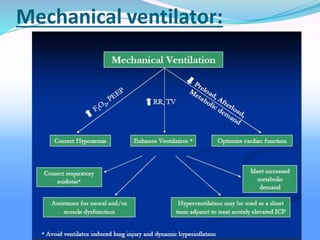
Mechanical ventilator:
Nursing Management
1. Nursing diagnosis: Impaired spontaneous ventilation
related to imbalance between Ventilatory capacity and
Ventilatory demand evidence by SPO2 and ABG findings.
2. Nursing diagnosis: Impaired gas exchange and ineffective
breathing pattern related to underlying diseases process
and artificial airway and ventilator system abnormal ABG
findings and respiratory rate .
3. Nursing diagnosis: Ineffective airway clearance related to
increased mucus production associated with continuous
positive-pressure mechanical ventilation evidence by
wheezes and crackles sounds in lungs.
4. Nursing diagnosis: Risk for trauma and infection
related to endotracheal intubation or tracheotomy.
5. Nursing diagnosis: Impaired physical mobility related
to ventilator dependency.
6. Nursing diagnosis: Impaired verbal communication
related to endotracheal tube and attachment to
ventilator
7. Nursing diagnosis: Defensive coping and
powerlessness related to ventilator Dependency.
By: Dipal Patel
F.Y.M.Sc. Nursing
College of nursing

Acute respiratory failure ppt

  • 1.
  • 3.
    Introduction:  The bodyrelies primarily on the central nervous system, the pulmonary system, the heart and the vascular system to accomplish effective respiration. Respiratory failure occurs when one or more of these system or organ fails to maintain optimal functioning. If the respiratory failure occurs so rapidly that the compensatory mechanisms cannot accommodate or if the compensatory mechanisms overwhelmed the acute respiratory failure develops.
  • 4.
    Definition:  Respiratory failureis defined as a PaO2 value of less than 60 mm Hg while breathing air or a PaCO2 of more than 50 mm Hg.
  • 5.
    Acute respiratory failuremay be classified as: 1. Hypoxemic Respiratory Failure  PaO2 low (< 60 mmHg (8.0 kPa))  PaCO2 normal or low  PA-aO2increased  2. Acute Ventilatory Failure  PaO2 decreased  PaCO2 increased  PA-aO2 normal  pH decreased
  • 6.
    Hypoxemic respiratory failure: Hypoxemic respiratory failure (type I) is characterized by a PaO2 of less than 60 mm Hg with a normal or low PaCO2.  This is the most common form of respiratory failure, and it can be associated with virtually all acute diseases of the lung, which generally involve fluid filling or collapse of alveolar units. 
  • 7.
    The most commoncause for hypoxemic respiratory failure in ICU patients is perfusion of non-ventilated alveoli(shunting).
  • 8.
    Etiology:  Chronic bronchitisand emphysema (COPD)  Pneumonia  Pulmonary edema  Pulmonary fibrosis  Asthma  Pneumothorax  Pulmonary embolism  Pulmonary arterial hypertension  Pneumoconiosis  Granulomatous lung diseases  Cyanotic congenital heart disease  Bronchiectasis  Adult respiratory distress syndrome  Fat embolism syndrome  Kyphoscoliosis  Obesity
  • 9.
  • 10.
    ↑ed hydrostatic pressuresin the pulmonary vessels Creates Imbalance in Starling Forces, ↓ Increase in fluid filtration into interstitial spaces of lungs that exceeds the lympatis capacity to drain the fluid away ↓ Increasing volumes of fluids leak into the alveolar space ↓ The lymphatic system attempts to compensate by draining excess interstitial fluid into the vascular system through the hilar lymph nodes ↓ If the pathway becomes overwhelmed, fluid moves from pleural interstitial to into the alveolar walls ↓ If the alveolar epithelium is damaged, the fluid begins to accumulate in the alveoli. ↓ Alveolar edema is serious late manifestation in the progression of fluid imbalance.
  • 11.
    Clinical Manifestations:  Hypoxemiaas alveolar membrane is thickened by fluid that impaired the gas exchange  Dyspnea  Tachypnea  Weak and thread tachycardia  Hypertension(if cardiogenic)  Orthopnea at less than 90 degrees  Coughing as to attempt to rid the fluid of chest  Sputum is thin and frothy because it is combined with water  Pink tinged sputum if small capillaries break  Patient may be anxious and restless from hypoxemia  Chest auscultation reveals crackles, wheezes, and presence of S3 sound  SPO2 is less than 85%  Arterial PaO2 revels less than 50%  Respiratory alkalosis because of Tachypnea  Pressure in Pulmonary artery and Pulmonary wedge Pressure(PAWP) will Increase  Chest X-Rays shows Areas of “white-out” where fluid has replaced air filled lung tissues  Right ventricular failure may be noted
  • 12.
    Diagnostic tests:  ABG X-Ray  SpO2 Management: 1. Emergency management 2. Medical Management: 3. Nursing Management:
  • 13.
  • 14.
    Medical Management: Correct hypoxemia: non invasive positive pressure ventilation (NPPV) Reduce preload:  upright position.  Diuretics  nitroglycerin,  treating the underlying cause. Reduce after load:  Antihypertensive such as nitroprusside,  Morphine Support perfusion:  The left ventricle is supported by using isotropic medication such as dobutamine.  Monitor --Urine output  An intra aortic balloon pump (IABP)
  • 15.
    Nursing Management: 1.Diagnosis: Impairedgas exchange related to capillary membrane obstruction from fluid evidence by decreased PaO2 and SiO2 2. Diagnosis: Excessive fluid volume related to excess preload evidence by weight gain, peripheral edema, and wheezes and crackles sounds in the lungs.
  • 16.
    Ventilatory / hypocapnicRespiratory failure:  This is characterized by a PaCO2 of more than 50 mm Hg. Hypoxemia is common in patients with hypercapnic respiratory failure who are breathing room air. The pH depends on the level of bicarbonate, which, in turn, is dependent on the duration of hypercapnia. 
  • 17.
    Etiology:  In acuteVentilatory failure, the respiratory load placed on the lungs to exchange CO2 is impaired by; 1. Problem of resistance to moving air in and out of the lung, 2. The ability of lung to expand and contact(elastic recoil), and 3. Conditions that increase the productions of CO2 or decrease the surface available for exchange of gases.
  • 18.
  • 19.
     In obstructivetype respiratory failure, the residual pressure in the chest impairs inhalation and increase the workload of breathing.  ↓  When end expiratory alveolar volume remains above their critical closing point, the alveoli remain open and functioning, ↓  Allowing oxygen to diffuse in bloodstream  ↓  If alveolar volume falls below the closing point, the alveoli tends to collapse  ↓  No oxygenation or blood flow to the alveoli occurs,  ↓  Leads to true intra pulmonary shunt (perfusion without oxygenation) and decreased lung compliance  ↓  Leads to hypoxia
  • 20.
    Clinical Manifestation:  Alteredrespiratory rate and patterns  Breaths are shallow due to spasm of the airway  Client become confused, less conversant, and are difficult to arouse  Pulsus paradoxes  Pulse oxymetry shows steadily decrease in SpO2  ABG analysis shows falling PaO2 and rising PaCO2 
  • 21.
  • 22.
    Medical Management:   ReverseBronchospasms:  Several forms of bronchodilators are used to treat obstructions to airflow in client with COPD and asthma. These agents include beta2 selective agonists (albuterol), ipratropium, theophyllin, and corticosteroids. If infection is cause then broad spectrum antibiotics are used.   Maintain oxygenation:  Oxygen by mask may be adequate to support oxygenation. Using forms of NPPV such as CPAP reduces the workload of breathing by decreasing the force needed to overcome the pressure in the chest.  Manage the underlying problem:  Maintain ventilation:
  • 23.
  • 24.
    Nursing Management 1. Nursingdiagnosis: Impaired spontaneous ventilation related to imbalance between Ventilatory capacity and Ventilatory demand evidence by SPO2 and ABG findings. 2. Nursing diagnosis: Impaired gas exchange and ineffective breathing pattern related to underlying diseases process and artificial airway and ventilator system abnormal ABG findings and respiratory rate . 3. Nursing diagnosis: Ineffective airway clearance related to increased mucus production associated with continuous positive-pressure mechanical ventilation evidence by wheezes and crackles sounds in lungs.
  • 25.
    4. Nursing diagnosis:Risk for trauma and infection related to endotracheal intubation or tracheotomy. 5. Nursing diagnosis: Impaired physical mobility related to ventilator dependency. 6. Nursing diagnosis: Impaired verbal communication related to endotracheal tube and attachment to ventilator 7. Nursing diagnosis: Defensive coping and powerlessness related to ventilator Dependency.
  • 26.
    By: Dipal Patel F.Y.M.Sc.Nursing College of nursing