WOBBLE HYPOTHESIS
● Crick proposed the ‘wobble hypothesis’ to explain the degeneracy of the
genetic code. Except for tryptophan and methionine, more than one
codon directs the synthesis of one amino acid. There are 61 codons that
synthesise amino acids, therefore, there must be 61 tRNAs each having
different anticodons. But the total number of tRNAs is less than 61.
● This may be explained that the anticodons of some tRNA read more
than one codon. ​According to this hypothesis, only the first two bases of the
codon have a precise pairing with the bases of the anticodon of tRNA, while
the pairing between the third bases of codon and anticodon may Wobble
(wobble means to sway or move unsteadily).
● . For example CGU, CGC, CGA and CGG all code for arginine. It appears
that CG specifies arginine and the third letter is not important.
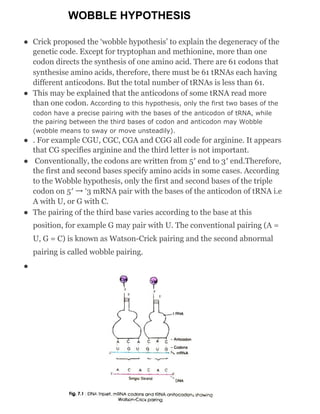
● Conventionally, the codons are written from 5′ end to 3′ end.Therefore,
the first and second bases specify amino acids in some cases. According
to the Wobble hypothesis, only the first and second bases of the triple
codon on 5′ → ‘3 mRNA pair with the bases of the anticodon of tRNA i.e
A with U, or G with C.
● The pairing of the third base varies according to the base at this
position, for example G may pair with U. The conventional pairing (A =
U, G = C) is known as Watson-Crick pairing and the second abnormal
pairing is called wobble pairing.
●
● Wobble base pairs
● A wobble base pair is a pairing between two nucleotides in RNA molecules that
does not follow Watson-Crick base pair rules.
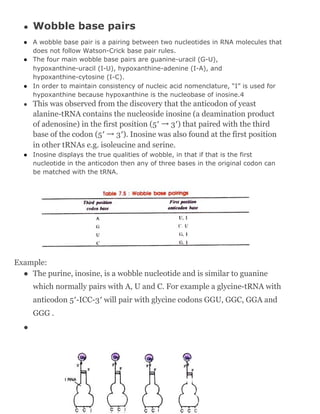
● The four main wobble base pairs are guanine-uracil (G-U),
hypoxanthine-uracil (I-U), hypoxanthine-adenine (I-A), and
hypoxanthine-cytosine (I-C).
● In order to maintain consistency of nucleic acid nomenclature, “I” is used for
hypoxanthine because hypoxanthine is the nucleobase of inosine.4
● This was observed from the discovery that the anticodon of yeast
alanine-tRNA contains the nucleoside inosine (a deamination product
of adenosine) in the first position (5′ → 3′) that paired with the third
base of the codon (5′ → 3′). Inosine was also found at the first position
in other tRNAs e.g. isoleucine and serine.
● Inosine displays the true qualities of wobble, in that if that is the first
nucleotide in the anticodon then any of three bases in the original codon can
be matched with the tRNA.
Example:
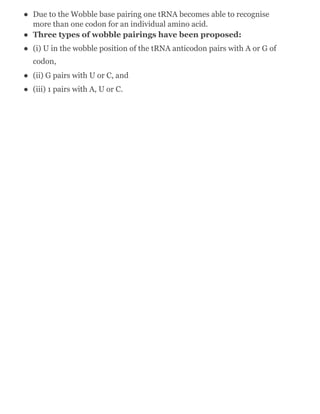
● The purine, inosine, is a wobble nucleotide and is similar to guanine
which normally pairs with A, U and C. For example a glycine-tRNA with
anticodon 5′-ICC-3′ will pair with glycine codons GGU, GGC, GGA and
GGG .
●
● Due to the Wobble base pairing one tRNA becomes able to recognise
more than one codon for an individual amino acid.
● Three types of wobble pairings have been proposed:
● (i) U in the wobble position of the tRNA anticodon pairs with A or G of
codon,
● (ii) G pairs with U or C, and
● (iii) 1 pairs with A, U or C.

Wooble hypothesis

  • 1.
    WOBBLE HYPOTHESIS ● Crickproposed the ‘wobble hypothesis’ to explain the degeneracy of the genetic code. Except for tryptophan and methionine, more than one codon directs the synthesis of one amino acid. There are 61 codons that synthesise amino acids, therefore, there must be 61 tRNAs each having different anticodons. But the total number of tRNAs is less than 61. ● This may be explained that the anticodons of some tRNA read more than one codon. ​According to this hypothesis, only the first two bases of the codon have a precise pairing with the bases of the anticodon of tRNA, while the pairing between the third bases of codon and anticodon may Wobble (wobble means to sway or move unsteadily). ● . For example CGU, CGC, CGA and CGG all code for arginine. It appears that CG specifies arginine and the third letter is not important. ● Conventionally, the codons are written from 5′ end to 3′ end.Therefore, the first and second bases specify amino acids in some cases. According to the Wobble hypothesis, only the first and second bases of the triple codon on 5′ → ‘3 mRNA pair with the bases of the anticodon of tRNA i.e A with U, or G with C. ● The pairing of the third base varies according to the base at this position, for example G may pair with U. The conventional pairing (A = U, G = C) is known as Watson-Crick pairing and the second abnormal pairing is called wobble pairing. ●
  • 2.
    ● Wobble basepairs ● A wobble base pair is a pairing between two nucleotides in RNA molecules that does not follow Watson-Crick base pair rules. ● The four main wobble base pairs are guanine-uracil (G-U), hypoxanthine-uracil (I-U), hypoxanthine-adenine (I-A), and hypoxanthine-cytosine (I-C). ● In order to maintain consistency of nucleic acid nomenclature, “I” is used for hypoxanthine because hypoxanthine is the nucleobase of inosine.4 ● This was observed from the discovery that the anticodon of yeast alanine-tRNA contains the nucleoside inosine (a deamination product of adenosine) in the first position (5′ → 3′) that paired with the third base of the codon (5′ → 3′). Inosine was also found at the first position in other tRNAs e.g. isoleucine and serine. ● Inosine displays the true qualities of wobble, in that if that is the first nucleotide in the anticodon then any of three bases in the original codon can be matched with the tRNA. Example: ● The purine, inosine, is a wobble nucleotide and is similar to guanine which normally pairs with A, U and C. For example a glycine-tRNA with anticodon 5′-ICC-3′ will pair with glycine codons GGU, GGC, GGA and GGG . ●
  • 3.
    ● Due tothe Wobble base pairing one tRNA becomes able to recognise more than one codon for an individual amino acid. ● Three types of wobble pairings have been proposed: ● (i) U in the wobble position of the tRNA anticodon pairs with A or G of codon, ● (ii) G pairs with U or C, and ● (iii) 1 pairs with A, U or C.