Gene expression in eukaryotes: lac operon and trp operon
2.
Unraveling Gene Regulation:
Lacand Trp Operons
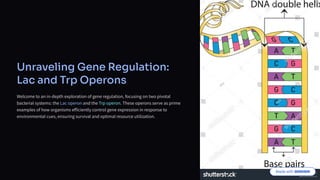
Welcome to an in-depth exploration of gene regulation, focusing on two pivotal
bacterial systems: the Lac operon and the Trp operon. These operons serve as prime
examples of how organisms efficiently control gene expression in response to
environmental cues, ensuring survival and optimal resource utilization.
3.
The Central DogmaRevisited: From DNA to Protein
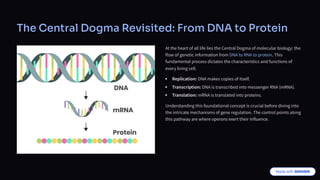
At the heart of all life lies the Central Dogma of molecular biology: the
flow of genetic information from DNA to RNA to protein. This
fundamental process dictates the characteristics and functions of
every living cell.
Replication: DNA makes copies of itself.
Transcription: DNA is transcribed into messenger RNA (mRNA).
Translation: mRNA is translated into proteins.
Understanding this foundational concept is crucial before diving into
the intricate mechanisms of gene regulation. The control points along
this pathway are where operons exert their influence.
4.
Gene Expression: Whyand How Cells Control It
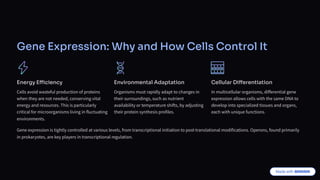
Energy Efficiency
Cells avoid wasteful production of proteins
when they are not needed, conserving vital
energy and resources. This is particularly
critical for microorganisms living in fluctuating
environments.
Environmental Adaptation
Organisms must rapidly adapt to changes in
their surroundings, such as nutrient
availability or temperature shifts, by adjusting
their protein synthesis profiles.
Cellular Differentiation
In multicellular organisms, differential gene
expression allows cells with the same DNA to
develop into specialized tissues and organs,
each with unique functions.
Gene expression is tightly controlled at various levels, from transcriptional initiation to post-translational modifications. Operons, found primarily
in prokaryotes, are key players in transcriptional regulation.
5.
Introducing the LacOperon: Controlling Lactose
Metabolism
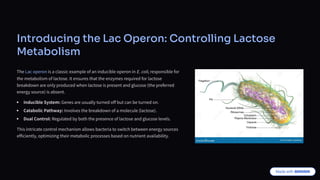
The Lac operon is a classic example of an inducible operon in E. coli, responsible for
the metabolism of lactose. It ensures that the enzymes required for lactose
breakdown are only produced when lactose is present and glucose (the preferred
energy source) is absent.
Inducible System: Genes are usually turned off but can be turned on.
Catabolic Pathway: Involves the breakdown of a molecule (lactose).
Dual Control: Regulated by both the presence of lactose and glucose levels.
This intricate control mechanism allows bacteria to switch between energy sources
efficiently, optimizing their metabolic processes based on nutrient availability.
6.
Components of theLac Operon: Regulator, Promoter,
Operator, and Structural Genes
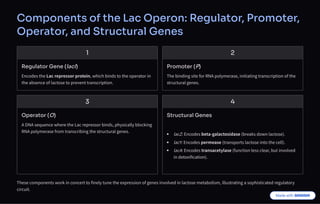
1
Regulator Gene (lacI)
Encodes the Lac repressor protein, which binds to the operator in
the absence of lactose to prevent transcription.
2
Promoter (P)
The binding site for RNA polymerase, initiating transcription of the
structural genes.
3
Operator (O)
A DNA sequence where the Lac repressor binds, physically blocking
RNA polymerase from transcribing the structural genes.
4
Structural Genes
lacZ: Encodes beta-galactosidase (breaks down lactose).
lacY: Encodes permease (transports lactose into the cell).
lacA: Encodes transacetylase (function less clear, but involved
in detoxification).
These components work in concert to finely tune the expression of genes involved in lactose metabolism, illustrating a sophisticated regulatory
circuit.
7.
When Lactose isAbsent: Lac Operon Repression
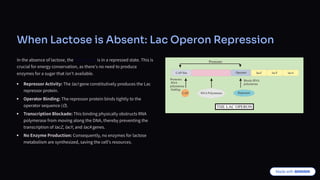
In the absence of lactose, the Lac operon is in a repressed state. This is
crucial for energy conservation, as there's no need to produce
enzymes for a sugar that isn't available.
Repressor Activity: The lacI gene constitutively produces the Lac
repressor protein.
Operator Binding: The repressor protein binds tightly to the
operator sequence (O).
Transcription Blockade: This binding physically obstructs RNA
polymerase from moving along the DNA, thereby preventing the
transcription of lacZ, lacY, and lacA genes.
No Enzyme Production: Consequently, no enzymes for lactose
metabolism are synthesized, saving the cell's resources.
8.
When Lactose isPresent: Lac Operon Induction
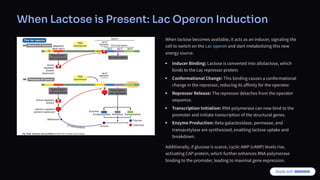
When lactose becomes available, it acts as an inducer, signaling the
cell to switch on the Lac operon and start metabolizing this new
energy source.
Inducer Binding: Lactose is converted into allolactose, which
binds to the Lac repressor protein.
Conformational Change: This binding causes a conformational
change in the repressor, reducing its affinity for the operator.
Repressor Release: The repressor detaches from the operator
sequence.
Transcription Initiation: RNA polymerase can now bind to the
promoter and initiate transcription of the structural genes.
Enzyme Production: Beta-galactosidase, permease, and
transacetylase are synthesized, enabling lactose uptake and
breakdown.
Additionally, if glucose is scarce, cyclic AMP (cAMP) levels rise,
activating CAP protein, which further enhances RNA polymerase
binding to the promoter, leading to maximal gene expression.
9.
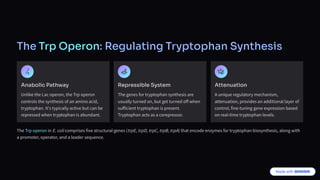
The Trp Operon:Regulating Tryptophan Synthesis
Anabolic Pathway
Unlike the Lac operon, the Trp operon
controls the synthesis of an amino acid,
tryptophan. It's typically active but can be
repressed when tryptophan is abundant.
Repressible System
The genes for tryptophan synthesis are
usually turned on, but get turned off when
sufficient tryptophan is present.
Tryptophan acts as a corepressor.
Attenuation
A unique regulatory mechanism,
attenuation, provides an additional layer of
control, fine-tuning gene expression based
on real-time tryptophan levels.
The Trp operon in E. coli comprises five structural genes (trpE, trpD, trpC, trpB, trpA) that encode enzymes for tryptophan biosynthesis, along with
a promoter, operator, and a leader sequence.
10.
Attenuation in theTrp Operon: Fine-Tuning Gene
Expression
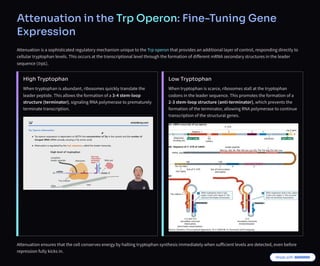
Attenuation is a sophisticated regulatory mechanism unique to the Trp operon that provides an additional layer of control, responding directly to
cellular tryptophan levels. This occurs at the transcriptional level through the formation of different mRNA secondary structures in the leader
sequence (trpL).
High Tryptophan
When tryptophan is abundant, ribosomes quickly translate the
leader peptide. This allows the formation of a - stem-loop
structure (terminator), signaling RNA polymerase to prematurely
terminate transcription.
Low Tryptophan
When tryptophan is scarce, ribosomes stall at the tryptophan
codons in the leader sequence. This promotes the formation of a
- stem-loop structure (anti-terminator), which prevents the
formation of the terminator, allowing RNA polymerase to continue
transcription of the structural genes.
Attenuation ensures that the cell conserves energy by halting tryptophan synthesis immediately when sufficient levels are detected, even before
repression fully kicks in.
11.
Comparative Insights: Similaritiesand Differences of
Lac and Trp Operons
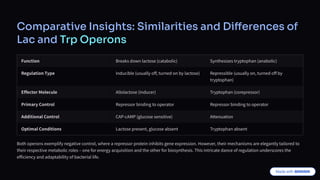
Function Breaks down lactose (catabolic) Synthesizes tryptophan (anabolic)
Regulation Type Inducible (usually off, turned on by lactose) Repressible (usually on, turned off by
tryptophan)
Effector Molecule Allolactose (inducer) Tryptophan (corepressor)
Primary Control Repressor binding to operator Repressor binding to operator
Additional Control CAP-cAMP (glucose sensitive) Attenuation
Optimal Conditions Lactose present, glucose absent Tryptophan absent
Both operons exemplify negative control, where a repressor protein inhibits gene expression. However, their mechanisms are elegantly tailored to
their respective metabolic roles 2 one for energy acquisition and the other for biosynthesis. This intricate dance of regulation underscores the
efficiency and adaptability of bacterial life.