• Introduction
• Genes
• Gene Regulation
• The Lactose Operon
• The Tryptophan Operon
• Always on-
Also known as ‘House Keeping Gene’.
• Regulate-
a) Normally off-
Also known as ‘Inducible Gene’. Because it
induces or switches on the gene.
b) Normally On-
Also known as ‘Repressible gene’. Because it
represses or switches off the gene.
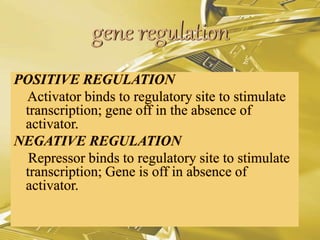
POSITIVE REGULATION
Activator binds to regulatory site to stimulate
transcription; gene off in the absence of
activator.
NEGATIVE REGULATION
Repressor binds to regulatory site to stimulate
transcription; Gene is off in absence of
activator.
• An operon is a group of genes that are
transcribed at the same time.
• They usually control an important biochemical
process.
• They are only found in prokaryotes.
The lac operon consists of three genes each
involved in processing the sugar lactose
One of them is the gene for the enzyme β-
galactosidase
This enzyme hydrolyses lactose into glucose
and galactose.
• E. coli can use either glucose, which is a
monosaccharide, or lactose, which is a
disaccharide
• However, lactose needs to be hydrolysed
(digested) first
• So the bacterium prefers to use glucose when it
can.
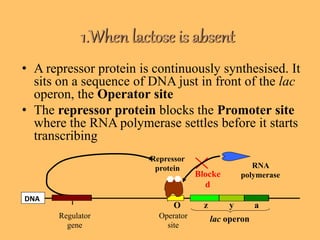
• A repressor protein is continuously synthesised. It
sits on a sequence of DNA just in front of the lac
operon, the Operator site
• The repressor protein blocks the Promoter site
where the RNA polymerase settles before it starts
transcribing
Regulator
gene
lac operonOperator
site
z y a
DNA I
O
Repressor
protein RNA
polymeraseBlocke
d
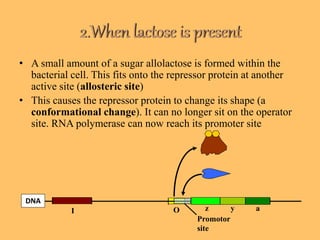
• A small amount of a sugar allolactose is formed within the
bacterial cell. This fits onto the repressor protein at another
active site (allosteric site)
• This causes the repressor protein to change its shape (a
conformational change). It can no longer sit on the operator
site. RNA polymerase can now reach its promoter site
Promotor
site
z y a
DNA
I O
• The genes of the trp operon are used to make
the amino acid tryptophan.
• It is turned off when enough tryptophan is in
the cell.
• Tryptophan is the effector molecule.
• Operon codes for 5 genes in bacteria.
• Five polypeptides combine to make three
enzymes.
• Each enzyme participates in a step to make
tryptophan
• Repressor Protein (trpR) binds to operator
when tryptophan is present.
• Prevents RNA polymerase from transcribing
genes when bound to operator.
• Transcribed as a different gene from trp operon
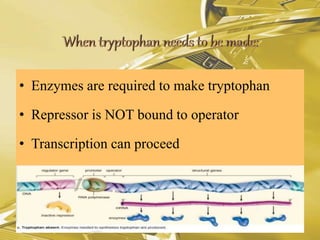
• Enzymes are required to make tryptophan
• Repressor is NOT bound to operator
• Transcription can proceed
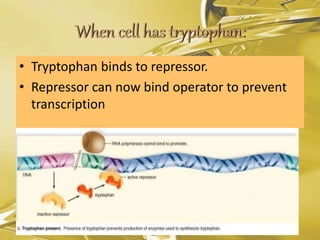
• Tryptophan binds to repressor.
• Repressor can now bind operator to prevent
transcription
Operon is set of gene that are coordinately
controlled by a regulatory protein and
transcribed as a single polycistronic message.
This mechanism allows for synchronization of
transcription and translation, a key element in
attenuation
• https://www.google.co.in/search?q=The+lac+operon
+in+e.coli.ppt&client=opera&hs=OtG&biw=1366&bih
=586&source=lnms&tbm=isch&sa=X&ei=OzQ0VJu1N4
2xuATqjIH4BQ&ved=0CAYQ_AUoAQ
• https://www.khanacademy.org/science/biology/gene-regulation/gene-
regulation-in-bacteria/a/the-trp-operon
• https://www.khanacademy.org/science/biology/gene-regulation/gene-
regulation-in-bacteria/a/the-lac-operon
• http://www.phschool.com/science/biology_place/biocoach/lacoperon/qui
z.html

Operon

  • 2.
    • Introduction • Genes •Gene Regulation • The Lactose Operon • The Tryptophan Operon
  • 3.
    • Always on- Alsoknown as ‘House Keeping Gene’. • Regulate- a) Normally off- Also known as ‘Inducible Gene’. Because it induces or switches on the gene. b) Normally On- Also known as ‘Repressible gene’. Because it represses or switches off the gene.
  • 4.
    POSITIVE REGULATION Activator bindsto regulatory site to stimulate transcription; gene off in the absence of activator. NEGATIVE REGULATION Repressor binds to regulatory site to stimulate transcription; Gene is off in absence of activator.
  • 5.
    • An operonis a group of genes that are transcribed at the same time. • They usually control an important biochemical process. • They are only found in prokaryotes.
  • 6.
    The lac operonconsists of three genes each involved in processing the sugar lactose One of them is the gene for the enzyme β- galactosidase This enzyme hydrolyses lactose into glucose and galactose.
  • 7.
    • E. colican use either glucose, which is a monosaccharide, or lactose, which is a disaccharide • However, lactose needs to be hydrolysed (digested) first • So the bacterium prefers to use glucose when it can.
  • 8.
    • A repressorprotein is continuously synthesised. It sits on a sequence of DNA just in front of the lac operon, the Operator site • The repressor protein blocks the Promoter site where the RNA polymerase settles before it starts transcribing Regulator gene lac operonOperator site z y a DNA I O Repressor protein RNA polymeraseBlocke d
  • 9.
    • A smallamount of a sugar allolactose is formed within the bacterial cell. This fits onto the repressor protein at another active site (allosteric site) • This causes the repressor protein to change its shape (a conformational change). It can no longer sit on the operator site. RNA polymerase can now reach its promoter site Promotor site z y a DNA I O
  • 10.
    • The genesof the trp operon are used to make the amino acid tryptophan. • It is turned off when enough tryptophan is in the cell. • Tryptophan is the effector molecule.
  • 11.
    • Operon codesfor 5 genes in bacteria. • Five polypeptides combine to make three enzymes. • Each enzyme participates in a step to make tryptophan
  • 12.
    • Repressor Protein(trpR) binds to operator when tryptophan is present. • Prevents RNA polymerase from transcribing genes when bound to operator. • Transcribed as a different gene from trp operon
  • 13.
    • Enzymes arerequired to make tryptophan • Repressor is NOT bound to operator • Transcription can proceed
  • 14.
    • Tryptophan bindsto repressor. • Repressor can now bind operator to prevent transcription
  • 15.
    Operon is setof gene that are coordinately controlled by a regulatory protein and transcribed as a single polycistronic message. This mechanism allows for synchronization of transcription and translation, a key element in attenuation
  • 16.