TREPONEMA
PALLIDUM
Amir Rajae
BSMU 2017
Contents
 History
 Introduction
 Pathogenicity
 Syphilis
 Laboratory diagnosis
 Treatment
 Prophylaxis
History
 Fritz Schaudinn (1871-1906) and Paul E.
Hoffmann (1868-1959) discovered Treponema
pallidum in serum in 1905.
Recent Years
 Scientist sequenced the
genome of the bacteria
Treponema Pallidum in
1998.
 From this information
scientist hoped to
advance their ability
to diagnose, treat, and
prevent Syphilis
Morpholgy
Spiral structure is wound around
endoflagella
length: 4-14µm
 width: 0.1-0.2µm
Motility includes rotation and flexion
Darkfield demonstrates spirochetes
Many are thin and take stains poorly
have not been isolated in culture
Resistance
Delicate and inactivated by drying or by
heat(41-42ºC in 1hr)
 Fever therapy for syphilis
 killed in 1-3 days at 0- 4ºC
 inactivated by soap, arsenicals, common
antiseptic agents
Pathogenesis
Organism entry(Sexual contact)
by penetrating the intact mucous membrane or
entering through breaks in the skin
Invade the blood stream and spreads to other
body sites
endarteritis
Progressive tissue destruction
Syphilis
Origin not definitely known
 widely spread disease in Europe in 15th
century
Types
 Early Syphilis
 Late Syphilis
Neuro Syphilis
Cardiovascular Syphilis
Late “Benigin” Syphilis
 Congenital Syphilis
Primary Syphilis
Primary lesion or "chancre" develops at the
site of inoculation after 18- 21 days
Chancre:
Progresses from macule to papule to ulcer
Typically painless, indurated, and has a clean base
Highly infectious
Cartilage-like consistency
Heals spontaneously within 1 to 6 weeks
25% present with multiple lesions
chancre also can develop on the cervix, tongue, lips or
other parts of the body
Regional lymphadenopathy
Primary lesion in penile
region
Primary lesion in tongue
Serologic tests for syphilis may not be
positive during early primary syphilis
Secondary Syphilis
Secondary lesions occur 3 to 6 weeks after the
primary chancre appears
 may persist for weeks to months
Primary and secondary stages may overlap
Mucocutaneous lesions most common
 Symptoms:
fever
swollen lymph glands
sore throat
patchy hair loss
headaches
weight loss
muscle aches
fatigue
Palmar/Plantar
Rash
Generalized
Body Rash
Alopecia
 Serologic tests are usually highest in titer
during this stage
Latent Syphilis
Host suppresses infection-no lesions are
clinically apparent
Only evidence is positive serologic test
May occur between
primary and secondary stages
secondary relapses
after secondary stage
◦ Categories:
◦ Early latent: <1 year duration
◦ Late latent: 1 year duration
Late Syphilis
Approximately 30% of untreated patients
progress to the tertiary stage within 1 to 20
years
Rare because of the widespread availability
and use of antibiotics
Manifestations
◦ Gummatous lesions
◦ Cardiovascular syphilis
◦ Neurosyphilis
Late “Benign” Syphilis
 characterized by formation of non specific
granulomatous lesion called gumma
 most common complication
15% of untreated patients
 indicates fully active
cellular immune response
Destory surrounding
tissue as it enlarge
Cardiovascular Syphilis
10% of untreated patients
 inflammation of the small vessel that feed
aorta and affect primarily the ascending aorta
 Complications
Aortic aneurysm
dilation of aortic ring
Neuro Syhilis
 May be symptomatic or asymptomatic
 asymptomatic disease is characterized by
CSF abnormalities
 symptomatic infection is either
meningovascular or parenchymatous
 In meningovascular syphilis any cranial
nerve may be inflammed and deafness and
visual impairement may occur
 Parenchymatous disease may involve the
neurons of cerebrum or the spinal cord
Congenital Syphilis
 Occurs when T. pallidum is transmitted from a
pregnant woman to her fetus
 May lead to
stillbirth &neonatal death
infant disorders such as deafness
neurologic impairment and bone deformities
 Transmission can occur during any stage of
syphilis
 risk is much higher during primary and
secondary syphilis
 Fetal infection can occur during any trimester
of pregnancy
Hutchinson’s TeethMucous Patches
Perforation of
Palate
Laboratory Diagnosis
Identification of Treponema pallidum in lesions
◦ Darkfield microscopy
◦ Direct fluorescent antibody - T. pallidum (DFA-
TP)
◦ PCR
Serologic tests
◦ Nontreponemal test
◦ Treponemal tests
Darkfield Microscopy
Direct fluorescent antibody test
Identifies T. pallidum in direct lesion smear by
immunofluorescence
 smear are stained flourescein-isothyocyanide
labelled anti-T.pallidum globulin
Advantages:
◦ Commercially available
◦ detects and differentiate pathogenic treponemes
from non pathogenic
◦ applicable to the sample of oral, rectal, intestinal
lesion
Disadvantages:
◦ Turnaround time 1-2 days
Serological tests
Complement fixation test
(Wassermann reaction)
 Formerly used for serodiagnosis of Syphilis
 consist of 2 steps
 Inactivated serum + (wassermann antigen + 2 unit of guinea pig
complement) incubate for 1hr at 37ºC
 2nd step addition of sensitized sheep red cell and incubate at 37ºC for 30
min
 No lysis--- Posituve
 Lysis----- Negative
Flocculation test
Soluble antigen + antibody---- antigen-antibody
complex form remain suspended as floccules
 Khan test is the first flocculation test and has been
replaced by VDRL test
 VDRL test can be used for CSF but not for plasma
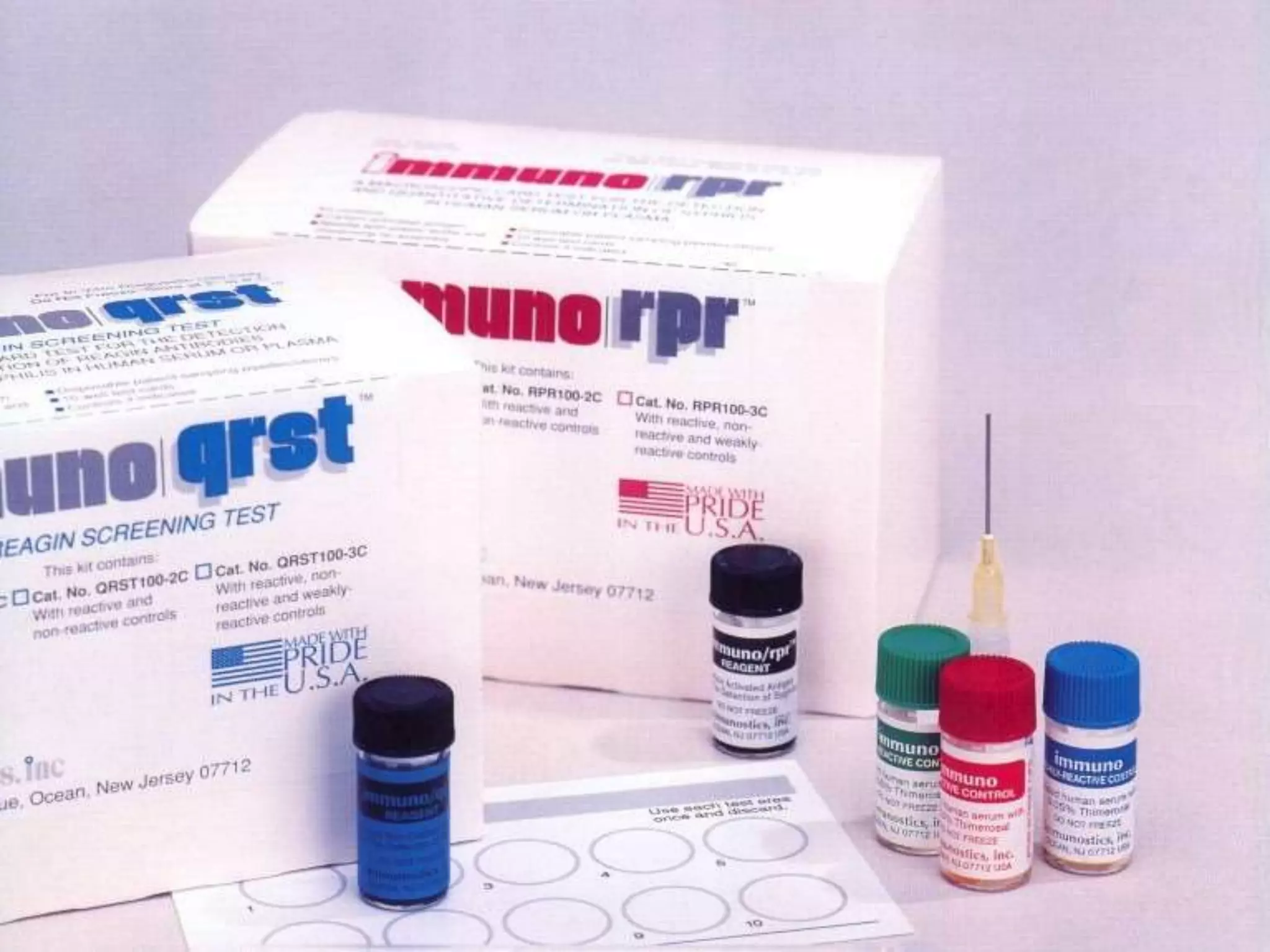
 Modification of VDRL test is RPR
 which uses the VDRL antigen containing carbon
particles
 RPR test can be done in unheated serum but not
CSF
 Automated RPR is also available
 Automated VDRL-ELISA test is also developed
◦ Intepretation of RPR test
Sensitivity & Specificity of non
treponemal test
% Sensitivity %
Specificity
Test Primary Secondary Latent Late Non-
Syphilis
VDRL 78 100 95 71 98
RPR 86 100 98 73 98
USR 80 100 95 99
TRUST 85 100 98 99
Treponemal tests
Treponema pallidum Immoblisation
Test serum is incubated with complement and T.pallidum maintained in a
complex medium anaerobically
 If antibody is present the treponemas are immobilized i.e. non-motile when
observed under dark ground ilumination
 Complex procedure
Fluorescent treponemal antibody
 Indirect immunofluorescent test using as antigen, smears prepared on
slides with Nichol`s strain
 Currently used modification is FTA-absorption (FTA-ABS)
 test serum is pre-absorbed with sorbent (heat extract from cultures of non
pathogenic Reiter strain) to eliminate group specific reactions
 serum is layered on slide to which T.pallidum is fixed
 FITC-labelled anti human immunolobulin is added and combine with
patient antibodies adhering to T.pallidum, resulting in FITC stained
spirochetes
◦ Modification of FTA-ABS is the FTA-ABS double stain
◦ Conjugate used is rhodamine isothiocyanate-labeled antihuman globulin
and counterstain FITC- labeled anti T.pallidum conjugate
Hemagglutination methods
TPHA uses tanned erythrocytes sensitised with
sonicated extract of T.pallidum as antigen
 presence of treponemal antibodies in patient serum
was detected by indirect agglutination of sensitized
erythocytes
 The procedure now employed is MHA-TP which can be
automated
 simpler to perform than flourescent antibody tests
Particle agglutination methods
 MHA test has been modified to use gelatin particles rather than
erythocytes as the antigen carrier creating T.pallidum particle
agglutination
 removal of preabsorption process
 procedure similar to MHA-TP
 Sensitivity and specificity similar to that of the FTA-ABS test
Latex agglutination methods
 In 1985 1st report of latex agglutination was publish
 use cloned T. pallidum antigens bound to latex particles
 easy to perform, fast and require less than 30 min for result
Enzyme immunoassay
 First applied in 1975 as a serology test for syphilis
 2 types of EIA tests are available
one uses sonicated T.pallidum as anitgen
one uses cloned antigen
 Advantage of EIA are capability to automate the test and run large number
of samples in relatively short time
Immunoblotting
Used to detect IgG or IgM
 to prepare the strips for T.pallidum immuno-blotting, intially boiled
sodium dodecyl sulphate (SDS) extract of organism is electrophoresed
through a gradient gel
After electrophoresis a sheet of nitrocellulose is placed on the top of gel
& the protein immuno- determinants are electrophoretically transfer to
blot
The blot is cut into strips and incubated with the patient serum
 after incubation strips with patient serum are detected using enzyme and
substrate lebeled antibody
 IgM western blot is most sensitive to diagnose the congenital syphilis
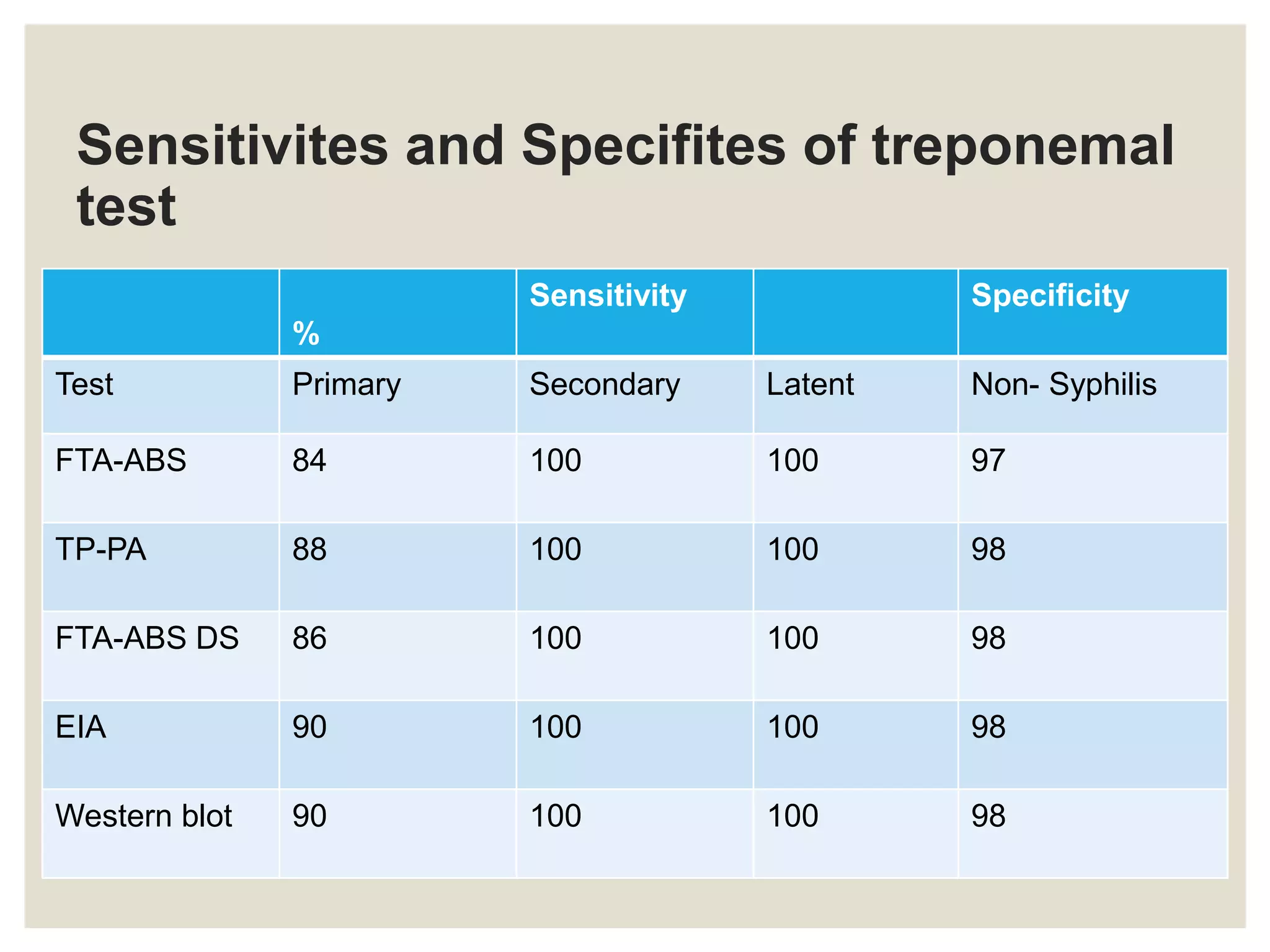
Sensitivites and Specifites of treponemal
test
%
Sensitivity Specificity
Test Primary Secondary Latent Non- Syphilis
FTA-ABS 84 100 100 97
TP-PA 88 100 100 98
FTA-ABS DS 86 100 100 98
EIA 90 100 100 98
Western blot 90 100 100 98

Treponema pallidum and syphilis

  • 1.
  • 2.
    Contents  History  Introduction Pathogenicity  Syphilis  Laboratory diagnosis  Treatment  Prophylaxis
  • 3.
    History  Fritz Schaudinn(1871-1906) and Paul E. Hoffmann (1868-1959) discovered Treponema pallidum in serum in 1905.
  • 4.
    Recent Years  Scientistsequenced the genome of the bacteria Treponema Pallidum in 1998.  From this information scientist hoped to advance their ability to diagnose, treat, and prevent Syphilis
  • 5.
    Morpholgy Spiral structure iswound around endoflagella length: 4-14µm  width: 0.1-0.2µm Motility includes rotation and flexion Darkfield demonstrates spirochetes Many are thin and take stains poorly have not been isolated in culture
  • 7.
    Resistance Delicate and inactivatedby drying or by heat(41-42ºC in 1hr)  Fever therapy for syphilis  killed in 1-3 days at 0- 4ºC  inactivated by soap, arsenicals, common antiseptic agents
  • 8.
    Pathogenesis Organism entry(Sexual contact) bypenetrating the intact mucous membrane or entering through breaks in the skin Invade the blood stream and spreads to other body sites endarteritis Progressive tissue destruction
  • 9.
    Syphilis Origin not definitelyknown  widely spread disease in Europe in 15th century Types  Early Syphilis  Late Syphilis Neuro Syphilis Cardiovascular Syphilis Late “Benigin” Syphilis  Congenital Syphilis
  • 11.
    Primary Syphilis Primary lesionor "chancre" develops at the site of inoculation after 18- 21 days Chancre: Progresses from macule to papule to ulcer Typically painless, indurated, and has a clean base Highly infectious Cartilage-like consistency Heals spontaneously within 1 to 6 weeks 25% present with multiple lesions chancre also can develop on the cervix, tongue, lips or other parts of the body Regional lymphadenopathy
  • 12.
    Primary lesion inpenile region Primary lesion in tongue Serologic tests for syphilis may not be positive during early primary syphilis
  • 13.
    Secondary Syphilis Secondary lesionsoccur 3 to 6 weeks after the primary chancre appears  may persist for weeks to months Primary and secondary stages may overlap Mucocutaneous lesions most common  Symptoms: fever swollen lymph glands sore throat patchy hair loss headaches weight loss muscle aches fatigue
  • 14.
    Palmar/Plantar Rash Generalized Body Rash Alopecia  Serologictests are usually highest in titer during this stage
  • 15.
    Latent Syphilis Host suppressesinfection-no lesions are clinically apparent Only evidence is positive serologic test May occur between primary and secondary stages secondary relapses after secondary stage ◦ Categories: ◦ Early latent: <1 year duration ◦ Late latent: 1 year duration
  • 16.
    Late Syphilis Approximately 30%of untreated patients progress to the tertiary stage within 1 to 20 years Rare because of the widespread availability and use of antibiotics Manifestations ◦ Gummatous lesions ◦ Cardiovascular syphilis ◦ Neurosyphilis
  • 17.
    Late “Benign” Syphilis characterized by formation of non specific granulomatous lesion called gumma  most common complication 15% of untreated patients  indicates fully active cellular immune response Destory surrounding tissue as it enlarge
  • 18.
    Cardiovascular Syphilis 10% ofuntreated patients  inflammation of the small vessel that feed aorta and affect primarily the ascending aorta  Complications Aortic aneurysm dilation of aortic ring
  • 19.
    Neuro Syhilis  Maybe symptomatic or asymptomatic  asymptomatic disease is characterized by CSF abnormalities  symptomatic infection is either meningovascular or parenchymatous  In meningovascular syphilis any cranial nerve may be inflammed and deafness and visual impairement may occur  Parenchymatous disease may involve the neurons of cerebrum or the spinal cord
  • 20.
    Congenital Syphilis  Occurswhen T. pallidum is transmitted from a pregnant woman to her fetus  May lead to stillbirth &neonatal death infant disorders such as deafness neurologic impairment and bone deformities  Transmission can occur during any stage of syphilis  risk is much higher during primary and secondary syphilis  Fetal infection can occur during any trimester of pregnancy
  • 21.
  • 22.
    Laboratory Diagnosis Identification ofTreponema pallidum in lesions ◦ Darkfield microscopy ◦ Direct fluorescent antibody - T. pallidum (DFA- TP) ◦ PCR Serologic tests ◦ Nontreponemal test ◦ Treponemal tests
  • 23.
  • 24.
    Direct fluorescent antibodytest Identifies T. pallidum in direct lesion smear by immunofluorescence  smear are stained flourescein-isothyocyanide labelled anti-T.pallidum globulin Advantages: ◦ Commercially available ◦ detects and differentiate pathogenic treponemes from non pathogenic ◦ applicable to the sample of oral, rectal, intestinal lesion Disadvantages: ◦ Turnaround time 1-2 days
  • 25.
  • 27.
    Complement fixation test (Wassermannreaction)  Formerly used for serodiagnosis of Syphilis  consist of 2 steps  Inactivated serum + (wassermann antigen + 2 unit of guinea pig complement) incubate for 1hr at 37ºC  2nd step addition of sensitized sheep red cell and incubate at 37ºC for 30 min  No lysis--- Posituve  Lysis----- Negative
  • 28.
    Flocculation test Soluble antigen+ antibody---- antigen-antibody complex form remain suspended as floccules  Khan test is the first flocculation test and has been replaced by VDRL test  VDRL test can be used for CSF but not for plasma  Modification of VDRL test is RPR  which uses the VDRL antigen containing carbon particles  RPR test can be done in unheated serum but not CSF  Automated RPR is also available  Automated VDRL-ELISA test is also developed
  • 29.
  • 30.
    Sensitivity & Specificityof non treponemal test % Sensitivity % Specificity Test Primary Secondary Latent Late Non- Syphilis VDRL 78 100 95 71 98 RPR 86 100 98 73 98 USR 80 100 95 99 TRUST 85 100 98 99
  • 31.
    Treponemal tests Treponema pallidumImmoblisation Test serum is incubated with complement and T.pallidum maintained in a complex medium anaerobically  If antibody is present the treponemas are immobilized i.e. non-motile when observed under dark ground ilumination  Complex procedure
  • 32.
    Fluorescent treponemal antibody Indirect immunofluorescent test using as antigen, smears prepared on slides with Nichol`s strain  Currently used modification is FTA-absorption (FTA-ABS)  test serum is pre-absorbed with sorbent (heat extract from cultures of non pathogenic Reiter strain) to eliminate group specific reactions  serum is layered on slide to which T.pallidum is fixed  FITC-labelled anti human immunolobulin is added and combine with patient antibodies adhering to T.pallidum, resulting in FITC stained spirochetes
  • 33.
    ◦ Modification ofFTA-ABS is the FTA-ABS double stain ◦ Conjugate used is rhodamine isothiocyanate-labeled antihuman globulin and counterstain FITC- labeled anti T.pallidum conjugate
  • 34.
    Hemagglutination methods TPHA usestanned erythrocytes sensitised with sonicated extract of T.pallidum as antigen  presence of treponemal antibodies in patient serum was detected by indirect agglutination of sensitized erythocytes  The procedure now employed is MHA-TP which can be automated  simpler to perform than flourescent antibody tests
  • 35.
    Particle agglutination methods MHA test has been modified to use gelatin particles rather than erythocytes as the antigen carrier creating T.pallidum particle agglutination  removal of preabsorption process  procedure similar to MHA-TP  Sensitivity and specificity similar to that of the FTA-ABS test
  • 36.
    Latex agglutination methods In 1985 1st report of latex agglutination was publish  use cloned T. pallidum antigens bound to latex particles  easy to perform, fast and require less than 30 min for result
  • 37.
    Enzyme immunoassay  Firstapplied in 1975 as a serology test for syphilis  2 types of EIA tests are available one uses sonicated T.pallidum as anitgen one uses cloned antigen  Advantage of EIA are capability to automate the test and run large number of samples in relatively short time
  • 38.
    Immunoblotting Used to detectIgG or IgM  to prepare the strips for T.pallidum immuno-blotting, intially boiled sodium dodecyl sulphate (SDS) extract of organism is electrophoresed through a gradient gel After electrophoresis a sheet of nitrocellulose is placed on the top of gel & the protein immuno- determinants are electrophoretically transfer to blot The blot is cut into strips and incubated with the patient serum  after incubation strips with patient serum are detected using enzyme and substrate lebeled antibody  IgM western blot is most sensitive to diagnose the congenital syphilis
  • 39.
    Sensitivites and Specifitesof treponemal test % Sensitivity Specificity Test Primary Secondary Latent Non- Syphilis FTA-ABS 84 100 100 97 TP-PA 88 100 100 98 FTA-ABS DS 86 100 100 98 EIA 90 100 100 98 Western blot 90 100 100 98