Periodontium
Amir Rajaey
Belarussian state Medical university
2017
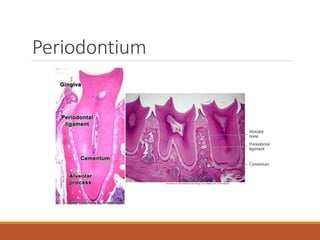
Periodontium
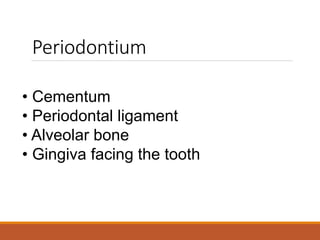
• Cementum
• Periodontal ligament
• Alveolar bone
• Gingiva facing the tooth
Periodontium
The other bone
It is a hard avascular connective
tissue that covers the roots of
teeth
Cementum
Role of Cementum
1) It covers and protects the root dentin
(covers the opening of dentinal tubules)
2) It provides attachment of the periodontal
fibers
3) It reverses tooth resorption
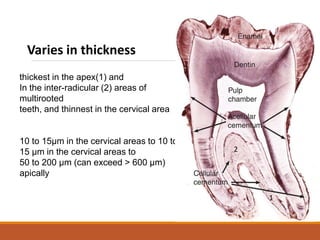
thickest in the apex(1) and
In the inter-radicular (2) areas of
multirooted
teeth, and thinnest in the cervical area
10 to 15µm in the cervical areas to 10 to
15 µm in the cervical areas to
50 to 200 µm (can exceed > 600 µm)
apically
2
1
Varies in thickness
Cementum simulates bone
• Organic fibrous framework, ground
substance, crystal type, development
• Lacunae
• Canaliculi
• Cellular component
• Incremental lines (also known as “resting”
(grow lines; they are produced by continuous
but
phasic, deposition of cementum)
Differences between cementum and bone
Not vascularized – a reason for it being resistant to resorption. More
resistant to resorption compared to bone
• Minor ability to remodel
• Lacks neural component
70% of bone is made by inorganic salts (cementum only 45-50%)
Chemical Composition of Cementum
Similar to bone
45%to 50%hydroxyapatite (inorganic)
50% to 55% collagenous and noncollagenous matrix proteins ggp
(organic)
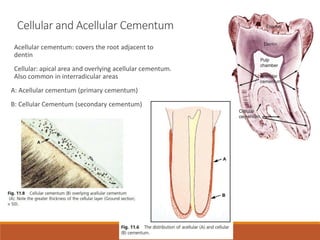
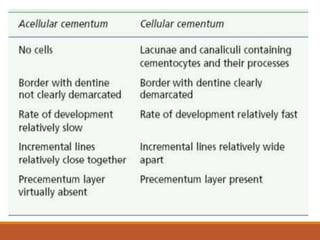
Cellular and Acellular Cementum
Acellular cementum: covers the root adjacent to
dentin
Cellular: apical area and overlying acellular cementum.
Also common in interradicular areas
A: Acellular cementum (primary cementum)
B: Cellular Cementum (secondary cementum)
CELLS OF CEMENTUM
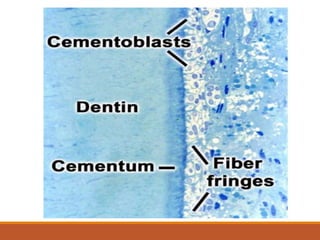
Cementoblasts: Found at the surface of the cementum and
Lay down organic matrix (cementoid) on the surface of root
dentin
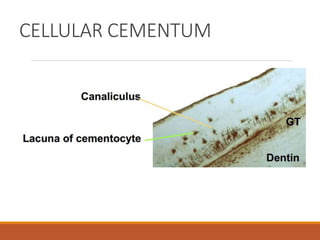
Cementocytes: Cementocytes are cementoblasts that have
become embedded in the cementum. They live in lacunae
and have processes called canaliculi.
Cementoid: ground substance and collagen fibers which are
produced by and located underneath the cementoblasts
Cementum formed from hydroxyapatite depositing on the
collagen fibers of the cementoid (organic matrix) and of the
PDL.
CELLULAR CEMENTUM
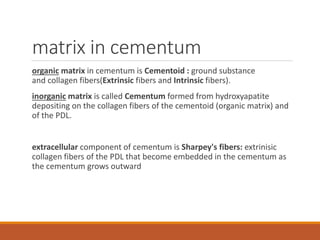
matrix in cementum
organic matrix in cementum is Cementoid : ground substance
and collagen fibers(Extrinsic fibers and Intrinsic fibers).
inorganic matrix is called Cementum formed from hydroxyapatite
depositing on the collagen fibers of the cementoid (organic matrix) and
of the PDL.
extracellular component of cementum is Sharpey's fibers: extrinisic
collagen fibers of the PDL that become embedded in the cementum as
the cementum grows outward
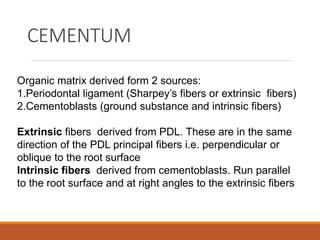
CEMENTUM
Organic matrix derived form 2 sources:
1.Periodontal ligament (Sharpey’s fibers or extrinsic fibers)
2.Cementoblasts (ground substance and intrinsic fibers)
Extrinsic fibers derived from PDL. These are in the same
direction of the PDL principal fibers i.e. perpendicular or
oblique to the root surface
Intrinsic fibers derived from cementoblasts. Run parallel
to the root surface and at right angles to the extrinsic fibers
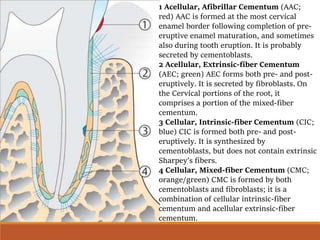
1 Acellular, Afibrillar Cementum (AAC;
red) AAC is formed at the most cervical
enamel border following completion of pre-
eruptive enamel maturation, and sometimes
also during tooth eruption. It is probably
secreted by cementoblasts.
2 Acellular, Extrinsic-fiber Cementum
(AEC; green) AEC forms both pre- and post-
eruptively. It is secreted by fibroblasts. On
the Cervical portions of the root, it
comprises a portion of the mixed-fiber
cementum.
3 Cellular, Intrinsic-fiber Cementum (CIC;
blue) CIC is formed both pre- and post-
eruptively. It is synthesized by
cementoblasts, but does not contain extrinsic
Sharpey’s fibers.
4 Cellular, Mixed-fiber Cementum (CMC;
orange/green) CMC is formed by both
cementoblasts and fibroblasts; it is a
combination of cellular intrinsic-fiber
cementum and acellular extrinsic-fiber
cementum.
Secondary cellular cementum
• Both intrinsic and extrinsic fibers
[Extrinsic (5 – 7 µm) and Intrinsic (1 – 2 µm)]
• Bulk of secondary cementum
• Cementocytes
• Laminated structure
• Cementoid on the surface
• Apical portion and intrerradicular area
• Adaptation
Intrinsic fibers are uniformly mineralized but the extrinsic fibers are
variably mineralized with some central unmineralized cores
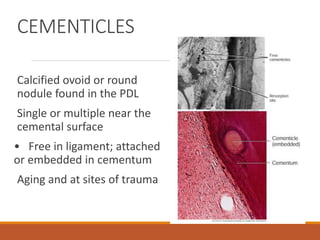
CEMENTICLES
Calcified ovoid or round
nodule found in the PDL
Single or multiple near the
cemental surface
• Free in ligament; attached
or embedded in cementum
Aging and at sites of trauma
PERIOODONTAL LIGAMENT
Soft specialize connective tissue between cementum & alveolar bone.
0.15 – 0.35 cm in width.
Thinnest around middle third of root.
Decrease with age.
FUNCTIONS
• Supports teeth in their sockets.
• Withstand force of mastication.
• Act as sensory receptor.
• Provide nutrition for cementoblast and
cementocytes
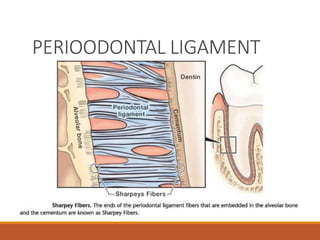
PERIOODONTAL LIGAMENT
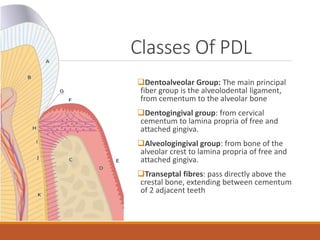
Classes Of PDL
Dentoalveolar Group: The main principal
fiber group is the alveolodental ligament,
from cementum to the alveolar bone
Dentogingival group: from cervical
cementum to lamina propria of free and
attached gingiva.
Alveologingival group: from bone of the
alveolar crest to lamina propria of free and
attached gingiva.
Transeptal fibres: pass directly above the
crestal bone, extending between cementum
of 2 adjacent teeth
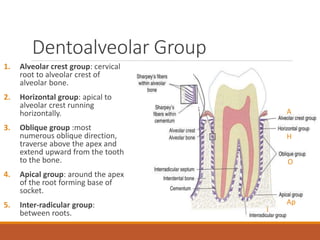
Dentoalveolar Group
1. Alveolar crest group: cervical
root to alveolar crest of
alveolar bone.
2. Horizontal group: apical to
alveolar crest running
horizontally.
3. Oblique group :most
numerous oblique direction,
traverse above the apex and
extend upward from the tooth
to the bone.
4. Apical group: around the apex
of the root forming base of
socket.
5. Inter-radicular group:
between roots.
H
O
A
Ap
I
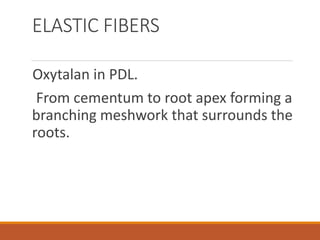
ELASTIC FIBERS
Oxytalan in PDL.
From cementum to root apex forming a
branching meshwork that surrounds the
roots.
GROUND SUBSTANCE
• 70% Water.
• Glycosaminoglycans.
CELLS
• FIBROBLAST: Principle cells. High rate of turnover of protein.
• EPITHELIAL CELLS: cells rests.
• UNDIFFERENTIATED CELLS.
• BONE &CEMENTUM CELLS (osteoblasts and cementoblasts).
DEFENCE CELLS: macrophages, mast cells, eosinophils (lymphocytes and
neutrophils occasionally)
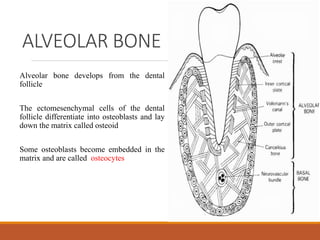
ALVEOLAR BONE
Alveolar bone develops from the dental
follicle
The ectomesenchymal cells of the dental
follicle differentiate into osteoblasts and lay
down the matrix called osteoid
Some osteoblasts become embedded in the
matrix and are called osteocytes
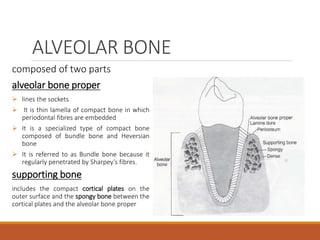
ALVEOLAR BONE
composed of two parts
alveolar bone proper
 lines the sockets
 It is thin lamella of compact bone in which
periodontal fibres are embedded
 It is a specialized type of compact bone
composed of bundle bone and Heversian
bone
 It is referred to as Bundle bone because it
regularly penetrated by Sharpey’s fibres.
supporting bone
includes the compact cortical plates on the
outer surface and the spongy bone between the
cortical plates and the alveolar bone proper
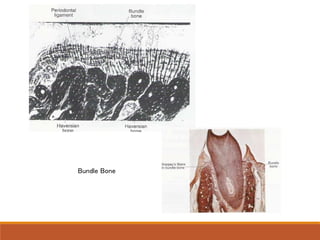
Bundle Bone
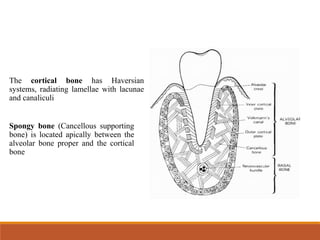
The cortical bone has Haversian
systems, radiating lamellae with lacunae
and canaliculi
Spongy bone (Cancellous supporting
bone) is located apically between the
alveolar bone proper and the cortical
bone
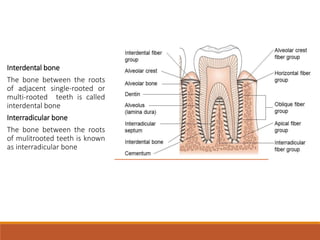
Interdental bone
The bone between the roots
of adjacent single-rooted or
multi-rooted teeth is called
interdental bone
Interradicular bone
The bone between the roots
of mulitrooted teeth is known
as interradicular bone

Periodontium

  • 1.
  • 2.
    Periodontium • Cementum • Periodontalligament • Alveolar bone • Gingiva facing the tooth
  • 3.
  • 4.
    The other bone Itis a hard avascular connective tissue that covers the roots of teeth Cementum
  • 5.
    Role of Cementum 1)It covers and protects the root dentin (covers the opening of dentinal tubules) 2) It provides attachment of the periodontal fibers 3) It reverses tooth resorption
  • 6.
    thickest in theapex(1) and In the inter-radicular (2) areas of multirooted teeth, and thinnest in the cervical area 10 to 15µm in the cervical areas to 10 to 15 µm in the cervical areas to 50 to 200 µm (can exceed > 600 µm) apically 2 1 Varies in thickness
  • 7.
    Cementum simulates bone •Organic fibrous framework, ground substance, crystal type, development • Lacunae • Canaliculi • Cellular component • Incremental lines (also known as “resting” (grow lines; they are produced by continuous but phasic, deposition of cementum)
  • 8.
    Differences between cementumand bone Not vascularized – a reason for it being resistant to resorption. More resistant to resorption compared to bone • Minor ability to remodel • Lacks neural component 70% of bone is made by inorganic salts (cementum only 45-50%)
  • 9.
    Chemical Composition ofCementum Similar to bone 45%to 50%hydroxyapatite (inorganic) 50% to 55% collagenous and noncollagenous matrix proteins ggp (organic)
  • 10.
    Cellular and AcellularCementum Acellular cementum: covers the root adjacent to dentin Cellular: apical area and overlying acellular cementum. Also common in interradicular areas A: Acellular cementum (primary cementum) B: Cellular Cementum (secondary cementum)
  • 12.
    CELLS OF CEMENTUM Cementoblasts:Found at the surface of the cementum and Lay down organic matrix (cementoid) on the surface of root dentin Cementocytes: Cementocytes are cementoblasts that have become embedded in the cementum. They live in lacunae and have processes called canaliculi. Cementoid: ground substance and collagen fibers which are produced by and located underneath the cementoblasts Cementum formed from hydroxyapatite depositing on the collagen fibers of the cementoid (organic matrix) and of the PDL.
  • 13.
  • 14.
    matrix in cementum organicmatrix in cementum is Cementoid : ground substance and collagen fibers(Extrinsic fibers and Intrinsic fibers). inorganic matrix is called Cementum formed from hydroxyapatite depositing on the collagen fibers of the cementoid (organic matrix) and of the PDL. extracellular component of cementum is Sharpey's fibers: extrinisic collagen fibers of the PDL that become embedded in the cementum as the cementum grows outward
  • 15.
    CEMENTUM Organic matrix derivedform 2 sources: 1.Periodontal ligament (Sharpey’s fibers or extrinsic fibers) 2.Cementoblasts (ground substance and intrinsic fibers) Extrinsic fibers derived from PDL. These are in the same direction of the PDL principal fibers i.e. perpendicular or oblique to the root surface Intrinsic fibers derived from cementoblasts. Run parallel to the root surface and at right angles to the extrinsic fibers
  • 16.
    1 Acellular, AfibrillarCementum (AAC; red) AAC is formed at the most cervical enamel border following completion of pre- eruptive enamel maturation, and sometimes also during tooth eruption. It is probably secreted by cementoblasts. 2 Acellular, Extrinsic-fiber Cementum (AEC; green) AEC forms both pre- and post- eruptively. It is secreted by fibroblasts. On the Cervical portions of the root, it comprises a portion of the mixed-fiber cementum. 3 Cellular, Intrinsic-fiber Cementum (CIC; blue) CIC is formed both pre- and post- eruptively. It is synthesized by cementoblasts, but does not contain extrinsic Sharpey’s fibers. 4 Cellular, Mixed-fiber Cementum (CMC; orange/green) CMC is formed by both cementoblasts and fibroblasts; it is a combination of cellular intrinsic-fiber cementum and acellular extrinsic-fiber cementum.
  • 18.
    Secondary cellular cementum •Both intrinsic and extrinsic fibers [Extrinsic (5 – 7 µm) and Intrinsic (1 – 2 µm)] • Bulk of secondary cementum • Cementocytes • Laminated structure • Cementoid on the surface • Apical portion and intrerradicular area • Adaptation Intrinsic fibers are uniformly mineralized but the extrinsic fibers are variably mineralized with some central unmineralized cores
  • 19.
    CEMENTICLES Calcified ovoid orround nodule found in the PDL Single or multiple near the cemental surface • Free in ligament; attached or embedded in cementum Aging and at sites of trauma
  • 20.
    PERIOODONTAL LIGAMENT Soft specializeconnective tissue between cementum & alveolar bone. 0.15 – 0.35 cm in width. Thinnest around middle third of root. Decrease with age.
  • 21.
    FUNCTIONS • Supports teethin their sockets. • Withstand force of mastication. • Act as sensory receptor. • Provide nutrition for cementoblast and cementocytes PERIOODONTAL LIGAMENT
  • 22.
  • 23.
    Classes Of PDL DentoalveolarGroup: The main principal fiber group is the alveolodental ligament, from cementum to the alveolar bone Dentogingival group: from cervical cementum to lamina propria of free and attached gingiva. Alveologingival group: from bone of the alveolar crest to lamina propria of free and attached gingiva. Transeptal fibres: pass directly above the crestal bone, extending between cementum of 2 adjacent teeth
  • 24.
    Dentoalveolar Group 1. Alveolarcrest group: cervical root to alveolar crest of alveolar bone. 2. Horizontal group: apical to alveolar crest running horizontally. 3. Oblique group :most numerous oblique direction, traverse above the apex and extend upward from the tooth to the bone. 4. Apical group: around the apex of the root forming base of socket. 5. Inter-radicular group: between roots. H O A Ap I
  • 25.
    ELASTIC FIBERS Oxytalan inPDL. From cementum to root apex forming a branching meshwork that surrounds the roots.
  • 26.
    GROUND SUBSTANCE • 70%Water. • Glycosaminoglycans.
  • 27.
    CELLS • FIBROBLAST: Principlecells. High rate of turnover of protein. • EPITHELIAL CELLS: cells rests. • UNDIFFERENTIATED CELLS. • BONE &CEMENTUM CELLS (osteoblasts and cementoblasts). DEFENCE CELLS: macrophages, mast cells, eosinophils (lymphocytes and neutrophils occasionally)
  • 28.
    ALVEOLAR BONE Alveolar bonedevelops from the dental follicle The ectomesenchymal cells of the dental follicle differentiate into osteoblasts and lay down the matrix called osteoid Some osteoblasts become embedded in the matrix and are called osteocytes
  • 29.
    ALVEOLAR BONE composed oftwo parts alveolar bone proper  lines the sockets  It is thin lamella of compact bone in which periodontal fibres are embedded  It is a specialized type of compact bone composed of bundle bone and Heversian bone  It is referred to as Bundle bone because it regularly penetrated by Sharpey’s fibres. supporting bone includes the compact cortical plates on the outer surface and the spongy bone between the cortical plates and the alveolar bone proper
  • 30.
  • 31.
    The cortical bonehas Haversian systems, radiating lamellae with lacunae and canaliculi Spongy bone (Cancellous supporting bone) is located apically between the alveolar bone proper and the cortical bone
  • 32.
    Interdental bone The bonebetween the roots of adjacent single-rooted or multi-rooted teeth is called interdental bone Interradicular bone The bone between the roots of mulitrooted teeth is known as interradicular bone