STREPTOLYSIN O
MR-Said Warsame Nur
Introduction
• Streptolysin O is a hemolytic factor produced
by most strains of GroupA beta- hemolytic
streptococci (S. pyogenes).
• Streptococci are gram-positive cocci in chain,
non-motile,facultative anaerobes.
• It produce toxin like streptolysin O &
streptolysin S and enzymes like DNAase,
streptokinase.
Antistreptolysin O (ASO)
• Is specific neutralizing antibody produced
after infection with these organisms & it
appears in serum from 1 week-1month after
the onset of a streptococcal infection.
• It combines and neutralizes the heamolytic
activity of streptolysin O.
Serological test
• Antistreptolysin O test is used to diagnose
conditions postbstreptococcal resulting from a
streptococcal infection especially in diagnosis
of rheumatic fever and glomerulonephritis
when it’s not possible to isolate Group
streptococci in culture (most complication
develop at a stage when it is not possible to
isolate groupA streptococcus in culture).
principle of the test
• Antistretolysin O can react specifically with SLO
and inhibits the heamolytic activity.
• The amount of ASO can be estimated by dilution
of patient’s serum in the presence of constant
amount of SLO to the point where there is still
complete prevention of haemolysis.
• The occurrence of ASO depends on the
production of SLO by streptococci in the infected
host.
Commercially available test are:
• Antistreptolysin O latex slide test- used for
screening a significant raise in ASO titer
• Antistreptolysin O titration test –used to
determine the titer of ASO antibody.
Rapid Antistreptolysin O latex
agglutination test
• Principle: In the presence of ASO antibody a
visible agglutination reaction will be exhibited
when a serum specimen combine with latex
particle coated with streptolysin O antigen.
• Specimen
– Clear, haemolysis free serum
REAGENT STORAGE AND STABILITY
• Reagents are stable until stated expiration date
on bottle label when stored refrigerated (2 - 8°C).
• DO NOT FREEZE.
• The ASO Latex Reagent, once shaken must be
uniform without visible clumping. When stored
refrigerated, a slight sedimentation may occur
and should be considered normal.
• Do not use the latex reagent or controls if they
become contaminated.
SPECIMEN COLLECTION AND
STORAGE
• Use fresh serum collected by centrifuging
clotted blood.
• If the test cannot be carried out on the same
day, store the specimen for 7 days at 2-8(C
and for 3 months at -20c0.
• For longer periods the sample must be frozen.
• As in all serological tests, hemolytic or
contaminated serum must not be used.
• DO NOT USE PLASMA.
Reagent & equipment required
• Latex particle coated with streptolycin O
• 0.9% NaCl solution
• Glass slide with six cells
• Applicator sticks (stirrer)
• Control reagent
• Other material required
– Timer
– Test tubes
– Pasture pipettes and rubber bulb
– Serologic pipette and safety bulb
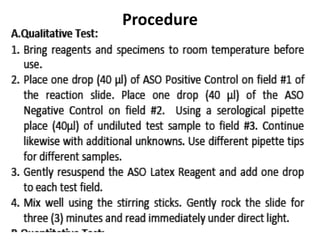
Procedure
RESULTS
• A.QUALITATIVE TEST:
• A negative reaction is indicated by a uniform
milky suspension with no agglutination as
observed with the ASO Negative Control.
• A positive reaction is indicated by any
observable agglutination in the reaction
mixture. The specimen reaction should be
compared to the ASO Negative Control.
LIMITATIONS
• Results should be read three (3) minutes after
the mixing of the reagent on the slide. A
reading obtained after this period of time may
be incorrect.

Lecture 8-streptolysin o

  • 1.
  • 2.
    Introduction • Streptolysin Ois a hemolytic factor produced by most strains of GroupA beta- hemolytic streptococci (S. pyogenes). • Streptococci are gram-positive cocci in chain, non-motile,facultative anaerobes. • It produce toxin like streptolysin O & streptolysin S and enzymes like DNAase, streptokinase.
  • 3.
    Antistreptolysin O (ASO) •Is specific neutralizing antibody produced after infection with these organisms & it appears in serum from 1 week-1month after the onset of a streptococcal infection. • It combines and neutralizes the heamolytic activity of streptolysin O.
  • 4.
    Serological test • AntistreptolysinO test is used to diagnose conditions postbstreptococcal resulting from a streptococcal infection especially in diagnosis of rheumatic fever and glomerulonephritis when it’s not possible to isolate Group streptococci in culture (most complication develop at a stage when it is not possible to isolate groupA streptococcus in culture).
  • 5.
    principle of thetest • Antistretolysin O can react specifically with SLO and inhibits the heamolytic activity. • The amount of ASO can be estimated by dilution of patient’s serum in the presence of constant amount of SLO to the point where there is still complete prevention of haemolysis. • The occurrence of ASO depends on the production of SLO by streptococci in the infected host.
  • 6.
    Commercially available testare: • Antistreptolysin O latex slide test- used for screening a significant raise in ASO titer • Antistreptolysin O titration test –used to determine the titer of ASO antibody.
  • 7.
    Rapid Antistreptolysin Olatex agglutination test • Principle: In the presence of ASO antibody a visible agglutination reaction will be exhibited when a serum specimen combine with latex particle coated with streptolysin O antigen. • Specimen – Clear, haemolysis free serum
  • 8.
    REAGENT STORAGE ANDSTABILITY • Reagents are stable until stated expiration date on bottle label when stored refrigerated (2 - 8°C). • DO NOT FREEZE. • The ASO Latex Reagent, once shaken must be uniform without visible clumping. When stored refrigerated, a slight sedimentation may occur and should be considered normal. • Do not use the latex reagent or controls if they become contaminated.
  • 9.
    SPECIMEN COLLECTION AND STORAGE •Use fresh serum collected by centrifuging clotted blood. • If the test cannot be carried out on the same day, store the specimen for 7 days at 2-8(C and for 3 months at -20c0. • For longer periods the sample must be frozen. • As in all serological tests, hemolytic or contaminated serum must not be used. • DO NOT USE PLASMA.
  • 10.
    Reagent & equipmentrequired • Latex particle coated with streptolycin O • 0.9% NaCl solution • Glass slide with six cells • Applicator sticks (stirrer) • Control reagent • Other material required – Timer – Test tubes – Pasture pipettes and rubber bulb – Serologic pipette and safety bulb
  • 11.
  • 12.
    RESULTS • A.QUALITATIVE TEST: •A negative reaction is indicated by a uniform milky suspension with no agglutination as observed with the ASO Negative Control. • A positive reaction is indicated by any observable agglutination in the reaction mixture. The specimen reaction should be compared to the ASO Negative Control.
  • 14.
    LIMITATIONS • Results shouldbe read three (3) minutes after the mixing of the reagent on the slide. A reading obtained after this period of time may be incorrect.