1
Metals in dentistry
2
Metals properties
Usually are:
Hard
Luster
High density is dependent on molar mass of molecule as well as
structure type of crystalline which determines amount of atomes to
be able to be packed in lattice.
Good heat nad electricity conductors because of metalic bonds
presence
3
Metallic bond
Elecetron configuration Na - 1s22s22p63s1
Valence elctron 3s1 is surranded by Na+
sodium elctron’s cloud
Accumulation of more amount of atoms
being in sodium crystal is causing that
valence elctrons are moving within entire
crystal volume
Electron gas which penetrates inter-ions
space as a result of electrostatic interaction
attracts positive charged ions making them
densely packed
Sodium atom
Na2 molecule
Sodium crystal
4
Metallic bond
Presence of metalic bond in structure determines its:
• Opaqueness
• Metalic gloss
• Good electrical conductivity
• Good thermal conductivity
• Ductililty
5
Metals used in dentistry
Noble metals:
Gold, palladium, platinum
High resistivity to corrosion
Non-noble metals
Titanium, nickel, copper, silver, zinc
Provide modulus of elasticity and abrasion resistance of
dental alloys.
6
Main type of metals used in dentistry
Gold
Gold belongs to copper „family”
Density 19,3 g/cm3
Melting temperature 1062oC
Boiling temperature 2600oC
Very soft, melleable, and ductile
Good elctrical and heat conductor
With silver, platinum and palladium makes solid solution
7
Main type of metals used in dentistry
Gold
Dissolves in:
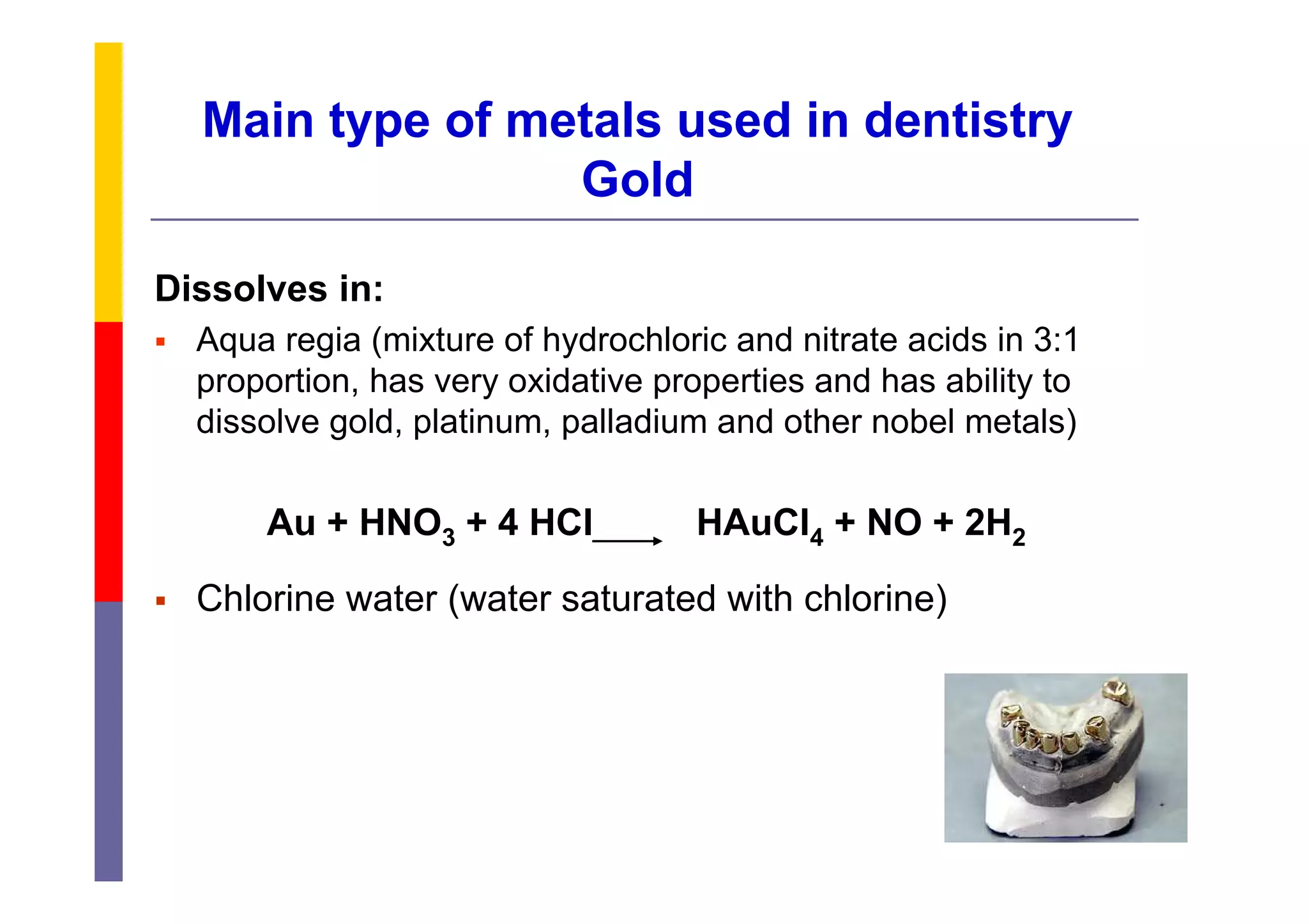
Aqua regia (mixture of hydrochloric and nitrate acids in 3:1
proportion, has very oxidative properties and has ability to
dissolve gold, platinum, palladium and other nobel metals)
Au + HNO3 + 4 HCl HAuCl4 + NO + 2H2
Chlorine water (water saturated with chlorine)
8
Main type of metals used in dentistry – Platinum
• Belongs to platinum „family”.
• Density - 21,45 g/cm3
• Melting point - 1773oC
• Boiling point - 4300oC
• Average hardness
• Easy to forging and rolling
• High resistance to chemicals
• Dissolves only in aqua regia making chloroplatinous
H2PtCl6 acid
9
Main type of metals used in dentistry
Platinum
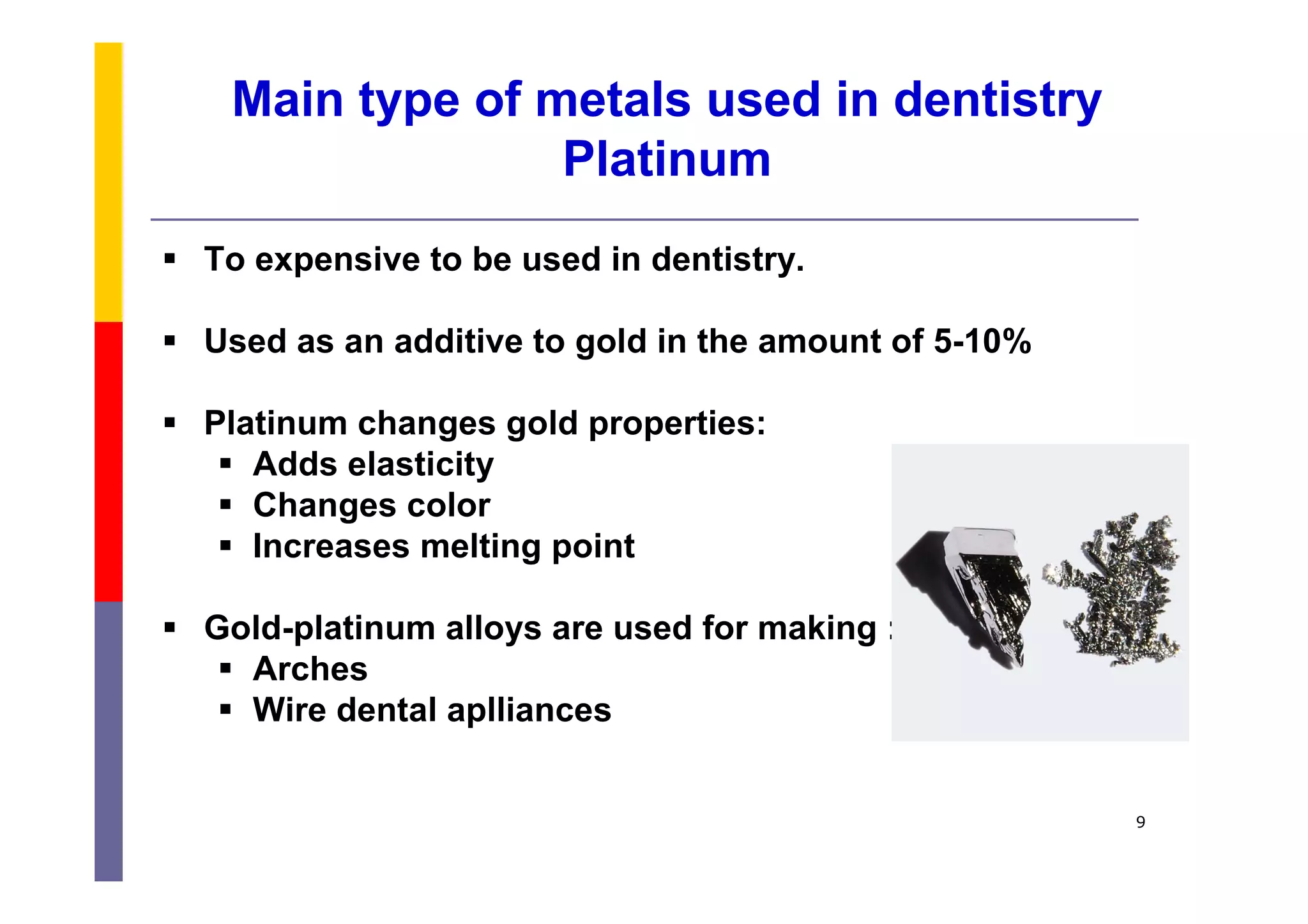
To expensive to be used in dentistry.
Used as an additive to gold in the amount of 5-10%
Platinum changes gold properties:
Adds elasticity
Changes color
Increases melting point
Gold-platinum alloys are used for making :
Arches
Wire dental aplliances
10
Main type of metals used in dentistry
Iridium
Density - 22,42 g/cm3
Melting point - 2440oC
Boiling temperature - 4400oC
Silver-white metal, very fragile but hard
High chemical resistance:
reacts only with chlorine and fluorium
DOES NOT dissolve in aqua regia
11
Main type of metals used in dentistry
Irydium
Alloys of irydium (10%) with platinum are more hard,
more resistant and have more chemical resistance than pure
platinum
Used for „stifts” for porcelain crowns
12
Main type of metals used in dentistry – Palladium
Density - 11,97 g/cm3
Melting temperature - 1549oC
Boiling point - 2540oC
Not very hard
Plastic
Melleable
13
Main type of metals used in dentistry
Palladium
Chemical reactivity
Dissolves in:
Nitric acid
Sulpuric acid,
Very easily in aqua regia
Addition of 20% palladium to gold with platinum gives „white
gold”.
Alloy of palladium with silver in 9:1 proportion is used for making
parts of porcelain crowns
Palladium is a part of platinum soldier
14
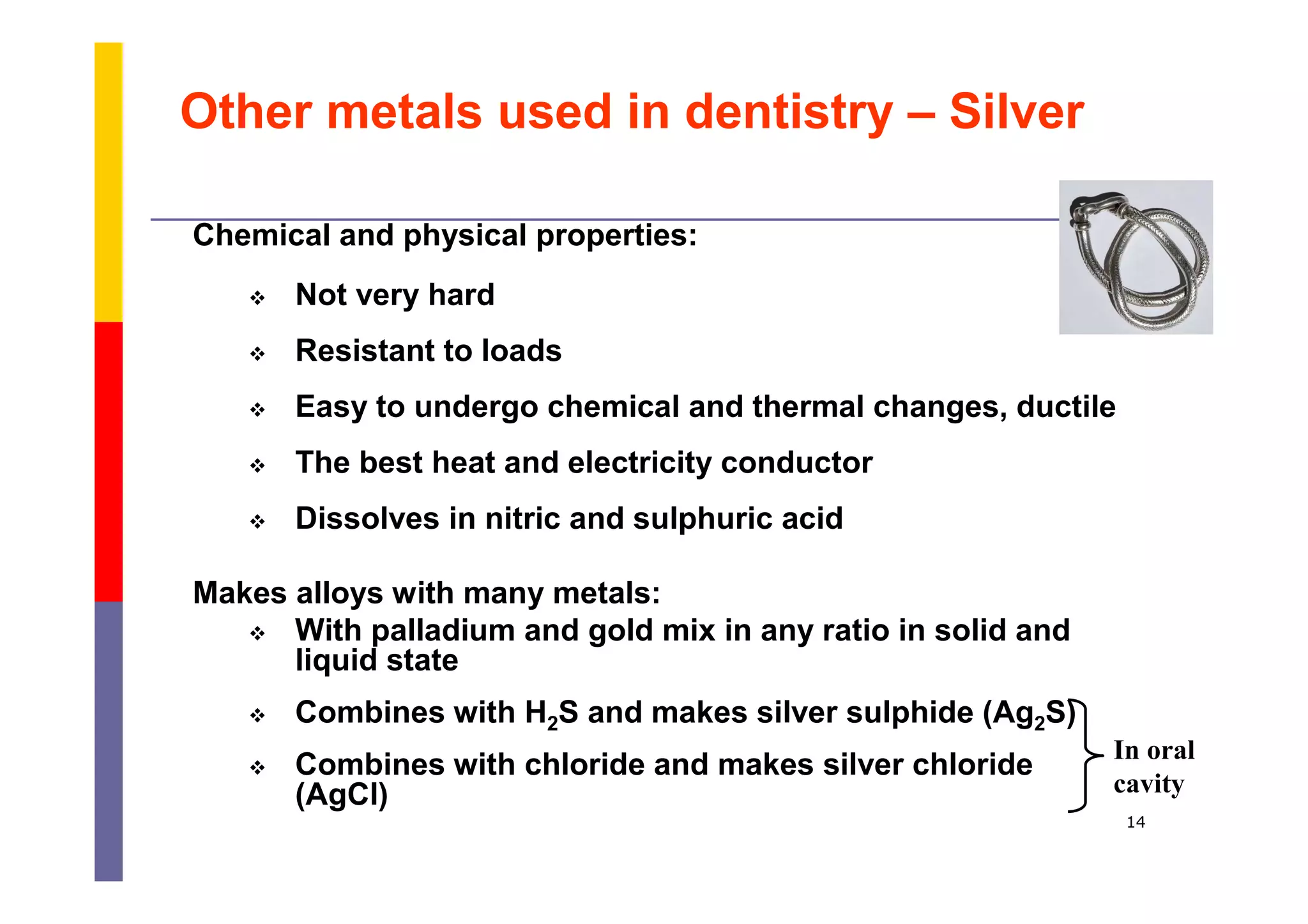
Other metals used in dentistry – Silver
Chemical and physical properties:
Not very hard
Resistant to loads
Easy to undergo chemical and thermal changes, ductile
The best heat and electricity conductor
Dissolves in nitric and sulphuric acid
Makes alloys with many metals:
With palladium and gold mix in any ratio in solid and
liquid state
Combines with H2S and makes silver sulphide (Ag2S)
Combines with chloride and makes silver chloride
(AgCl)
In oral
cavity
15
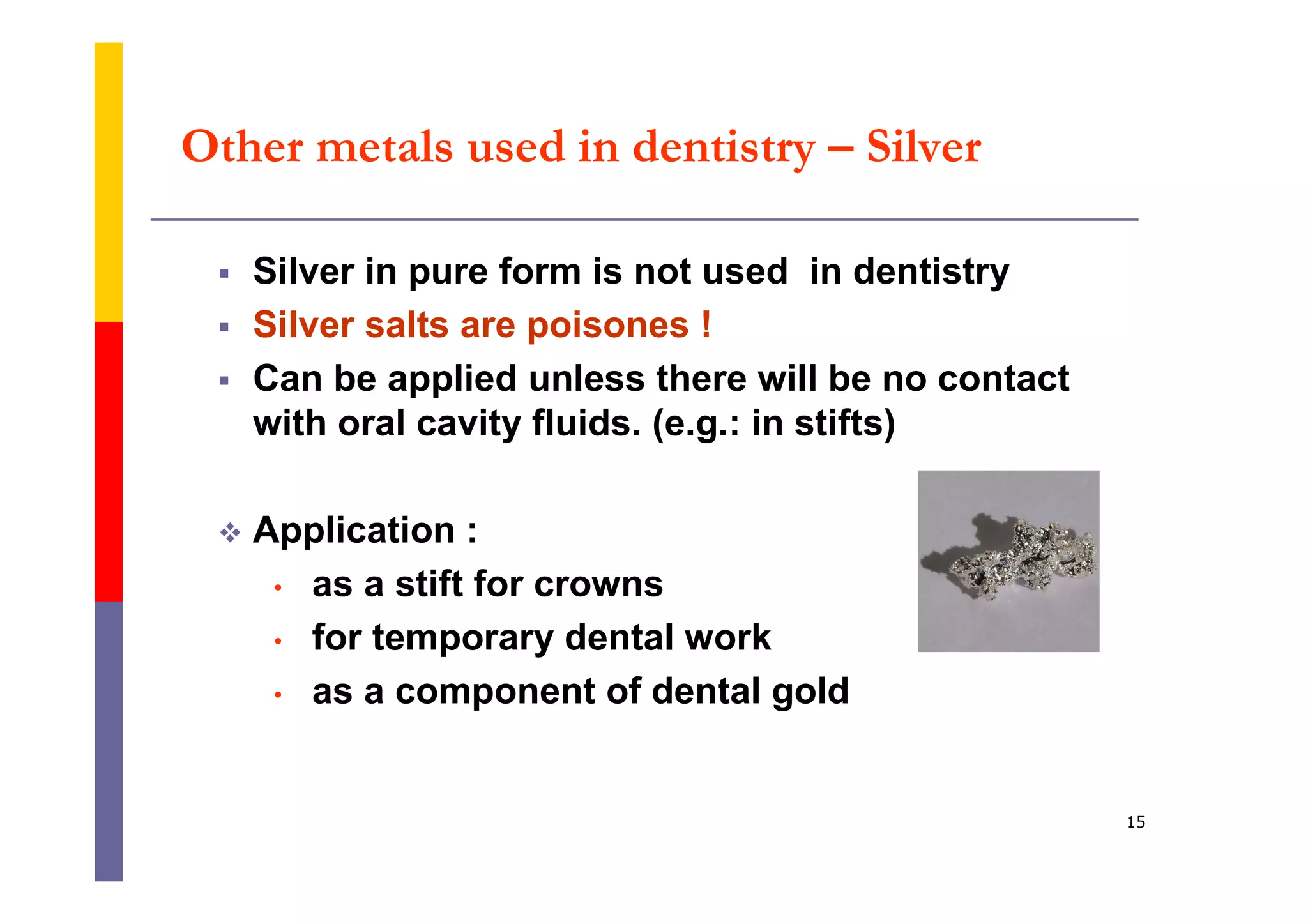
Silver in pure form is not used in dentistry
Silver salts are poisones !
Can be applied unless there will be no contact
with oral cavity fluids. (e.g.: in stifts)
Application :
• as a stift for crowns
• for temporary dental work
• as a component of dental gold
Other metals used in dentistry – Silver
16
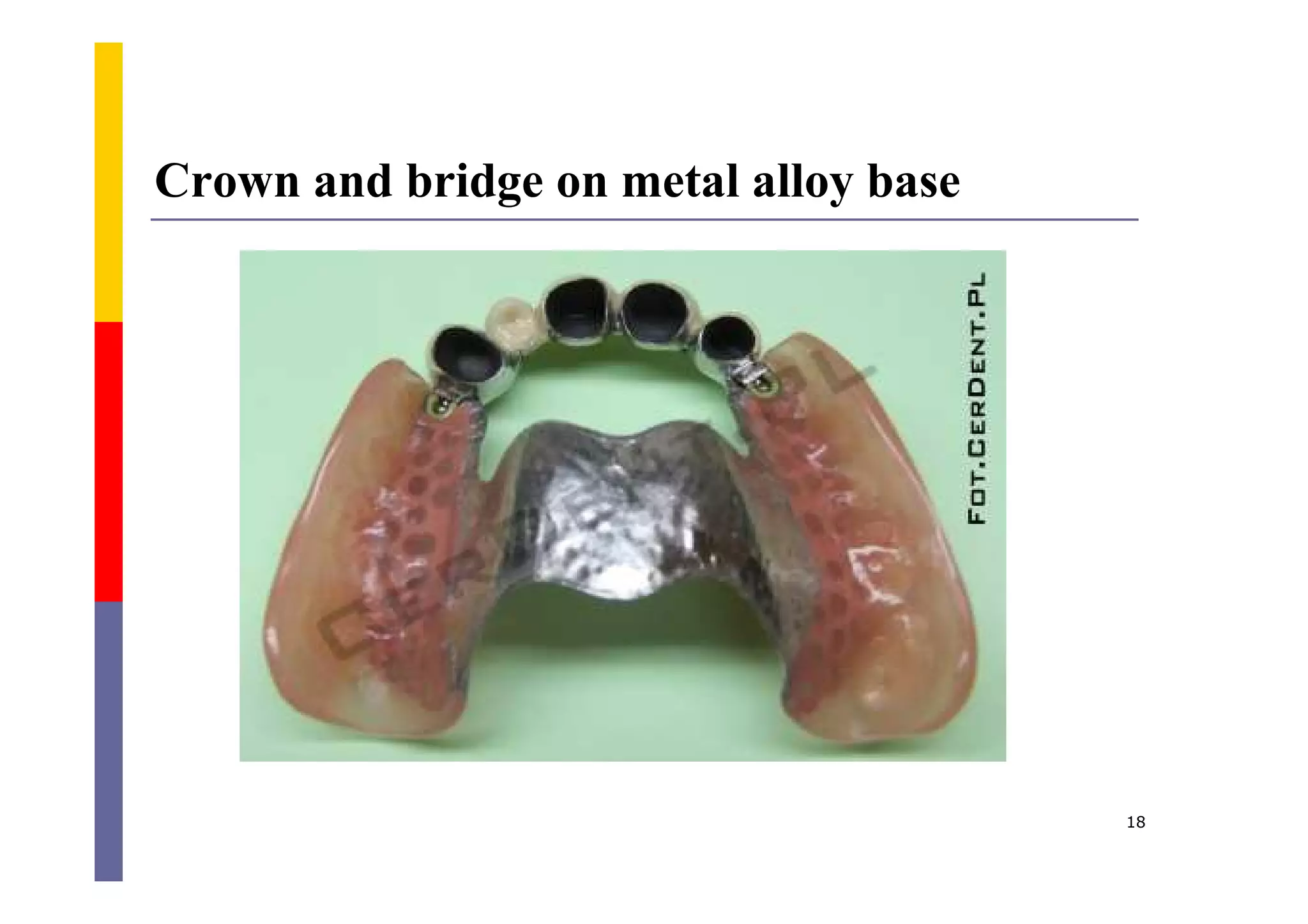
Permanent protetic suplement
- porcelain crowns on the base made from metal
or steel
17
Permanent protetic suplement
Porcelain crowns fused to steel or gold base
18
Crown and bridge on metal alloy base
19
Removeable denture
http://www.wikidoc.org/index.php/Removable_partial_dentures
20
Other metals used in dentistry
Mercury
In room temperature it is thick fluid metal
Belongs to zinc”family”
Density 13,54 g/cm3
Freezing temperature -38,89oC
Boiling temperature 356,90oC
Dissolves all metals except ferrum and platinum „families”
Reacts with nitric acid only
21
Other metals used in dentistry
Titanium
atomic number 22
posseses high mechanical strength,
corosion resistant (including sea water and chlorine)
gray color
can be added as an addition to iron, aluminum, vanadium,
molibdenium and other alloys.
Titanium alloys are used in airspace industry ( engines), in
military, metalurgic processes, moto, medical ( dentures,
orthopedic braclets), in sports (bicycle frames and components,
tennis rackets, baseball bats, hiking equipment, golf clubs)
http://images-of-elements.com/titanium.php
http://www.gtagaming.com/downloads/gta-san-andreas/weapon-mods/10718
22
• Used in dentistry
• Posesses much more lower thermal conductivity than
traditional prosthetic materials
• High hardness, mechanical strength and longevity
• Hypoalergenic and corrosion resistant
• For bones treatments alloys of titanium and Al, Nb
(niobum). For example Blount braces with longevity about
20 years are made from alloy of Titanium (43-47%) and
Nickel (53-57%)
• Other application of Ni-Ti alloys are implants plates and for
curing bite in chieldren
Other metals used in dentistry
Titanium
23
Titanium is a metal very often used in implants and
more often in protetic
Main adventure is to create oxidation layer on the surface
which protects against corrosion and interaction of cell
fluids with chemical reaction.
After implant is introduced directly to bone
contact osteogenesis starts - process which is building up of
bone directly on the implant surface.
That leads to the direct structural and functional
connection between living bone and the surface of
implant - osteointegration
24
Osteointegration on the surface of implant
25
Dental implants
A dental implant, sometimes called a tooth implant, is an
artificial tooth root (synthetic material) that is surgically
anchored into jaw to hold a replacement tooth or bridge in place
26
Parts of implant
http://www.dentalorg.com/dental-implant-overview-part-1.html
27
Metal alloys – classification criteria
Alloys can be divided in respect to:
1. Amount of noble or non-noble components. For
example: 60% Au, 10% Pl, 5% Pt i 25% Cu –
combined „nobility” of alloys is 75%. (Copper is not
noble and does not count)
2. Dominant metal. For example: alloys based on gold.
3. Color – alloys in yellow or silver color sometimes
are called „white” .
4. Application – alloys for making fillings or solders
28
Metal alloys
Metal alloys have crystal structure.
During solidification of melted alloys crystals are formed
and become larger
Smaller grains gives better alloy properties.
In order to have the smallest possible grains other
components are added such as iridium or ruthenium.
In alloys with high quantities of non-nobel metals crystals
with large diameter are dominant.
29
Alloy properties are usually not an average from
properties of metalic components
Addition of even small amount of any metal to alloy can
cause dramatic change in its properties
For example: small amount (5-10%) of platinum in gold
alloy increases hardness and elasticity of alloy.
Palladium and nickel increase hardness of alloy.
Alloy properties are determined by many factors:
composition, manufacturing condition, mechanical and
thermal treatment, crystal structure etc.
30
Requirements for metal alloys
Alloys should posses:
• Ease of melt
• Ease to make a cast (melted alloys with high
density and good flow are easier to be cast)
• Ease of processing
• Corrosion resistance and dullness in oral cavity
environment
• Biocompatibility : should not be toxic and cause
allergy
31
Proper mechanical properties, especially:
• High plastic resistance, especially for alloys
exposed to high stress
• Proper ductility protecting against breaking
during the fixing
• Proper hardness which results in milling dificulties
and its resistance to grinding
• Should not be expensive. Ideal alloy shoud not
be expensive in terms of material and processing
Requirements for metal alloys
32
Metal alloys – classification criteria according to ANSI/ADA
(American National Standards Institute /American Dental Association)
< 25any
With advantage of
noble metals
> 25anyNoble
> 60> 40Very noble
Nobel metal
content
Gold content
[weight %]
Alloy type
33
Metal alloys - the most important parameters
Melting temperature range
Density
Strength and hardnes
34
Metal alloys – melting temperature range
Metal alloys are melting in specific temperature range.
During the heating melting temperature range: 950o -1000oC
950oC first symptoms of melting
975oC part of the alloy is liquid but some of the
components are still solid
1000oC entire alloys become liquid
35
Metal alloys – melting temperature range
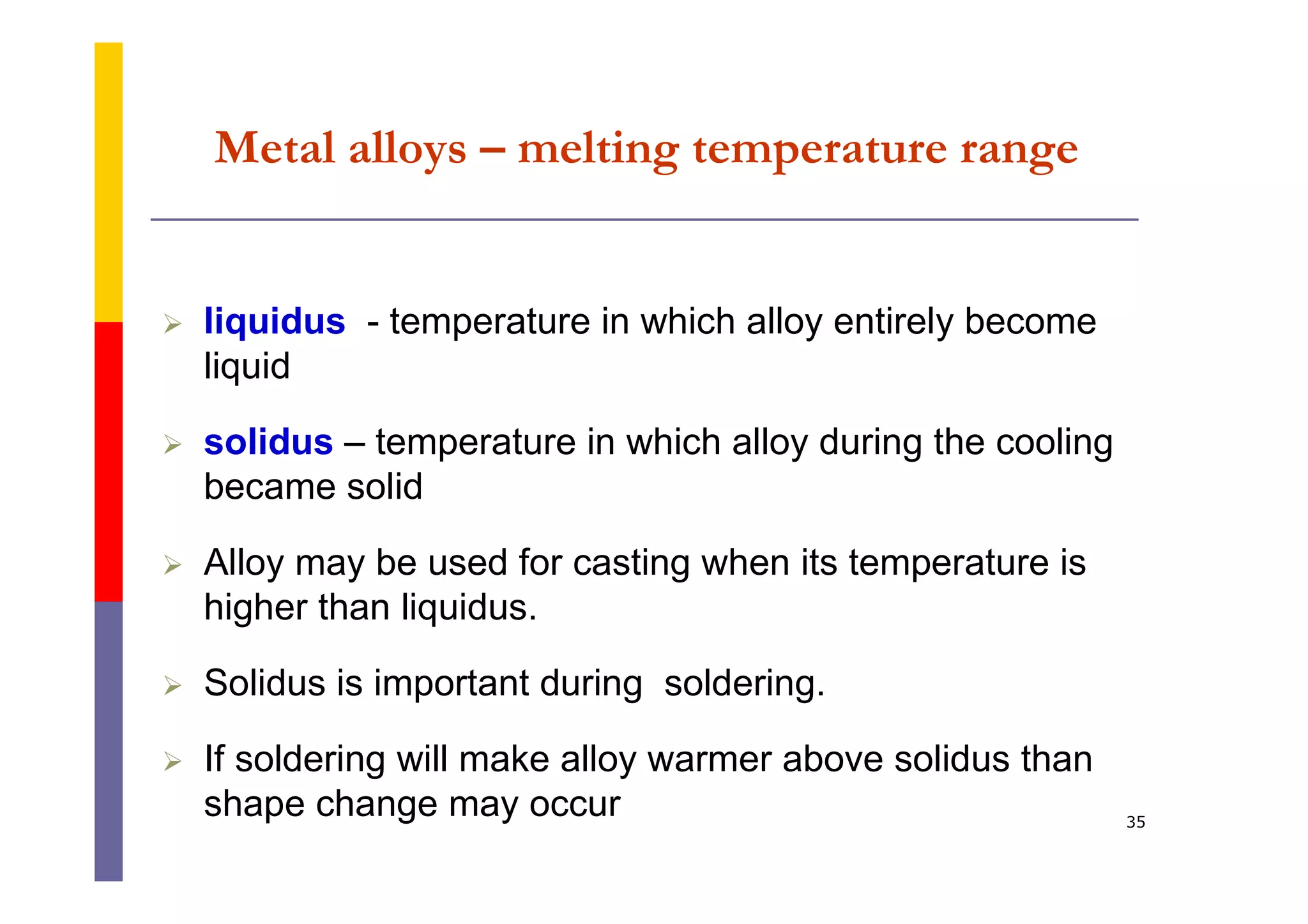
liquidus - temperature in which alloy entirely become
liquid
solidus – temperature in which alloy during the cooling
became solid
Alloy may be used for casting when its temperature is
higher than liquidus.
Solidus is important during soldering.
If soldering will make alloy warmer above solidus than
shape change may occur
36
Metal alloys – alloy density
Density of dental alloys are in the range from 4,5 g/cm3 (titanium alloys)
to 18,5 g/cm3 (some nobel alloys)
7,5
7,5
4,5
1275
1400 – 1500
1700
With excess of nobel
metals
Based on nickel
Based on cobalt
Based on titanium
12,4
10,6
10,6
865 – 925
1100 – 1190
1020 – 1100
Nobel
Silver- gold- copper
Palladium – copper
Silver -palladium
18,5
15,6
1045 – 1140
910 – 1065
Higly nobel
Gold - platinum
Gold- copper- silver
Density [g/cm3]Melting range [oC]Alloy type
37
Metal alloys – alloys strength
Yield point – indicates force applied to the surface unit at
which permanent deformation will appear
Yield point unit is Mega pascal (MPa)
Yield point for alloys is in th erange of: 260-1150 MPa
Alloy deformation – magnitude express in percentage (%)
Yield point 750 MPa and deformation 0,2% -
it means that force of 750 MPa is causing deformation of
alloy by 0,2%
38
Metal alloys – hardness
Influences polish of alloy
Hardness is related to yield point.
Hardness is express in kg/mm2.
-it means amount of mass [kg] needed to be apply to make
notch of 1 mm2 area
hardness of dental alloys is in the range:125 – 425 kg/mm2
Enamel hardness is 343 kg/mm2
39
Amalgam
Amalgam – it is the mixture of silver alloy with liquid
mercury
Sillver alloy – it is the powder consisting of silver, tin and
copper
After mixing silver alloy with mercury chemical reaction
takes place which gives amalgam:
silver alloy + mercury -> amalgam
At the begining it is plastic and after it hardens it is harder
than other dental filling
40
Amalgam
Currently alloys with high quantity of copper are used (13 – 30%)
Amalgams made of silver alloy with high content of copper (in
comparison to small amount of Cu 2 – 4%) are:
More resistant to crushing and elongation
Less resistant to corrosion
More susceptible to edge ckracking
Example of composition of silver alloy with high content of copper:
Silver 40 – 60%
Tin 27 – 30%
Copper 13 – 30%
41
Amalgamation
Combining silver alloy with mercury starts process of dissolving alloy in
mercury
During dissolving process chemical reaction takes place which leads to mixture
cristalization which results in thickening and hardening of amalgam
Hardening of amalgam starts before all alloys molecules are totally dissolved
Fixed amalgam contains large amount of silver alloy surrounded by new
product of chemical reaction which took place in amalgam
Simplified reaction schematic:
Silver alloy (tin - silver - copper) + mercury
Silver alloy (unreacted) + copper-tin + silver-mercury
After amalgamation process ends there is no „free” mercury in amalgam
42
THE END

Metals in dentistry

  • 1.
  • 2.
    2 Metals properties Usually are: Hard Luster Highdensity is dependent on molar mass of molecule as well as structure type of crystalline which determines amount of atomes to be able to be packed in lattice. Good heat nad electricity conductors because of metalic bonds presence
  • 3.
    3 Metallic bond Elecetron configurationNa - 1s22s22p63s1 Valence elctron 3s1 is surranded by Na+ sodium elctron’s cloud Accumulation of more amount of atoms being in sodium crystal is causing that valence elctrons are moving within entire crystal volume Electron gas which penetrates inter-ions space as a result of electrostatic interaction attracts positive charged ions making them densely packed Sodium atom Na2 molecule Sodium crystal
  • 4.
    4 Metallic bond Presence ofmetalic bond in structure determines its: • Opaqueness • Metalic gloss • Good electrical conductivity • Good thermal conductivity • Ductililty
  • 5.
    5 Metals used indentistry Noble metals: Gold, palladium, platinum High resistivity to corrosion Non-noble metals Titanium, nickel, copper, silver, zinc Provide modulus of elasticity and abrasion resistance of dental alloys.
  • 6.
    6 Main type ofmetals used in dentistry Gold Gold belongs to copper „family” Density 19,3 g/cm3 Melting temperature 1062oC Boiling temperature 2600oC Very soft, melleable, and ductile Good elctrical and heat conductor With silver, platinum and palladium makes solid solution
  • 7.
    7 Main type ofmetals used in dentistry Gold Dissolves in: Aqua regia (mixture of hydrochloric and nitrate acids in 3:1 proportion, has very oxidative properties and has ability to dissolve gold, platinum, palladium and other nobel metals) Au + HNO3 + 4 HCl HAuCl4 + NO + 2H2 Chlorine water (water saturated with chlorine)
  • 8.
    8 Main type ofmetals used in dentistry – Platinum • Belongs to platinum „family”. • Density - 21,45 g/cm3 • Melting point - 1773oC • Boiling point - 4300oC • Average hardness • Easy to forging and rolling • High resistance to chemicals • Dissolves only in aqua regia making chloroplatinous H2PtCl6 acid
  • 9.
    9 Main type ofmetals used in dentistry Platinum To expensive to be used in dentistry. Used as an additive to gold in the amount of 5-10% Platinum changes gold properties: Adds elasticity Changes color Increases melting point Gold-platinum alloys are used for making : Arches Wire dental aplliances
  • 10.
    10 Main type ofmetals used in dentistry Iridium Density - 22,42 g/cm3 Melting point - 2440oC Boiling temperature - 4400oC Silver-white metal, very fragile but hard High chemical resistance: reacts only with chlorine and fluorium DOES NOT dissolve in aqua regia
  • 11.
    11 Main type ofmetals used in dentistry Irydium Alloys of irydium (10%) with platinum are more hard, more resistant and have more chemical resistance than pure platinum Used for „stifts” for porcelain crowns
  • 12.
    12 Main type ofmetals used in dentistry – Palladium Density - 11,97 g/cm3 Melting temperature - 1549oC Boiling point - 2540oC Not very hard Plastic Melleable
  • 13.
    13 Main type ofmetals used in dentistry Palladium Chemical reactivity Dissolves in: Nitric acid Sulpuric acid, Very easily in aqua regia Addition of 20% palladium to gold with platinum gives „white gold”. Alloy of palladium with silver in 9:1 proportion is used for making parts of porcelain crowns Palladium is a part of platinum soldier
  • 14.
    14 Other metals usedin dentistry – Silver Chemical and physical properties: Not very hard Resistant to loads Easy to undergo chemical and thermal changes, ductile The best heat and electricity conductor Dissolves in nitric and sulphuric acid Makes alloys with many metals: With palladium and gold mix in any ratio in solid and liquid state Combines with H2S and makes silver sulphide (Ag2S) Combines with chloride and makes silver chloride (AgCl) In oral cavity
  • 15.
    15 Silver in pureform is not used in dentistry Silver salts are poisones ! Can be applied unless there will be no contact with oral cavity fluids. (e.g.: in stifts) Application : • as a stift for crowns • for temporary dental work • as a component of dental gold Other metals used in dentistry – Silver
  • 16.
    16 Permanent protetic suplement -porcelain crowns on the base made from metal or steel
  • 17.
    17 Permanent protetic suplement Porcelaincrowns fused to steel or gold base
  • 18.
    18 Crown and bridgeon metal alloy base
  • 19.
  • 20.
    20 Other metals usedin dentistry Mercury In room temperature it is thick fluid metal Belongs to zinc”family” Density 13,54 g/cm3 Freezing temperature -38,89oC Boiling temperature 356,90oC Dissolves all metals except ferrum and platinum „families” Reacts with nitric acid only
  • 21.
    21 Other metals usedin dentistry Titanium atomic number 22 posseses high mechanical strength, corosion resistant (including sea water and chlorine) gray color can be added as an addition to iron, aluminum, vanadium, molibdenium and other alloys. Titanium alloys are used in airspace industry ( engines), in military, metalurgic processes, moto, medical ( dentures, orthopedic braclets), in sports (bicycle frames and components, tennis rackets, baseball bats, hiking equipment, golf clubs) http://images-of-elements.com/titanium.php http://www.gtagaming.com/downloads/gta-san-andreas/weapon-mods/10718
  • 22.
    22 • Used indentistry • Posesses much more lower thermal conductivity than traditional prosthetic materials • High hardness, mechanical strength and longevity • Hypoalergenic and corrosion resistant • For bones treatments alloys of titanium and Al, Nb (niobum). For example Blount braces with longevity about 20 years are made from alloy of Titanium (43-47%) and Nickel (53-57%) • Other application of Ni-Ti alloys are implants plates and for curing bite in chieldren Other metals used in dentistry Titanium
  • 23.
    23 Titanium is ametal very often used in implants and more often in protetic Main adventure is to create oxidation layer on the surface which protects against corrosion and interaction of cell fluids with chemical reaction. After implant is introduced directly to bone contact osteogenesis starts - process which is building up of bone directly on the implant surface. That leads to the direct structural and functional connection between living bone and the surface of implant - osteointegration
  • 24.
    24 Osteointegration on thesurface of implant
  • 25.
    25 Dental implants A dentalimplant, sometimes called a tooth implant, is an artificial tooth root (synthetic material) that is surgically anchored into jaw to hold a replacement tooth or bridge in place
  • 26.
  • 27.
    27 Metal alloys –classification criteria Alloys can be divided in respect to: 1. Amount of noble or non-noble components. For example: 60% Au, 10% Pl, 5% Pt i 25% Cu – combined „nobility” of alloys is 75%. (Copper is not noble and does not count) 2. Dominant metal. For example: alloys based on gold. 3. Color – alloys in yellow or silver color sometimes are called „white” . 4. Application – alloys for making fillings or solders
  • 28.
    28 Metal alloys Metal alloyshave crystal structure. During solidification of melted alloys crystals are formed and become larger Smaller grains gives better alloy properties. In order to have the smallest possible grains other components are added such as iridium or ruthenium. In alloys with high quantities of non-nobel metals crystals with large diameter are dominant.
  • 29.
    29 Alloy properties areusually not an average from properties of metalic components Addition of even small amount of any metal to alloy can cause dramatic change in its properties For example: small amount (5-10%) of platinum in gold alloy increases hardness and elasticity of alloy. Palladium and nickel increase hardness of alloy. Alloy properties are determined by many factors: composition, manufacturing condition, mechanical and thermal treatment, crystal structure etc.
  • 30.
    30 Requirements for metalalloys Alloys should posses: • Ease of melt • Ease to make a cast (melted alloys with high density and good flow are easier to be cast) • Ease of processing • Corrosion resistance and dullness in oral cavity environment • Biocompatibility : should not be toxic and cause allergy
  • 31.
    31 Proper mechanical properties,especially: • High plastic resistance, especially for alloys exposed to high stress • Proper ductility protecting against breaking during the fixing • Proper hardness which results in milling dificulties and its resistance to grinding • Should not be expensive. Ideal alloy shoud not be expensive in terms of material and processing Requirements for metal alloys
  • 32.
    32 Metal alloys –classification criteria according to ANSI/ADA (American National Standards Institute /American Dental Association) < 25any With advantage of noble metals > 25anyNoble > 60> 40Very noble Nobel metal content Gold content [weight %] Alloy type
  • 33.
    33 Metal alloys -the most important parameters Melting temperature range Density Strength and hardnes
  • 34.
    34 Metal alloys –melting temperature range Metal alloys are melting in specific temperature range. During the heating melting temperature range: 950o -1000oC 950oC first symptoms of melting 975oC part of the alloy is liquid but some of the components are still solid 1000oC entire alloys become liquid
  • 35.
    35 Metal alloys –melting temperature range liquidus - temperature in which alloy entirely become liquid solidus – temperature in which alloy during the cooling became solid Alloy may be used for casting when its temperature is higher than liquidus. Solidus is important during soldering. If soldering will make alloy warmer above solidus than shape change may occur
  • 36.
    36 Metal alloys –alloy density Density of dental alloys are in the range from 4,5 g/cm3 (titanium alloys) to 18,5 g/cm3 (some nobel alloys) 7,5 7,5 4,5 1275 1400 – 1500 1700 With excess of nobel metals Based on nickel Based on cobalt Based on titanium 12,4 10,6 10,6 865 – 925 1100 – 1190 1020 – 1100 Nobel Silver- gold- copper Palladium – copper Silver -palladium 18,5 15,6 1045 – 1140 910 – 1065 Higly nobel Gold - platinum Gold- copper- silver Density [g/cm3]Melting range [oC]Alloy type
  • 37.
    37 Metal alloys –alloys strength Yield point – indicates force applied to the surface unit at which permanent deformation will appear Yield point unit is Mega pascal (MPa) Yield point for alloys is in th erange of: 260-1150 MPa Alloy deformation – magnitude express in percentage (%) Yield point 750 MPa and deformation 0,2% - it means that force of 750 MPa is causing deformation of alloy by 0,2%
  • 38.
    38 Metal alloys –hardness Influences polish of alloy Hardness is related to yield point. Hardness is express in kg/mm2. -it means amount of mass [kg] needed to be apply to make notch of 1 mm2 area hardness of dental alloys is in the range:125 – 425 kg/mm2 Enamel hardness is 343 kg/mm2
  • 39.
    39 Amalgam Amalgam – itis the mixture of silver alloy with liquid mercury Sillver alloy – it is the powder consisting of silver, tin and copper After mixing silver alloy with mercury chemical reaction takes place which gives amalgam: silver alloy + mercury -> amalgam At the begining it is plastic and after it hardens it is harder than other dental filling
  • 40.
    40 Amalgam Currently alloys withhigh quantity of copper are used (13 – 30%) Amalgams made of silver alloy with high content of copper (in comparison to small amount of Cu 2 – 4%) are: More resistant to crushing and elongation Less resistant to corrosion More susceptible to edge ckracking Example of composition of silver alloy with high content of copper: Silver 40 – 60% Tin 27 – 30% Copper 13 – 30%
  • 41.
    41 Amalgamation Combining silver alloywith mercury starts process of dissolving alloy in mercury During dissolving process chemical reaction takes place which leads to mixture cristalization which results in thickening and hardening of amalgam Hardening of amalgam starts before all alloys molecules are totally dissolved Fixed amalgam contains large amount of silver alloy surrounded by new product of chemical reaction which took place in amalgam Simplified reaction schematic: Silver alloy (tin - silver - copper) + mercury Silver alloy (unreacted) + copper-tin + silver-mercury After amalgamation process ends there is no „free” mercury in amalgam
  • 42.