WELCOME TO MY PRESENTATION
A Presentation on
Public Key Distribution
Topics to be covered by
 Public key cryptography
 Public key announcement
 Trusted center and Controlled trusted center
 Certification Authority
 X.509
 Public key Infrastructures
Public Key Distribution
 Diffie - Hellman (1976) proposed the “public file”
concept
 Universally accessible
 No unauthorized modification
Public Key Cryptography
 In public key cryptography, everyone has access to
everyone’s public key.
 Public key are available to everyone.
Ways of Public Key Distribution:
 Public Announcement
 Trusted center
 Controlled trusted center
 Certification Authority
 Public key Infrastructures
Public Announcement
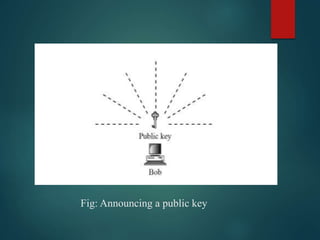
 Each person /user can announce or broadcast their public key to
the world.
 No authenticity : It is not a secure way.
Fig: Announcing a public key
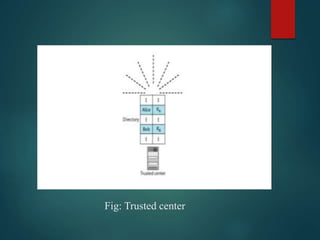
Trusted Center
 It has a directory and the directory can be publicly
advertised by the trusted center
 User can keep the private key, and deliver the
public key for insertion into the directory.
 The center can also respond to any inquiry about a
public key
Fig: Trusted center
Controlled Trusted Center
 Controls are added on the distribution of the
public keys to achieve a higher level of security.
 The public key announcement can include a
timestamp.
 Trusted center can be signed by an authority to
prevent interception and modification of the
response.
Fig: Controlled trusted center
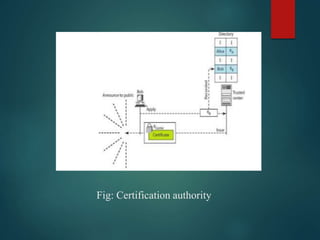
Certification Authority
 Certification Authority(CA) which is a federal or
state organization that binds a public key to an entity
and issues a certificate.
 CA must verify the entity requesting a new
certificate.
 CA’s own certificate is signed by a higher-level CA.
Root CA’s certificate is self-signed and its name is
“well- known”.
Fig: Certification authority
X.509
 CA has solved the problem of public –key fraud
but it has created a side-effect. To remove this
side-effect, ITU has designed a protocol called
X.509.
 X.509 uses a well known protocol called ASN.1.
Public-Key Infrastructures (PKI)
 A public key infrastructures a set of roles, policies
and procedures needed to create, manage,
distribute, use, store digital certificates and
manage public-key encryption.
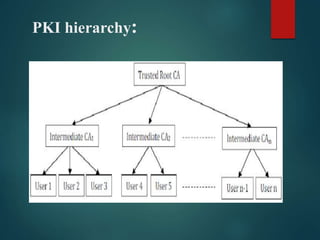
 It is a hierarchical structure.
PKI hierarchy:
Summary:
 Distribution of public keys.
 X.509 authentication.
 A hierarchical system (PKI) to answer queries
about key certification.
ANY QUESTION???
THANK YOU

Public Key Distribution

  • 1.
    WELCOME TO MYPRESENTATION
  • 2.
    A Presentation on PublicKey Distribution
  • 3.
    Topics to becovered by  Public key cryptography  Public key announcement  Trusted center and Controlled trusted center  Certification Authority  X.509  Public key Infrastructures
  • 4.
    Public Key Distribution Diffie - Hellman (1976) proposed the “public file” concept  Universally accessible  No unauthorized modification
  • 5.
    Public Key Cryptography In public key cryptography, everyone has access to everyone’s public key.  Public key are available to everyone.
  • 6.
    Ways of PublicKey Distribution:  Public Announcement  Trusted center  Controlled trusted center  Certification Authority  Public key Infrastructures
  • 7.
    Public Announcement  Eachperson /user can announce or broadcast their public key to the world.  No authenticity : It is not a secure way.
  • 8.
  • 9.
    Trusted Center  Ithas a directory and the directory can be publicly advertised by the trusted center  User can keep the private key, and deliver the public key for insertion into the directory.  The center can also respond to any inquiry about a public key
  • 10.
  • 11.
    Controlled Trusted Center Controls are added on the distribution of the public keys to achieve a higher level of security.  The public key announcement can include a timestamp.  Trusted center can be signed by an authority to prevent interception and modification of the response.
  • 12.
  • 13.
    Certification Authority  CertificationAuthority(CA) which is a federal or state organization that binds a public key to an entity and issues a certificate.  CA must verify the entity requesting a new certificate.  CA’s own certificate is signed by a higher-level CA. Root CA’s certificate is self-signed and its name is “well- known”.
  • 14.
  • 15.
    X.509  CA hassolved the problem of public –key fraud but it has created a side-effect. To remove this side-effect, ITU has designed a protocol called X.509.  X.509 uses a well known protocol called ASN.1.
  • 16.
    Public-Key Infrastructures (PKI) A public key infrastructures a set of roles, policies and procedures needed to create, manage, distribute, use, store digital certificates and manage public-key encryption.  It is a hierarchical structure.
  • 17.
  • 18.
    Summary:  Distribution ofpublic keys.  X.509 authentication.  A hierarchical system (PKI) to answer queries about key certification.
  • 19.
  • 20.