CHAPTER 3 NUMERICAL METHOD
3.1  The Trapezium Rule OBJECTIVES :  The objectives of this  lesson are to enable students to a) derive the trapezium rule by dividing the area represented by    dx into n ( n    7 )  trapezium each with width h. b)  use the trapezium rule to approximate
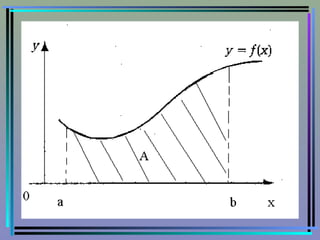
Introduction What happens when a mathematical function cannot be integrated ? In these cases a numerical method can be used to find an approximate value for the integral  As the definite integral  is a number  which represents the area between  y = f (x)  , the  x-axis and the lines  x = a  and x =b .
Therefore , even  if  cannot be found, approximate value for  can be found by evaluating the appropriate area using another method.  The two common methods are the trapezium rule and Simpson’s rule.  However, here we will discuss the trapezium rule  as requested by our syllabus .
The trapezium rule This method divides the area A under the curve  y = f(x) is into n vertical strips.  The width of each strip is h.  The area under the curve    sum of areas of n trapezia. Note :   approximately equal to
 
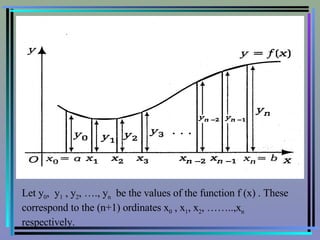
Let y 0 ,  y 1  , y 2 , …., y n   be the values of the function f (x) . These correspond to the (n+1) ordinates x 0  , x 1 , x 2 , ……..,x n   respectively.
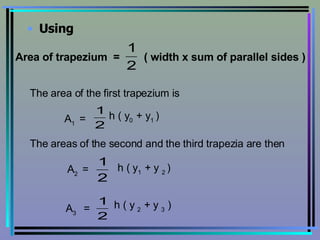
Using Area of trapezium  =  ( width x sum of parallel sides ) The area of the first trapezium is A 1  =  h ( y 0  + y 1  ) The areas of the second and the third trapezia are then A 2  =  h ( y 1  + y  2  ) A 3  = h ( y  2  + y  3  )
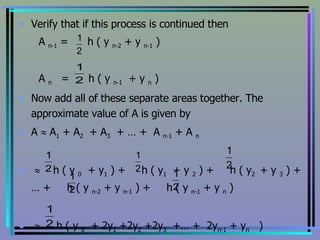
Verify that if this process is continued then A  n-1  =  h ( y  n-2  + y  n-1  ) A  n   =  h ( y  n-1   + y  n  ) Now add all of these separate areas together. The approximate value of A is given by A    A 1  + A 2   + A 3   + … +  A  n-1  + A  n    h ( y  0   + y 1  ) +  h ( y 1   + y  2  ) +  h ( y 2  + y  3  ) + … +  h ( y  n-2  + y  n-1  ) +  h ( y  n-1  + y  n  )    h ( y  0   + 2y 1  +2y 2  +2y 3   +… +  2y n-1  + y n   )
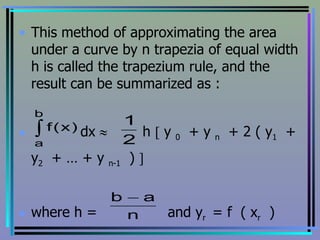
This method of approximating the area under a curve by n trapezia of equal width h is called the trapezium rule, and the result can be summarized as : dx      h    y  0   + y  n   + 2 ( y 1   + y 2   + … + y  n-1   )   where h =  and y r  = f  ( x r   )
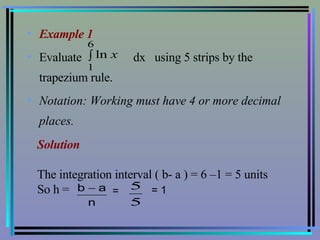
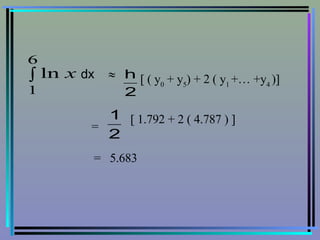
Example 1   Evaluate  dx  using 5 strips by the trapezium rule. Notation: Working must have 4 or more decimal places. Solution The integration interval ( b- a ) = 6 –1 = 5 units So h =  =   = 1
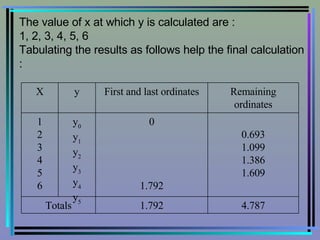
The value of x at which y is calculated are : 1, 2, 3, 4, 5, 6 Tabulating the results as follows help the final calculation : 4.787 1.792 Totals 0.693 1.099 1.386 1.609 0 1.792 y 0 y 1 y 2 y 3 y 4 y 5 1 2 3 4 5 6 Remaining ordinates First and last ordinates y X
dx      ( y 0  + y 5 ) + 2 ( y 1  +… +y 4  )    =     1.792 + 2 ( 4.787 )   =  5.683
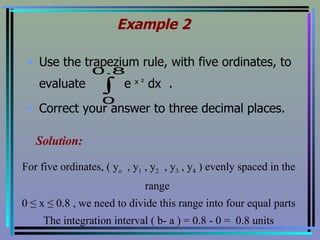
Example 2 Use the trapezium rule, with five ordinates, to evaluate  e  x ²  dx  . Correct your answer to three decimal places. Solution: For five ordinates, ( y o   , y 1  , y 2   , y 3  , y 4  ) evenly spaced in the range  0 ≤ x ≤ 0.8 , we need to divide this range into four equal parts The integration interval ( b- a ) = 0.8 - 0 =  0.8 units
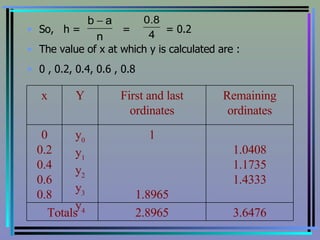
So,  h =  =  = 0.2  The value of x at which y is calculated are : 0 , 0.2, 0.4, 0.6 , 0.8 3.6476 2.8965 Totals 1.0408 1.1735 1.4333 1 1.8965 y 0 y 1 y 2 y 3 y 4 0 0.2 0.4 0.6 0.8 Remaining ordinates First and last ordinates Y x
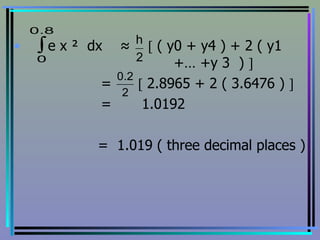
e x ²  dx  ≈    ( y0 + y4 ) + 2 ( y1  +… +y 3  )     =    2.8965 + 2 ( 3.6476 )     =  1.0192 =  1.019 ( three decimal places )
3.2  Solutions of non – linear equations   OBJECTIVE :  The objective of this  lesson is to enable students to understand the method of finding roots using the iteration method by writing:  f(x) = 0 in the form of x = g(x). The iteration scheme is x n+1  = g(x n ) , n = 1,2,3….. The method fails when   g  (x)    > 1 in the neighborhood of the roots of the equation.
Introduction Many equations cannot be solved exactly, but various methods of finding approximate numerical solutions exist. The most commonly used methods have two main parts: (a) finding an initial approximate value (b) improving this value by an iterative process
Initial Values: The  initial value of the roots of f(x) = 0 can be located approximately by either a graphical or an algebraic method. Graphical Method: Either (a)  Plot ( or sketch ) the graph of y = f(x). The real roots are the points where the curve  cuts the x axis. Or (b)  Rewrite f(x) = 0 in the form F(x) = G(x). Plot ( or sketch ) y =F(x) and y = G(x).  The real roots are at the points  where these graphs intersect.
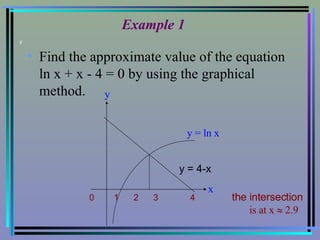
Example 1 Find the approximate value of the equation ln x + x - 4 = 0 by using the graphical method. y = 4-x y 0  1  2  3   4  the intersection   is at x    2.9 x y y = ln x
Algebraic Method   Find two values a and b such that f(a) and f(b) have different signs. At least one root must lie between a and b if f(x) is continuous. If more than one root is suspected between a and b, sketch a graph of y = f(x).
Iterative Method All iterative methods follow the same basic pattern. A sequence of approximations  x 1 , x 2  , x 3  , x 4  ….. is found , each one closer to the root    of f(x)=0. Each approximation is found from the one before it using a specified method. The process is continued until the required accuracy is reached. Two methods we have to discuss are Iteration Method and Newton-Raphson Method.
Iteration Method   Rewrite the equation f(x) = 0 in the form x = g(x). If the initial approximation is x 1  , then calculate x 2  = g(x 1 ) x 3  = g(x 2 ) x 4  = g(x 3 ) and so on ….. This method fails if   g   (x)    > 1 near the root.  So, the value of   g  (x1)    should be  < 1.
Example 2 Using the iteration method, find the solution of f(x) = x + e x   near x = -0.6 to three decimal places. Solution Iteration method Write the given equation as x = - e x      x = g(x) g (x) = - e x g  (x) = - e x ,   g  (-0.6)    =   -e-0.6   = 0.5488  ( < 1 )
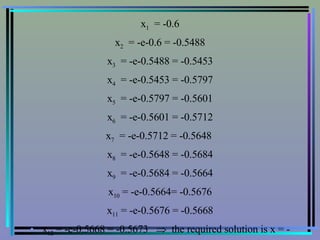
x 1   = -0.6 x 2   = -e-0.6 = -0.5488 x 3   = -e-0.5488 = -0.5453 x 4   = -e-0.5453 = -0.5797 x 5   = -e-0.5797 = -0.5601 x 6   = -e-0.5601 = -0.5712 x 7   = -e-0.5712 = -0.5648  x 8   = -e-0.5648 = -0.5684 x 9   = -e-0.5684 = -0.5664 x 10  = -e-0.5664= -0.5676 x 11  = -e-0.5676 = -0.5668 x 12  = -e-0.5668 = -0.5673     the required solution is x = - 0.567 ( three decimal places )#
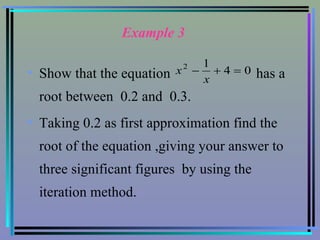
Example 3 Show that the equation  has a root between  0.2 and  0.3. Taking 0.2 as first approximation find the root of the equation ,giving your answer to three significant figures  by using the iteration method.
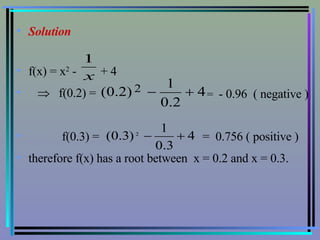
Solution f(x) = x 2  -  + 4     f(0.2) =  f(0.3) =  =  0.756 ( positive ) therefore f(x) has a root between  x = 0.2 and x = 0.3. =  - 0.96  ( negative )
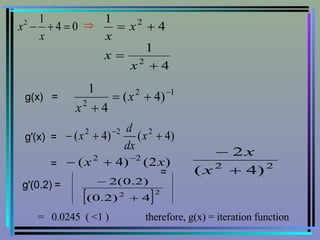
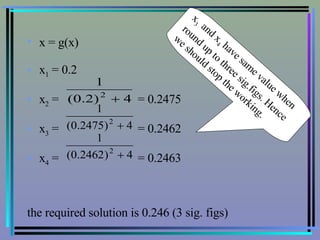
   g(x)  =   g'(x)  =   =   =  g'(0.2) =   =  0.0245  ( <1 )  therefore, g(x) = iteration function
x = g(x) x 1  = 0.2  x 2  =  = 0.2475 x 3  =  = 0.2462 x 4  =  = 0.2463 the required solution is 0.246 (3 sig. figs) x 3  and x 4  have same value when round up to three sig.figs. Hence we should stop the working.
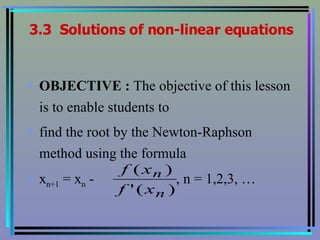
3.3  Solutions of non-linear equations OBJECTIVE :  The objective of this lesson is to enable students to find the root by the Newton-Raphson method using the formula x n+1  = x n  -  , n = 1,2,3, …
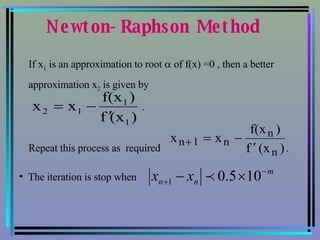
Newton-Raphson Method If x 1  is an approximation to root    of f(x) =0 , then a better approximation x 2  is given by  . Repeat this process as  required  .   The iteration is stop when
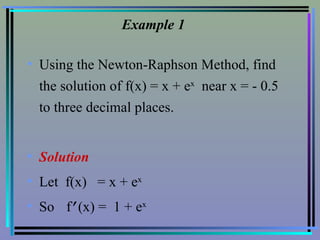
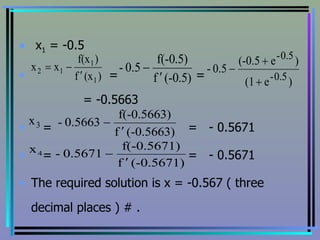
Example 1 Using the Newton-Raphson Method, find the solution of f(x) = x + e x   near x = - 0.5 to three decimal places. Solution Let  f(x)  = x + e x So   f   (x) =  1 + e x
x 1  = -0.5 =  =  = -0.5663 =  =  - 0.5671 =  =  - 0.5671 The required solution is x = -0.567 ( three decimal places ) # .
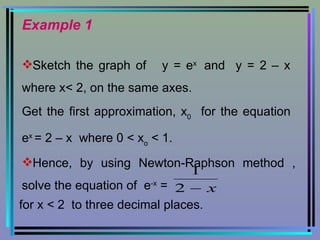
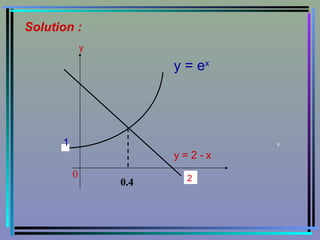
Example 1 Sketch the graph of  y = e x  and  y = 2 – x  where x< 2, on the same axes. Get the first approximation, x 0   for the equation  e x  = 2 – x  where 0 < x o  < 1. Hence, by using Newton-Raphson method , solve the equation of  e -x  =  for x < 2  to three decimal places.
2 1 Solution :   y y = e x   1   x y = 2 - x 0 0.4
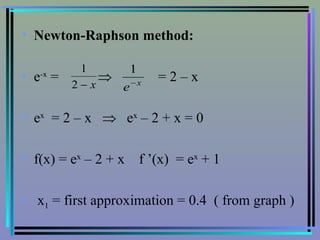
Newton-Raphson method: e -x  =     = 2 – x e x   = 2 – x     e x  – 2 + x = 0 f(x) = e x  – 2 + x  f ’(x)  = e x  + 1 x 1  = first approximation = 0.4  ( from graph )
0.4 - [ ]  = =  0.4043 =  0.4043 - [ ]   =  0.4433  =  0.4433 - [ ]   =  0.4428 =  0.4428 - [ ]  =  0.4428 The required solution is 0.443 ( three decimal places ).
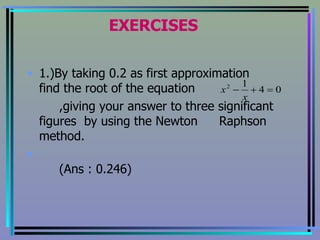
EXERCISES 1.)By taking 0.2 as first approximation  find the root of the equation  ,giving your answer to three significant  figures  by using the Newton  Raphson method. (Ans : 0.246)
2.) Show that the equations  2sin x – x = 0 has a root between  x = 1(radian) and x= 2 (radian). Find the root of the equation by using  i) iteration method ii) Newton Raphson method Giving your answer to two decimal places.

Chapter 3

  • 1.
  • 2.
    3.1 TheTrapezium Rule OBJECTIVES : The objectives of this lesson are to enable students to a) derive the trapezium rule by dividing the area represented by dx into n ( n  7 ) trapezium each with width h. b) use the trapezium rule to approximate
  • 3.
    Introduction What happenswhen a mathematical function cannot be integrated ? In these cases a numerical method can be used to find an approximate value for the integral As the definite integral is a number which represents the area between y = f (x) , the x-axis and the lines x = a and x =b .
  • 4.
    Therefore , even if cannot be found, approximate value for can be found by evaluating the appropriate area using another method. The two common methods are the trapezium rule and Simpson’s rule. However, here we will discuss the trapezium rule as requested by our syllabus .
  • 5.
    The trapezium ruleThis method divides the area A under the curve y = f(x) is into n vertical strips. The width of each strip is h. The area under the curve  sum of areas of n trapezia. Note :  approximately equal to
  • 6.
  • 7.
    Let y 0, y 1 , y 2 , …., y n be the values of the function f (x) . These correspond to the (n+1) ordinates x 0 , x 1 , x 2 , ……..,x n respectively.
  • 8.
    Using Area oftrapezium = ( width x sum of parallel sides ) The area of the first trapezium is A 1 = h ( y 0 + y 1 ) The areas of the second and the third trapezia are then A 2 = h ( y 1 + y 2 ) A 3 = h ( y 2 + y 3 )
  • 9.
    Verify that ifthis process is continued then A n-1 = h ( y n-2 + y n-1 ) A n = h ( y n-1 + y n ) Now add all of these separate areas together. The approximate value of A is given by A  A 1 + A 2 + A 3 + … + A n-1 + A n  h ( y 0 + y 1 ) + h ( y 1 + y 2 ) + h ( y 2 + y 3 ) + … + h ( y n-2 + y n-1 ) + h ( y n-1 + y n )  h ( y 0 + 2y 1 +2y 2 +2y 3 +… + 2y n-1 + y n )
  • 10.
    This method ofapproximating the area under a curve by n trapezia of equal width h is called the trapezium rule, and the result can be summarized as : dx  h  y 0 + y n + 2 ( y 1 + y 2 + … + y n-1 )  where h = and y r = f ( x r )
  • 11.
    Example 1 Evaluate dx using 5 strips by the trapezium rule. Notation: Working must have 4 or more decimal places. Solution The integration interval ( b- a ) = 6 –1 = 5 units So h = = = 1
  • 12.
    The value ofx at which y is calculated are : 1, 2, 3, 4, 5, 6 Tabulating the results as follows help the final calculation : 4.787 1.792 Totals 0.693 1.099 1.386 1.609 0 1.792 y 0 y 1 y 2 y 3 y 4 y 5 1 2 3 4 5 6 Remaining ordinates First and last ordinates y X
  • 13.
    dx  ( y 0 + y 5 ) + 2 ( y 1 +… +y 4 )  =  1.792 + 2 ( 4.787 )  = 5.683
  • 14.
    Example 2 Usethe trapezium rule, with five ordinates, to evaluate e x ² dx . Correct your answer to three decimal places. Solution: For five ordinates, ( y o , y 1 , y 2 , y 3 , y 4 ) evenly spaced in the range 0 ≤ x ≤ 0.8 , we need to divide this range into four equal parts The integration interval ( b- a ) = 0.8 - 0 = 0.8 units
  • 15.
    So, h= = = 0.2 The value of x at which y is calculated are : 0 , 0.2, 0.4, 0.6 , 0.8 3.6476 2.8965 Totals 1.0408 1.1735 1.4333 1 1.8965 y 0 y 1 y 2 y 3 y 4 0 0.2 0.4 0.6 0.8 Remaining ordinates First and last ordinates Y x
  • 16.
    e x ² dx ≈  ( y0 + y4 ) + 2 ( y1 +… +y 3 )  =  2.8965 + 2 ( 3.6476 )  = 1.0192 = 1.019 ( three decimal places )
  • 17.
    3.2 Solutionsof non – linear equations OBJECTIVE : The objective of this lesson is to enable students to understand the method of finding roots using the iteration method by writing: f(x) = 0 in the form of x = g(x). The iteration scheme is x n+1 = g(x n ) , n = 1,2,3….. The method fails when  g  (x)  > 1 in the neighborhood of the roots of the equation.
  • 18.
    Introduction Many equationscannot be solved exactly, but various methods of finding approximate numerical solutions exist. The most commonly used methods have two main parts: (a) finding an initial approximate value (b) improving this value by an iterative process
  • 19.
    Initial Values: The initial value of the roots of f(x) = 0 can be located approximately by either a graphical or an algebraic method. Graphical Method: Either (a) Plot ( or sketch ) the graph of y = f(x). The real roots are the points where the curve cuts the x axis. Or (b) Rewrite f(x) = 0 in the form F(x) = G(x). Plot ( or sketch ) y =F(x) and y = G(x). The real roots are at the points where these graphs intersect.
  • 20.
    Example 1 Findthe approximate value of the equation ln x + x - 4 = 0 by using the graphical method. y = 4-x y 0 1 2 3 4 the intersection is at x  2.9 x y y = ln x
  • 21.
    Algebraic Method Find two values a and b such that f(a) and f(b) have different signs. At least one root must lie between a and b if f(x) is continuous. If more than one root is suspected between a and b, sketch a graph of y = f(x).
  • 22.
    Iterative Method Alliterative methods follow the same basic pattern. A sequence of approximations x 1 , x 2 , x 3 , x 4 ….. is found , each one closer to the root  of f(x)=0. Each approximation is found from the one before it using a specified method. The process is continued until the required accuracy is reached. Two methods we have to discuss are Iteration Method and Newton-Raphson Method.
  • 23.
    Iteration Method Rewrite the equation f(x) = 0 in the form x = g(x). If the initial approximation is x 1 , then calculate x 2 = g(x 1 ) x 3 = g(x 2 ) x 4 = g(x 3 ) and so on ….. This method fails if  g  (x)  > 1 near the root. So, the value of  g  (x1)  should be < 1.
  • 24.
    Example 2 Usingthe iteration method, find the solution of f(x) = x + e x near x = -0.6 to three decimal places. Solution Iteration method Write the given equation as x = - e x  x = g(x) g (x) = - e x g  (x) = - e x ,  g  (-0.6)  =  -e-0.6  = 0.5488 ( < 1 )
  • 25.
    x 1 = -0.6 x 2 = -e-0.6 = -0.5488 x 3 = -e-0.5488 = -0.5453 x 4 = -e-0.5453 = -0.5797 x 5 = -e-0.5797 = -0.5601 x 6 = -e-0.5601 = -0.5712 x 7 = -e-0.5712 = -0.5648 x 8 = -e-0.5648 = -0.5684 x 9 = -e-0.5684 = -0.5664 x 10 = -e-0.5664= -0.5676 x 11 = -e-0.5676 = -0.5668 x 12 = -e-0.5668 = -0.5673  the required solution is x = - 0.567 ( three decimal places )#
  • 26.
    Example 3 Showthat the equation has a root between 0.2 and 0.3. Taking 0.2 as first approximation find the root of the equation ,giving your answer to three significant figures by using the iteration method.
  • 27.
    Solution f(x) =x 2 - + 4  f(0.2) = f(0.3) = = 0.756 ( positive ) therefore f(x) has a root between x = 0.2 and x = 0.3. = - 0.96 ( negative )
  • 28.
    g(x) = g'(x) = = = g'(0.2) = = 0.0245 ( <1 ) therefore, g(x) = iteration function
  • 29.
    x = g(x)x 1 = 0.2 x 2 = = 0.2475 x 3 = = 0.2462 x 4 = = 0.2463 the required solution is 0.246 (3 sig. figs) x 3 and x 4 have same value when round up to three sig.figs. Hence we should stop the working.
  • 30.
    3.3 Solutionsof non-linear equations OBJECTIVE : The objective of this lesson is to enable students to find the root by the Newton-Raphson method using the formula x n+1 = x n - , n = 1,2,3, …
  • 31.
    Newton-Raphson Method Ifx 1 is an approximation to root  of f(x) =0 , then a better approximation x 2 is given by . Repeat this process as required . The iteration is stop when
  • 32.
    Example 1 Usingthe Newton-Raphson Method, find the solution of f(x) = x + e x near x = - 0.5 to three decimal places. Solution Let f(x) = x + e x So f  (x) = 1 + e x
  • 33.
    x 1 = -0.5 = = = -0.5663 = = - 0.5671 = = - 0.5671 The required solution is x = -0.567 ( three decimal places ) # .
  • 34.
    Example 1 Sketchthe graph of y = e x and y = 2 – x where x< 2, on the same axes. Get the first approximation, x 0 for the equation e x = 2 – x where 0 < x o < 1. Hence, by using Newton-Raphson method , solve the equation of e -x = for x < 2 to three decimal places.
  • 35.
    2 1 Solution: y y = e x 1 x y = 2 - x 0 0.4
  • 36.
    Newton-Raphson method: e-x =  = 2 – x e x = 2 – x  e x – 2 + x = 0 f(x) = e x – 2 + x f ’(x) = e x + 1 x 1 = first approximation = 0.4 ( from graph )
  • 37.
    0.4 - [] = = 0.4043 = 0.4043 - [ ] = 0.4433 = 0.4433 - [ ] = 0.4428 = 0.4428 - [ ] = 0.4428 The required solution is 0.443 ( three decimal places ).
  • 38.
    EXERCISES 1.)By taking0.2 as first approximation find the root of the equation ,giving your answer to three significant figures by using the Newton Raphson method. (Ans : 0.246)
  • 39.
    2.) Show thatthe equations 2sin x – x = 0 has a root between x = 1(radian) and x= 2 (radian). Find the root of the equation by using i) iteration method ii) Newton Raphson method Giving your answer to two decimal places.