HIBERNATION
 I t i s a p h e n o m e n o n i n w h i c h animals undergo d o r m a n c y t o
e s c a p e f ro m e x c e s s i v e c o l d . H e n c e , i t i s also called w i n t e r
sleep.
 I t i s s e a s o n a l a n d p e r i o d i c .
Hibernation is the state of inactivity and metabolic depression in endotherms
during winter. It is characterized by low b o d y temperature, slow breathing and
heart rate, and low metabolic rate.
The function of hibernation is to conserve energy when sufficient food is
unavailable. To achieve this energy saving, an endotherm decreases its metabolic
rate, which then decreases body temperature.
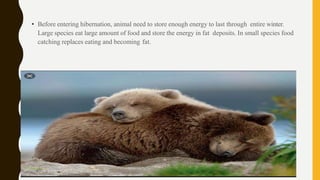
• Before entering hibernation, animal need to store enough energy to last through entire winter.
Large species eat large amount of food and store the energy in fat deposits. In small species food
catching replaces eating and becoming fat.
TYPES
1. True hibernation:
It is regular hibernation found in frogs, reptiles, monotremes.
2. Pseudo hibernation:
It occurs in carnivorous animals and is not regular. Hence, it is called pseudo hibernation or
carnivoran lethargy.
3. Obligate hibernation:
The animals that spontaneously, and annually, enter hibernation regardless of ambient temperature
and access to food. Example: ground squirrels, rodents.
4. Faculative hibernation:
Faculative hibernators only enter hibernation when either cold stressed, heat deprived, or both.
CHARACTERISTICS OF HIBERNATION
 Animals find a secluded place and hide themselves. Usually they hibernate in crevices, under
rocks, burrows and mud.
 The hibernating animals do not feed.
 They do not move.
 Energy requirements are very low.
 Body reserves such as fat and glycogen are used forenergy.
 Respiratory rate, metabolic rate, heartbeat rate are reduced.
 Body temperature is lowered.
 The physiological activities of thyroid and adrenal glands are considerably lessened.
 Warm blooded animals develop special coats like fur, feather and fatty layers which try to conserve heat.
 The duration of hibernation varies from species tospecies.
 Waking from hibernation is explosive and it occurs when the climate becomes suitable. All the
physiological activities come tonormal.
CLIMATIC ADAPTATIONS
 Hot climatic adaptations
 Around the world, desert biomes and other brutally hot climates seem unbearable to humans
accustomed to air conditioning, cars and other conveniences of modern life. Evolution is
smart, and animals indigenous to desert and tropical climes feature all sorts of adaptations that
help them pull through in the heat and with scarce water.
 Every organism has certain features or characteristics that allow it to live successfully in its
habitat. These features are called adaptations, and we say that the organism is adapted to its
habitat.
COLD CLIMATIC ADAPTATIONS
 The Arctic is cold and windy with very little rainfall. Plants in the Arctic often grow very close
to the ground and have small leaves. This helps to conserve water and to avoid damage by the
wind.
 The snowshoe hare has white fur in the winter and reddish-brown fur in the summer.
• This means that it is camouflaged from its predators for most of the year.
ENDOTHERMS
ECTOTHERMS
• Endotherms generate most of the heat
they need internally. When it’s cold out,
they increase metabolic heat production
to keep their body temperature constant,
so their internal body temperature is
independent of temperature of the
environment.
• People, polar bears, penguins,
and prairie dogs, birds and
mammals are endotherms.
• For ectotherms, body temperature mainly
depends on external heat sources. That is,
ectotherms body temperature rises and falls
along with the temperature of the surrounding
environment. Examples: amphibians,
invertebrates and most fishes.
• Although ectotherms do generate metabolic
heat like all living things. Ectotherms can’t
increase this heat production to maintain a
specific internaltemperature.
POIKILOTHERMS
• Poikilothermic – body temperature may fluctuate widely
• “Lower” vertebrates and invertebrates
• Cold-blooded animals do not have a body temperature like humans do. Our body
temperature is usually 98.6 degrees Fahrenheit. Cold-blooded animals’ body temperature
stays the same as the outside temperature.
• These animals come in and out of hibernation when the temperature is comfortable for their
body.
• E.g. reptiles, amphibians, bees etc.

Mammalian winter sleep behavior hibernation

  • 1.
  • 2.
     I ti s a p h e n o m e n o n i n w h i c h animals undergo d o r m a n c y t o e s c a p e f ro m e x c e s s i v e c o l d . H e n c e , i t i s also called w i n t e r sleep.  I t i s s e a s o n a l a n d p e r i o d i c . Hibernation is the state of inactivity and metabolic depression in endotherms during winter. It is characterized by low b o d y temperature, slow breathing and heart rate, and low metabolic rate. The function of hibernation is to conserve energy when sufficient food is unavailable. To achieve this energy saving, an endotherm decreases its metabolic rate, which then decreases body temperature.
  • 3.
    • Before enteringhibernation, animal need to store enough energy to last through entire winter. Large species eat large amount of food and store the energy in fat deposits. In small species food catching replaces eating and becoming fat.
  • 4.
    TYPES 1. True hibernation: Itis regular hibernation found in frogs, reptiles, monotremes. 2. Pseudo hibernation: It occurs in carnivorous animals and is not regular. Hence, it is called pseudo hibernation or carnivoran lethargy. 3. Obligate hibernation: The animals that spontaneously, and annually, enter hibernation regardless of ambient temperature and access to food. Example: ground squirrels, rodents. 4. Faculative hibernation: Faculative hibernators only enter hibernation when either cold stressed, heat deprived, or both.
  • 5.
    CHARACTERISTICS OF HIBERNATION Animals find a secluded place and hide themselves. Usually they hibernate in crevices, under rocks, burrows and mud.  The hibernating animals do not feed.  They do not move.  Energy requirements are very low.  Body reserves such as fat and glycogen are used forenergy.  Respiratory rate, metabolic rate, heartbeat rate are reduced.  Body temperature is lowered.
  • 6.
     The physiologicalactivities of thyroid and adrenal glands are considerably lessened.  Warm blooded animals develop special coats like fur, feather and fatty layers which try to conserve heat.  The duration of hibernation varies from species tospecies.  Waking from hibernation is explosive and it occurs when the climate becomes suitable. All the physiological activities come tonormal.
  • 7.
    CLIMATIC ADAPTATIONS  Hotclimatic adaptations  Around the world, desert biomes and other brutally hot climates seem unbearable to humans accustomed to air conditioning, cars and other conveniences of modern life. Evolution is smart, and animals indigenous to desert and tropical climes feature all sorts of adaptations that help them pull through in the heat and with scarce water.  Every organism has certain features or characteristics that allow it to live successfully in its habitat. These features are called adaptations, and we say that the organism is adapted to its habitat.
  • 8.
    COLD CLIMATIC ADAPTATIONS The Arctic is cold and windy with very little rainfall. Plants in the Arctic often grow very close to the ground and have small leaves. This helps to conserve water and to avoid damage by the wind.  The snowshoe hare has white fur in the winter and reddish-brown fur in the summer. • This means that it is camouflaged from its predators for most of the year.
  • 9.
    ENDOTHERMS ECTOTHERMS • Endotherms generatemost of the heat they need internally. When it’s cold out, they increase metabolic heat production to keep their body temperature constant, so their internal body temperature is independent of temperature of the environment. • People, polar bears, penguins, and prairie dogs, birds and mammals are endotherms. • For ectotherms, body temperature mainly depends on external heat sources. That is, ectotherms body temperature rises and falls along with the temperature of the surrounding environment. Examples: amphibians, invertebrates and most fishes. • Although ectotherms do generate metabolic heat like all living things. Ectotherms can’t increase this heat production to maintain a specific internaltemperature.
  • 10.
    POIKILOTHERMS • Poikilothermic –body temperature may fluctuate widely • “Lower” vertebrates and invertebrates • Cold-blooded animals do not have a body temperature like humans do. Our body temperature is usually 98.6 degrees Fahrenheit. Cold-blooded animals’ body temperature stays the same as the outside temperature. • These animals come in and out of hibernation when the temperature is comfortable for their body. • E.g. reptiles, amphibians, bees etc.