TRANSPOSITION
BY: NSUBUGA IVAN 2024-08-28024
SUPERVISED BY: Dr JOAN
INTRODUCTION
• Prerequisite knowledge:
DNA structure
Genome, replication, transcription
• Transposition, is the movement of DNA from one location to another.
Segments of DNA with this ability to move are called transposable
elements. (jumping genes)
• Transposable elements are recognized as components of the genomes
of virtually all species.
Continua……………..
• Can insert themselves into many different locations in the genome.
• No requirement of homology between the ends of the element and
the target sequence.
• Most transposons rarely move, in bacteria it occurs once every 10e5
cell divisions.
Transposable Elements (Transposons)
• Transposable elements (both active and inactive) occupy
approximately half the human genome and a substantially greater
fraction of some plant genomes.
• They are ubiquitous in the biosphere, and are highly successful in
propagating themselves.
• Some transposable elements are also viruses, for instance, some
retroviruses can integrate into a host genome to form endogenous
retroviruses.
Continua………
• Some viruses may be derived from natural transposable elements and
vice versa.
• Since viruses move between individuals, at least some transposable
elements can move between genomes (between individuals) as well
as within an individual’s genome.
Continua………..
• Transposition is related to replication, recombination and repair. The
process of moving from one place to another involves a type of
recombination, insertions of transposable elements can cause
mutations, and some transpositions are replicative, generating a new
copy while leaving the old copy intact.
• However, this ability to move is a unique property of transposable
elements.
Properties and effects of transposable
elements
• The defining property of transposable elements is their mobility; i.e.
they are genetic elements that can move from one position to
another in the genome.
• They show considerable diversity.
• Some move by DNA intermediates, and others move by RNA
intermediates.
• All transposable elements effectively insert at staggered breaks in
chromosomes.
Continua…………..
• Some transposable elements move in a replicative manner, whereas
others are non-replicative, i.e. they move without making a copy of
themselves.
• Transposable elements are major forces in the evolution and
rearrangement of genomes.
• Some transposition events inactivate genes, since the coding potential
or expression of a gene is disrupted by insertion of the transposable
element.
Continua…………..
• Example is the r allele (rugosus) of the gene encoding a starch
branching enzyme in peas is nonfunctional due to the insertion of a
transposable element.
• This allele causes the wrinkled pea phenotype in homozygotes
originally studied by Mendel.
• In other cases, transposition can activate nearby genes by bringing an
enhancer of transcription (within the transposable element) close
enough to a gene to stimulate its expression.
Continua…………
• If the target gene is not usually expressed in a certain cell type, this
activation can lead to pathology, such as activation of a proto-
oncogene causing a cell to become cancerous.
• In other cases, no obvious phenotype results from the transposition.
• There fore, a transposable element can activate, inactivate or have no
effect on nearby genes, depending on exactly where it inserts, it’s
orientation and other factors.
Continua……….
• Transposable elements can cause deletions or inversions of DNA.
• When transposition generates two copies of the same sequence in
the same orientation, recombination can delete the DNA between
them.
• If the two copies are in the opposite orientations, recombination will
invert the DNA between them.
Continua…………..
• As part of the mechanism of transposition, additional DNA sequences
can be mobilized.
• DNA located between two copies of a transposable element can be
moved together with them when they move.
Continua…………….
• In this manner, transposition can move DNA sequences that are not
normally part of a transposable element to new locations.
• Indeed, "host" sequences can be acquired by viruses and propagated
by infection of other individuals. This may be a natural means for
evolving new strains of viruses.
Are Transposons Parasites or Symbionts?
• Transposable elements can confer some selective advantage on the
"host" Or they can merely be parasitic or "selfish," existing only to
increase the number of copies of the element?
• Certain results of transposition can be detrimental, leading to a loss of
function or changes in regulation of the genes at the site of
integration after movement.
• There’s intimate connection between viruses and transposable
elements. Thus one can view many transposable elements as
parasites on the genome.
Continua…………..
• However, other studies indicate that the presence of transposable
elements is beneficial to an organism.
• Two strains of bacteria, one with a normal number of transposable
elements and the other with many fewer, can be grown in
competitive conditions.
• The strain with the higher number of transposable elements has a
growth advantage under these conditions.
Continua…………..
• The nature of that advantage. One intriguing possibility is that the
mechanism of transposition affords an opportunity to seal
chromosome breaks.
• Thus the relationship between transposable elements and their hosts
may be as much symbiotic as parasitic.
• Resolving these issues is an interesting challenge for future research.
Transposition occurs by Insertion into
Staggered Breaks
Staggered Break in a chromosome:
• All transposable elements move by inserting into a staggered break in
a chromosome, i.e. one strand is slightly longer than the other at the
break.
• This is supported by the observation that the same short DNA
sequence is found on each side of a transposable element.
• The sequence within these flanking direct repeats (FDRs) is distinctive
for each copy of the transposable element, but the size of the FDR is
characteristic of a particular family of transposable elements.
Continua……………..
• Some families of transposable
elements have FDRs as short as
4 bp and other families have
FDRs as long as 12 bp.
• However, within a particular
family, the sequence of the FDR
will differ between individual
copies. These FDRs are hallmarks
of transposable elements.
Continua…………….
• Since the FDRs are distinctive for each copy, they are not part of the
transposable element themselves.
• Some families of transposable elements do have repeated sequences
at their flanks that are identical for all members of the family, but
these are integral parts of the transposable element.
Continua…………….
• The variation in sequence of the FDRs indicates that they are
generated from the target sites for the transposition events.
• If the transposable element inserted into a break in the chromosome
that left a short overhang (one strand longer than the other), and this
overhang were filled in by DNA polymerase as part of the
transposition, then the sequence of that overhang would be
duplicated on each side of the new copy.
Continua……………….
• Such a break with an overhang is called a staggered break. The size of
the staggered break would determine the size of the FDR.
• Mechanistic studies of the enzymes used for transposition have
shown that such staggered breaks are made at the target site prior to
integration and are repaired as part of the process of transposition.
• The staggered breaks are used in transposition both by DNA
intermediates and by RNA intermediates.
Classes of Transposable Elements
• The two major classes of transposable elements are defined by the
intermediates in the transposition process.
• One class moves by DNA intermediates, using transposases and DNA
polymerases to catalyze transposition.
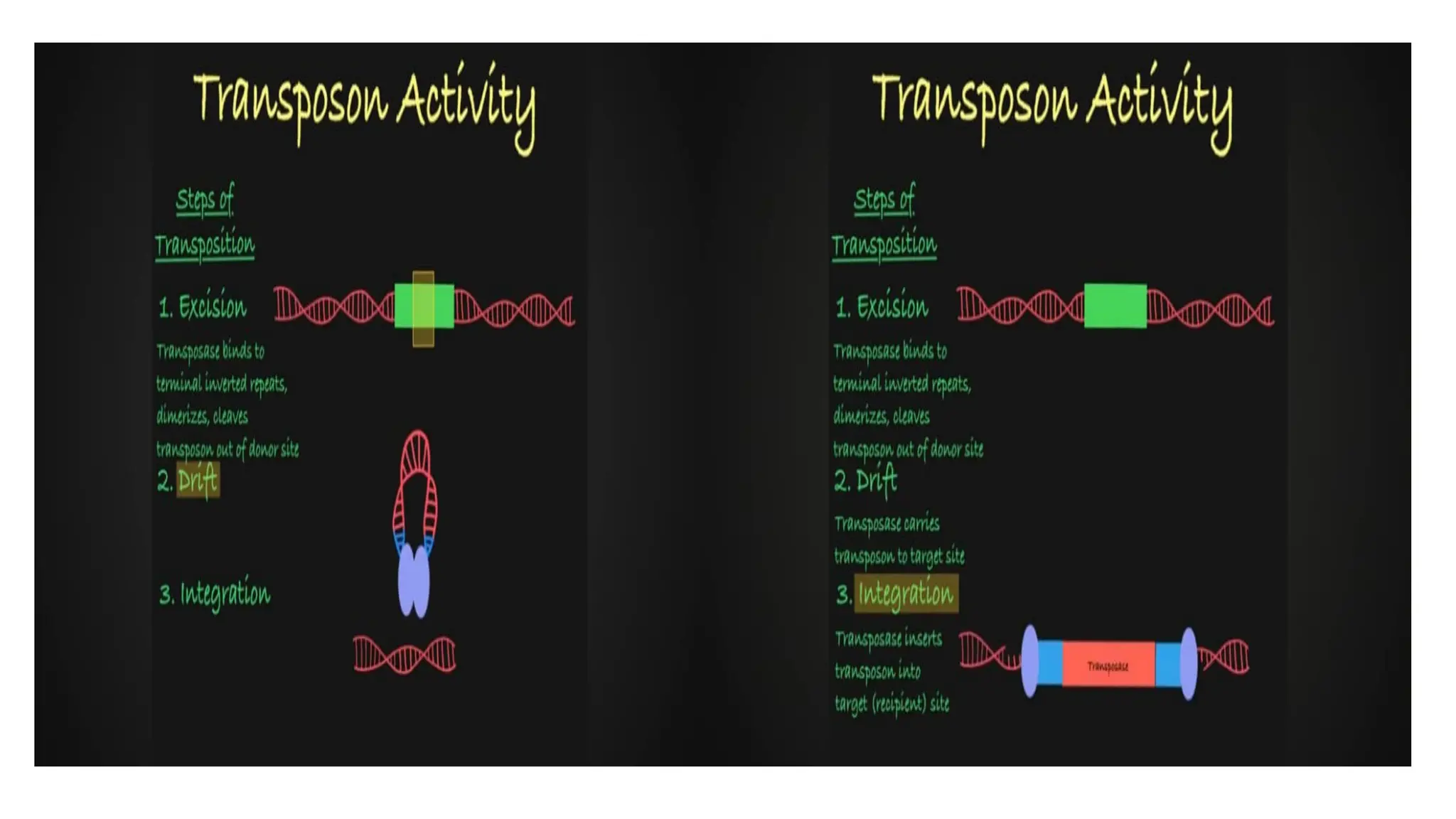
• The other class moves by RNA intermediates, using RNA polymerase,
endonucleases and reverse transcriptase to catalyze the process.
Transposable elements that move via DNA
intermediates
• In bacteria, these are either short insertion sequences or longer
transposons. Responsible for antibiotic resistance
• An insertion sequences, or IS, is a short DNA sequence that moves
from one location to another.
• Different insertion sequences range in size from about 800 bp to 2000
bp. The DNA sequence of an IS has inverted repeats (about 10 to 40
bp) at its terminal.
Continua…………
• Note that this is different from the FDRs, which are duplications of the
target site.
• The inverted repeats are part of the IS element itself.
• The sequences of the inverted repeats at each end of the IS are very
similar but not necessarily identical.
• Each family of insertion sequence in a species is named IS followed by
a number, e.g. IS1, IS10, etc.
Continua………….
• An insertion sequence encodes a transposase enzyme that catalyzes
the transposition.
• The amount of transposase is well regulated and is the primary
determinant of the rate of transposition.
• Transposons are larger transposable elements, ranging in size from
2500 to 21,000 bp.
Mechanism of DNA-mediated transposition
• Some families of transposable elements that move via a DNA
intermediate do so in a replicative manner.
• In this case, transposition generates a new copy of the transposable
element at the target site, while leaving a copy behind at the original
site.
• A co-integrate structure is formed by fusion of the donor and
recipient replicons, which is then resolved.
Continua…….
• Other families use a non-replicative mechanism. In this case, the
original copy excises from the original site and move to a new target
site, leaving the original site vacant.
• Replicative transposition and some types of non-replicative
transposition proceed through a strand-transfer intermediate (also
known as a crossover structure), in which both the donor and
recipient replicons are attached to the transposable element
Continua…….
• For replicative transposition, DNA
synthesis through the strand-
transfer intermediate produces a
transposable element at both the
donor and target sites, forming the
co-integrate intermediate.
• This is subsequently resolved to
separate the replicons. DNA
synthesis does not occur at the
crossover structure in non-
replicative transposition, thus
leaving a copy only at the new
target site.
Continua…….
• A homologous recombination btwn two copies of the transposon.
• 2 individual replicons released, each of which has a copy of the
transposon.
• One is the original donor replicon, the other is the target replicon that
has gained a transposon flanked by short direct repeats of the host
target sequence.
• The recombination reaction is called a resolution, by enzyme
resolvase
Continua………….
• In an alternative pathway for non-replicative transposition, the
transposon is excised by two double strand breaks, and is joined to
the recipient at a staggered break
Continua………..
• There are two steps in common for replicative and non-replicative
transposition, generating the strand-transfer intermediate.
• The transposase encoded by a transposable element makes four nicks
initially. Two nicks are made at the target site, one in each strand, to
generate a staggered break with 5' extensions (3' recessed).
• The other two nicks flank the transposon; one nick is made in one
DNA strand at one end of the transposon, and the other nick is made
in the other DNA strand at the other end
Continua…….
• Since the transposon has inverted repeats at each end, these two
nicks that flank the transposon are cleavages in the same sequence.
• Thus the transposase has a sequence-specific nicking activity.
• It nicks a single strand at each end of the transposon, as well as the
target site.
Continua…….
• At each end of the transposon, the 3' end of one strand of the
transposon is joined to the 5' extension of one strand at the target
site.
• This ligation is also catalyzed by transposase. ATP stimulates the
reaction but it can occur in the absence of ATP if the substrate is
supercoiled.
• Ligation of the ends of the transposon to the target site generates a
strand-transfer intermediate, in which the donor and recipient
replicons are now joined by the transposon.
Continua…….
• After formation of the strand-transfer intermediate, two different
pathways can be followed.
• For replicative transposition, the 3' ends of each strand of the
staggered break (originally at the target site) serve as primers for
repair synthesis.
• Replication followed by ligation leads to the formation of the co-
integrate structure, which can then be resolved into the separate
replicons, each with a copy of the transposon.
Transposable elements that move via RNA
intermediates
• Transposable DNA sequences that move by an RNA intermediate are
called retrotransposons.
• They are very common in eukaryotic organisms, but some examples
have also been found in bacteria. Some retrotransposons have long
terminal repeats (LTRs) that regulate expression.
• The LTRs were initially discovered in retroviruses. They have now been
seen in some but not all retrotransposons.
Continua…….
• They have a strong promoter and enhancer, as well as signals for
forming the 3’ end of mRNAs after transcription.
• The presence of the LTR is distinctive for this family, and members are
referred to as LTR-containing retrotransposons. Examples include the
yeast Ty-1family and retroviral proviruses in vertebrates.
Continua…….
• Retroviral proviruses encode a reverse transcriptase and an
endonuclease, as well as other proteins, some of which are needed
for viral assembly and structure.
• Others retrotransposons are in the large and diverse class of non-LTR
retrotransposons.
• One of the most prevalent examples is the family of long interspersed
repetitive elements, or LINEs. Initially found in mammals but has now
been found in a broad range of phyla, including fungi.
Mechanism of retro-transposition
• Not completely understood,
• At least two enzymatic activities are utilized.
• An integrase, which is an endonuclease that cleaves at the site of
integration to generate a staggered break.
• The other is RNA-dependent DNA polymerase, also called reverse
transcriptase.
Continua…….
• The RNA transcript of the transposable element interacts with the site
of cleavage at the DNA target site.
• One strand of DNA at the cleaved integration site serves as the primer
for reverse transcriptase.
• DNA polymerase then copies the RNA into DNA.
• That cDNA copy of the retrotransposon must be converted to a
double stranded product and inserted at a staggered break at the
target site.
Continua…….
• The enzymes required for joining
the reverse transcript (first
strand of the new copy) to the
other end of the staggered break
and for second strand synthesis
have not yet been established.
Perhaps some cellular DNA
repair functions are used.

transposition, cell molecular biology.pptx

  • 1.
    TRANSPOSITION BY: NSUBUGA IVAN2024-08-28024 SUPERVISED BY: Dr JOAN
  • 2.
    INTRODUCTION • Prerequisite knowledge: DNAstructure Genome, replication, transcription • Transposition, is the movement of DNA from one location to another. Segments of DNA with this ability to move are called transposable elements. (jumping genes) • Transposable elements are recognized as components of the genomes of virtually all species.
  • 3.
    Continua…………….. • Can insertthemselves into many different locations in the genome. • No requirement of homology between the ends of the element and the target sequence. • Most transposons rarely move, in bacteria it occurs once every 10e5 cell divisions.
  • 6.
    Transposable Elements (Transposons) •Transposable elements (both active and inactive) occupy approximately half the human genome and a substantially greater fraction of some plant genomes. • They are ubiquitous in the biosphere, and are highly successful in propagating themselves. • Some transposable elements are also viruses, for instance, some retroviruses can integrate into a host genome to form endogenous retroviruses.
  • 7.
    Continua……… • Some virusesmay be derived from natural transposable elements and vice versa. • Since viruses move between individuals, at least some transposable elements can move between genomes (between individuals) as well as within an individual’s genome.
  • 8.
    Continua……….. • Transposition isrelated to replication, recombination and repair. The process of moving from one place to another involves a type of recombination, insertions of transposable elements can cause mutations, and some transpositions are replicative, generating a new copy while leaving the old copy intact. • However, this ability to move is a unique property of transposable elements.
  • 9.
    Properties and effectsof transposable elements • The defining property of transposable elements is their mobility; i.e. they are genetic elements that can move from one position to another in the genome. • They show considerable diversity. • Some move by DNA intermediates, and others move by RNA intermediates. • All transposable elements effectively insert at staggered breaks in chromosomes.
  • 10.
    Continua………….. • Some transposableelements move in a replicative manner, whereas others are non-replicative, i.e. they move without making a copy of themselves. • Transposable elements are major forces in the evolution and rearrangement of genomes. • Some transposition events inactivate genes, since the coding potential or expression of a gene is disrupted by insertion of the transposable element.
  • 11.
    Continua………….. • Example isthe r allele (rugosus) of the gene encoding a starch branching enzyme in peas is nonfunctional due to the insertion of a transposable element. • This allele causes the wrinkled pea phenotype in homozygotes originally studied by Mendel. • In other cases, transposition can activate nearby genes by bringing an enhancer of transcription (within the transposable element) close enough to a gene to stimulate its expression.
  • 12.
    Continua………… • If thetarget gene is not usually expressed in a certain cell type, this activation can lead to pathology, such as activation of a proto- oncogene causing a cell to become cancerous. • In other cases, no obvious phenotype results from the transposition. • There fore, a transposable element can activate, inactivate or have no effect on nearby genes, depending on exactly where it inserts, it’s orientation and other factors.
  • 14.
    Continua………. • Transposable elementscan cause deletions or inversions of DNA. • When transposition generates two copies of the same sequence in the same orientation, recombination can delete the DNA between them. • If the two copies are in the opposite orientations, recombination will invert the DNA between them.
  • 15.
    Continua………….. • As partof the mechanism of transposition, additional DNA sequences can be mobilized. • DNA located between two copies of a transposable element can be moved together with them when they move.
  • 16.
    Continua……………. • In thismanner, transposition can move DNA sequences that are not normally part of a transposable element to new locations. • Indeed, "host" sequences can be acquired by viruses and propagated by infection of other individuals. This may be a natural means for evolving new strains of viruses.
  • 17.
    Are Transposons Parasitesor Symbionts? • Transposable elements can confer some selective advantage on the "host" Or they can merely be parasitic or "selfish," existing only to increase the number of copies of the element? • Certain results of transposition can be detrimental, leading to a loss of function or changes in regulation of the genes at the site of integration after movement. • There’s intimate connection between viruses and transposable elements. Thus one can view many transposable elements as parasites on the genome.
  • 18.
    Continua………….. • However, otherstudies indicate that the presence of transposable elements is beneficial to an organism. • Two strains of bacteria, one with a normal number of transposable elements and the other with many fewer, can be grown in competitive conditions. • The strain with the higher number of transposable elements has a growth advantage under these conditions.
  • 19.
    Continua………….. • The natureof that advantage. One intriguing possibility is that the mechanism of transposition affords an opportunity to seal chromosome breaks. • Thus the relationship between transposable elements and their hosts may be as much symbiotic as parasitic. • Resolving these issues is an interesting challenge for future research.
  • 20.
    Transposition occurs byInsertion into Staggered Breaks Staggered Break in a chromosome: • All transposable elements move by inserting into a staggered break in a chromosome, i.e. one strand is slightly longer than the other at the break. • This is supported by the observation that the same short DNA sequence is found on each side of a transposable element. • The sequence within these flanking direct repeats (FDRs) is distinctive for each copy of the transposable element, but the size of the FDR is characteristic of a particular family of transposable elements.
  • 21.
    Continua…………….. • Some familiesof transposable elements have FDRs as short as 4 bp and other families have FDRs as long as 12 bp. • However, within a particular family, the sequence of the FDR will differ between individual copies. These FDRs are hallmarks of transposable elements.
  • 23.
    Continua……………. • Since theFDRs are distinctive for each copy, they are not part of the transposable element themselves. • Some families of transposable elements do have repeated sequences at their flanks that are identical for all members of the family, but these are integral parts of the transposable element.
  • 24.
    Continua……………. • The variationin sequence of the FDRs indicates that they are generated from the target sites for the transposition events. • If the transposable element inserted into a break in the chromosome that left a short overhang (one strand longer than the other), and this overhang were filled in by DNA polymerase as part of the transposition, then the sequence of that overhang would be duplicated on each side of the new copy.
  • 25.
    Continua………………. • Such abreak with an overhang is called a staggered break. The size of the staggered break would determine the size of the FDR. • Mechanistic studies of the enzymes used for transposition have shown that such staggered breaks are made at the target site prior to integration and are repaired as part of the process of transposition. • The staggered breaks are used in transposition both by DNA intermediates and by RNA intermediates.
  • 26.
    Classes of TransposableElements • The two major classes of transposable elements are defined by the intermediates in the transposition process. • One class moves by DNA intermediates, using transposases and DNA polymerases to catalyze transposition. • The other class moves by RNA intermediates, using RNA polymerase, endonucleases and reverse transcriptase to catalyze the process.
  • 28.
    Transposable elements thatmove via DNA intermediates • In bacteria, these are either short insertion sequences or longer transposons. Responsible for antibiotic resistance • An insertion sequences, or IS, is a short DNA sequence that moves from one location to another. • Different insertion sequences range in size from about 800 bp to 2000 bp. The DNA sequence of an IS has inverted repeats (about 10 to 40 bp) at its terminal.
  • 29.
    Continua………… • Note thatthis is different from the FDRs, which are duplications of the target site. • The inverted repeats are part of the IS element itself. • The sequences of the inverted repeats at each end of the IS are very similar but not necessarily identical. • Each family of insertion sequence in a species is named IS followed by a number, e.g. IS1, IS10, etc.
  • 30.
    Continua…………. • An insertionsequence encodes a transposase enzyme that catalyzes the transposition. • The amount of transposase is well regulated and is the primary determinant of the rate of transposition. • Transposons are larger transposable elements, ranging in size from 2500 to 21,000 bp.
  • 31.
    Mechanism of DNA-mediatedtransposition • Some families of transposable elements that move via a DNA intermediate do so in a replicative manner. • In this case, transposition generates a new copy of the transposable element at the target site, while leaving a copy behind at the original site. • A co-integrate structure is formed by fusion of the donor and recipient replicons, which is then resolved.
  • 32.
    Continua……. • Other familiesuse a non-replicative mechanism. In this case, the original copy excises from the original site and move to a new target site, leaving the original site vacant. • Replicative transposition and some types of non-replicative transposition proceed through a strand-transfer intermediate (also known as a crossover structure), in which both the donor and recipient replicons are attached to the transposable element
  • 33.
    Continua……. • For replicativetransposition, DNA synthesis through the strand- transfer intermediate produces a transposable element at both the donor and target sites, forming the co-integrate intermediate. • This is subsequently resolved to separate the replicons. DNA synthesis does not occur at the crossover structure in non- replicative transposition, thus leaving a copy only at the new target site.
  • 34.
    Continua……. • A homologousrecombination btwn two copies of the transposon. • 2 individual replicons released, each of which has a copy of the transposon. • One is the original donor replicon, the other is the target replicon that has gained a transposon flanked by short direct repeats of the host target sequence. • The recombination reaction is called a resolution, by enzyme resolvase
  • 35.
    Continua…………. • In analternative pathway for non-replicative transposition, the transposon is excised by two double strand breaks, and is joined to the recipient at a staggered break
  • 39.
    Continua……….. • There aretwo steps in common for replicative and non-replicative transposition, generating the strand-transfer intermediate. • The transposase encoded by a transposable element makes four nicks initially. Two nicks are made at the target site, one in each strand, to generate a staggered break with 5' extensions (3' recessed). • The other two nicks flank the transposon; one nick is made in one DNA strand at one end of the transposon, and the other nick is made in the other DNA strand at the other end
  • 40.
    Continua……. • Since thetransposon has inverted repeats at each end, these two nicks that flank the transposon are cleavages in the same sequence. • Thus the transposase has a sequence-specific nicking activity. • It nicks a single strand at each end of the transposon, as well as the target site.
  • 41.
    Continua……. • At eachend of the transposon, the 3' end of one strand of the transposon is joined to the 5' extension of one strand at the target site. • This ligation is also catalyzed by transposase. ATP stimulates the reaction but it can occur in the absence of ATP if the substrate is supercoiled. • Ligation of the ends of the transposon to the target site generates a strand-transfer intermediate, in which the donor and recipient replicons are now joined by the transposon.
  • 42.
    Continua……. • After formationof the strand-transfer intermediate, two different pathways can be followed. • For replicative transposition, the 3' ends of each strand of the staggered break (originally at the target site) serve as primers for repair synthesis. • Replication followed by ligation leads to the formation of the co- integrate structure, which can then be resolved into the separate replicons, each with a copy of the transposon.
  • 44.
    Transposable elements thatmove via RNA intermediates • Transposable DNA sequences that move by an RNA intermediate are called retrotransposons. • They are very common in eukaryotic organisms, but some examples have also been found in bacteria. Some retrotransposons have long terminal repeats (LTRs) that regulate expression. • The LTRs were initially discovered in retroviruses. They have now been seen in some but not all retrotransposons.
  • 45.
    Continua……. • They havea strong promoter and enhancer, as well as signals for forming the 3’ end of mRNAs after transcription. • The presence of the LTR is distinctive for this family, and members are referred to as LTR-containing retrotransposons. Examples include the yeast Ty-1family and retroviral proviruses in vertebrates.
  • 46.
    Continua……. • Retroviral provirusesencode a reverse transcriptase and an endonuclease, as well as other proteins, some of which are needed for viral assembly and structure. • Others retrotransposons are in the large and diverse class of non-LTR retrotransposons. • One of the most prevalent examples is the family of long interspersed repetitive elements, or LINEs. Initially found in mammals but has now been found in a broad range of phyla, including fungi.
  • 47.
    Mechanism of retro-transposition •Not completely understood, • At least two enzymatic activities are utilized. • An integrase, which is an endonuclease that cleaves at the site of integration to generate a staggered break. • The other is RNA-dependent DNA polymerase, also called reverse transcriptase.
  • 48.
    Continua……. • The RNAtranscript of the transposable element interacts with the site of cleavage at the DNA target site. • One strand of DNA at the cleaved integration site serves as the primer for reverse transcriptase. • DNA polymerase then copies the RNA into DNA. • That cDNA copy of the retrotransposon must be converted to a double stranded product and inserted at a staggered break at the target site.
  • 49.
    Continua……. • The enzymesrequired for joining the reverse transcript (first strand of the new copy) to the other end of the staggered break and for second strand synthesis have not yet been established. Perhaps some cellular DNA repair functions are used.