Transport in animals Mass flow transport
Mass flow transport Needed for a constant supply of: Oxygen Nutrients Also needed to get rid of waste products such as: Carbon
Mass flow transport Small animals such as sea anemones, flatworms and nematodes can do this by  diffusion  across their moist body surfaces
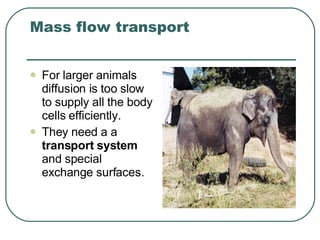
Mass flow transport For larger animals diffusion is too slow to supply all the body cells efficiently. They need a a  transport system  and special exchange surfaces.
Mass flow transport Humans have a circulatory system that transports large volumes of fluid to all parts of the body. We have a  mass flow system.
Mass flow transport Our circulatory system consists of: Blood  – the fluid that is transported through the system Blood vessels  – the tubes that carry the blood A  heart  – to pump the blood through the blood vessels
head, neck and arms lungs right atrium right ventricle left atrium left ventricle liver gut kidneys body and legs
head, neck and arms lungs right atrium right ventricle left atrium left ventricle liver gut kidneys body and legs aorta
head, neck and arms lungs right atrium right ventricle left atrium left ventricle liver gut kidneys body and legs aorta inferior vena cava superior vena cava
head, neck and arms lungs right atrium right ventricle left atrium left ventricle liver gut kidneys body and legs aorta inferior vena cava superior vena cava pulmonary artery pulmonary vein
head, neck and arms lungs right atrium right ventricle left atrium left ventricle liver gut kidneys body and legs aorta inferior vena cava superior vena cava pulmonary artery pulmonary vein hepatic vein hepatic artery
head, neck and arms lungs right atrium right ventricle left atrium left ventricle liver gut kidneys body and legs aorta inferior vena cava superior vena cava pulmonary artery pulmonary vein hepatic vein hepatic artery renal vein renal artery
head, neck and arms lungs right atrium right ventricle left atrium left ventricle liver gut kidneys body and legs aorta inferior vena cava superior vena cava pulmonary artery pulmonary vein hepatic vein hepatic artery renal vein renal artery hepatic portal vein
head, neck and arms lungs right atrium right ventricle left atrium left ventricle liver gut kidneys body and legs aorta inferior vena cava superior vena cava pulmonary artery pulmonary vein hepatic vein hepatic artery renal vein renal artery hepatic portal vein mesenteric artery
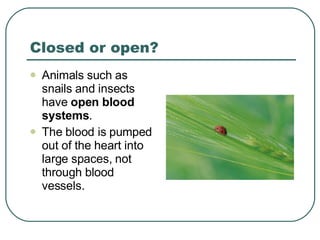
Closed or open? Animals such as snails and insects have  open blood systems . The blood is pumped out of the heart into large spaces, not through blood vessels.
Single or double? Fish have a  single circulation system The hearts pumps blood to the gills and from their it passes directly to the tissues before being returned to the heart.
Double circulation In mammals, the flow of blood is maintained by: A muscular heart that pumps blood Rhythmical contractions of muscle in artery walls (the pulse) Contraction of body muscles during normal movement squeezing blood along the veins Breathing creates a negative pressure inside the thorax which draws blood towards the heart
The heart The heart is mainly made of  cardiac muscle , each muscle cell is joined to the next by an  intercalary disc. These cells are  ‘myogenic’ , this means they can contract and relax of their own accord throughout a human life
 
cardiac muscle fibre
cardiac muscle fibre one muscle cell
cardiac muscle fibre one muscle cell nucleus
cardiac muscle fibre one muscle cell nucleus intercalary disc between muscle cells, these allow the rapid spread of impulses through the tissue from cell to cell
 
superior vena cava
superior vena cava aorta
superior vena cava aorta left pulmonary artery right pulmonary artery
superior vena cava aorta left pulmonary artery right pulmonary artery pulmonary veins pulmonary veins
superior vena cava aorta left pulmonary artery right pulmonary artery pulmonary veins pulmonary veins right atrium
superior vena cava aorta left pulmonary artery right pulmonary artery pulmonary veins pulmonary veins right atrium left atrium
superior vena cava aorta left pulmonary artery right pulmonary artery pulmonary veins pulmonary veins right atrium left atrium tricuspid valve
superior vena cava aorta left pulmonary artery right pulmonary artery pulmonary veins pulmonary veins right atrium left atrium tricuspid valve bicuspid valve
superior vena cava aorta left pulmonary artery right pulmonary artery pulmonary veins pulmonary veins right atrium left atrium tricuspid valve bicuspid valve right ventricle
superior vena cava aorta left pulmonary artery right pulmonary artery pulmonary veins pulmonary veins right atrium left atrium tricuspid valve bicuspid valve right ventricle left ventricle
superior vena cava aorta left pulmonary artery right pulmonary artery pulmonary veins pulmonary veins right atrium left atrium tricuspid valve bicuspid valve right ventricle left ventricle septum
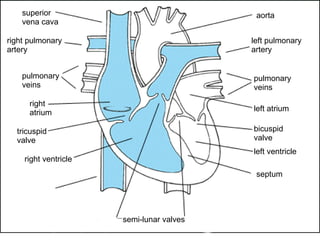
superior vena cava aorta left pulmonary artery right pulmonary artery pulmonary veins pulmonary veins right atrium left atrium tricuspid valve bicuspid valve right ventricle left ventricle septum semi-lunar valves
superior vena cava aorta left pulmonary artery right pulmonary artery pulmonary veins pulmonary veins right atrium left atrium tricuspid valve bicuspid valve right ventricle left ventricle septum semi-lunar valves inferior vena cava


The heart The heart is really two pumps side by side. The left side pumps deoxygenated blood to the lungs The right side pumps oxygenated blood to the rest of the body
The heart Each side of the heart is completely separate and so deoxygenated blood and oxygenated blood do not mix
The heart The thickness of the walls of each chamber is related to the distance that it has to pump the blood. The atria just pump into the ventricles so are very thin
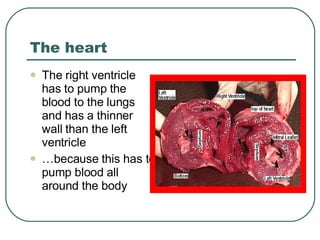
The heart The right ventricle has to pump the blood to the lungs and has a thinner wall than the left ventricle … because this has to pump blood all around the body
The heart The valves keep the blood flowing in one direction. The  atrio-ventricular valves  prevent the back flow of blood into the atria when the ventricles contract On the right side the  tricuspid  valve has three flaps, on the left the  bicuspid  has two flaps.
The heart The  semi-lunar valves  are found at the base of the pulmonary artery and the aorta. These prevent the backflow of blood into the ventricles when they relax

Transport In Animals

  • 1.
    Transport in animalsMass flow transport
  • 2.
    Mass flow transportNeeded for a constant supply of: Oxygen Nutrients Also needed to get rid of waste products such as: Carbon
  • 3.
    Mass flow transportSmall animals such as sea anemones, flatworms and nematodes can do this by diffusion across their moist body surfaces
  • 4.
    Mass flow transportFor larger animals diffusion is too slow to supply all the body cells efficiently. They need a a transport system and special exchange surfaces.
  • 5.
    Mass flow transportHumans have a circulatory system that transports large volumes of fluid to all parts of the body. We have a mass flow system.
  • 6.
    Mass flow transportOur circulatory system consists of: Blood – the fluid that is transported through the system Blood vessels – the tubes that carry the blood A heart – to pump the blood through the blood vessels
  • 7.
    head, neck andarms lungs right atrium right ventricle left atrium left ventricle liver gut kidneys body and legs
  • 8.
    head, neck andarms lungs right atrium right ventricle left atrium left ventricle liver gut kidneys body and legs
  • 9.
    head, neck andarms lungs right atrium right ventricle left atrium left ventricle liver gut kidneys body and legs
  • 10.
    head, neck andarms lungs right atrium right ventricle left atrium left ventricle liver gut kidneys body and legs
  • 11.
    head, neck andarms lungs right atrium right ventricle left atrium left ventricle liver gut kidneys body and legs aorta
  • 12.
    head, neck andarms lungs right atrium right ventricle left atrium left ventricle liver gut kidneys body and legs aorta inferior vena cava superior vena cava
  • 13.
    head, neck andarms lungs right atrium right ventricle left atrium left ventricle liver gut kidneys body and legs aorta inferior vena cava superior vena cava pulmonary artery pulmonary vein
  • 14.
    head, neck andarms lungs right atrium right ventricle left atrium left ventricle liver gut kidneys body and legs aorta inferior vena cava superior vena cava pulmonary artery pulmonary vein hepatic vein hepatic artery
  • 15.
    head, neck andarms lungs right atrium right ventricle left atrium left ventricle liver gut kidneys body and legs aorta inferior vena cava superior vena cava pulmonary artery pulmonary vein hepatic vein hepatic artery renal vein renal artery
  • 16.
    head, neck andarms lungs right atrium right ventricle left atrium left ventricle liver gut kidneys body and legs aorta inferior vena cava superior vena cava pulmonary artery pulmonary vein hepatic vein hepatic artery renal vein renal artery hepatic portal vein
  • 17.
    head, neck andarms lungs right atrium right ventricle left atrium left ventricle liver gut kidneys body and legs aorta inferior vena cava superior vena cava pulmonary artery pulmonary vein hepatic vein hepatic artery renal vein renal artery hepatic portal vein mesenteric artery
  • 18.
    Closed or open?Animals such as snails and insects have open blood systems . The blood is pumped out of the heart into large spaces, not through blood vessels.
  • 19.
    Single or double?Fish have a single circulation system The hearts pumps blood to the gills and from their it passes directly to the tissues before being returned to the heart.
  • 20.
    Double circulation Inmammals, the flow of blood is maintained by: A muscular heart that pumps blood Rhythmical contractions of muscle in artery walls (the pulse) Contraction of body muscles during normal movement squeezing blood along the veins Breathing creates a negative pressure inside the thorax which draws blood towards the heart
  • 21.
    The heart Theheart is mainly made of cardiac muscle , each muscle cell is joined to the next by an intercalary disc. These cells are ‘myogenic’ , this means they can contract and relax of their own accord throughout a human life
  • 22.
  • 23.
  • 24.
    cardiac muscle fibreone muscle cell
  • 25.
    cardiac muscle fibreone muscle cell nucleus
  • 26.
    cardiac muscle fibreone muscle cell nucleus intercalary disc between muscle cells, these allow the rapid spread of impulses through the tissue from cell to cell
  • 27.
  • 28.
  • 29.
  • 30.
    superior vena cavaaorta left pulmonary artery right pulmonary artery
  • 31.
    superior vena cavaaorta left pulmonary artery right pulmonary artery pulmonary veins pulmonary veins
  • 32.
    superior vena cavaaorta left pulmonary artery right pulmonary artery pulmonary veins pulmonary veins right atrium
  • 33.
    superior vena cavaaorta left pulmonary artery right pulmonary artery pulmonary veins pulmonary veins right atrium left atrium
  • 34.
    superior vena cavaaorta left pulmonary artery right pulmonary artery pulmonary veins pulmonary veins right atrium left atrium tricuspid valve
  • 35.
    superior vena cavaaorta left pulmonary artery right pulmonary artery pulmonary veins pulmonary veins right atrium left atrium tricuspid valve bicuspid valve
  • 36.
    superior vena cavaaorta left pulmonary artery right pulmonary artery pulmonary veins pulmonary veins right atrium left atrium tricuspid valve bicuspid valve right ventricle
  • 37.
    superior vena cavaaorta left pulmonary artery right pulmonary artery pulmonary veins pulmonary veins right atrium left atrium tricuspid valve bicuspid valve right ventricle left ventricle
  • 38.
    superior vena cavaaorta left pulmonary artery right pulmonary artery pulmonary veins pulmonary veins right atrium left atrium tricuspid valve bicuspid valve right ventricle left ventricle septum
  • 39.
    superior vena cavaaorta left pulmonary artery right pulmonary artery pulmonary veins pulmonary veins right atrium left atrium tricuspid valve bicuspid valve right ventricle left ventricle septum semi-lunar valves
  • 40.
    superior vena cavaaorta left pulmonary artery right pulmonary artery pulmonary veins pulmonary veins right atrium left atrium tricuspid valve bicuspid valve right ventricle left ventricle septum semi-lunar valves inferior vena cava
  • 41.
  • 42.
  • 43.
  • 44.
  • 45.
  • 46.
  • 47.
  • 48.
  • 49.
  • 50.
  • 51.
  • 52.
    The heart Theheart is really two pumps side by side. The left side pumps deoxygenated blood to the lungs The right side pumps oxygenated blood to the rest of the body
  • 53.
    The heart Eachside of the heart is completely separate and so deoxygenated blood and oxygenated blood do not mix
  • 54.
    The heart Thethickness of the walls of each chamber is related to the distance that it has to pump the blood. The atria just pump into the ventricles so are very thin
  • 55.
    The heart Theright ventricle has to pump the blood to the lungs and has a thinner wall than the left ventricle … because this has to pump blood all around the body
  • 56.
    The heart Thevalves keep the blood flowing in one direction. The atrio-ventricular valves prevent the back flow of blood into the atria when the ventricles contract On the right side the tricuspid valve has three flaps, on the left the bicuspid has two flaps.
  • 57.
    The heart The semi-lunar valves are found at the base of the pulmonary artery and the aorta. These prevent the backflow of blood into the ventricles when they relax