09/04/2016
9. Transport in Animals
Syllabus statements
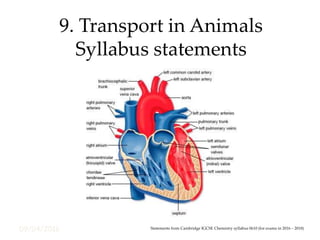
Statements from Cambridge IGCSE Chemistry syllabus 0610 (for exams in 2016 – 2018)
9.1 Transport in Animals
• Describe the circulatory system as a system of
blood vessels with a pump and valves to ensure
one-way flow of blood
• Describe the single circulation of a fish
• Describe the double circulation of a mammal
• Explain the advantages of a double circulation
9.2 Heart
• Name and identify the structures of the
mammalian heart, limited to the muscular wall,
the septum, the left and right ventricles and atria,
one-way valves, coronary arteries and the
atrioventricular and semilunar valves
• State that blood is pumped away from the heart
into arteries and returns to the heart in veins
9.2 Heart
• Explain the relative thickness:
– of the muscle wall of the left and right ventricles
– of the muscle wall of the atria compared to that
of the ventricles
• Explain the importance of the septum in
separating oxygenated and deoxygenated blood
• Describe the functioning of the heart in terms of
the contraction of muscles of the atria and
ventricles and the action of the valves
9.2 Heart
• State that the activity of the heart may be
monitored by ECG, pulse rate and listening to
sounds of valves closing
• Investigate and state the effect of physical activity
on the pulse rate
• Explain the effect of physical activity on the heart
rate
9.2 Heart
• Describe coronary heart disease in terms of the
blockage of coronary arteries and state the
possible risk factors as diet, stress, smoking,
genetic predisposition, age and gender
• Discuss the roles of diet and exercise in the
prevention of coronary heart disease
• Describe ways in which coronary heart disease
may be treated, limited to drug treatment with
aspirin and surgery (stents, angioplasty and by-
pass)
9.3 Blood & lymphatic vessels
• Describe the structure and functions of arteries,
veins and capillaries
• Explain how the structures of arteries, veins and
capillaries are adapted for their functions
• Name the main blood vessels to and from the:
– heart, limited to vena cava, aorta, pulmonary
artery and pulmonary vein
– lungs, limited to the pulmonary artery and
pulmonary vein
– kidney, limited to the renal artery and renal vein
9.3 Blood & lymphatic vessels
• State the function of arterioles, venules and shunt
vessels
• Outline the lymphatic system in terms of
lymphatic vessels and lymph nodes
• Describe the function of the lymphatic system in
the circulation of body fluids and the protection of
the body from infection
9.4 Blood
• List the components of blood as red blood cells,
white blood cells, platelets and plasma
• Identify red and white blood cells, as seen under
the light microscope, on prepared slides and in
diagrams and photomicrographs
• Identify lymphocyte and phagocyte white blood
cells, as seen under the light microscope, on
prepared slides and in diagrams and
photomicrographs
9.4 Blood
• State the functions of the following components of
blood:
– red blood cells in transporting oxygen, including
the role of haemoglobin
– white blood cells in phagocytosis and antibody
production
– platelets in clotting (details are not required)
– plasma in the transport of blood cells, ions,
soluble nutrients, hormones and carbon dioxide
9.4 Blood
• State the functions of:
– lymphocytes – antibody production
– phagocytes – phagocytosis
• Describe the process of clotting as the conversion
of fibrinogen to fibrin to form a mesh
• State the roles of blood clotting as preventing
blood loss and preventing the entry of pathogens
• Describe the transfer of materials between
capillaries and tissue fluid (details of the roles of
water potential and hydrostatic pressure are not
required)

9 syllabus statements

  • 1.
    09/04/2016 9. Transport inAnimals Syllabus statements Statements from Cambridge IGCSE Chemistry syllabus 0610 (for exams in 2016 – 2018)
  • 2.
    9.1 Transport inAnimals • Describe the circulatory system as a system of blood vessels with a pump and valves to ensure one-way flow of blood • Describe the single circulation of a fish • Describe the double circulation of a mammal • Explain the advantages of a double circulation
  • 3.
    9.2 Heart • Nameand identify the structures of the mammalian heart, limited to the muscular wall, the septum, the left and right ventricles and atria, one-way valves, coronary arteries and the atrioventricular and semilunar valves • State that blood is pumped away from the heart into arteries and returns to the heart in veins
  • 4.
    9.2 Heart • Explainthe relative thickness: – of the muscle wall of the left and right ventricles – of the muscle wall of the atria compared to that of the ventricles • Explain the importance of the septum in separating oxygenated and deoxygenated blood • Describe the functioning of the heart in terms of the contraction of muscles of the atria and ventricles and the action of the valves
  • 5.
    9.2 Heart • Statethat the activity of the heart may be monitored by ECG, pulse rate and listening to sounds of valves closing • Investigate and state the effect of physical activity on the pulse rate • Explain the effect of physical activity on the heart rate
  • 6.
    9.2 Heart • Describecoronary heart disease in terms of the blockage of coronary arteries and state the possible risk factors as diet, stress, smoking, genetic predisposition, age and gender • Discuss the roles of diet and exercise in the prevention of coronary heart disease • Describe ways in which coronary heart disease may be treated, limited to drug treatment with aspirin and surgery (stents, angioplasty and by- pass)
  • 7.
    9.3 Blood &lymphatic vessels • Describe the structure and functions of arteries, veins and capillaries • Explain how the structures of arteries, veins and capillaries are adapted for their functions • Name the main blood vessels to and from the: – heart, limited to vena cava, aorta, pulmonary artery and pulmonary vein – lungs, limited to the pulmonary artery and pulmonary vein – kidney, limited to the renal artery and renal vein
  • 8.
    9.3 Blood &lymphatic vessels • State the function of arterioles, venules and shunt vessels • Outline the lymphatic system in terms of lymphatic vessels and lymph nodes • Describe the function of the lymphatic system in the circulation of body fluids and the protection of the body from infection
  • 9.
    9.4 Blood • Listthe components of blood as red blood cells, white blood cells, platelets and plasma • Identify red and white blood cells, as seen under the light microscope, on prepared slides and in diagrams and photomicrographs • Identify lymphocyte and phagocyte white blood cells, as seen under the light microscope, on prepared slides and in diagrams and photomicrographs
  • 10.
    9.4 Blood • Statethe functions of the following components of blood: – red blood cells in transporting oxygen, including the role of haemoglobin – white blood cells in phagocytosis and antibody production – platelets in clotting (details are not required) – plasma in the transport of blood cells, ions, soluble nutrients, hormones and carbon dioxide
  • 11.
    9.4 Blood • Statethe functions of: – lymphocytes – antibody production – phagocytes – phagocytosis • Describe the process of clotting as the conversion of fibrinogen to fibrin to form a mesh • State the roles of blood clotting as preventing blood loss and preventing the entry of pathogens • Describe the transfer of materials between capillaries and tissue fluid (details of the roles of water potential and hydrostatic pressure are not required)